
Flyer Size Dimensions Guide for Every Standard Format


US Letter runs 8.5 x 11 inches, half-letter is 5.5 x 8.5, and international A4 is 8.27 x 11.7. Here is every standard flyer size, when to use it, and how to set up files that print clean.
The standard flyer sizes are US Letter (8.5 x 11 in), half-letter (5.5 x 8.5 in), A4 (8.27 x 11.7 in), A5 (5.83 x 8.27 in), A6 (4.13 x 5.83 in), and DL (3.94 x 8.27 in). Pick the size by how you distribute it, add 0.125 inch of bleed on every side, keep text 0.125 inch inside the trim, and export a 300 DPI CMYK press-ready PDF.

Quick answer
What you need to know about flyer sizes before you print
The right flyer size can make or break your campaign. Standard US Letter flyers measure 8.5 x 11 inches, half-letter flyers come in at 5.5 x 8.5 inches, and international A4 flyers run 8.27 x 11.7 inches. Each size serves a different purpose, from event handouts to direct mail inserts. 4OVER4.COM offers 60+ paper types across every popular flyer dimension, backed by 25+ years of printing experience, so this guide breaks down every option to help you pick the right one.
Why flyer dimensions matter more than you think
Choosing the wrong flyer size wastes money and dilutes your message. A flyer that is too large for a mailbox gets folded and crumpled, and one that is too small gets lost in a stack. This flyer size guide walks you through every standard size, when to use each one, and how to set up your files so nothing gets clipped at the printer.
Whether you are promoting a grand opening, advertising a sale, or handing out menus at a food festival, size dictates design. It affects how much text you can fit, how images render, and what your printing costs look like. If you want the full creative process, start with our guide on how to make flyers for a step-by-step walkthrough.
4OVER4.COM backs every flyer order with a price match guarantee, so you get the best deal no matter which size you pick. Now let us dig into the numbers.
US Letter flyers: 8.5 x 11 inches
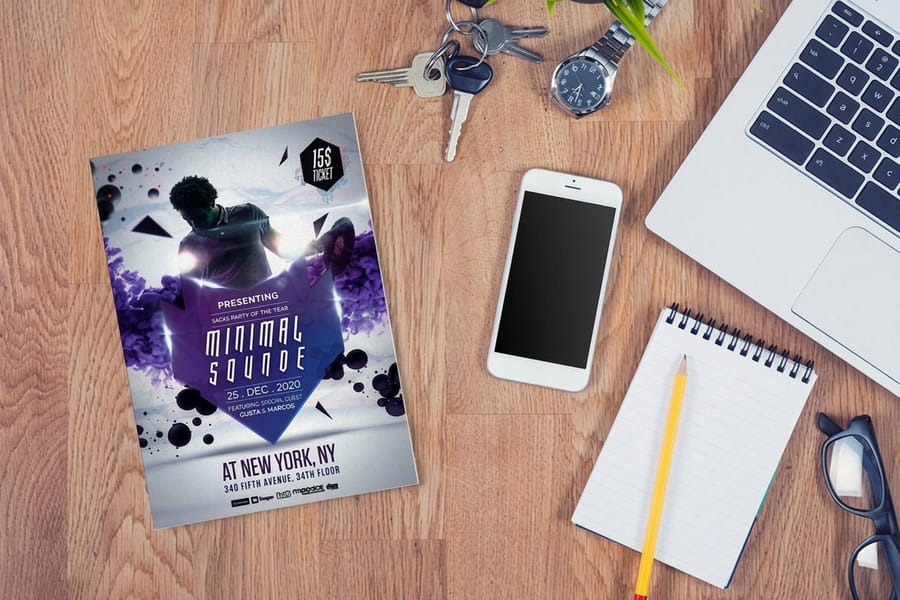
The US Letter flyer is the workhorse of North American print marketing. At 8.5 x 11 inches (215.9 x 279.4 mm) it matches a standard sheet of printer paper, and that familiarity is an advantage. People know how to handle it, file it, and pin it to a corkboard.
This size gives you room for detailed content. Real estate agents use it for property listings with multiple photos, restaurants print full menus on it, and event organizers pack in schedules, maps, and sponsor logos without feeling cramped. If your message needs breathing room, US Letter is the go-to.
The trade-off is that it does not fit a standard #10 envelope without folding, and it is not exactly pocket-friendly. For direct mail campaigns you will want to pair this size with the right packaging, and our guide on how to make envelopes covers your options.
Half-letter flyers: 5.5 x 8.5 inches
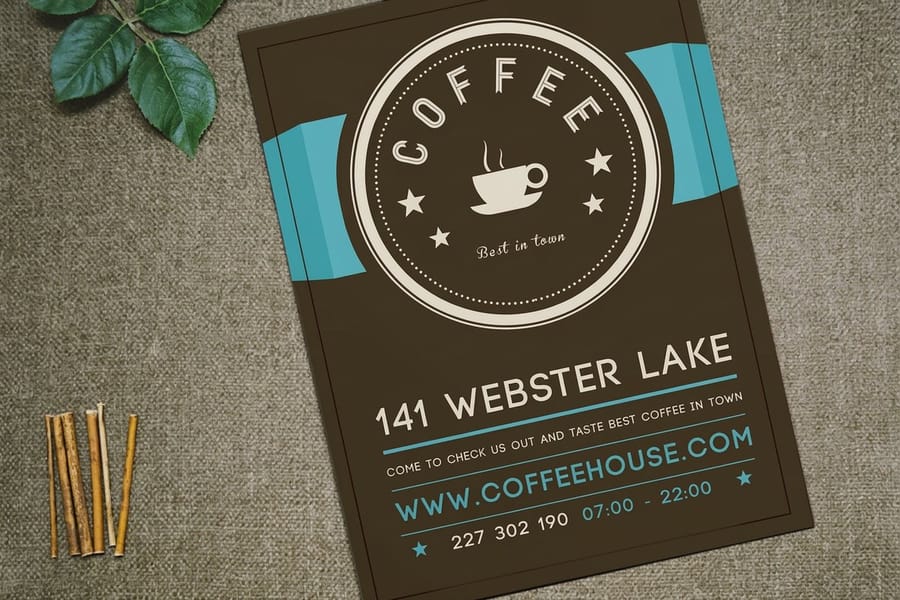
Cut a US Letter in half and you get the 5.5 x 8.5 inch half-letter flyer. It is one of the most popular sizes for direct mail inserts, event invitations, and promotional handouts, and it fits inside a standard A2 envelope without folding.
Half-letter flyers hit the sweet spot between enough space for your message and being compact enough to slip into a bag or pocket. Gyms use them for class schedules, salons hand them out with appointment reminders, and nonprofits tuck them into donation packets.
Because you are working with less real estate, design discipline matters. Stick to one clear headline, one call to action, and maybe one or two supporting images. Do not cram a US Letter's worth of content into half the space, because that is how you end up with a flyer nobody reads.
A4 flyers: 8.27 x 11.7 inches (international standard)

If you are printing for an international audience, A4 (8.27 x 11.7 inches / 210 x 297 mm) is the global standard. It is slightly narrower and taller than US Letter. The difference is small, about a quarter inch in width and nearly half an inch in height, but it matters when you design for print.
A4 is the default paper size in Europe, Asia, South America, and most of Africa. If your business operates internationally or you are printing for overseas events, A4 keeps everything consistent with local expectations. Printers outside North America are set up for A4, so US Letter dimensions can cause alignment issues abroad.
When you design for A4, do not just resize a US Letter layout. The different proportions shift your margins, text blocks, and image placement, so build the design from scratch in A4 dimensions for the cleanest result.
A5 flyers: 5.83 x 8.27 inches
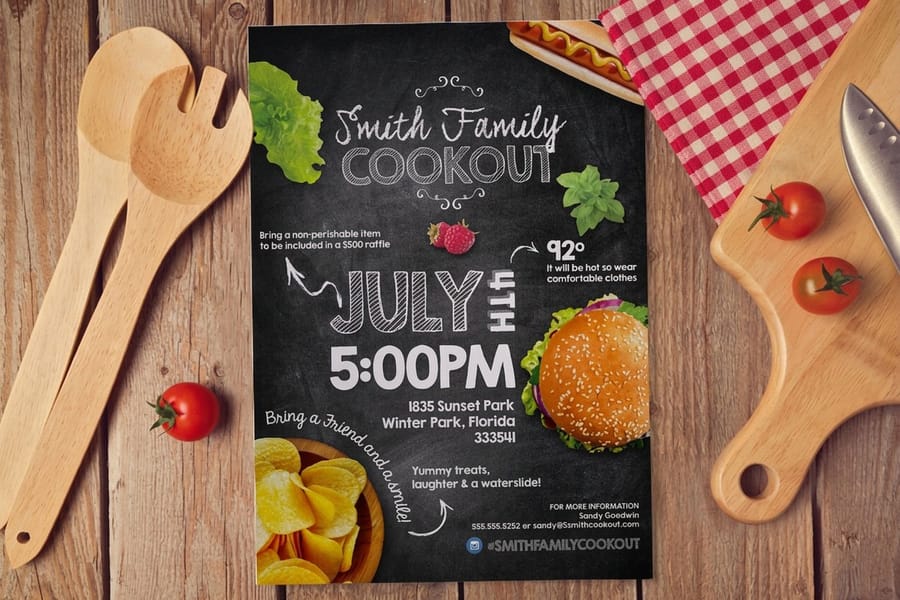
The A5 flyer (5.83 x 8.27 inches / 148 x 210 mm) is the international equivalent of the half-letter. It is half an A4 sheet, and it is wildly popular for event flyers, product announcements, and leaflets across Europe and Asia.
A5 works great for content that needs to be scannable in seconds. Think concert promotions, restaurant specials, or grand-opening announcements. The compact format forces you to prioritize your strongest selling point and a single clear call to action.
For businesses that do both domestic and international marketing, keeping A5 templates alongside your half-letter templates saves time. You will not need to redesign from scratch when switching between markets. If you are exploring other print formats for your marketing mix, the guide hub has walkthroughs covering everything from postcards to banners.
A6 flyers: 4.13 x 5.83 inches
A6 flyers (4.13 x 5.83 inches / 105 x 148 mm) are about the size of a postcard. They are perfect for quick, punchy messages such as a discount code, a QR code linking to your website, or a simple "we've moved" announcement.
Because A6 is so compact, it is the cheapest option to print in bulk. Street teams love this size, and so do retail shops that slip a promo into every shopping bag. The small footprint means lower paper costs and more flyers per print run.
Design-wise, less is more with A6. One image, one headline, one action item, and that is it. If you need more space, step up to A5 or half-letter.
DL flyers: 3.94 x 8.27 inches
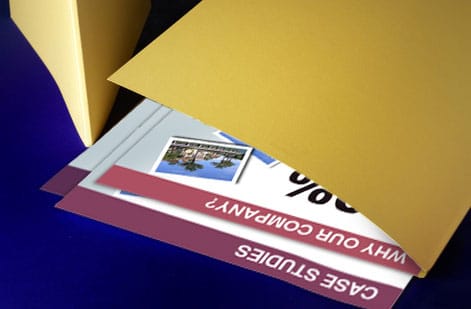
The DL flyer (3.94 x 8.27 inches / 99 x 210 mm) is a tall, narrow format that fits perfectly inside a standard DL envelope. DL stands for "dimension lengthwise," and this size is a staple for rack cards, tourism brochures, and restaurant takeout menus.
DL flyers are designed to stand upright in the display racks you see in hotel lobbies, visitor centers, and waiting rooms. The vertical format naturally draws the eye from top to bottom, which makes it ideal for step-by-step offers or tiered pricing displays.
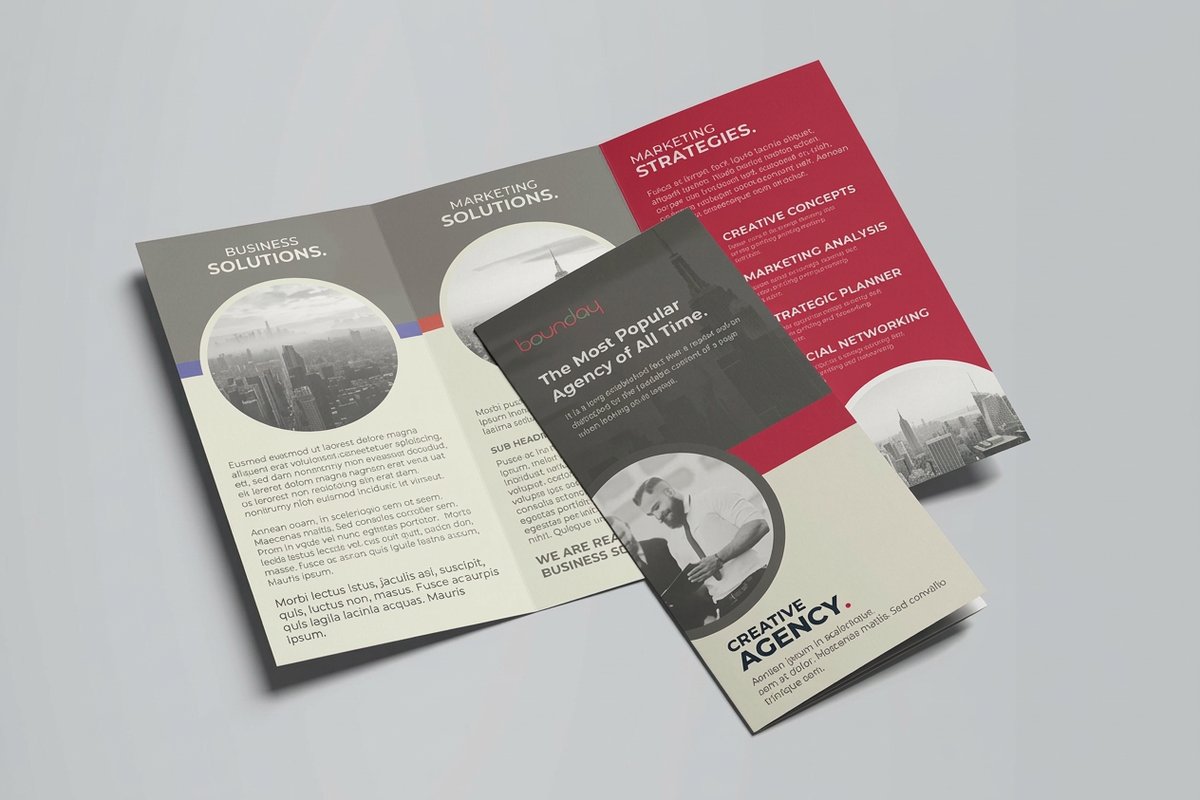
If you are creating folded materials, DL dimensions also work as the base for tri-fold brochures. Our guide on how to fold a brochure explains how to set up fold lines correctly so your panels align.
Setting up your flyer file for print
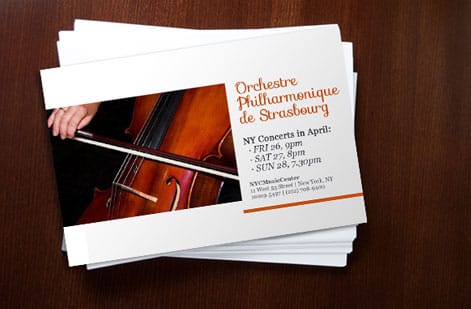
Bleed, trim, and safe zones are the three terms that save you from a bad print job. Here is what each one means in practice.
Bleed is the extra area beyond your trim line. For most flyers, add 0.125 inches (3mm) of bleed on all sides, so an 8.5 x 11 inch flyer should be built as 8.75 x 11.25 inches. The bleed gets cut off during trimming, so extend background colors and images all the way to the bleed edge.
Trim line is where the paper actually gets cut, and that is your final flyer size. Safe zone is the area inside the trim line where all important text and logos should stay. Keep everything at least 0.125 inches inside the trim line, because anything closer to the edge risks getting clipped.
Set your resolution to 300 DPI minimum, since anything lower looks fuzzy in print even when it looks fine on screen. Use CMYK color mode rather than RGB, because RGB is for screens and CMYK is for ink on paper. Save the final file as a press-ready PDF with fonts embedded and images at full resolution. Most printing issues come from files that were not set up correctly, not from the printer itself.
Choosing the right size for your campaign
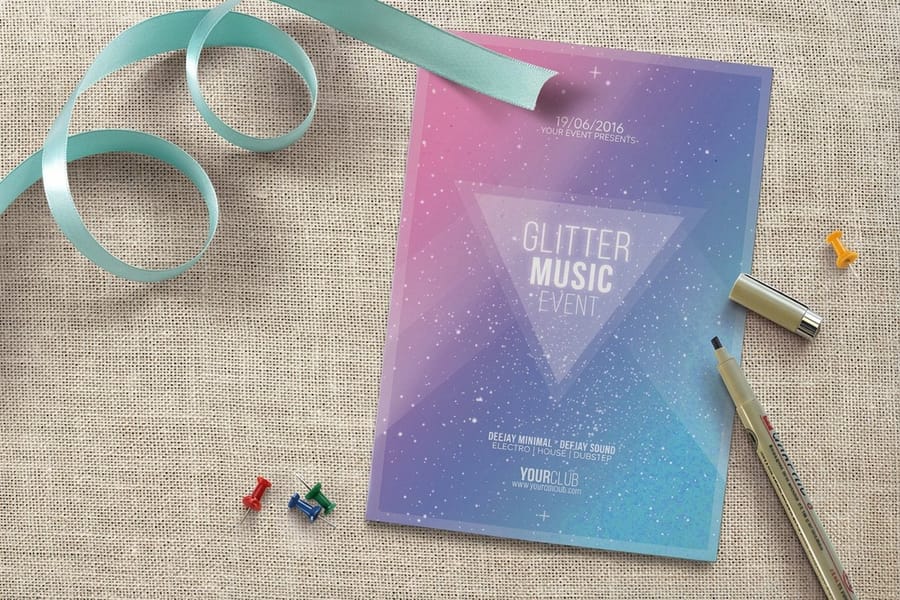
Your distribution method should drive your size choice. Mailing flyers? Half-letter or A5 fits standard envelopes without folding. Handing them out at events? A6 or DL fits in a back pocket. Posting on bulletin boards or walls? US Letter or A4 stays visible from a distance.
Budget matters too. Smaller flyers cost less per unit and you get more per print run. A business printing 1,000 A6 flyers will spend far less than printing 1,000 US Letter flyers on the same paper stock.
Think about content volume. If you have a lot to say, with multiple products, a detailed event schedule, or a full menu, go bigger. If your message is "50% off this weekend, here's the address," go small. When you are ready to order, our business flyers page lets you customize size, paper, and finish in a few clicks.
Folded flyer dimensions
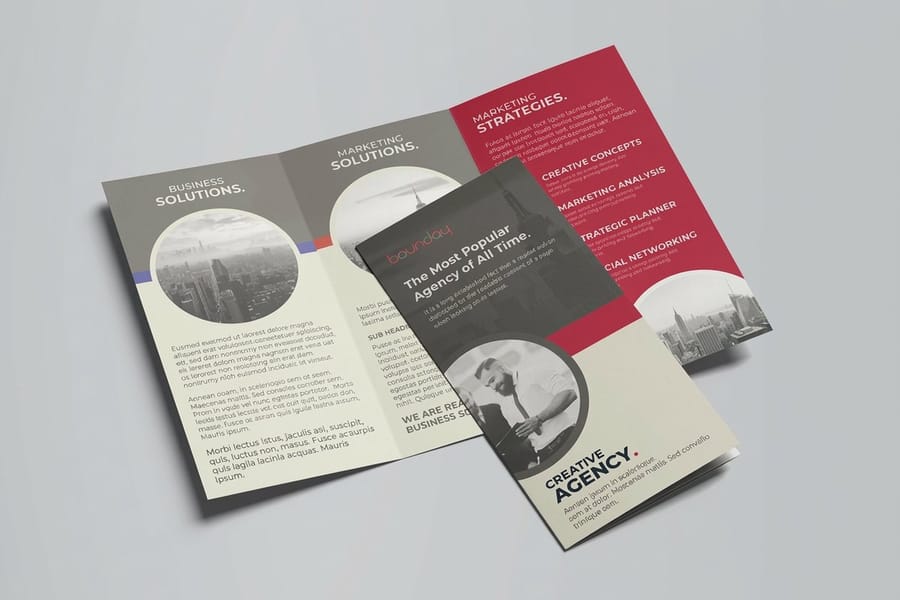
Folding changes everything. A US Letter flyer folded in half becomes 5.5 x 8.5 inches, the same as a half-letter. Tri-folded, it becomes roughly 3.67 x 8.5 inches, which fits a #10 business envelope.
When designing folded flyers, account for panel widths. On a tri-fold, the inside panel should be about 1/16 inch narrower than the other two panels so it folds cleanly without buckling. Your printer's template usually builds this in, but double-check.
Folded flyers work great for content that unfolds like a story. The front panel hooks attention, the inside panels deliver details, and the back panel closes with contact info or a call to action. If you are exploring other print projects alongside your flyers, our guides on custom magnets and how to clean rubber stamps have more hands-on tips.
Ready-to-use blank flyer templates
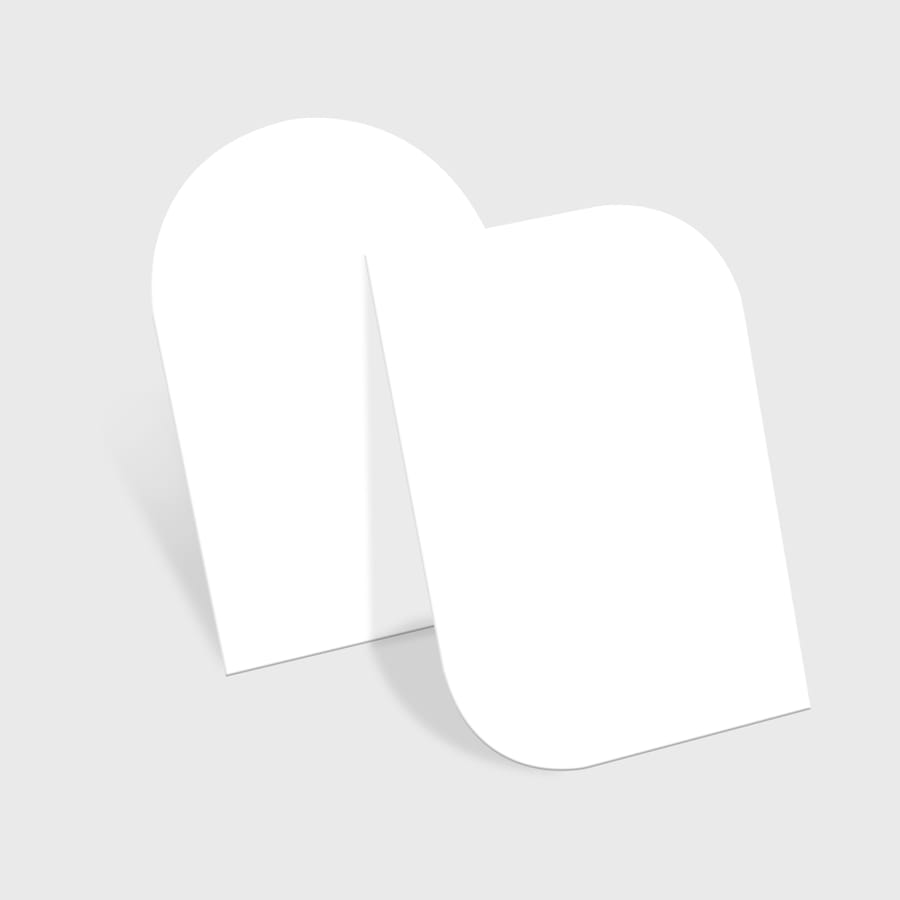
The fastest way to nail your dimensions is to start from a template that already has the size, bleed, and safe zone built in. Two crowd favorites are the circle flyers and club flyers layouts, both set up so you drop in your art and export a press-ready file.
Circle flyers break the standard rectangle and grab attention at events and in-store displays, while club flyers are tuned for the bold, high-contrast look that nightlife and concert promotions rely on. Both come pre-sized so you are not guessing at margins.
Starting from a blank template also keeps your files consistent across a campaign. Once your first flyer is dialed in, reusing the same base for the next size or the next event keeps your brand looking sharp from one print run to the next.
Flyer sizing mistakes that waste your money

Even experienced designers trip up on flyer dimensions. Here are the most common errors to avoid.
No bleed area. Forgetting to add 0.125 inches of bleed leaves thin white edges on your finished flyers, which looks cheap. Always extend backgrounds and images past the trim line.
Designing in RGB instead of CMYK. That bright neon green on screen turns into a muddy olive in print. Convert your color mode before you start designing, not after.
Text too close to the edge. Keep all important content at least 0.125 inches inside the trim line, because cutting is not pixel-perfect and there is always slight variation.
Using the wrong size for your envelope. A US Letter flyer does not fit a #10 envelope without folding, and an A5 does not fit a US envelope at all. Match your flyer size to your distribution method first.
Low-resolution images. 72 DPI looks fine on a website but terrible on paper. We recommend 300 DPI minimum for all flyer artwork, so check every image before uploading your file.
Size and price reference
Every flyer size at a glance
Use this table to match a format to your project, then check the live specs and price-per-unit for business flyers straight from the configurator below.
| Flyer | Inches | Millimeters | Best for |
|---|---|---|---|
| Letter (US) | 8.5 x 11 | 215.9 x 279.4 | Corporate handouts, event promos, menus, real estate listings |
| Half Letter (US) | 5.5 x 8.5 | 139.7 x 215.9 | Program notes, event invites, coupons, direct mail inserts |
| A4 (International) | 8.27 x 11.7 | 210 x 297 | Business correspondence, formal documents, magazine-style flyers |
| A5 (International) | 5.83 x 8.27 | 148 x 210 | Booklets, direct mail, notepads, informational handouts |
| A6 (International) | 4.13 x 5.83 | 105 x 148 | Postcards, pocket guides, simple announcements, coupons |
| DL | 3.94 x 8.27 | 99 x 210 | Rack cards, tourism brochures, takeout menus |
| Fold type | Base size (US) | Base size (ISO) | Final panel (approx.) |
|---|---|---|---|
| Bi-Fold | 8.5 x 11 in | A4 (210 x 297 mm) | 5.5 x 8.5 in per panel |
| Tri-Fold | 8.5 x 11 in | A4 (210 x 297 mm) | 3.66 x 8.5 in, uneven panels |
| Z-Fold | 8.5 x 11 in | A4 (210 x 297 mm) | 3.66 x 8.5 in, equal panels |
Specs and pricing
Business flyer specs and pricing
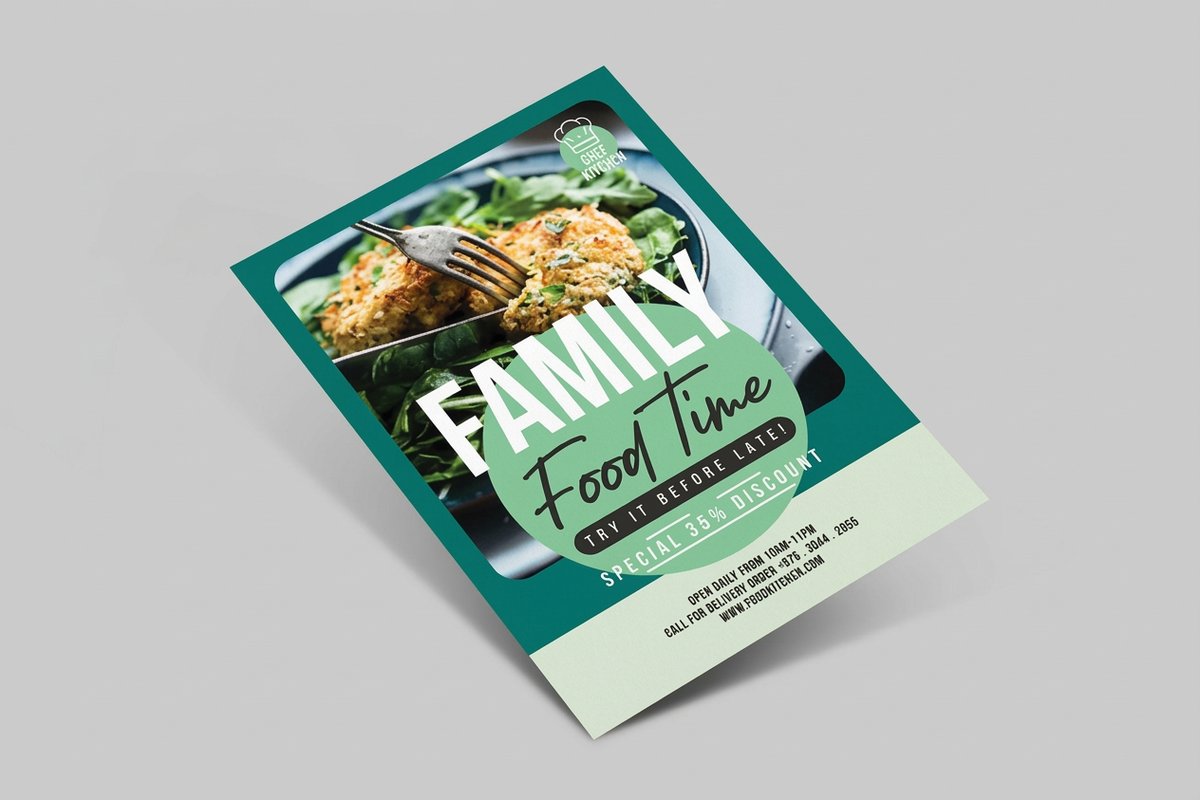
Once you have picked a size, here is what a made-to-order business flyer gives you at 4OVER4.COM, with live specs and price-per-unit straight from the configurator.
| Quantity | Price Per Unit | Total |
|---|---|---|
| 50 | $1.14 | $57.11 |
| 100 | 82.4¢ | $82.38 |
| 200 | 53.3¢ | $106.55 |
| 300 | 41.0¢ | $123.02 |
| 400 | 34.9¢ | $139.49 |
| 500 | 31.2¢ | $155.97 |
| 600 | 26.7¢ | $160.36 |
| 700 | 23.5¢ | $164.75 |
Print it
Order flyers in the right size at 4OVER4

Wally explains flyer sizes
Pick the size before you pick the design
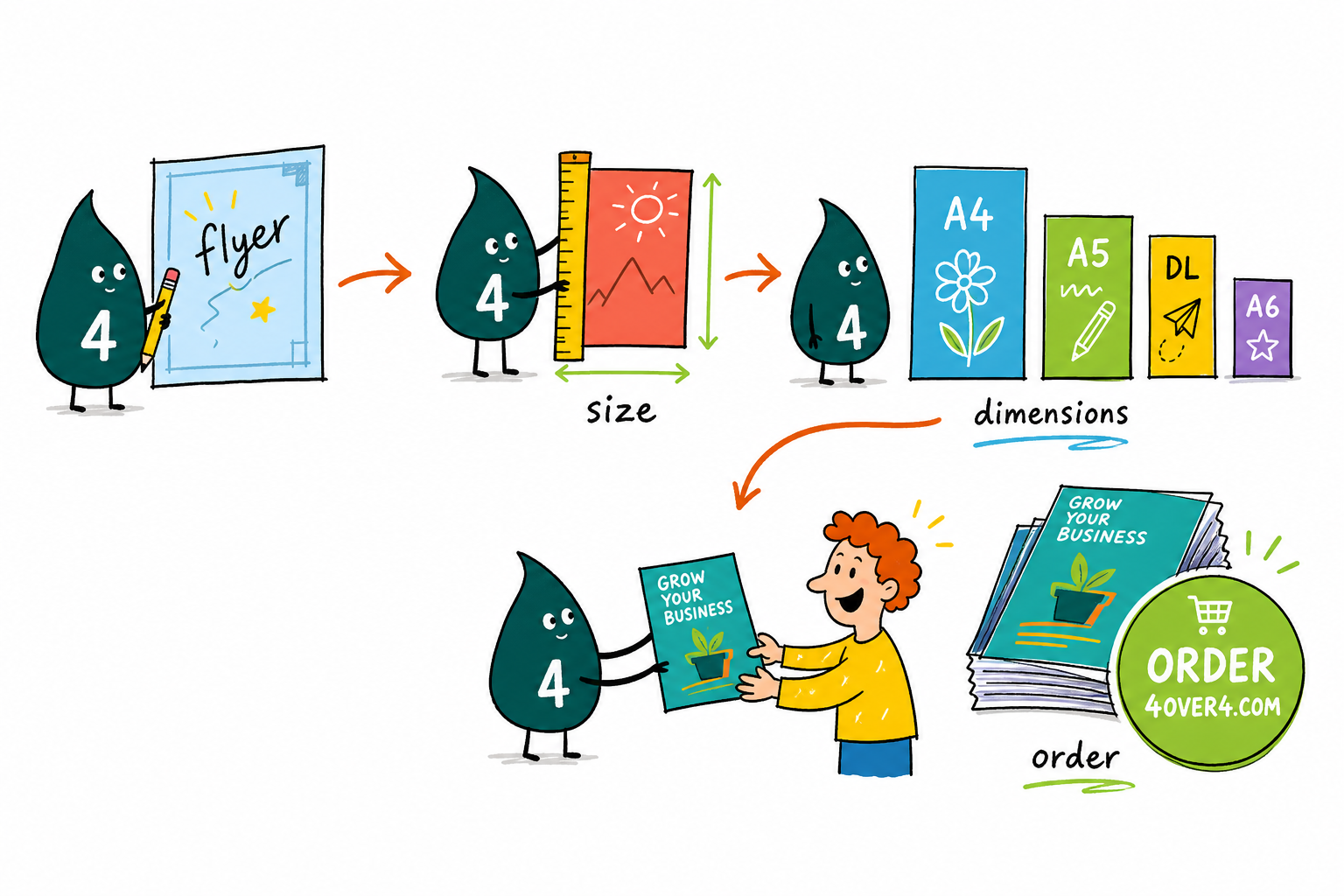
Wally sizes a flyer to the job, not the other way around. Mailing it? Half-letter or A5 slides into an envelope without folding. Handing it out? A6 or DL fits a pocket. Posting it on a wall? US Letter or A4 reads from across the room. Lock the size first, add a quarter inch of bleed, keep text off the edge, and the design falls into place. When you are ready, order business flyers in any standard size at 4OVER4.
Order business flyers →See it in use
Real flyer work, printed in-house
Explore more
Where to go next



By the numbers
Printing you can count on at 4OVER4
Common Questions
Your flyer size questions, answered
What is the most common flyer size in the US?
The most common flyer size in the US is 8.5 x 11 inches, the US Letter format. It is the standard for event promotions, restaurant menus, real estate listings, and corporate handouts. Because it matches a normal sheet of printer paper, you can proof it at home or in the office before sending the final file to a professional printer like 4OVER4.COM.
What size flyer fits in a standard envelope without folding?
A 5.5 x 8.5 inch half-letter flyer fits inside an A2 envelope without folding. For a #10 business envelope, tri-fold a US Letter flyer down to roughly 3.67 x 8.5 inches. DL flyers, which measure 3.94 x 8.27 inches, slide into DL envelopes that are standard in international markets.
How much bleed should I add to my flyer design?
Add 0.125 inches, about 3mm, of bleed on all four sides. That means an 8.5 x 11 inch flyer should be built as an 8.75 x 11.25 inch document. The bleed gets trimmed off during cutting, so extend every background color and edge-to-edge image into the bleed zone. Always confirm the exact bleed requirement for the product you are ordering before you finalize artwork.
What's the difference between US Letter and A4 flyer sizes?
US Letter measures 8.5 x 11 inches while A4 measures 8.27 x 11.7 inches, so A4 is a touch narrower and noticeably taller. The gap is small but it shifts your margins, text columns, and image placement. If you are printing for an international audience, design in A4 to match local paper standards instead of stretching a US Letter layout.
What resolution should my flyer images be?
Every image should be 300 DPI minimum in CMYK color mode. Lower-resolution files at 72 or 150 DPI look sharp on a screen but come out blurry or pixelated on paper. Check the resolution of each placed image before you upload, and export the final file as a press-ready PDF with fonts embedded.
Which flyer size is cheapest to print in bulk?
Smaller sizes like A6, at 4.13 x 5.83 inches, and half-letter, at 5.5 x 8.5 inches, cost the least per unit in bulk orders because you fit more pieces on each sheet. For high-volume campaigns such as street-team handouts or bag inserts, the compact formats give you the best cost per piece without wasting paper.
Get Started
Ready to order flyers in the right size?
Pick your dimensions, paper, and finish, then upload your press-ready file and we print sharp, edge-to-edge flyers that land exactly as designed.
Legal Disclaimer
Gold Standard guarantees apply to all standard orders placed through 4over4.com. Price match requires verifiable proof of a competitor's published price for an equivalent product with matching specifications and turnaround time. Satisfaction guarantee covers manufacturing defects and print quality issues. Contact support with order number and documentation. On-time delivery rate based on tracked orders 1999 to 2026. Individual results may vary based on shipping carrier performance.
