
Plastic Discount Cards

Important Artwork Notice!
If ordering optional foil stamping, please follow the Prepared Instructions. Please prepare CMYK File with all design areas that do not have a metallic foil finish. You MUST include a 100% Black Foil Mask of the elements of your design to be stamped with foil. Only one foil color is available per card design, whether you print on the front, back or both sides. Furthermore, if you are ordering optional spot or raised spot UV, please follow the Prepared Instructions found on the same page in the link below under Spot UV. Once again, you must include a SEPERATE 100% Black Foil Mask of the elements of your design to be spot UV coated.
See Plastic Discount Cards in action
Watch the Plastic Discount Cards overview from 4OVER4.COM. A short walkthrough of options, premium stocks, live pricing and fast turnaround.
- From $226.11 per 250 cards, with the per-card price sliding from about 90 cents down to roughly 25 cents at 10,000 across 12 quantity tiers.
- 30mil white PVC, the exact thickness and 2.125" x 3.375" size of a bank card, finished with 1/8" rounded corners on every card.
- Real card hardware: a LoCo or HiCo magnetic stripe, Code 128 or Code 39 barcoding, sequential variable-data numbering, and a scratch-off PIN panel.
- Embossed numbering, optional gold or silver foil tipping, a signature panel, foil stamping, and a punched lanyard slot for VIP and event cards.
- 2 finishes, UV Gloss or Silk Laminated Matte, full color front-only or both sides, rated 4.8 out of 5 across 5 reviews on a 15 business day standard turnaround.
Put Your Discount on a Card People Keep
Where a paper coupon tears, fades, and ends up in the trash, a plastic discount card keeps your offer working for years. Each one runs on solid 30mil white PVC, the exact stock banks use, cut to the standard 2.125" x 3.375" credit-card size with 1/8" rounded corners so it drops straight into a wallet slot, a card reader, or a badge holder. Pick one up and it flexes and snaps back like the card already in your pocket, shrugs off water, and carries your offer through daily use. Runs start at $226.11 for 250, rated 4.8 out of 5 across 5 reviews.
What turns a printed rectangle into a working discount is what you build into it. A magnetic stripe, a barcode, a scratch-off PIN, embossed numbering, a signature panel, and sequential variable data all let one card carry a loyalty program, a gift balance, or a one-time promo code. Want to see how it sits next to the rest of the range? Browse every style on business cards printing, or stay here and build yours from the choices below.
The price rewards a bigger run. A set of 250 starts at $226.11, about 90 cents a card, and the per-card cost keeps sliding as the count climbs toward 10,000, where it lands near 25 cents. Tap any tier below to see the live total and exactly how much each step up saves before you commit.
What Are Plastic Discount Cards?
Plastic discount cards are durable PVC cards printed full color on a single 30mil white plastic stock at 2.125" x 3.375", the same thickness and size as a credit card. People reach for them when a paper coupon would not survive: loyalty and VIP cards, gift and prepaid cards, promo and coupon cards, membership cards, and referral cards. The white plastic base makes color artwork read clean and bright, whether you print the offer on the front and leave the back blank or run full color on both sides. If you want an everyday plastic card without the discount hardware, the Plastic Business Cards cover that, and this card sits beside it as the version built to carry a program.
Discount card specs
| Spec | Value |
|---|---|
| Size | 2.125" x 3.375", the CR80 credit card footprint |
| Body | 30mil white PVC, the same thickness banks use |
| Corners | 1/8" rounded on every card |
| Finishes | UV Gloss or Silk Laminated Matte |
| Ink | 4/0 full color front only, or 4/4 full color both sides |
| Minimum order | 250 cards |
| Turnaround | 15 business day standard production |
Discount Cards for Fundraising, Membership and Rewards
Fundraising cards are the volume use. A school, a team or a booster club sells the card at a fixed price, and the back lists the participating merchants and what each one gives, so the buyer keeps the card in their wallet for a season and the organisation keeps the whole sale price. Print the year on the face, keep the merchant list to the back, and order the run against the number of sellers rather than the number of supporters.
Membership cards carry a standing percentage rather than a list. The holder shows the card and gets the same discount every visit, which makes the card itself the record, so the design usually pairs the member name space or a printed number with the terms on the reverse.
Rewards cards are tied to the till. A barcode or a magnetic stripe on the card matches the customer to an account in your point of sale system, so the discount is applied by the software and the visit is logged at the same time. That is the version where numbering and encoding stop being decoration and start doing the work.
What Finishes and Ink Options Can You Choose?
Two finishes set the feel. A UV Gloss coat gives color and photos a hard, shiny surface that catches the eye, ideal for a bright gift or loyalty card. A Silk Laminated Matte reads softer and more premium, with a smooth low-glare surface that feels expensive in the hand and takes a signature or a stamp without beading. For ink you choose 4/0, full color across the front with a blank back for a signature panel or the fine print, or 4/4, full color on both sides so the back can carry terms, a barcode, or the redemption steps. All of it, plus the card features, is grouped below exactly the way the live configurator presents it, so you know what you can change before you change it.
What Features Can You Add to a Discount Card?
This is where a plain card becomes a working discount program. The options below turn a printed rectangle into hardware people actually swipe, scan, and scratch, and you only pay for the ones you turn on.
| Feature | Options | What it is for |
|---|---|---|
| Magnetic stripe | LoCo or HiCo coercivity | Swipe readers and access systems, HiCo where the card lives in a wallet for a long time |
| Barcoding | Code 128, Code 39, UPC-A or EAN-13 | Scanning the card at a point of sale or a scanner already in the store |
| Sequential numbering | Variable data, a different number on every card | Tracking which card was issued to whom, and which are still outstanding |
| Scratch-off PIN panel | Scratch-off with pin | One time redemption codes, where the code has to stay hidden until use |
| Embossed numbering | 14pt or 18pt, with no tipping or gold or silver tipping | The raised bank card look, readable by touch as well as by eye |
| Foil stamping and foil tipping | Gold or silver | VIP and tier cards that have to look different from the standard issue |
| Signature panel | Printed panel | Cards that have to be signed to be valid |
| Lanyard slot | Punched on either edge | Event and staff cards worn rather than carried |
Encode it with a magnetic stripe
Add a magnetic stripe in LoCo or HiCo coercivity and the card swipes through gift, loyalty, and point-of-sale readers. LoCo suits high-turnover promo and gift cards, while HiCo holds up on cards members carry and swipe for years. Pair it with a signature panel, a white strip on the back that members can sign like a bank card.
Number every card differently
Turn on barcoding with Code 128 or Code 39, or sequential variable data, and every card in the run ships with its own number or code instead of a repeat. That is what makes a numbered membership card, a unique loyalty code, or a scannable gift balance. Add embossed numbering to raise the digits like a classic credit card, plain or tipped in gold or silver foil.
Hide the code and finish it for the job
A scratch-off panel hides a one-time PIN or promo code that the holder reveals to redeem, ideal for prepaid and coupon runs. Foil stamping adds a metallic accent to the front or back. And a punched lanyard slot on the short or long edge turns the same card into a VIP or event badge that clips to a reel or hangs from a lanyard.
Design it without a designer
You do not need a design background to make a discount card look sharp. Start from one of thousands of free, professionally built layouts in our business card design templates, then change the colors, copy, and logo in the online editor in minutes.
Already have your artwork? Skip the editor and download a press-ready blank instead. Each blank plastic card template is built at the real trim size with the 1/8" bleed and safe margin already drawn in, plus the rounded-corner, stripe, and signature zones marked, so your design never crowds the cut. Grab it, drop your art in, and upload.
Wally puts the discount on a card people keep
Why a $226.11 run of 30mil plastic discount cards outlasts any paper coupon.
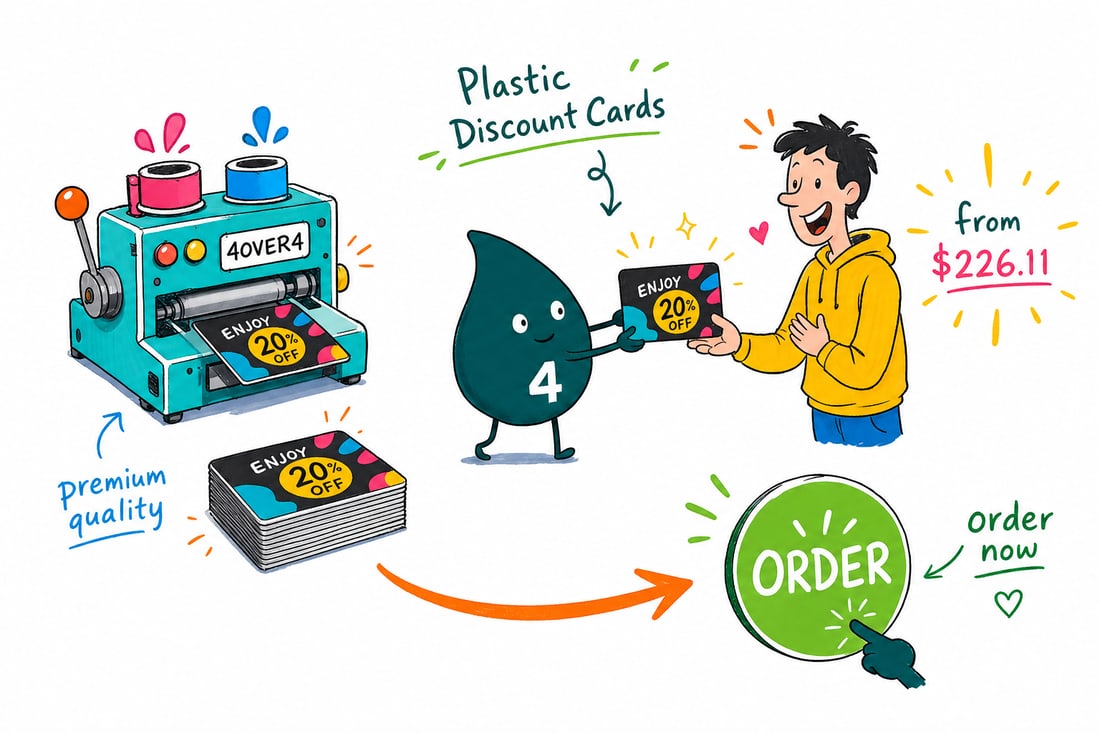
A run of 250 starts at $226.11 on real 30mil white PVC, the same thickness as a bank card. Add a magnetic stripe, a scratch-off PIN, or sequential numbering, and Wally turns your offer into a loyalty, gift, or VIP card that rides in a wallet for years.
Press-Ready Blank Templates
How Much Do Plastic Discount Cards Cost?
Plastic discount cards start at $226.11 per 250, about 90 cents a card, and the per-card price keeps dropping as the quantity climbs toward 10,000, where it lands near 25 cents. Along the way 1,000 cards run $377.68, 3,000 run $1,009.25, and 7,500 land at $2,019.75, with 12 quantity tiers in all. So how many do you actually need? Drag the slider below to set your count and watch both the run total and the true per-card cost update live, and find the point where one more step up barely moves the budget.
| Quantity | Set total | Per card |
|---|---|---|
| 250 | $226.11 | About 90 cents |
| 1,000 | $377.68 | About 38 cents |
| 3,000 | $1,009.25 | About 34 cents |
| 7,500 | $2,019.75 | About 27 cents |
Those are four of the 12 quantity tiers, and they show where the money actually moves: the jump from 250 to 1,000 cards more than halves the cost of a card, while the steps above 3,000 shave cents. At 10,000 the per card figure sits at roughly 25 cents. A fundraising organizer can price a programme straight off that table, since the card cost per seller is the number that decides the sale price.
Can You Number or Encode Each Card?
Yes. Turn on variable data and you can drop a unique number, a serial, or a one-off code onto every single card in the run, so each one ships personalized instead of identical. Pair it with a Code 128 or Code 39 barcode and a magnetic stripe, and the card becomes a numbered membership card, a scannable loyalty card, or a prepaid gift card where every code is different. Add embossed numbering, a signature panel, and a scratch-off PIN, and a plain white rectangle starts doing the work of a full bank card, right down to the one-time redemption code.
Will a discount card scan at my POS
Start from the reader, not from the card. Find out which symbology your point of sale system reads, then order that one, because a scanner set for Code 128 will not resolve an EAN-13 and a system expecting a UPC-A will reject a number that is not the right length. Code 128 and Code 39 cover most loyalty setups, UPC-A and EAN-13 are there when the card has to behave like a retail product code.
Leave the quiet zone clear. A barcode needs blank space either side of it, so keep artwork, borders and text out of that margin, and do not place the barcode hard against the trimmed edge of the card or the rounded corner. Keep the printed digits under the bars as well, so the cashier can key the number when a card gets scratched.
Supply the number range rather than a single number: the first number, the last number and any prefix that has to stay fixed, so the variable data run matches the accounts you have already created. Then scan a sample card on your own hardware before the full quantity goes to press. A 250 card minimum is a small mistake, 7,500 cards with a barcode your till cannot read is not.
How Long Should a Discount Card Stay Valid?
Print the end date on the face if the offer stops on a date, or a season code such as a year if the programme reprints annually, so an expired card is obvious without a lookup. For a card that is meant to be used once, a scratch-off pin is the answer: the code is hidden until the customer redeems it, and once it is exposed the card cannot quietly be reused. A sequential range does the same job in software, since you can close a block of numbers at the till.
Discount key tags and combo cards
Not every discount belongs in a wallet. A key tag rides on a keyring and comes out at the till without anyone hunting for it, which is why loyalty programmes hand them out alongside the card. Plastic key tags run on the same plastic and take the same barcode, key tags cover the wider range of shapes and stocks, and plastic card with key tag is the combo: one printed card with tags attached, so the member gets a wallet card and a keyring tag from a single piece with a single number on both.
How Do They Compare to the Other Plastic Cards?
Plastic discount cards are the pick when you want a bright, printable base at bank-card thickness that carries a program, but they are not your only move. If you are weighing the same stock without the discount angle, a see-through look, or an everyday plastic card, it helps to see the trade-off in plain numbers. The chart below lines these up against their closest siblings, the 30mil White Plastic Cards and the 30mil Clear Plastic Cards, so you can compare the starting price on each before you choose.
See How a Finished Discount Card Lands
Words only go so far. Want to see how stock, color, and finish come together on a real 30mil card? The gallery below collects work our own customers printed in-house, across different finishes and features, so you can borrow ideas and see how a choice actually reads at credit-card size. Tap any print to see it larger.
How Fast Can You Get Plastic Discount Cards?
Plastic discount cards print on a standard 15 business day production schedule, since encoding, embossing, scratch-off panels, and lamination each take a real step on the line, so plan the order around your promotion or launch date. Before anything prints you choose how to handle proofing: send it Straight To Production when your file is final, or request a Free Online Proof and approve a digital preview of the exact card first. The proof is the safer path when you have variable numbering, a barcode, or a scratch-off code that has to be right on every card.
See the Rest of Our Cards
These plastic discount cards are one stop in a much larger lineup, and you can scan the full print product range any time. If a plain plastic card, a see-through card, or an everyday plastic business card would serve you better, the rest of the family is one tap away. Each option shows its own starting price and links straight to its product page, so finding the right fit takes seconds.
Print Your Plastic Discount Cards Today
At 4OVER4.COM, quality comes first, and it is backed by a satisfaction guarantee and 25+ years of printing since 1999. Whatever finish, ink, and card features you pick, these plastic discount cards are built to swipe, scratch, and last like the card already in your wallet. Choose your quantity, add the features your program needs, and print your plastic discount cards today.