
Plastic Credit Cards
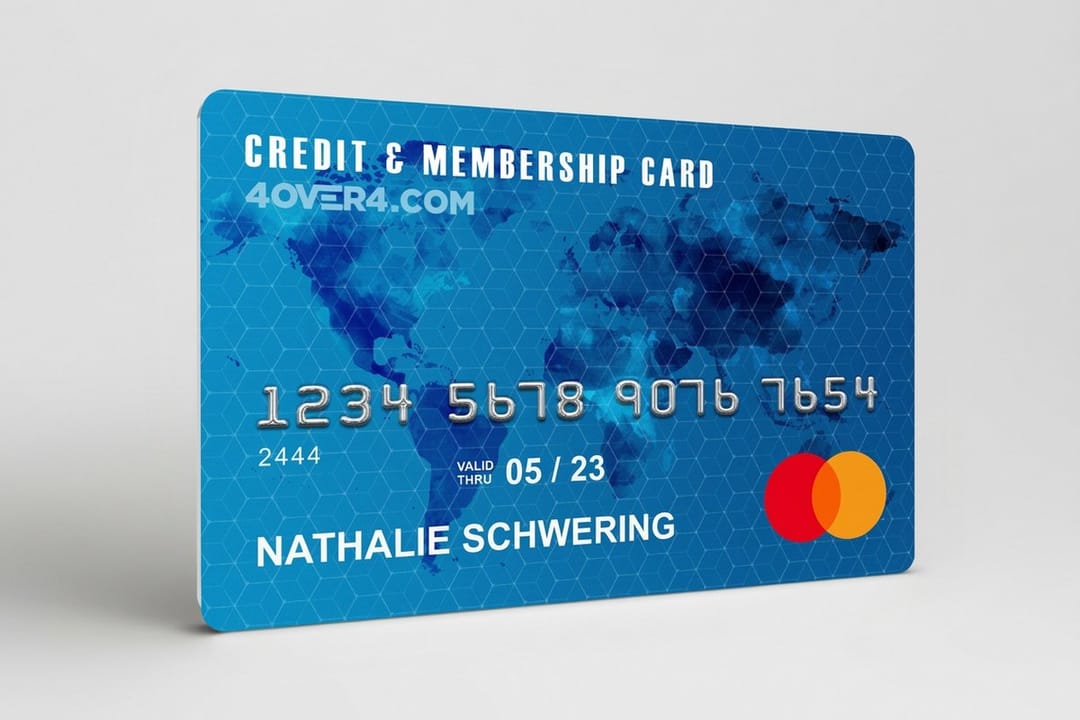
Important Artwork Notice!
If ordering optional foil stamping, please follow the Prepared Instructions. Please prepare CMYK File with all design areas that do not have a metallic foil finish. You MUST include a 100% Black Foil Mask of the elements of your design to be stamped with foil. Only one foil color is available per card design, whether you print on the front, back or both sides. Furthermore, if you are ordering optional spot or raised spot UV, please follow the Prepared Instructions found on the same page in the link below under Spot UV. Once again, you must include a SEPERATE 100% Black Foil Mask of the elements of your design to be spot UV coated.
See Plastic Credit Cards in action
Watch the Plastic Credit Cards overview from 4OVER4.COM. A short walkthrough of options, premium stocks, live pricing and fast turnaround.
- From $226.11 per 250 cards, with the per-card price dropping across 12 quantity tiers to about 25 cents each at 10,000.
- Credit card size, the exact 2.125" x 3.375" footprint, printed on a single 30mil white plastic stock the same thickness as a bank card.
- Magnetic stripe in LoCo or HiCo, plus barcoding with numbering and sequential variable-data numbering so every card ships unique.
- UV Gloss or Silk Matte finish, full color on one or both sides, with embossed numbering, foil stamping, a signature panel, scratch-off and a lanyard slot as add-ons.
- 15 business day standard production, 1/8" rounded corners as standard, rated 5 out of 5 and backed by five Gold Standard guarantees.
Print a Card That Earns a Wallet Slot
Take the exact card a bank hands out, then build it for your brand instead. These plastic credit cards are rigid 30mil stock cut to the familiar 2.125" x 3.375" shape, with the same weight in the hand and the same rounded corners, so people treat one as worth keeping and it lands in a wallet where a paper card never would. Print full color, then decide how far to take it with a stripe, a number, a signature panel, or a barcode. Pricing starts at $226.11 for 250, with a perfect 5 out of 5 rating.
These cards do the work of a bank card without the bank. They swipe, they scan, they carry a unique number, and they survive a wallet for years. Want to see how they sit next to the rest of the plastic-card lineup? Browse every style on gift cards printing, or stay here and build yours from the choices below.
The price rewards a bigger run. A set of 250 starts at $226.11, and the per-card cost keeps sliding as the count climbs to 10,000, so a full box for a store rollout or a membership drive costs far less per card than a small test batch. Tap any tier below to see the live order total and exactly how much each step up saves before you commit.
What Are Plastic Credit Cards?
Plastic credit cards are durable 30mil white plastic cards printed full color at the standard 2.125" x 3.375" credit card size, on one or both sides. People reach for them when a paper card would not survive or would not be trusted: gift cards, membership and loyalty cards, VIP and discount cards, hotel key cards and photo ID cards. Because the card looks and feels like the real thing, it gets kept and used instead of tossed. If you need the same card built around a specific job, the Plastic Gift Cards and Plastic Membership Cards start from this same stock and size.
Credit card style cards for business
These are business issued cards in credit card format: gift cards, membership cards, loyalty cards and VIP cards, printed with your brand on the same rigid plastic and at the same size as the card in your wallet. They are not bank issued payment cards, they carry no funds of their own and they are not accepted anywhere as a means of payment.
What people are buying is the format. A card at this size and weight goes into a wallet slot and stays there, which is the whole reason a gift card outperforms a paper voucher and a membership card outperforms a keyring tag. Your systems do the rest: the value, the balance, the membership record and the discount all live in your own database or point of sale, and the card is the physical key that points at them through a number, a barcode or a magnetic stripe.
What can you print on a credit card sized plastic card?
Custom PVC cards at credit card size and thickness, printed for loyalty, membership, gift, VIP and ID use. They are not bank issued payment cards. Beyond that, almost anything you can design: full color artwork on one side or both, a photo, a logo, a QR code, a barcode, a member name, a unique serial number on every card, terms and a signature panel on the back.
The common jobs are a gift card sold at the counter, a membership or loyalty card that gets scanned on each visit, a staff or student ID with a photo and a lanyard slot, a VIP or access card for an event, and a discount card handed out by a partner business. All of them use the same stock and the same size; what changes is which add-ons you turn on.
What Size and Material Is a Plastic Credit Card?
There is one size here for a reason: 2.125" x 3.375" is the exact credit card standard, so your card fits every wallet slot, cardholder and swipe reader built for a bank card. The stock is a single 30mil white plastic, the same 0.030 inch thickness as the card in your pocket, rigid enough to feel premium and durable enough to last for years. The 1/8" rounded corners come standard, matching the profile of a real card down to the edge. You are not choosing between thin and thick or square and round, you are getting the genuine credit card build every time. Every option below is grouped exactly the way the live configurator presents it, so you know what you can change before you change it.
The exact spec
| Spec | What ships |
|---|---|
| Size | 2.125" x 3.375", the standard bank card footprint, so it fits every wallet slot and card holder already in circulation. |
| Stock | 30mil White Plastic, the same thickness as a bank card, rigid rather than flexible. |
| Corners | 1/8" rounded radius as standard, cut on all four corners. |
| Printing | Full color on one side or both. |
| Finish | UV Gloss or Silk Matte across the face. |
Those numbers matter for more than the feel. A card at this exact size and thickness runs through the swipe readers, badge printers, card holders and wallet slots that were built around the standard, which is what separates a plastic card from a thick printed card that only looks like one.
What Finishes and Printing Options Are There?
Start with the surface. A UV Gloss finish makes color and logos snap, while a Silk Laminated Matte gives the card a soft, premium touch that resists fingerprints. For ink you print 4/0, full color on the front with a blank back, or 4/4, full color on both sides when the back needs terms, a barcode or a design.
From there the finishing options turn a printed card into a real credential. Embossed numbering presses raised digits into the plastic, with plain, gold tipped or silver tipped styles to choose from. Foil stamping adds a metallic hit to the front, the back, or both. And a signature panel prints onto the card so it can be authorized by hand. Every one of these is a live option, so you build exactly the card you need and nothing you do not.
Metal look finishes without the metal
Two options here get most of the way to a metal card on a plastic budget.
Foil stamping in silver or gold presses real metallic foil into the card, so a logo, a name or a number sits on the surface as reflective metal rather than as printed ink. Printed metallic ink never quite convinces, foil does, because it is actually reflecting the room. It is the strongest option for a VIP or premium gift card where one element should catch the light.
The Silk Matte finish takes the shine off the whole face and leaves a soft, even surface that reads like brushed metal in the hand, especially in a dark or metallic color scheme. It also hides fingerprints, which UV Gloss does not.
Being straight about the difference: an etched metal card is milled from metal, so it has real weight, a cold feel and a cut edge you can see. A 30mil PVC card with silver foil and a silk matte face looks the part in a photograph and in a wallet, but it weighs what plastic weighs and it flexes where metal does not. If the goal is a card people photograph and keep, this gets there. If the goal is the sound it makes when it lands on a table, that is a metal card.
Can You Add a Magnetic Stripe, Barcode, or Numbering?
Yes, and this is where a plastic credit card becomes a working tool. Add a magnetic stripe in LoCo or HiCo and the card swipes through a reader, ready to drive a gift balance, a membership check-in or a hotel door. Add barcoding with numbering, in Code 128, Code 39 or another format, and every card scans at a register or a scanner. Turn on variable data with sequential numbering and each card in the run prints a different number or code, so a batch of 1,000 gift or loyalty cards ships with 1,000 unique IDs instead of duplicates.
You can layer a scratch-off panel with a hidden pin for redemption codes, and punch a lanyard slot on the 2.125" or 3.375" edge for badges worn on a cord. Combine a few of these and one card handles print, scan, swipe and sign at once. The same encoding is what powers the Hotel Key Cards and the Plastic Identification Cards in the range.
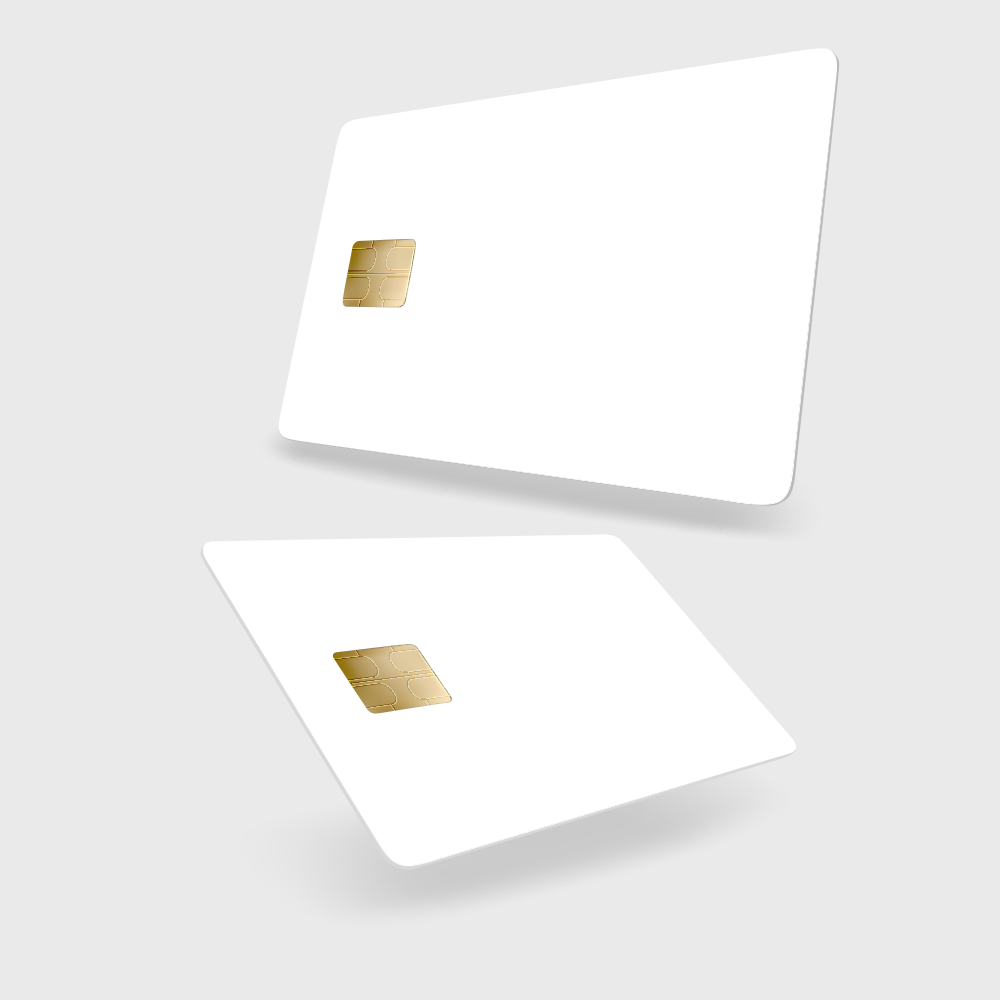
Already have your artwork? Skip the editor and download a press-ready blank instead. The blank plastic credit card template is built at the real 2.125" x 3.375" trim size with the 1/8" bleed and safe margin already drawn in, so your design never crowds the cut or the rounded corners. Drop your art in and upload.
Wally prints a card people keep in their wallet
Why a $226.11 stack of plastic cards outlasts every paper one.
Plastic credit cards start at $226.11 for 250, printed on the same 30mil plastic and the exact 2.125 by 3.375 inch size as a real bank card. Add a magnetic stripe, a barcode or a unique number per card, pick UV Gloss or Silk Matte, and Wally turns your design into a gift, membership or key card that earns a wallet slot.
Press-Ready Blank Templates

Every add-on, by its configurator label
- Magnetic Stripe, LoCo or HiCo. LoCo is low coercivity, the easier stripe to encode and re-encode, so it suits cards whose data changes. HiCo is high coercivity, harder to erase by accident against a phone or another card, so it suits cards that stay in a wallet for years.
- Barcoding with Numbering, in Code 128, Code 39, UPC-A or EAN-13. Pick the symbology your scanner and point of sale already read. Code 128 and Code 39 are the usual choices for membership and loyalty numbers; UPC-A and EAN-13 are the retail formats, for cards that ring up at a till.
- Variable Data sequential numbering. A different number printed on every card in the run, which is what makes each card unique enough to track, redeem once, or tie to a member record.
- Embossed Numbering at 14pt or 18pt, with gold or silver tipping. Raised characters pressed into the card the way a bank card carries its number, with the raised faces tipped in metallic foil. 18pt is the larger, more visible size.
- Signature Panel. A writeable strip on the back, so a member or cardholder can sign in ink on a surface that otherwise rejects a pen.
- Scratch Off with Pin. A concealed code under a scratch layer, the standard way to ship a gift or promotional code without exposing it on the shelf.
- Lanyard Slot, on the 2.125" side or the 3.375" side. A punched slot for a clip or lanyard. Choose the short side for a card that hangs portrait, like an event or staff badge, and the long side for one that hangs landscape.
Add-ons combine, so one card can carry a magnetic stripe, a barcode and sequential numbering at once. Decide first how the card gets read, by swipe, by scanner or by eye, because that decides which of these you actually need.
How Much Do Plastic Credit Cards Cost?
Plastic credit cards start at $226.11 for 250, and the per-card price keeps dropping as the quantity climbs toward 10,000, so a cheap plastic card really comes down to how big a run you order. A 1,000-card run is $377.68 and a 10,000-card order is $2,474.47, which brings the per-card cost down to roughly 25 cents. So how many do you actually need? Drag the slider below to set your count and watch both the order total and the true per-card cost update live, and find the point where one more step up barely moves the budget.
Minimum order, quantity ladder and production time
The minimum order is 250 cards, at $226.11 for the set. Plastic card production runs on a press and finishing line set up per job, so the setup is the same whether you order 250 or 10,000, which is why there is a floor and why the per-card cost falls steeply as the run grows.
| Quantity | What it costs |
|---|---|
| 250 (minimum) | $226.11 for the set. |
| Twelve tiers in between | The per-card price drops at each step, so the next tier up is usually cheaper per card than topping up later with a second order. |
| 10,000 (largest tier) | About 25 cents per card. |
Plan the timing too. Standard production is 15 business days, because encoding, embossing, foil and finishing each add a pass after printing. That is the one thing to work backwards from if the cards have to be in hand for a launch, a season or an event.
Which card should you order
Every card below prints on the same 30mil stock at the same 2.125" x 3.375" size. The difference is which add-ons and artwork the product is set up around, so start from the job:
- Plastic gift cards, for a card sold or given at the counter and redeemed against a balance. Pair with a barcode or magnetic stripe and a scratch-off pin.
- Plastic membership cards, for a card that identifies a member on every visit. Pair with sequential numbering and the barcode format your system reads.
- Plastic discount cards, for a card handed out to drive repeat visits, usually printed at volume with a single offer on the face.
- Plastic VIP cards, for the tier that has to look the part. This is where foil stamping, embossed numbering and the silk matte face earn their cost.
How Do Plastic Credit Cards Compare to the Range?
Plastic credit cards, gift cards, membership cards and VIP cards all print on the same 30mil white plastic at the same credit card size, and they all start at $226.11. The real difference is the job each one is built for and the encoding you add, not the base price. The chart below lines up plastic credit cards against their closest siblings so you can see how they stack up before you choose.
How Fast Can You Get Plastic Credit Cards?
Standard production for plastic credit cards is 15 business days, since the plastic process, magnetic stripe encoding and finishing steps take longer than paper cards. Choose a Free Online Proof and you can check your file before it goes to production, or go straight to production when your artwork is ready. Upload a print-ready PDF, JPG or PNG built at the 2.125" x 3.375" trim size and your card is on its way.
See the Rest of Our Cards
Plastic credit cards are one stop in a much larger lineup, and you can scan the full print product range any time. If a gift card, a membership card or a VIP card would serve you better, the rest of the family is one tap away. Each option shows its own starting price and links straight to its product page, so finding the right fit takes seconds.
Print Your Plastic Credit Cards Today
At 4OVER4.COM, quality comes first, and it is backed by a satisfaction guarantee and 25+ years of printing since 1999. Whatever finish, encoding or numbering you pick, these plastic credit cards are built to feel like the real thing and earn a spot in a wallet. Order your plastic credit cards today.