
How to Build a Positive Digital Presence That Holds Up to Search


A working plan rather than a pep talk: audit the first page of results for your name, repair the properties you control, collect reviews on purpose, and hold one cadence you can actually keep.
Your digital presence is whatever the first ten results say when a stranger searches your name, so you build it by taking control of that page rather than by posting more. Three of those results are usually owned property you can edit today, a few are earned through customers, and the rest cannot be deleted at all. The work splits accordingly: repair the owned pages first, collect reviews second, and outrank the rest by publishing.
Quick answer
Own three results, earn two, outrank the rest
A positive digital presence is a first page of search results that is accurate, current, and mostly yours. Your site, your Google Business Profile and your main handle are owned property and respond to work the same week. Reviews and listings are earned, so they move at the speed your customers act. Everything else is a mention with no delete button, which leaves one lever: publish enough strong owned pages that it slides out of view.
Audit What Search Already Says Before You Change Anything
Open a private browsing window, sign out of everything, and search four things: your personal name, your business name, your business name plus your city, and your business name plus the word reviews. Write down the first ten results for each, in order. That page is your digital presence. Everything else in this guide is about moving items on that list.
Sort what you find into three buckets. Owned is anything you can log into and edit: your site, your Google Business Profile, your LinkedIn, your handle on whichever platform you use. Earned is anything other people wrote about you that a platform lets you respond to, mostly reviews and listings. Mentioned is everything else, the forum thread, the old directory entry, the profile from a business you closed in 2019.
The buckets matter because they respond to completely different work. Owned pages change the day you edit them. Earned results change as customers act. Mentioned results usually have no removal path at all, which is the fact most people discover far too late in this process. Doing the audit first stops you spending three weeks writing blog posts when the real problem is an unclaimed profile with a wrong phone number.
Keep the screenshot with a date on it. In three months you will want to compare, and memory is a poor judge of whether a first page improved.
Fix the Properties You Own Before You Chase the Ones You Do Not
Owned property is where the first month of work belongs, because it is the only part of the list that answers to you. Four things, in this order.
- Your site. A homepage that says what you do and for whom in the first line, a real about page with a face and a location, and contact details that match everywhere else. If nothing else exists, this one page carries the whole presence. Our guide to business websites covers what belongs on each page.
- Your Google Business Profile. Claimed, categorised correctly, hours accurate, and photographed this year. For anything local this outranks your own site for your own name more often than owners expect. The Google Business Profile guide walks through the setup that survives an edit review.
- One social handle. The same string on every platform, even the ones you do not use, so nobody else takes it. Fill the bio, link the site, then either post or leave the account looking deliberately quiet rather than half abandoned.
- Consistent details. Same business name, same address format, same phone number, everywhere. Directories cross reference these, and a mismatch splits your identity into two weaker records.
Then close the loop between the offline moment and the online property, because that is where most presence work quietly leaks. Someone meets you, likes you, and has nothing to act on twenty minutes later. A card in their hand solves it: put the handle on the front and a scannable code to the profile you actually maintain. Standard business cards start at $17.57, and our notes on business cards with social media icons cover how many icons a card can carry before the back turns into noise.
Stickers do the same job in a place a card cannot reach. A clear sticker on a laptop lid, a case, or the seal of a shipped box keeps the handle visible long after the meeting, and clear stock starts at $25 so a run costs less than a week of paid reach. If you would rather hand someone a screen than a card, the digital business card guide covers that route, and both can run at once.
Reviews Are the Loudest Part of Your Presence

A star rating sits next to your name in results and gets read before anyone clicks anything. It is also the fastest moving number on the whole first page, because it changes with customer behavior rather than with search engine crawls. Three habits do most of the work.
Ask at the moment of relief. The window is the hour after you solve the problem, not the invoice a week later. Ask in person, then hand over something with a code on it so the request survives the walk to the car. A follow up postcard starts at $16.48 and works for jobs where the customer left before you could ask. Our walkthrough on making a QR code for Google reviews covers generating the direct link so the customer lands on the review box rather than on your listing.
Answer every one of them, and answer the bad ones the same day. The reply is not for the reviewer. It is for the next hundred people reading the thread, and they are judging your tone, not the facts of a dispute they cannot verify. Acknowledge, say what changed, offer a direct contact, stop. The psychology of five star reviews goes deeper into what makes someone bother to write one at all.
Never buy them. Purchased reviews arrive in clusters from accounts with no history, which is exactly the pattern platform filters are built to catch, and a removal sweep can take your legitimate reviews with it. The recovery from that is far more expensive than the slow honest version.
One limit worth naming: a rating below four with fewer than twenty reviews is unstable, and a single unhappy customer moves it visibly. Volume is the defense. Twenty honest reviews absorb a bad week in a way that six cannot.
Pick a Cadence You Can Hold in a Bad Week

Most presence plans fail on scheduling, not on ideas. Someone commits to daily posting on four platforms, holds it for eleven days, then leaves four visibly dead accounts, which is a worse result than never starting. Choose the cadence you could still hit during your busiest month, then choose the channel.
| Channel | What it does for your name in search | Honest weekly effort | Where it fails |
|---|---|---|---|
| Your own site | Ranks for your name and your service terms, and it is the one page you keep if a platform closes. | 1 to 2 hours when you publish something | Slow to gain traction, and invisible until someone links to it or searches you. |
| Google Business Profile | Usually the first result for a local business name, with photos, hours and reviews attached. | 20 minutes | Local intent only, and suspensions happen with little warning or explanation. |
| Personal name results, and it ranks unusually well for an individual. | 30 to 60 minutes | Reach collapses if you post nothing for a month, and it is the wrong room for most consumer businesses. | |
| Short video | Almost nothing directly in search results, but strong for reach and recall. | 3 to 5 hours | The highest production cost on the list, and the shortest shelf life per piece. |
| Email list | Nothing in search at all, and everything for the people already convinced. | 1 hour per send | Needs an existing audience, so it compounds late rather than early. |
Read the last column before the second. Every channel on that list works for somebody, and the one that works for you is the one whose failure mode you can live with. A trades business with a van and no camera should be spending its hour on the profile and the reviews, not on video. Our organic social media growth guide covers holding a cadence when reach is flat.
Offline events still feed all of this. A table at a local market, a talk, a sponsored kids team, they all produce the photos and the mentions that give an owned page something to say. A run of flyers starts at $39.54, and everything you hand out that day should carry the same handle the audit told you to defend.
Handle Criticism Without Making It Bigger

Something unflattering will land eventually. The damage almost never comes from the original post. It comes from the reaction, because a long public argument gives the page fresh activity, more inbound links and a longer life in results.
The sequence that works: respond once in public, plainly, without sarcasm. Say what you are doing about it. Give a direct route to reach you. Then take the conversation off the page. If the complaint is fair, fixing the underlying cause is the only move that stops the next four versions of it appearing.
Check whether the content actually breaks a rule before you start a removal campaign. Platforms will act on personal data, impersonation, and content that breaks their own posted policies, and those reports are worth filing. General criticism is not a violation, and a failed takedown attempt has a habit of becoming its own story. When there is no removal path, the answer is the one on the diagram above: publish and strengthen owned pages until the unwanted result sits below the fold.
Lock the perimeter while you are in there. Two factor authentication on every account that carries your name, a password manager instead of one password reused across profiles, and a written list of who else can post as the business. A hijacked account does more damage in an afternoon than a bad review does in a year. Our guide to protecting your digital life and the online business security practices guide cover the setup.
The 30 Day Digital Presence Checklist

Run this in order. Each week is deliberately small enough to finish, because a checklist you abandon in week two is worse than no plan at all.
Week 1, find out where you stand.
- Search your name, your business name, your business name plus city, and your business name plus reviews in a private window. Screenshot each first page and date it.
- Sort the results into owned, earned and mentioned.
- List every account carrying your name, including the dead ones. Reclaim or close them.
- Fix the details that disagree with each other: name spelling, address format, phone number.
Week 2, repair what you own.
- Rewrite the homepage first line so it names what you do and who it is for.
- Put a face, a location and a working contact route on the about page.
- Claim and complete the Google Business Profile, with photos taken this year.
- Claim your handle on the platforms you do not use, so nobody else can.
Week 3, build the proof.
- Ask your last ten happy customers for a review, individually, by name.
- Reply to every existing review, oldest first.
- Print the offline half of the loop: cards, a follow up postcard, a sticker for the box. The brand launch essentials kit is the shortest route if you are starting from nothing.
- Put the same handle and the same scannable code on all of it.
Week 4, set the cadence and the guard.
- Choose one channel and one realistic frequency, then put it in the calendar as a recurring block.
- Publish the first two pieces before the month ends, so the habit starts with proof.
- Turn on two factor authentication everywhere and write down who else can post.
- Set a quarterly reminder to repeat the week one audit and compare screenshots.
Print the checklist, cross items off by hand, and keep it where the work happens. Anything still uncrossed at the end of the month becomes week one of next month rather than a reason to start over. For the print half, the business basics printing collection has the cards, postcards and stickers in one place, and the marketing strategy guides cover what to do once the foundation holds.
Wally explains digital presence
Ten results, and only some of them answer to you
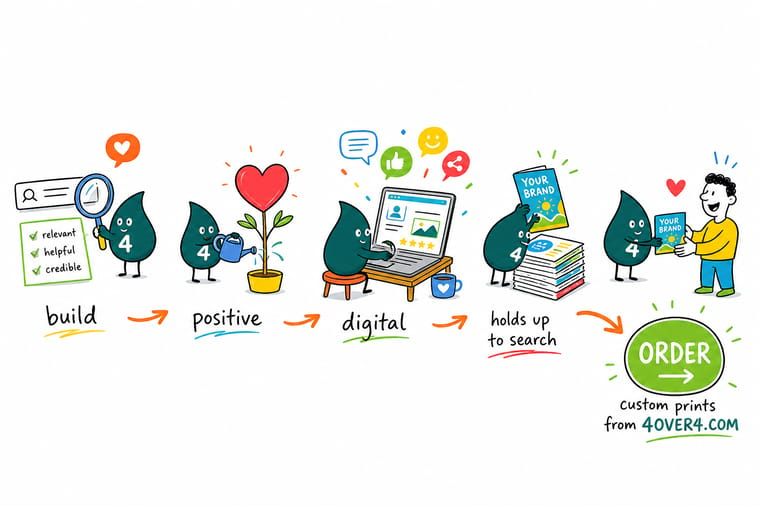
Wally searches his own name in a private window and writes down the first ten results. Three he can log into and fix before lunch. Two are reviews, so he asks customers and replies to every one. The last one is a forum thread with no delete button, so he stops trying to erase it and publishes until it drops below the fold. Then he puts the same handle on his cards and his stickers, because nobody types a URL from memory.
Print cards that carry your handle →Specs and pricing
The print pieces that carry your handle, with live prices
Cards for the handover, postcards for the follow up, stickers for the box and the laptop lid. Sizes, stocks and starting prices straight from the 4OVER4.COM configurator.



Print it
Close the loop between the handshake and the profile


Explore more
Where to go next





By the numbers
The print half of your presence, handled at 4OVER4
Common Questions
Your digital presence questions, answered
What does a positive digital presence actually mean?
It means that when someone searches your name, the first screen of results is accurate, current, and controlled by you. Concretely: a working site with a real about page, a claimed Google Business Profile with photos from this year, one active social handle, a review rating you are not embarrassed by, and no abandoned profile from a business you closed. It is not about volume. A consultant with four well kept properties looks stronger than one with fourteen half filled ones.
How long does it take to change what shows up for my name?
Owned properties move quickly. A rewritten homepage title or a corrected Google Business Profile can be re-crawled within days. Reviews shift as fast as you collect them. Pushing an unwanted third party result off the visible part of page one is the slow part, because you are waiting for new pages to earn enough authority to outrank an established one, and that is a matter of months rather than days. Plan the fast wins first so you have something to point at while the slow work runs.
Can I get a negative page removed from search?
Rarely. Search engines index what publishers put up, so removal normally has to come from the publisher, and most have no reason to agree. There are narrow exceptions, such as content that is defamatory, that exposes personal data, or that violates the host platform's own rules, and those are worth pursuing through the platform's reporting route. For everything else the practical answer is to publish and strengthen owned pages until the unwanted result drops down the page.
Should I reply to a bad review in public?
Yes, once, briefly, and without arguing the facts. A short reply that acknowledges the problem, states what you changed, and offers a direct contact reads well to the hundred people who will see it later, which is who the reply is really for. Litigating details in public makes the thread longer and pushes it up the page. If the reviewer is wrong, say so plainly in one sentence and move the rest to email or a phone call.
Do printed materials matter when the goal is a digital presence?
They matter as the bridge between an offline moment and an online action. Nobody types a URL from memory after a conversation, but they will scan a code on a card or a sticker while it is in their hand. That is why a handle and a scannable link belong on the pieces you hand over. Standard business cards start at $17.57 at 4OVER4.COM, which makes the print half of the loop the cheapest part of the whole exercise.
How often should I audit what search says about me?
Once a quarter is enough for most businesses, and after any change that produces a paper trail: a move, a rename, a lawsuit, a leadership change, a product recall. Do it in a private window on a device you are not signed in on, because your own signed-in results are personalised and flatter you. Keep the screenshot. Comparing this quarter's first page against last quarter's is the only honest measure of whether the work is landing.
Get Started
100 business cards cost $17.57, with the handle on them
Cards for the meeting, postcards for the follow up, stickers for the box. Print the offline half of your presence so the online half gets found.
Legal Disclaimer
Gold Standard guarantees apply to all standard orders placed through 4over4.com. Price match requires verifiable proof of a competitor's published price for an equivalent product with matching specifications and turnaround time. Satisfaction guarantee covers manufacturing defects and print quality issues. Contact support with order number and documentation. On-time delivery rate based on tracked orders 1999 to 2026. Individual results may vary based on shipping carrier performance.
