
What Is a Letterhead and Why Does It Matter?


A letterhead is your branded business paper: your logo, company name, and contact details sitting at the top of every letter you send. Here is what belongs on it, the paper that feels right, and how to set up a print-ready file.
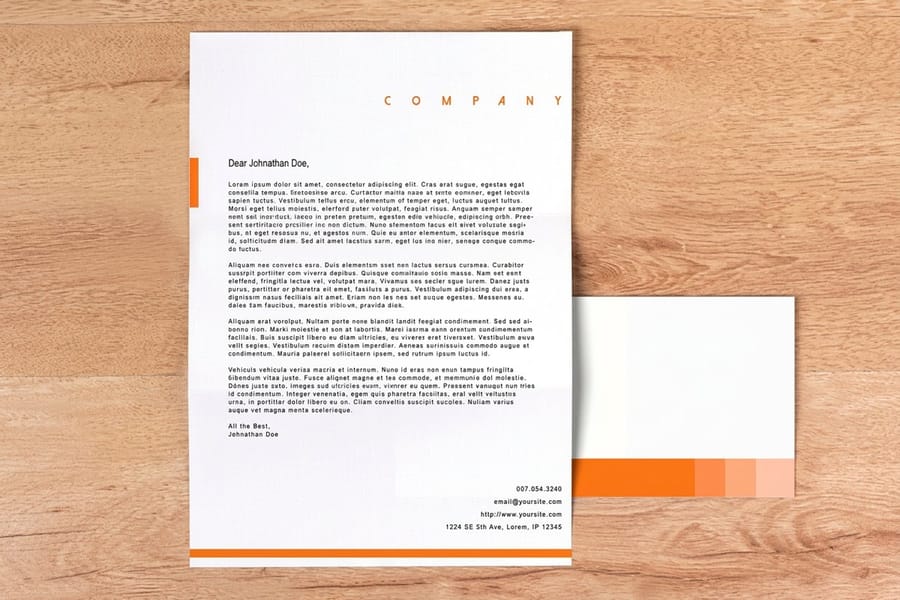
A letterhead is a pre-printed sheet that carries your logo, company name, and contact details at the top of the page. Businesses use it for letters, invoices, contracts, and memos so every piece of correspondence reinforces the brand and reads as professional. Keep the header to the top two to three inches, hold to two or three colors, and match it to your cards and envelopes for one consistent look.
Quick answer
Letterhead in plain terms
A letterhead is a pre-printed sheet with your logo, company name, and contact details across the top. Keep that header to the top two to three inches of an 8.5 by 11 inch page, design in CMYK at 300 DPI, hold to two or three brand colors, and pick an uncoated 24 to 28 lb stock so it runs cleanly through office printers. Match it to your business cards and envelopes and every letter you send reinforces one professional brand.
Watch it printed
See standard letterheads on the press, in 142 seconds
Why letterhead still matters in a digital world
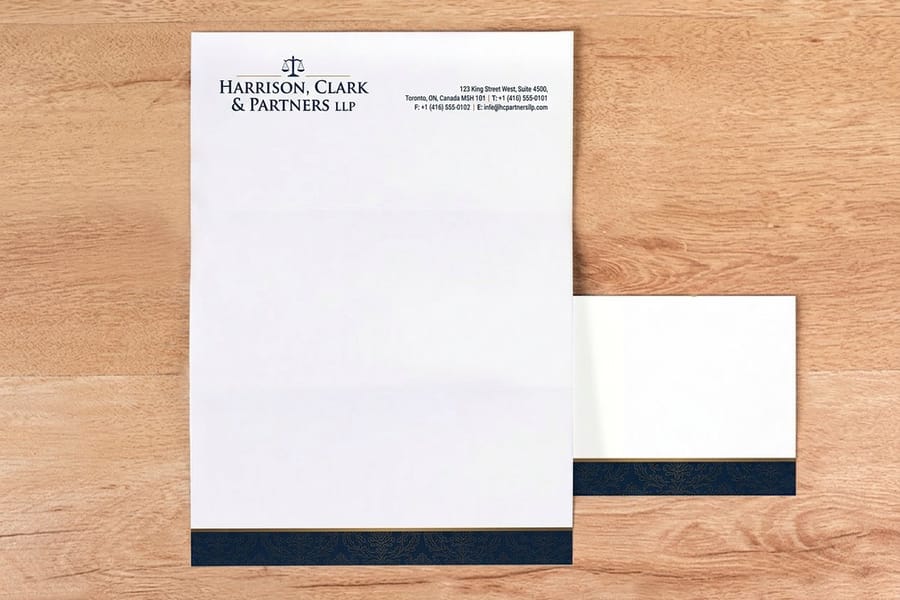
So what is a letterhead, exactly? It is a printed or digital sheet that carries your brand identity across the top of the page: your logo, company name, address, phone number, and sometimes a tagline. When someone receives a physical letter on custom letterhead, it reads as legitimate. It says you are established. It says you are real.
Letterhead never works alone. It sits next to your business cards, brochures, and marketing collateral to build one cohesive identity. If you are mapping out the rest of your print essentials, our guide on what is a brochure covers another key piece of the puzzle, and spot color printing explains how to lock in your brand's exact hues across every sheet.
You do not have to start from a blank page either. 4OVER4.COM offers ready-to-customize design templates that get you to a finished layout fast, and our letterheads print on stocks built for everyday business correspondence.
Breaking down every part of a professional letterhead
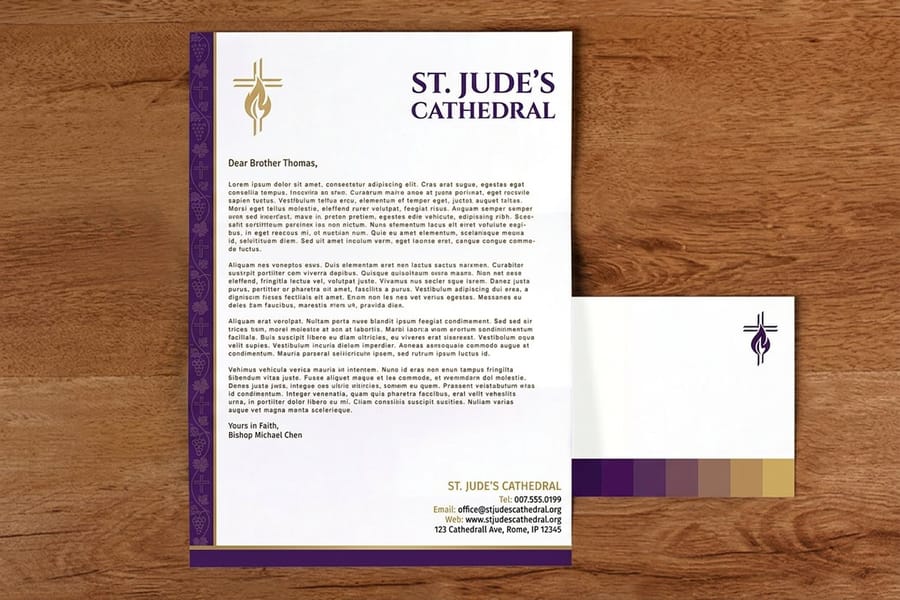
A letterhead is not just a logo dropped onto paper. It is a carefully designed header that usually takes up the top two to three inches of an 8.5 by 11 inch sheet. The best ones balance branding with function, so they look sharp while leaving plenty of room for the actual letter below.
Your company logo is the anchor, and it usually sits in the top-left or top-center. Keep it high resolution, at least 300 DPI for print, so it reproduces cleanly with no pixelation. Set your company name in a clear, readable typeface right below or beside it. Even when the logo already contains the name, spelling it out in text keeps it legible on faxes, scans, and photocopies.
Next comes your contact information: street address, phone, email, and website. Some businesses add a fax number or social handles depending on the industry. Keep it organized rather than crammed onto one line. Optional extras like a tagline, registration numbers, or legal disclaimers matter too, and law firms and financial companies often build licensing details into the design from the start.
The anatomy of a letterhead, labeled
Read from the top edge down, a letterhead is four labeled zones on one 8.5 by 11 inch sheet. Measure them once and the design stops fighting the letter that has to sit on it.
- 1. Logo zone, top 0.5 to 1.5 inches. The logo anchors the sheet, left or centered, placed at least 0.25 inch inside the trim so nothing is shaved off. Supply it at 300 DPI, or as vector art, and it stays crisp at any size.
- 2. Contact block, roughly 1.5 to 3 inches down. Company name in text, street address, phone, email, website, plus a fax number, social handles, registration numbers or licensing lines if your industry expects them. Stack it in two or three short lines, or run it as a single band across the width. This block and the logo together are the two to three inches of header everything else is built around.
- 3. Body area, about seven inches of clear paper. This is the part people actually write in, so leave it empty. Keep any watermark or tint light enough that black 11 or 12 point text still reads over it, and keep side margins near 1 inch so a laser printer never clips a line.
- 4. Footer rule, bottom 0.5 to 0.75 inch. A thin rule, a tagline, or a second address line closes the page. Pull it up 0.375 inch from the trim edge, and if it bleeds off the paper, extend the artwork 0.125 inch past the trim on that side.
Quick check before you send the file: print one page at 100 percent, run a real letter through your office printer on top of it, and see whether the text lands clear of both the header and the footer. If it collides, shrink the header rather than the type.
Choosing the right paper stock for letterhead
Paper choice makes or breaks the feel of a letterhead. A flimsy sheet undermines even the best design. Standard letterhead runs between 24 lb and 32 lb bond weight, and the heavier the stock, the more solid it feels in someone's hands.
Uncoated paper is the classic pick. It is easy to write on, feeds smoothly through laser and inkjet printers, and has a natural, professional texture. If your team prints letters in-house after the letterhead arrives, uncoated stock is the safe choice. Linen and laid textures add a tactile, premium quality, and running a finger across linen reveals a subtle crosshatch pattern that law offices and accounting firms love.
Cotton paper is another step up. It is durable, archival, and has a soft feel that wood-pulp sheets cannot match. When longevity matters, think contracts or official records, cotton is worth the investment.
Design principles for effective letterhead
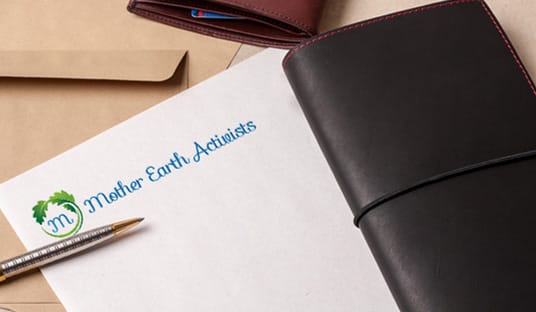
Keep the design clean. White space is not wasted space, it is breathing room, and the strongest letterheads use a few elements arranged with intention so the eye moves naturally from logo to company name to contact details.
Stick to two or three colors. Your primary brand color, one accent, and black for text is plenty. Anything more reads as clutter and pushes up printing costs. If your brand runs on specific Pantone colors, confirm your printer can match them exactly. Typography carries the same weight as color, so use your brand typeface for the company name and a complementary font for the fine print. Skip decorative or script fonts for small text, because they turn unreadable at 8 or 9 point sizes.
Margins need attention too. Leave at least half an inch on every side and keep the header compact enough that the body of the letter starts no lower than three inches from the top edge. People need room to write. If you are coordinating a whole set of branded pieces, our guide hub walks through print setup and finishing from end to end.
Letterhead vs stationery: what is the difference
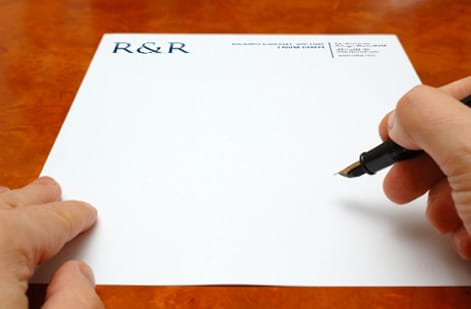
People swap these two words around, but they are not the same thing. Letterhead refers specifically to the branded paper used for correspondence. Stationery is the broader family, covering letterhead, envelopes, notecards, memo pads, and anything else you write on.
A full stationery suite usually pairs matching letterhead, envelopes, and business cards so every piece looks coordinated. The colors, fonts, and logo treatment carry across all three. If you are building out the envelope side of that set, our guide on how to make envelopes covers how to create pieces that match your letterhead exactly.
When and where to use letterhead
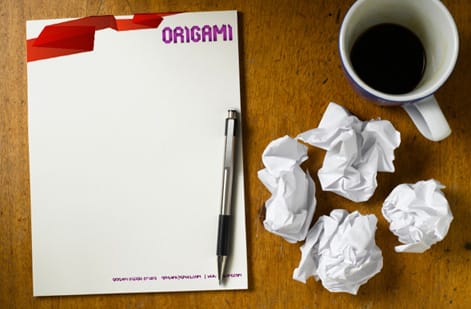
Letterhead earns its keep on the documents that need to feel official. Here is where it does the most work.
- Client proposals and contracts. Branded paper adds weight to a pitch and quietly signals stability.
- Invoices and billing statements. Clients can verify the sender at a glance, which cuts down on disputes.
- Internal memos and announcements. Policy changes and formal recognitions carry more authority than a casual email.
- Cover letters and HR correspondence. Offer letters, reference letters, and notices present a unified brand and protect you legally.
- Thank-you notes and follow-ups. A handwritten note on branded letterhead after a meeting stands out in a stack of mail far more than another email ever will.
The through-line is simple. Anytime a document represents your company in someone else's hands, letterhead makes it look considered. A useful rule for how many to order: count the outward-facing letters you send in a quarter, add the proposals and invoices, then round up, because printing 500 sheets in one run beats reordering 100 four times.
Once you know which of those documents you send most, our letterhead printing range shows the sizes and paper finishes side by side, and you can move straight to custom letterhead printing to set the stock, quantity and turnaround for your own file.
How to set up your letterhead file for printing
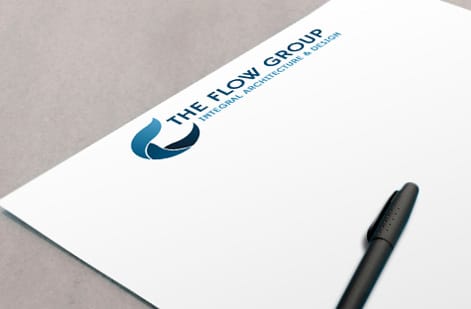
Getting the file right saves you from reprints. Start with the correct dimensions. Standard letterhead in the US is 8.5 by 11 inches. Add a 0.125 inch bleed on every side if your design runs to the edge of the paper, which prevents thin white borders after trimming.
Set your document to CMYK color mode at 300 DPI. RGB colors shift when they convert to print, so designing in CMYK from the start avoids surprises. Export the final artwork as a high-resolution PDF, flatten the layers, embed the fonts, and convert text to outlines if your printer asks for it. That one step eliminates the font substitution errors that quietly wreck a layout.
The same setup habits apply to the rest of your collateral. Our guide on how to make flyers walks through nearly identical file prep, so the skills carry straight over.
Here are the three sizes we set up most often, with the numbers to build the document around:
| Size | Dimensions | Safe margin | Bleed | Recommended stock |
|---|---|---|---|---|
| US Letter | 8.5 by 11 inches | 0.25 inch | 0.125 inch | 24 lb to 32 lb bond, uncoated |
| A4 | 210 by 297 mm, or 8.27 by 11.69 inches | 6 mm | 3 mm | 24 lb to 32 lb bond, uncoated or linen |
| Legal | 8.5 by 14 inches | 0.25 inch | 0.125 inch | 28 lb to 32 lb bond, uncoated |
Two notes on that table. The safe margin is where logos, text and rules must stop, not where the paper ends, so a header sitting 0.1 inch from the trim will look off-center after cutting even when the cut is perfect. And you only need the bleed when ink runs off the edge, which on letterhead is usually a color band behind the header or the footer rule. If your design floats inside white paper, build the file at flat size with no bleed and keep everything inside the safe margin.
Digital letterhead: the modern companion
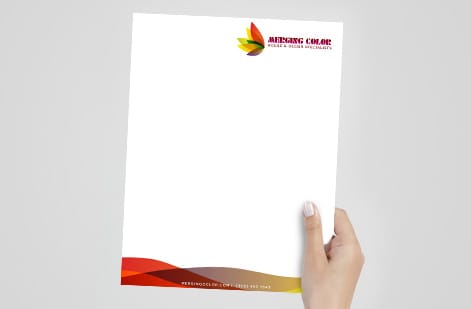
Physical paper is not the only option anymore. Plenty of businesses build a digital letterhead template for emails, PDF attachments, and electronic documents. The design stays identical, you just save it as a reusable template in Word, Google Docs, or whatever you write in.
Digital letterhead should match the printed version down to the detail: same logo placement, same fonts, same colors. When a client gets a printed letter and then an email from you, the branding should feel like one voice. That consistency is what quietly builds trust over time.
One practical tip: keep the file size small. A 5 MB attachment caused by an oversized header graphic helps no one. Optimize images for screen at 72 to 150 DPI for digital use, and keep the print version at a full 300 DPI.
Pairing letterhead with other branded materials
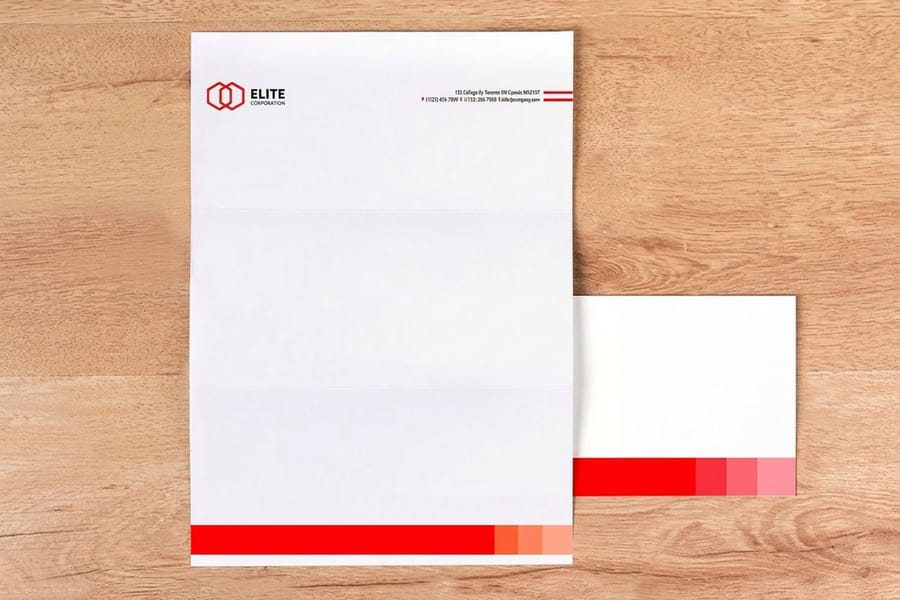
Letterhead does not live in isolation. It is one piece of a larger brand system, and your business cards, brochures, and promotional items should all share the same visual DNA of colors, fonts, and logo treatment. Every piece that repeats those cues makes the brand more recognizable.
Think about how each item connects. A branded magnet on a client's fridge reinforces the same identity they see on your letterhead, and our custom magnets guide has ideas for extending your brand into unexpected places. Rubber stamps are another underrated companion for return addresses or received marks, and our guide on how to clean rubber stamps keeps them printing sharp. Even a well-folded brochure tucked inside a letterhead envelope reads as a polished package, and you can learn the technique in our how to fold a brochure guide.
When you are ready to design, our free blank letterhead templates give you correctly sized files to drop your artwork into.
Letterhead mistakes that undermine your brand
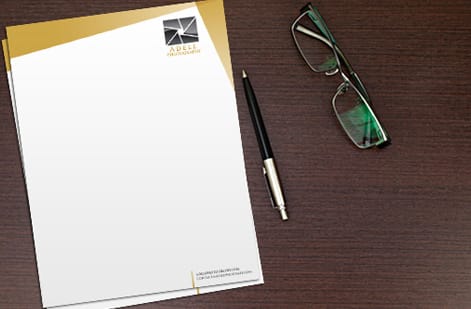
Even people who know their way around print make these letterhead mistakes. Avoid them and your brand looks tighter everywhere.
Overcrowding the header. Cramming a logo, tagline, three phone numbers, two addresses, and a row of social icons into a two-inch strip creates chaos. Edit ruthlessly and keep only what a reader actually needs.
Using low-resolution logos. That 72 DPI PNG pulled off your website will look fuzzy in print, so always use a vector file or a high-resolution raster at 300 DPI or better. Ignoring printer compatibility is just as costly, so if your team prints in-house, confirm the stock feeds through your office machine. Heavy coated sheets can jam a laser printer, while uncoated bond in the 24 to 28 lb range runs smoothly.
Forgetting the bleed leaves uneven white strips along the edges after trimming, so add that 0.125 inch bleed whenever color runs to the edge. And mismatched branding quietly undermines the whole effort, because letterhead colors that drift from your business cards and envelopes read as sloppy. Match them exactly and the details take care of themselves.
Wally explains letterhead
One clean header, and every letter you send looks established
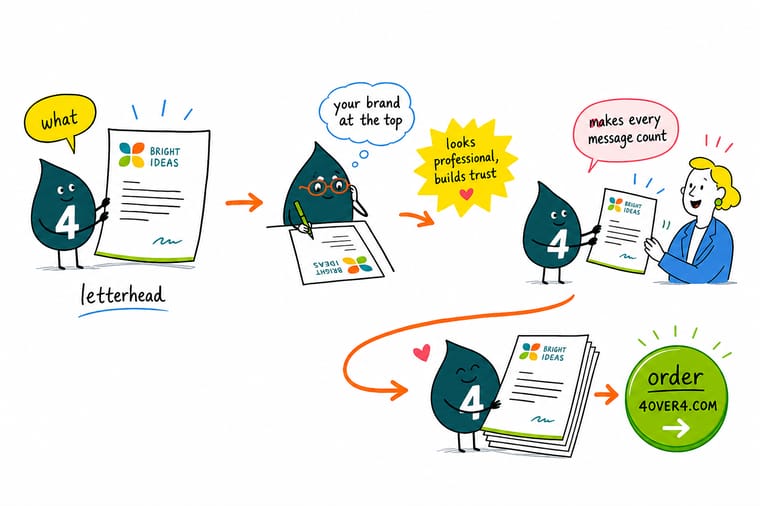
Wally treats a letterhead like a handshake on paper: the logo, name, and contact details across the top tell a reader you are real before they read a single word. Keep the header to the top two to three inches, hold to two or three brand colors, and match it to your cards and envelopes so the whole set speaks in one voice. When you are ready to print, 4OVER4 sets your letterhead on stocks built for everyday business correspondence.
Order letterhead →Specs and pricing
Custom letterhead specs and pricing
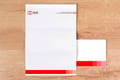
Here is what a fresh, made-to-order letterhead gives you at 4OVER4.COM, with live specs and price-per-unit straight from the configurator.
| Quantity | Price Per Unit | Total |
|---|---|---|
| 50 | $2.00 | $99.95 |
| 100 | $1.05 | $105.44 |
| 200 | 58.2¢ | $116.43 |
| 300 | 43.6¢ | $130.72 |
| 400 | 34.9¢ | $139.49 |
| 500 | 29.4¢ | $147.18 |
| 600 | 25.4¢ | $152.68 |
| 700 | 22.6¢ | $158.17 |
Print it
Order letterhead and matching print at 4OVER4
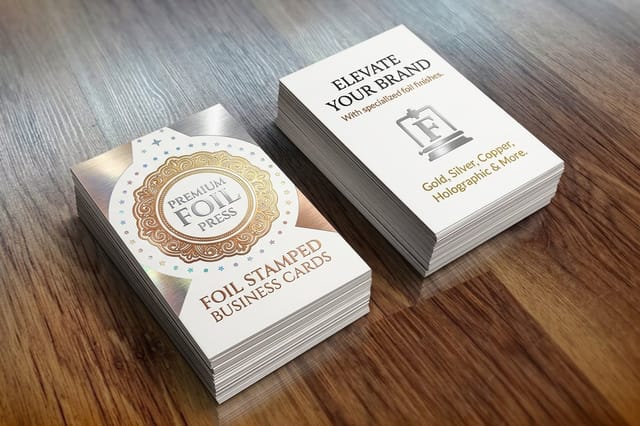
Now that you know what a letterhead is and how to design one, pick the product that fits. 4OVER4.COM prints letterheads on multiple stocks with full-color options, and they slot neatly into a wider set of marketing materials. New here? Start with a set of free business cards to test the print quality before a larger order.
See it in use
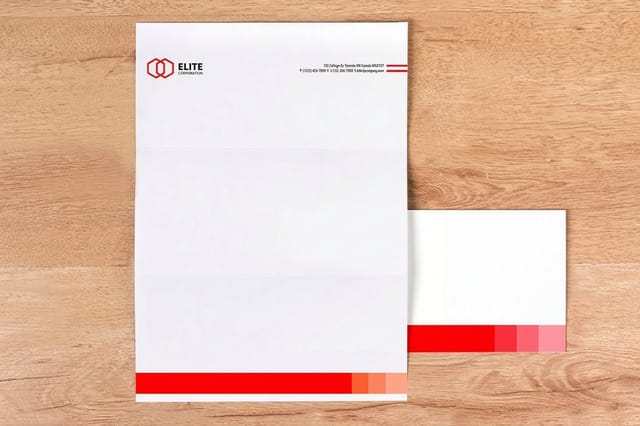
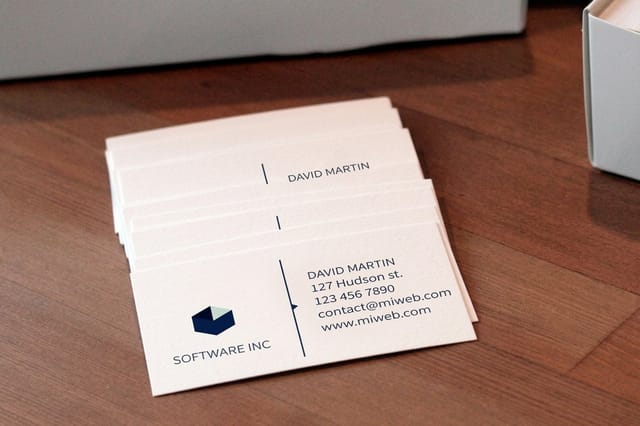
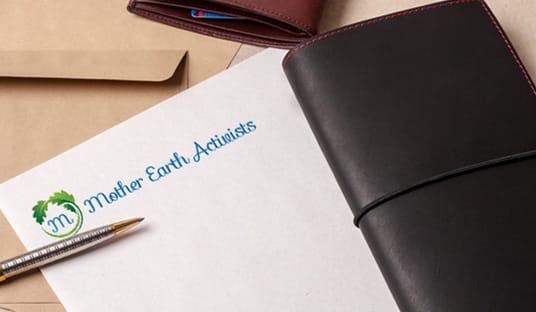
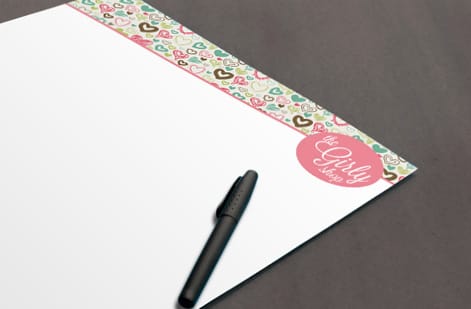
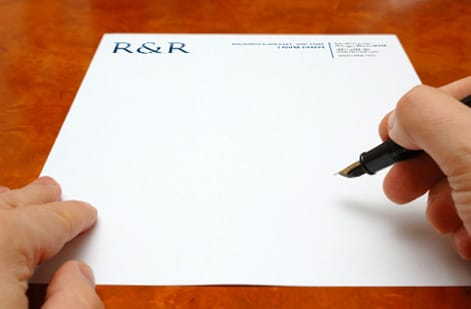
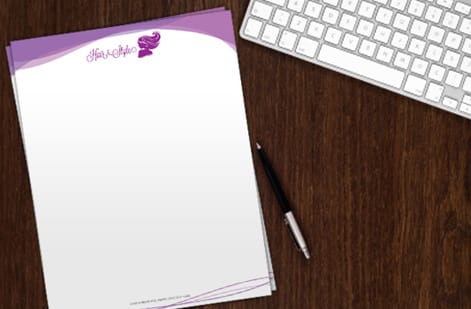
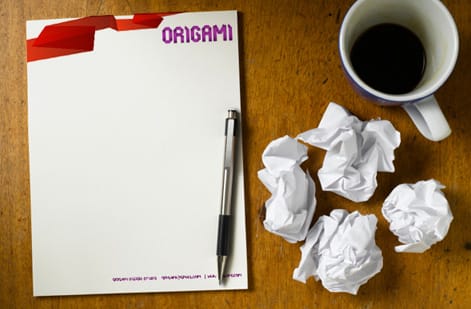
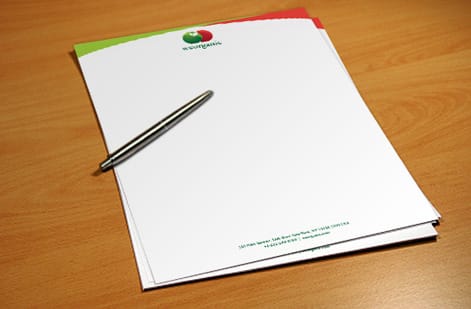
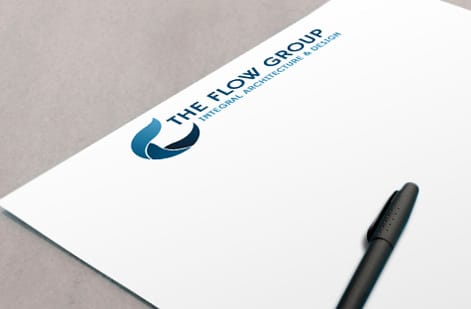
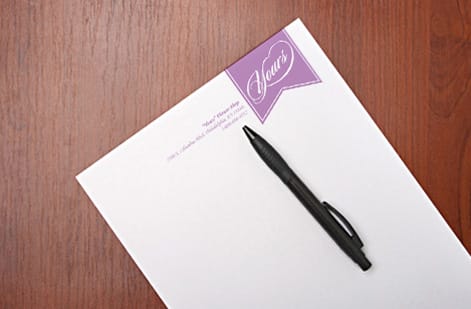
Letterheads we printed for working businesses
Explore more
Where to go next

By the numbers
Trusted print for your whole brand kit at 4OVER4
Common Questions
Your letterhead questions, answered
What is an example of a letterhead?
Picture a law firm letter. Across the top two inches sit the firm's logo at the left, the firm name set in the brand typeface beside it, and one line of contact details underneath: street address, phone, email and website. A thin rule separates that header from the body, the letter itself runs on plain white paper below it, and a footer rule at the bottom carries a second office address or a bar registration line. That printed frame, with the letter text left out, is the letterhead.
How do I make a letterhead?
Start a document at 8.5 by 11 inches and reserve the top two to three inches for the header. Place your logo at 300 DPI or as vector art in the top left or top center, set the company name in text beside or below it, then add the contact block in two or three short lines. Keep the rest of the page clear for the letter, hold the design to two or three colors, and export a CMYK PDF with the fonts embedded. If you would rather not start from a blank page, 4OVER4 letterheads print from a ready file and start at $99.95.
What is a letterhead on a document?
It is the pre-printed heading at the top of the sheet that identifies who sent the document, usually a logo, the company name and the contact details, sometimes with a footer rule along the bottom. The letterhead is fixed and repeats on every page you print, while the letter, invoice or memo changes underneath it. On a digital document the same header is saved once in a Word or Google Docs template so every file you send carries it.
What is a letterhead used for in business?
A letterhead is used for official business correspondence like proposals, invoices, contracts, HR documents, and client letters. It carries your logo, company name, and contact details so every piece of mail reinforces your brand and looks professional.
What size is standard letterhead?
In the United States, standard letterhead is 8.5 by 11 inches, known as letter size. In countries on international paper standards, A4 at 8.27 by 11.69 inches is the norm. Confirm the size with your printer before you start designing.
Can I print on letterhead with a regular office printer?
Yes. Choose an uncoated stock in the 24 to 28 lb bond range for the best results on standard laser and inkjet printers. Heavier or coated sheets can jam, so run a few test sheets before a full batch.
What is the difference between letterhead and a letter template?
Letterhead is the physical or digital pre-printed paper with your branding. A letter template is the document layout, covering where the date sits, the salutation style, paragraph spacing, and the closing. You use a letter template on top of your letterhead.
How many colors should a letterhead have?
Stick to two or three colors. Your primary brand color, one accent, and black for body text works best. Too many colors create visual noise and raise printing costs. If you want a hand with your design, the help center is a good place to start.
Should my letterhead match my business cards and envelopes?
Absolutely. Consistent branding across every printed piece builds trust and recognition. Use the same logo, colors, and fonts on your letterhead, business cards, and envelopes, because even small mismatches make a brand look disorganized.
What file format should I use when ordering letterhead?
Submit a high-resolution PDF in CMYK color mode at 300 DPI. Include a 0.125 inch bleed on all sides if your design runs to the edge, and embed all fonts or convert text to outlines to prevent substitution errors during printing.
What is a letterhead used for?
A letterhead is the sheet you use whenever a document has to represent the company in someone else's hands: client proposals and contracts, invoices and billing statements, internal memos and announcements, cover letters and HR correspondence such as offer letters and reference letters, and thank-you notes after a meeting. The pre-printed header identifies the sender at a glance, which cuts down on billing disputes, and it gives formal letters the weight an email never has. Day-to-day printouts and drafts do not need it, so most offices order letterhead for the outward-facing documents and keep plain stock for the rest.
What is the difference between letterhead and letterhead paper?
Letterhead is the design: your logo, company name and contact information printed into the top two to three inches of the sheet, sometimes with a footer rule at the bottom. Letterhead paper is the blank stock that design gets printed on, the 24 lb to 32 lb bond in uncoated, linen, laid or cotton. People use the two words for the same thing in conversation, but they are separate decisions: you approve the artwork once, then choose the paper it lives on, and the same design will feel completely different on smooth uncoated stock than on a linen finish. When you order custom letterhead printing you are choosing both at the same time.
What weight paper should letterhead be printed on?
Between 24 lb and 32 lb bond. Pick 24 lb when volume is high and the sheets get folded into envelopes by the hundred, since it is the friendliest weight for office laser and inkjet feeders. Move to 28 lb or 32 lb for proposals, contracts and anything a client will hold, because the heavier sheet feels solid and shows almost no show-through from ink on the reverse. Anything lighter than 24 lb reads as copier paper and undercuts the design. If the letter has to survive in a file for years, step across to cotton stock at the same weight range for the archival durability and the softer feel.
Get Started
Ready to order custom letterhead?
Pick your paper, drop in your logo and details, and we print a crisp, professional letterhead that makes every letter look established.
Legal Disclaimer
Gold Standard guarantees apply to all standard orders placed through 4over4.com. Price match requires verifiable proof of a competitor's published price for an equivalent product with matching specifications and turnaround time. Satisfaction guarantee covers manufacturing defects and print quality issues. Contact support with order number and documentation. On-time delivery rate based on tracked orders 1999 to 2026. Individual results may vary based on shipping carrier performance.
