
Direct Mail ROI Statistics & Benchmarks


Real benchmarks, tracking methods, and a plain calculator formula, set against the order data behind 25 plus years of printing direct mail at 4OVER4.
Direct mail ROI averages about $4.09 for every $1 spent, and the strongest verticals return far more. ROI on direct mail is simple math: revenue minus cost, divided by cost, times 100. Response rate, conversion rate, and average order value move the number, and print quality quietly shapes all three. With 150,000 plus businesses printing with 4OVER4.COM and 10 billion plus cards produced, the order data backs up the benchmarks.

Key figures
What direct mail ROI actually looks like in real numbers
Direct mail ROI stays one of the strongest performance metrics in offline marketing. For every dollar spent, businesses consistently see returns that outpace many digital channels, and understanding how to measure ROI of direct mail starts with tracking response rates, conversion rates, and average order values against total campaign cost. 4OVER4.COM has helped 150,000 plus businesses produce mail pieces that drive real, trackable revenue, with 10,000 plus reviews backing the print quality behind those returns. Join our Loyalty Program to reduce your per-piece costs and push those margins even higher.
By the numbers
The ROI figures a mail budget is built on
Here are the headline figures marketers reach for first when they forecast a mailing, drawn from industry benchmarks and our own production data. Returns cluster around $4 for every $1 spent and climb well past that in high-value verticals. Set those benchmarks against 25 plus years of printing direct mail at 4OVER4.COM and the pattern is consistent: the pieces people can hold get acted on.

The full breakdown
Breaking down direct mail ROI by channel, format, and strategy
Direct mail ROI is the ratio of revenue generated from a mail campaign to the total cost of producing and sending it. The strategy is knowing which levers to pull, format, audience, timing, and print quality, to push that number higher. For the wider picture, start with our direct mail statistics hub, dig into direct mail effectiveness, and place it all against print marketing statistics for context.
Response rates are the foundation of direct mail ROI
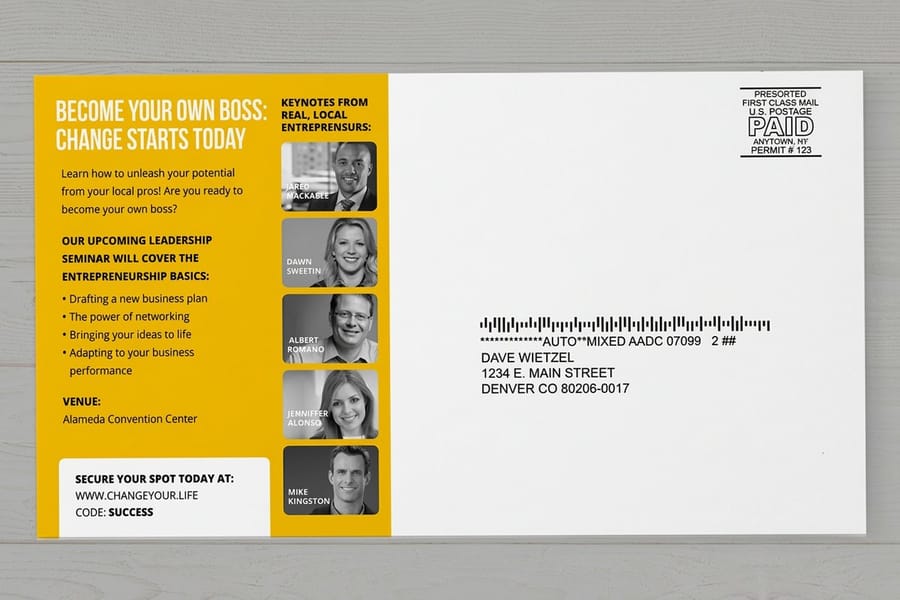
Response rate is where every direct mail ROI calculation starts. A higher response rate means more people visiting your URL, scanning your QR code, calling your number, or walking into your store, and industry data shows direct mail response rates consistently outpace digital channels. Check the average direct mail response rate benchmarks for current numbers across formats.
Format matters just as much. Oversized postcards grab attention faster than standard envelopes, and personalized letters with variable data printing push response higher still. What kills a response is generic messaging, weak targeting, and cheap-looking print. A flimsy postcard on thin stock reads as junk mail before the headline lands, which is exactly where print quality starts to move your return.
How to measure ROI of direct mail with precision
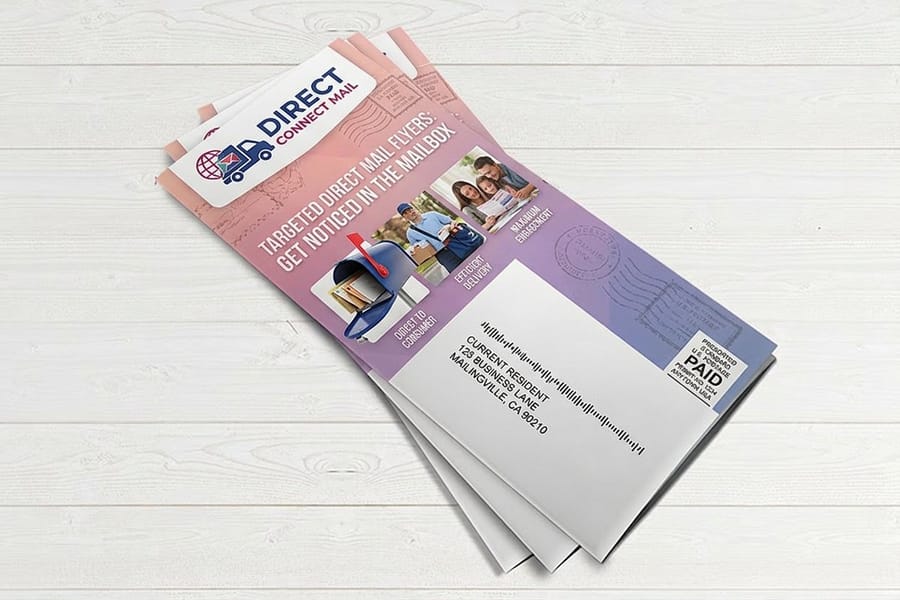
Tracking direct mail is not guesswork anymore. Modern campaigns connect a mail piece to a sale with unique URLs and landing pages, QR codes, promo codes, dedicated call-tracking numbers, and matchback analysis against your customer file. The best campaigns stack two or three of these methods together.
A postcard carrying a QR code, a unique promo code, and a dedicated landing page gives you three data points per recipient. That is how you build a reliable direct mail ROI calculator for your own business, and how you turn a rough estimate into a hard, batch-level number you can defend to a finance team.
Direct mail versus digital, where the ROI comparison gets interesting
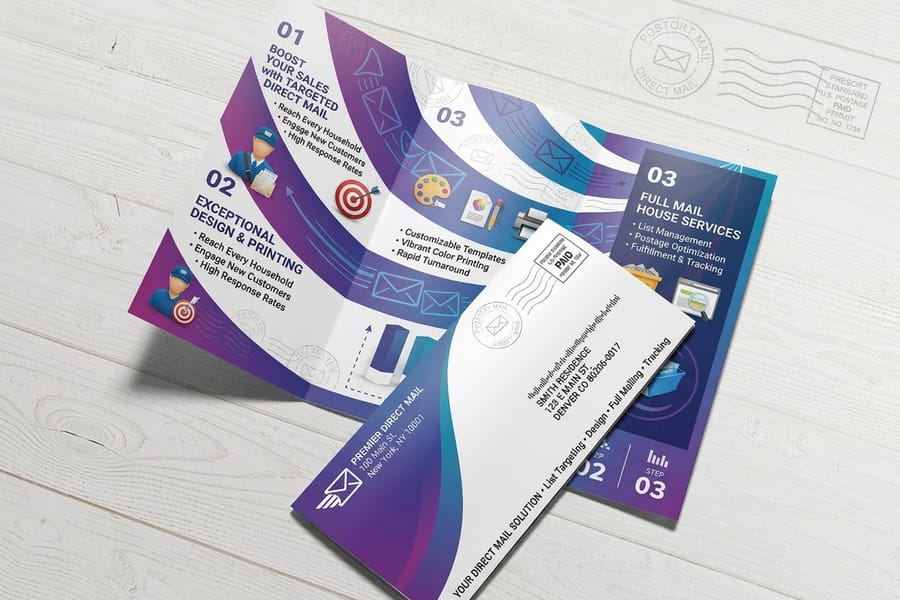
The direct mail vs email debate is not about picking one over the other. Email is cheap to send but drowns in inbox clutter, while direct mail costs more per touch and commands attention. A prospect who receives a well-designed postcard on thick, textured stock has a physical reminder sitting on the kitchen counter for days, while an email is buried under dozens of other messages within hours.
The cost per acquisition for direct mail runs higher than email, but the lifetime value of customers acquired through mail tends to be higher too. They spend more per order and come back more often. Once you factor in customer lifetime value, the ROI on direct mail often surpasses digital-only campaigns.
Direct mail ROI benchmarks for 2026
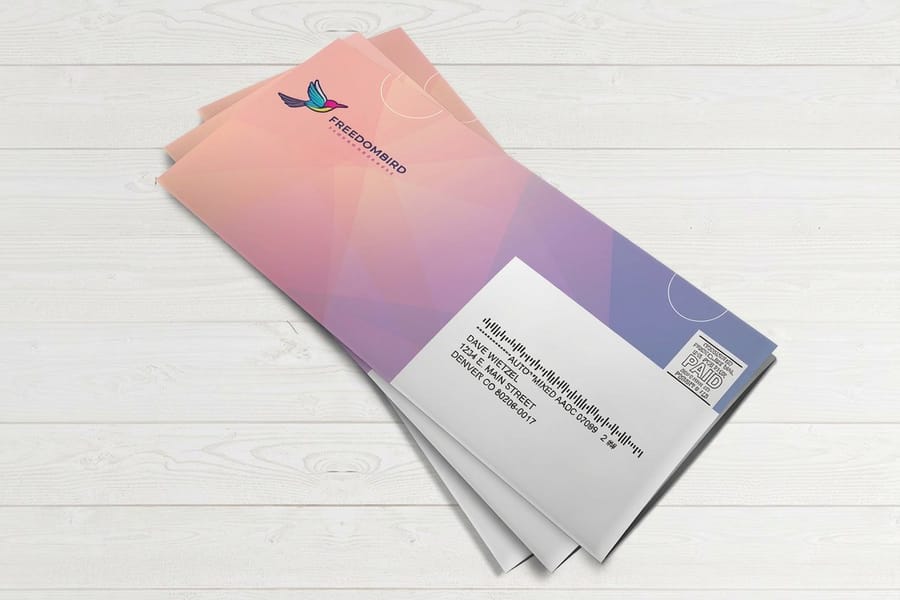
Direct mail ROI benchmarks reflect a market where postage costs have risen but targeting technology has improved. Variable data printing personalizes every piece, name, offer, and imagery, without slowing production. Better targeting means less waste, and less waste means higher ROI.
Industry-wide, marketers report average returns ranging from about $4 to $12 for every $1 spent, depending on the vertical. Financial services and insurance tend to see the highest returns, with retail and e-commerce close behind. Nonprofits often reach strong ROI through donation campaigns that pair emotional storytelling with tangible print quality. Your specific benchmark depends on list quality, offer strength, and mail piece design.
How print quality moves your campaign returns
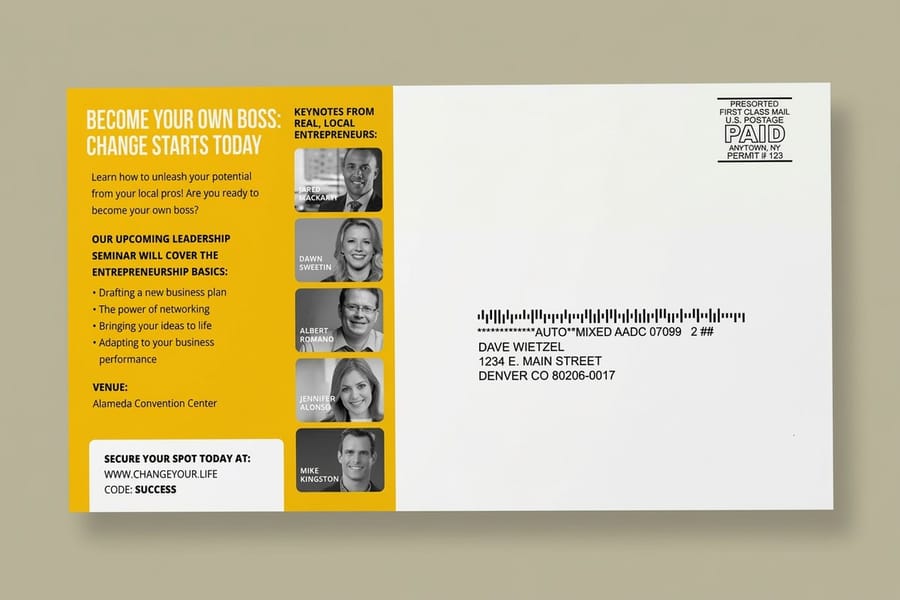
Most ROI discussions skip the physical quality of the mail piece, yet it decides whether people engage at all. A postcard printed on 16pt card stock with a matte finish feels different in the hand than a thin, glossy flier, and that tactile experience creates a subconscious quality signal.
Picture the recipient flipping through the stack at the mailbox. The pieces that feel solid get a second look. The flimsy ones go straight to recycling. Your direct mail ROI starts at the mailbox, not on the landing page, which is why 4OVER4.COM offers 60 plus paper types so the right stock for your audience makes a measurable difference.
Proof, not promises
What our mailing runs cost and how fast they print
Here are the quality and delivery signals from our side of the press, the numbers that round out the ROI picture for marketers planning campaigns in 2026 and beyond. A 99.8 percent on-time delivery rate keeps your mailing schedule on track, and 60 plus paper types let you match stock to the return you are chasing.
Run the numbers
How to calculate your own direct mail ROI
Building a direct mail ROI calculator for your campaigns does not require fancy software. Start with a handful of numbers and the math does the rest.
The formula is simple: total revenue from the campaign minus total campaign cost, divided by total campaign cost, times 100. A campaign that costs $5,000 and generates $25,000 in sales delivers a 400 percent ROI. Build your own calculator from five inputs:
- Total campaign cost. Printing, postage, list rental or purchase, design, and any fulfillment fees.
- Pieces mailed. Your total send volume for the drop.
- Response rate. The share of recipients who take a trackable action.
- Conversion rate. The share of responders who become paying customers.
- Average order value. What each converted customer spends.
Multiply pieces mailed by response rate, then by conversion rate, then by average order value for total revenue. Subtract campaign cost, divide by campaign cost, and multiply by 100. For deeper direct mail data points and industry averages, explore the statistics hub.
Push it higher
Strategies that push direct mail ROI higher
The gap between a 200 percent ROI and an 800 percent ROI is set by a handful of decisions made before anything goes to print.
- List segmentation. Mail your best prospects, not everyone. A smaller, targeted list almost always beats a massive generic one.
- A strong offer. Give people a clear, specific reason to respond now. Urgency beats vague brand awareness.
- Multi-touch sequencing. One mailer is a nudge, three over six weeks is a strategy. Repetition builds recognition and trust.
- Premium print quality. The physical feel of the piece affects engagement, so invest in stock and finish.
- A clear call to action. One action, prominently displayed. Do not make recipients guess what to do next.
For businesses running frequent campaigns, same day printing paired with bulk pricing tiers drops your cost per piece, pushing ROI on direct mail higher with every send. To make a mailer impossible to ignore, formats like 3D postcards add a visual wow factor that lifts response above standard flat mail.
Side by side
Direct mail ROI compared across marketing channels
Understanding direct mail ROI in isolation only tells part of the story. Marketers need to see how it stacks up against other channels to make smart budget decisions. The comparison is not always apples to apples, but the relative performance data helps you allocate spend where it counts.
| Channel | Cost per touch | Typical return | Attention and recall | Trackable |
|---|---|---|---|---|
| Direct mail | Higher per piece | Around $4 to $12 per $1 | Highest, physical recall | Yes, codes and QR |
| Very low per send | Strong but inbox-limited | Lower, easy to ignore | Yes | |
| Paid social | Low per impression | Variable, short attention | Lower, scrolled past | Yes |
| Display ads | Low per impression | Lowest, banner blindness | Lowest recall | Yes |
Direct mail keeps a longer shelf life than digital. Recipients hold physical mail for an average of more than two weeks, which means conversions trickle in over weeks rather than hours. Your attribution window needs to account for that, so a 30-day lookback is standard for direct mail against roughly 7 days for most email campaigns.
4OVER4.COM's 99.8 percent on-time delivery rate makes sure your campaign hits mailboxes on schedule, which matters when you are coordinating multi-channel efforts with specific timing windows. The medium is part of the message, and quality print on premium stock earns the returns cheap alternatives miss.
Wally turns the ROI math into your next mailing
The formula is step one. The piece is step two.
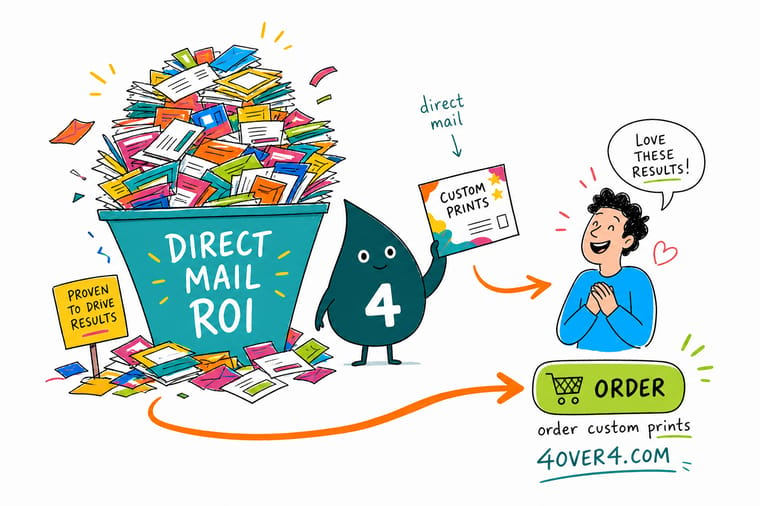
ROI on mail is arithmetic: cost per piece going out, revenue per response coming back. Wally's rule is simple. Track every dollar, print heavy on the stock that signals quality, and let response rate do the rest. Direct Mail Postcards start at 500 for $89.68 on 14pt or 16pt cover and print in 4 business days, which is where most of these models begin.
Order postcards →Myths vs facts
Four ROI assumptions the mailing data corrects
A few myths keep marketers from running mail that would pay off. The pairs below set each common assumption against what the direct mail ROI data actually shows, so you can plan your next campaign on evidence rather than habit.
Direct mail ROI cannot be measured the way digital can.
Track response rate, cost per acquisition, and revenue, then add QR codes or unique promo codes per batch for hard, batch-level numbers.
Email always wins on ROI because it is cheaper to send.
Email is cheaper per send, but direct mail earns more revenue per piece and higher customer lifetime value, so the return per dollar often comes out ahead.
A bigger mailing list always means a bigger return.
A smaller, well-segmented list of your best prospects almost always beats a massive generic one on cost per acquisition and overall ROI.
Print quality has nothing to do with ROI.
Heavier stock and premium finishes lift engagement before the offer is read, so the piece that feels solid gets kept and acted on.
Stock, finishing and price
What a postcard costs per piece as the run grows
For businesses ready to act on these numbers, here is current pricing for Postcards, the direct mail format with the highest response per dollar, alongside the full specifications so you can match the right stock and finish to your ROI goal.
| Quantity | Price Per Unit | Total |
|---|---|---|
| 50 | 33.0¢ | $16.48 |
| 100 | 24.2¢ | $24.16 |
| 200 | 15.9¢ | $31.86 |
| 300 | 12.8¢ | $38.45 |
| 400 | 11.3¢ | $45.04 |
| 500 | 10.3¢ | $51.62 |
| 600 | 9.89¢ | $59.31 |
| 700 | 9.57¢ | $67.00 |

Start from a blank
Postcard and letter templates sized to trim
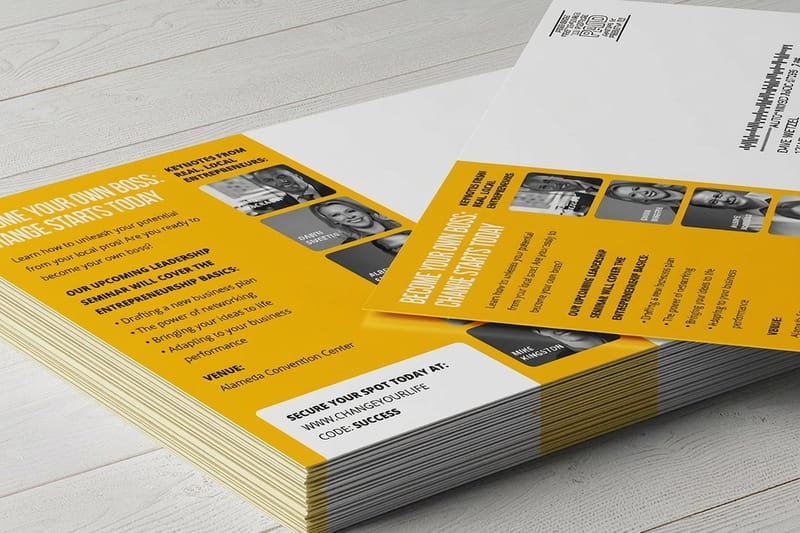
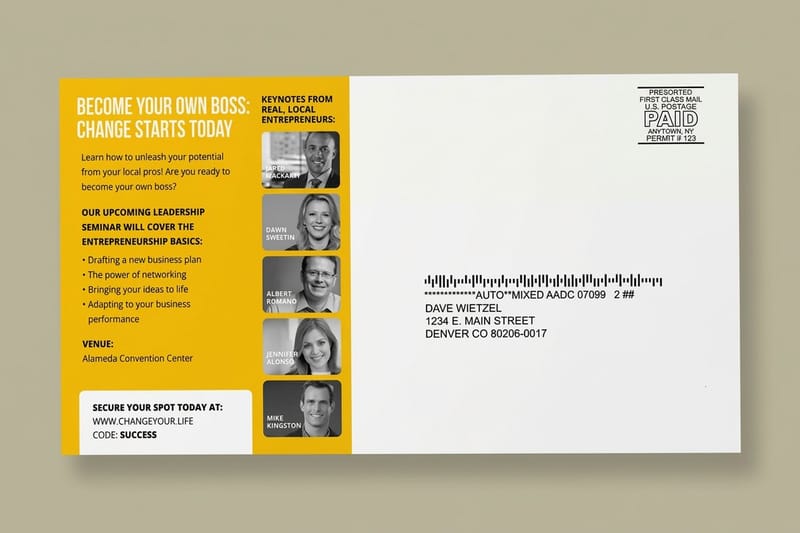
Starting from a proven layout saves design time and reduces errors. These blank templates come print-ready, with bleed and safe margins already built in.
Print it
The mail formats these ROI numbers were run on
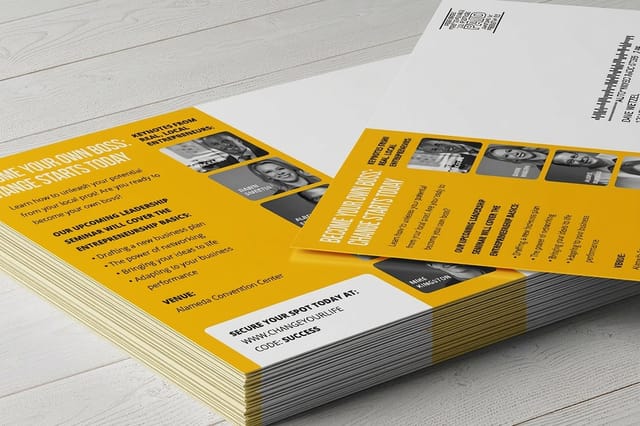
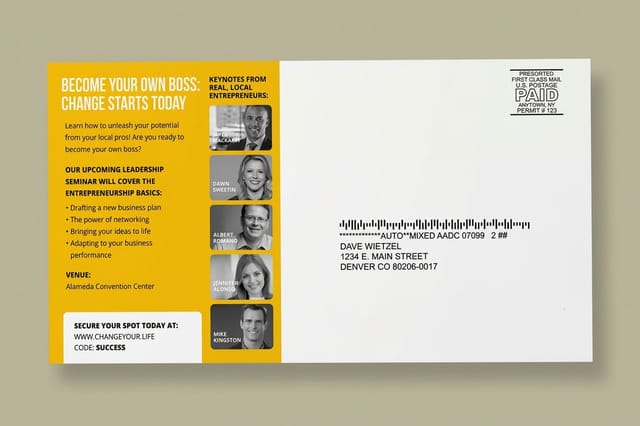
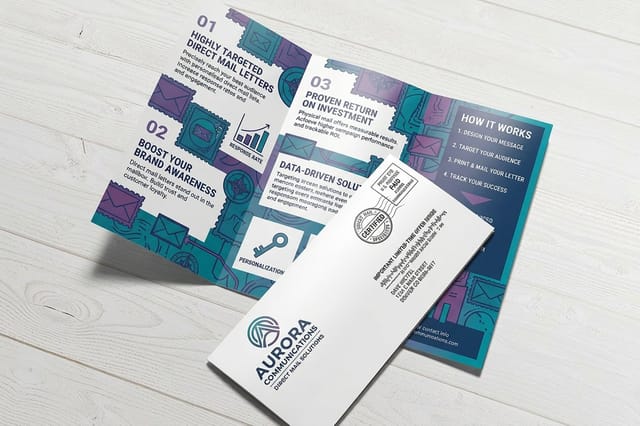
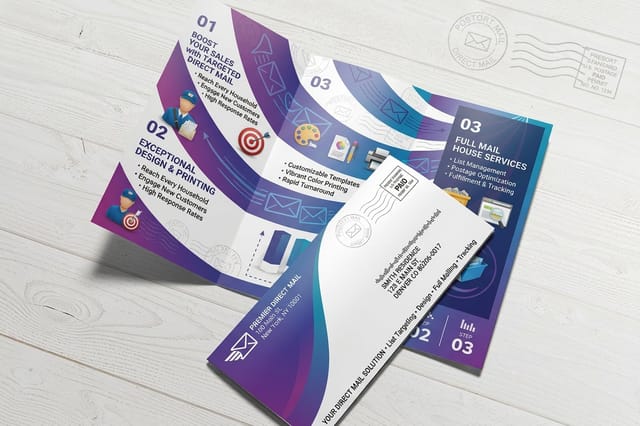
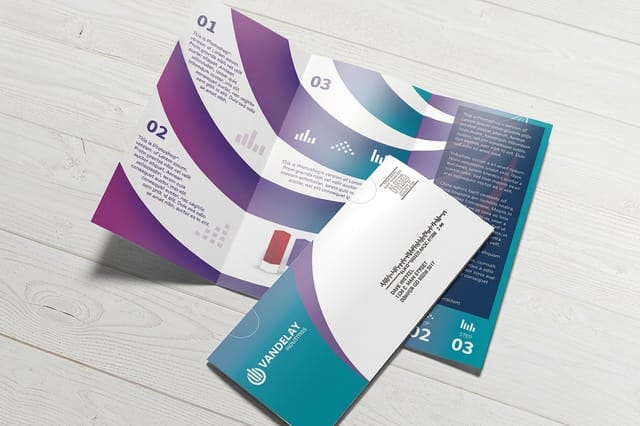
Knowing the direct mail ROI numbers is step one. Executing a campaign that actually hits those benchmarks is step two, and it starts with the right piece. Here are the products marketers reach for most when they put these numbers to work.

What our print data reveals
Patterns from 150,000 plus businesses printing direct mail
Direct mail ROI data from third-party sources is valuable, but 4OVER4.COM's own data, drawn from 150,000 plus businesses ordering print, adds another layer. Businesses that order on heavier stock, 16pt and above, tend to reorder more frequently, a strong signal that their campaigns are performing well enough to justify continued investment.
We also see a clear correlation between personalization and reorder rates. Clients using variable data printing come back faster and order larger quantities over time, which points to personalized mail driving better direct mail ROI than generic blasts.
Another pattern stands out. Businesses that combine multiple formats, postcards plus letters plus catalogs, in sequenced campaigns show the highest long-term retention as 4OVER4.COM customers. Multi-touch, multi-format strategies are not just theory, they show up in real purchasing behavior across our platform.
We run monthly postcard campaigns through 4OVER4.COM and the consistency is incredible. Every batch looks identical, arrives on time, and our response rates have stayed well above our old printer's results.
Verified customer, Owner, Regional Home Services Company
Why marketers trust us
The press record behind these ROI figures
An ROI model only holds if the mail prints and ships on schedule. A 4.8 out of 5 average across 10,000 plus reviews and 150,000 plus businesses served stand behind these runs, and Direct Mail Postcards print in 4 business days while letters and brochures take 6.
How we built this
How we source and verify direct mail ROI data
Every statistic on this page comes from published industry reports, recognized marketing associations, and 4OVER4.COM's own operational data from serving 150,000 plus businesses since 1999. We cross-reference multiple sources before including any benchmark, and when figures conflict we note the range rather than cherry-pick the most impressive number. Our internal data reflects real order patterns and customer behavior, not surveys or projections.

Get Started
Run the numbers on 500 postcards at $89.68
Postcards print in 4 business days on 14pt or 16pt cover. Letters, flyers, and brochures start at 500 for $238.73 on 100# text and take 6.
Legal Disclaimer
Gold Standard guarantees apply to all standard orders placed through 4over4.com. Price match requires verifiable proof of a competitor's published price for an equivalent product with matching specifications and turnaround time. Satisfaction guarantee covers manufacturing defects and print quality issues. Contact support with order number and documentation. On-time delivery rate based on tracked orders 1999 to 2026. Individual results may vary based on shipping carrier performance.
Explore more
ROI calculators, mailing formats, and postcard pricing
 Statistics Direct Mail Statistics Industry-wide trends, spending, and response data.
  Statistics Direct Mail Effectiveness The engagement and recall research behind the returns.
  Statistics Response Rate Benchmarks Current response rates across every mail format.
  Statistics Direct Mail vs Email Engagement, cost, and conversion side by side.
  Statistics Print Marketing Statistics How print performs across channels and formats.
  Product Postcards Print the format with the highest response per dollar.
  Product 3D Postcards Dimensional pieces that lift response above flat mail.
  Guide How to Make Postcards Design, print, and mail a postcard campaign step by step.
  Benefit Same Day Printing Get time-sensitive campaigns out without losing quality. FAQs Printing FAQs Answers on stock, sizes, proofs, and mailing turnaround.
 Questions and answers
Common questions about direct mail ROI
Benchmarks, the calculation, formats, print quality, and samples, answered.
What is a good direct mail ROI for a small business?
A strong direct mail ROI for small businesses typically lands between 300 and 600 percent, meaning $3 to $6 back for every $1 spent. Your actual return depends on list quality, offer strength, and the print quality of your mail piece. Businesses that use targeted lists with personalized messaging consistently reach the higher end of that range, and our Showcase shows the kind of mailer designs that get there.
How do you calculate direct mail marketing ROI?
Use this formula: total revenue from the campaign minus total campaign cost, divided by total campaign cost, times 100. Include every cost, printing, postage, design, list acquisition, and fulfillment. A direct mail ROI calculator built on those inputs gives you an accurate read on performance. Track responses with unique URLs, QR codes, or promo codes for precise attribution.
Why is direct mail ROI often higher than email marketing?
Direct mail gets physically handled, which creates stronger brand recall and higher engagement. Response rates for direct mail comfortably exceed email open rates. Cost per touch is higher, but the conversion quality and customer lifetime value usually make up the difference, which often results in better overall ROI on direct mail.
What direct mail formats deliver the best ROI?
Oversized postcards and personalized letters tend to deliver the strongest returns. Postcards are cost-effective because there is no envelope to open and the message is visible right away, so check the response rate benchmarks before you choose. Letters work well for high-value offers that need more explanation, while catalogs generate the highest average order values at a higher cost per piece.
How does print quality affect direct mail ROI?
Print quality directly influences whether recipients engage with a piece or discard it. Heavier card stock at 16pt and above, premium finishes like Soft Touch or Spot UV, and vivid color all signal credibility. 4OVER4.COM offers 60 plus paper types so you can match the tactile experience to your brand and audience, and you can order free samples to feel the difference first.
What are the direct mail ROI benchmarks for 2026?
Direct mail ROI benchmarks for 2026 show average returns of about $4 to $12 per dollar spent, varying by industry. Financial services and insurance lead, with retail and e-commerce close behind. Improved targeting through variable data printing and tighter list segmentation keeps returns strong despite rising postage costs.
