
Work ID Cards Explained, From CR80 Size to Slot Punch


Work cards, employee ID cards, staff badges: one thing under three names. There is a size to build to, a stock that survives a lanyard, and six steps from spreadsheet to printed run.
A work ID card is an employee badge printed at CR80 size, 3.375 by 2.125 inches, on 30 mil PVC. Build the file at 3.625 by 2.375 inches to carry an eighth of an inch of bleed, keep every word inside 3.125 by 1.875 inches, decide vertical or horizontal before you design because it fixes where the slot punch goes, and use paper badges rather than plastic for anyone who hands the card back within two weeks.

Quick answer
Bank card size, plastic thickness, and very little safe area
Work cards are employee ID badges, and the whole job rests on three numbers. CR80 at 3.375 by 2.125 inches is the size, because every lanyard and reader is cut for it. Thirty mil, or 0.76 millimeters, is the thickness that takes a slot punch and a year of wear. And 3.125 by 1.875 inches is all the safe area you get once bleed, trim and rounded corners have taken their share. Everything below follows from those three.
What a Work ID Card Is, and the Size Everything Is Built Around

A work ID card carries five things: a photo, a name, a department or job title, the company mark, and a machine readable element such as a barcode, QR code or card number. Everything else on the card is decoration or policy text.
Build it at CR80. That is 3.375 by 2.125 inches, and the reason it is not negotiable is the ecosystem around it. Lanyards, badge reels, rigid holders, wall readers and desk printers are all cut to that footprint, so a badge at any other size means custom holders forever. Two relatives are worth knowing.
| Format | Inches | Millimeters | When you would use it |
|---|---|---|---|
| CR80 | 3.375 x 2.125 | 85.6 x 54 | The default staff badge. Same as a bank card, fits every holder and reader. |
| CR79 | 3.303 x 2.051 | 83.9 x 52.1 | Adhesive backed, slightly undersized so it sticks cleanly onto an existing proximity card. |
| CR100 | 3.88 x 2.63 | 98.5 x 66.8 | Oversize. Hospitals and secure sites where a badge has to be read from across a corridor. |
| Paper badge | Sized to the holder, 3 x 4 is common | 76 x 102 | Visitors, contractors and one day events. Replaced, not reused. |
The trap inside CR80 is how little of it you actually get. Take an eighth of an inch off each edge for bleed and another eighth for the safe margin and rounded corners, and the area you can safely put a name in is 3.125 by 1.875 inches. Then the slot punch takes a bite out of the top. Our plastic identification cards are cut and finished to that standard, and the bleed and trim guide covers the geometry in full.
How to Make Work ID Cards, Step by Step
Six decisions, in this order. Getting them out of order is what produces a reprint.
- Split your people into permanent and temporary. Anyone on payroll for more than a season gets PVC. Visitors, contractors and conference staff get a paper badge in a holder. Mixing the two into one PVC order is the most common way to overspend on a badge someone hands back on Friday.
- Choose the orientation. Vertical badges punch on the short edge and keep the photo upright when the card hangs. Horizontal badges punch on the long edge and give a name more room. Choose now, because the punch position is baked into the artwork.
- Set the document at 3.625 by 2.375 inches. That is CR80 plus an eighth of an inch of bleed all round. Run background color and any photo edge right out to that boundary, and pull every word, logo and barcode inside 3.125 by 1.875 inches. Start from a correctly sized file in the blank template library rather than drawing a rectangle by eye.
- Design the front, then the back. Front: photo, name, department, logo, and a color band if you use clearance levels. Back: the card number, an emergency contact line, and the return address policy. Leave the barcode a clear quiet zone of at least a quarter inch and set it on flat white, because a scanner reading a code over a busy photo will fail more than it succeeds.
- Decide how personal data lands on the card. If every card is different, that is a variable data job and the photo and name files need naming to match a spreadsheet. If you would rather personalize in house, order a shared front on 30mil white plastic cards and print names on a dye sublimation card printer.
- Proof one card in your hand. Hold it, clip it, run it past whatever reader you use. Color on PVC reads differently from color on paper, and a photograph that looked fine at 100 percent on screen can look flat once it is 0.8 inches wide. Our color profile guide covers what to send so the second run matches the first.
Skipping step one is the expensive mistake. Skipping step six is the embarrassing one.
Stock, Thickness, and Where Badges Actually Fail

Badges do not fail in the middle. They fail at the hole and at the edge, so thickness and finish matter more than anything on the artboard.
Thirty mil PVC is 0.76 millimeters. That is thick enough that a slot punch removes material without tearing the surrounding plastic, and stiff enough that a badge reel pulling on the slot does not fold the card. Twenty mil at 0.51 millimeters is a wallet card, not a worn card: it survives a pocket happily and curls within a month on a lanyard. A 14 pt paper card is 0.36 millimeters, less than half the thickness of PVC, and it softens around the punch as soon as it gets damp. Paper badges are the right answer for a two day event and the wrong answer for a warehouse.
Finish is the second decision. Gloss looks sharper on a photo but throws reflections back at a barcode scanner, which is why a lot of access control badges are matte. Clear and frosted plastic look expensive and read badly, because a photo and a barcode both need an opaque backing to sit on. If you want translucency, keep it to a border and print the identity area on white.
Two habits extend badge life more than any stock upgrade. Punch the slot rather than a round hole, since a slot spreads the load across half an inch instead of concentrating it on one point. And put worn cards in plastic card sleeves or a rigid holder if your team clips to reels, because the sleeve takes the abrasion instead of the print. The same stock logic runs through the rest of the plastic card printing range, from membership cards to hotel key cards.
What to Order, and What It Costs

Plastic card printing is set up heavy, so the price is driven by the run rather than the design. Plastic identification cards start at $264.00 and 30mil white plastic cards start at $226.11 for the blank stock route. Event badges start at $49.88, which is the whole argument for keeping temporary people off PVC.
A practical pattern for a company under fifty staff: order one PVC run covering everyone plus a margin of about 20 percent for new hires and replacements, since a second small run costs nearly as much as the first. Keep a box of event badges at reception for visitors and contractors. Add sleeves for anyone in a workshop or a kitchen.
Where PVC is not worth it: seasonal retail staff on eight week contracts, film and construction crews who change weekly, and any program where the badge is the sign in record rather than the identity. In those cases a paper badge in a reusable holder costs a fraction and nobody chases it at the end. If the badge is doubling as a customer facing card, look at plastic membership cards instead, and if you want to see the raised and specialty finishes we can add, the plastic card collection lists them side by side. For badges that only need to look good for one weekend, the conference badge guide is the better starting point.
Wally explains work ID cards
Bank card size, plastic thickness, punch at the top
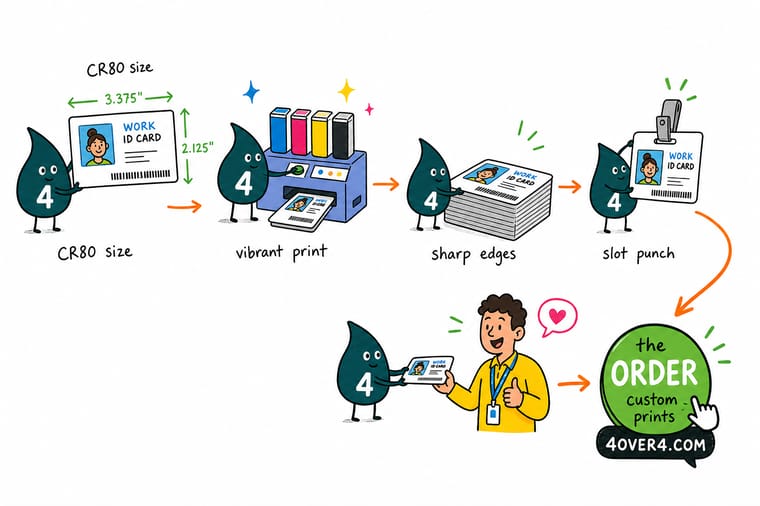
Wally builds every staff badge to the same recipe. CR80, so it fits the lanyard you already bought. Thirty mil PVC, so the slot punch does not tear out the first time someone yanks the reel. Bleed to 3.625 by 2.375 inches, then keep the name, the photo and the barcode inside 3.125 by 1.875. He decides vertical or horizontal before he draws anything, because the punch position depends on it. And he sends the two week contractors home with a paper badge, not a plastic one.
Order plastic identification cards →Specs and pricing
Badge stocks, sizes, and starting prices
Compare the badge options side by side, with live configuration choices and starting prices straight from the 4OVER4.COM configurator.



Print it
Badge your team with cards that last the year



Explore more
Where to go next



By the numbers
ID badges, key cards and card sleeves
Common Questions
Your work ID card questions, answered
What are work cards?
In everyday use, work cards are employee ID cards: the badge a staff member carries to prove who they are and what they are allowed to reach. A typical one holds a photo, a full name, a job title or department, a company logo, and a card number or barcode. It is printed on plastic at bank card size so it survives being worn. The phrase sometimes gets confused with work permits or job cards on a shop floor, but when someone searches for work cards and lands on a printer, this is what they mean.
What size is a work ID card?
CR80, which measures 3.375 by 2.125 inches or 85.6 by 54 millimeters. It is the same ISO size as a credit card, which is the whole point: every lanyard, badge holder, clip, reel and card reader on the market is built around it. Two variations exist. CR79 is a hair smaller at 3.303 by 2.051 inches and comes with an adhesive back so it can be stuck onto an existing proximity card. CR100 is oversize at 3.88 by 2.63 inches and shows up in hospitals and secure sites where a badge has to be readable across a room.
What does 30 mil mean on a plastic card?
Thickness. One mil is a thousandth of an inch, so 30 mil is 0.030 inches, about 0.76 millimeters. That is the standard for a card that gets worn, because it is stiff enough to take a slot punch without tearing and thick enough for a badge clip to grip. Thinner 20 mil stock at roughly 0.51 millimeters is fine for a loyalty or gift card that lives in a wallet, but it flexes on a lanyard and eventually curls. Anything printed on paper stock is a different category altogether.
Can I print work ID cards on my office printer?
Not on 30 mil PVC. A laser printer fuser runs hot enough to warp the plastic, and a card that thick is likely to jam on the way through. Inkjets will not bond to an untreated PVC surface either. There are two workable routes: order the cards printed with everything on them, or order a shared design and add names and photos on a dedicated card printer that uses a dye sublimation ribbon. If you only need badges for a day, print paper inserts and slide them into holders instead.
Should the badge be vertical or horizontal?
Decide before you design, because it changes where the punch goes and how the artwork sits. Vertical badges hang from a slot punched in the center of the short edge and are the norm for staff who move through card readers, since the photo stays upright when the card dangles. Horizontal badges punch on the long edge and give you more room for a name and a wide logo, which suits reception and event use. A card designed horizontally and then punched on the short edge reads sideways all day.
Do work ID cards need a photo?
For anything that controls access, yes, because a photo is the only element a human can check in a second. Build the photo box at roughly 0.8 by 1 inch and supply the image at 300 pixels per inch, which is only about 240 by 300 pixels of real data. That is a low bar, but a webcam grab stretched to fill the box still looks like a webcam grab. Head and shoulders, plain background, even lighting. For contractors and visitors who only need to be visibly badged, a photo free card with a bold VISITOR band does the job.
How much do work ID cards cost?
Plastic identification cards at 4OVER4.COM start at $264.00 for a printed run, and 30mil white plastic cards start at $226.11 if you want a blank stock design you personalize yourself. Event badges start at $49.88, which is why a two day conference gets paper badges and permanent staff get PVC. The variable that moves the number most is quantity: plastic card printing is a set up heavy process, so the price per card falls sharply as the run grows and barely changes between 100 and 250.
Get Started
Plastic identification cards run 125 for $264.00
Pick CR80 on 30 mil PVC, send us a front and a back, and we print staff cards that take a slot punch and a year on a lanyard without curling.
Legal Disclaimer
Gold Standard guarantees apply to all standard orders placed through 4over4.com. Price match requires verifiable proof of a competitor's published price for an equivalent product with matching specifications and turnaround time. Satisfaction guarantee covers manufacturing defects and print quality issues. Contact support with order number and documentation. On-time delivery rate based on tracked orders 1999 to 2026. Individual results may vary based on shipping carrier performance.
