
How to Choose a Poster Printer That Gets Size, Paper and Deadline Right


Roll width, stock range, proofing, color handling and the ship cutoff. Five questions sort the poster printers who can do your job from the ones who will try.
Choose a poster printer on five answers: the maximum print width, the stocks and finishes actually stocked, whether you get a proof and which kind, how the shop handles an RGB file, and the ship cutoff for your in-hand date. Price is the sixth question, not the first, because setup dominates a small poster order and the gap between shops narrows fast once quantity rises. Match the finishing to the job as well: rolled paper for posting, mounted for easels and displays, framed for a wall it will stay on.
Quick answer
Five questions, asked in this order
Start with roll width, because it decides what is physically possible. Then stock range, because one house paper means no choice was made for your job. Then proofing, so you know whether you are approving layout or color. Then color handling, which is the difference between a shop that warns you about an unreachable blue and one that converts in silence. Then the ship cutoff, because production days and in-hand dates are not the same number. Price comes last, and it moves less than people expect once you compare like for like.
What Separates a Poster Printer From a Print Button
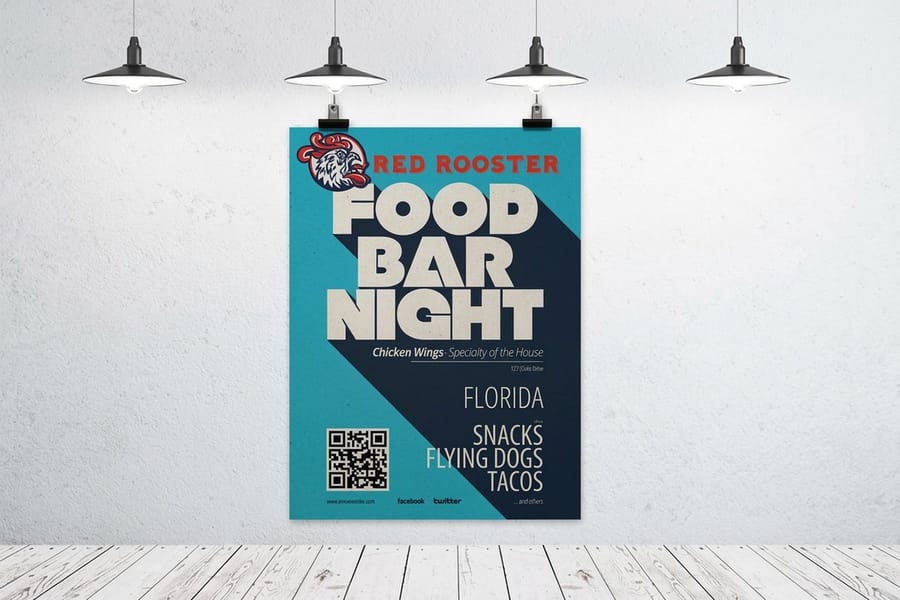
Most poster disappointment comes from one of five places, and every one of them is knowable before you pay.
Print width. Large format work runs off rolls, and the roll width is a hard ceiling on one dimension. Ask for it in inches. It tells you instantly whether a shop can run your 48 inch banner poster or is quietly going to tile it in two pieces.
Stock range. A printer with one house paper is not choosing a stock for your job, it is using the one it has. You want at least a matte and a gloss poster paper, a heavier photo grade option, and a rigid substrate for anything that has to stand up. The stocks live on the poster printing category, and the whole large format range sits under large format printing.
Proofing. A digital proof confirms layout, bleed and trim. It does not confirm color, because your monitor is backlit and paper is not. If exact color matters, ask whether a printed proof is available and budget the extra day. Most poster jobs do not need one. The ones that do are usually reprints matching something already on a wall.
Color handling. Ask what happens to an RGB file. A good shop converts to its own profile and tells you which colors will shift, usually the electric blues and the bright greens that no CMYK press can reach. A shop that says nothing is converting silently and hoping.
Damage in transit. Rolled posters travel in a tube, and a thin tube crushes. Mounted work ships flat in a corner protected carton. Ask which one your order gets, because a perfect print with a crease across it is a reprint either way.
Sizing the Poster to the Wall and to Your File

Pick the size from viewing distance first, then check the file can carry it. Those two steps in that order prevent almost every sizing regret.
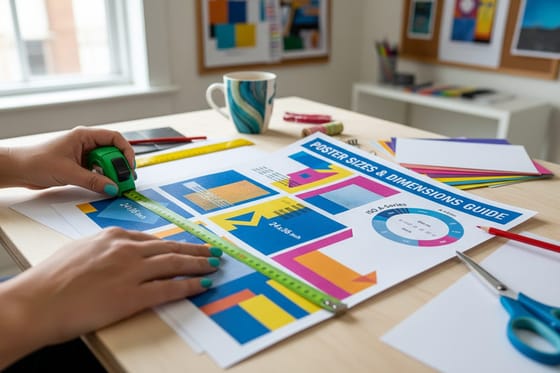
The everyday sizes exist for practical reasons. An 11 by 17 reads at counter distance and fits a standard frame. An 18 by 24 is the working size for events, gigs and classroom walls, big enough to command a corner and small enough to post with tape. A 24 by 36 is the lobby and cinema size, read from six feet or more. Anything larger is a statement piece and should be treated as one, because the mounting and the shipping start to cost real money. The poster size reference lists the full set with the frames each one fits.
Now the file. Headline type and vector logos scale to any size without loss, so the constraint is always the photography. Take your image pixel dimensions and divide by the poster dimensions in inches to get your real ppi at final size. If a 3600 by 5400 pixel photo goes on a 24 by 36 poster, that is 150 ppi, which is right for something read from across a room and wrong for something someone will lean into. Our image resolution guide covers the upsampling question, and the blank template library gives you a correctly sized document with the bleed already set.
One habit worth keeping: build the artwork at final size rather than at half scale with a note to enlarge. Scaling at the printer is where stroke weights, small type and bleed margins quietly go wrong.
Paper, Mounted or Framed, and What Each One Is For

These three get quoted as if they were good, better and best. They are not. They solve different problems, and picking by price alone is how a poster ends up curling off an easel at a trade show.
| Option | What you get | Ships as | Right when |
|---|---|---|---|
| Paper poster | Print on poster stock, matte or gloss, trimmed to size. | Rolled in a tube. | Short campaigns, wall posting, anything going into an existing frame. Cheapest per unit by a wide margin. |
| Mounted | Print bonded to a rigid board so it stays dead flat and self supporting. | Flat, in a protective carton. | Easels, counter displays, trade show boards, humid rooms where paper ripples. From $39.99. |
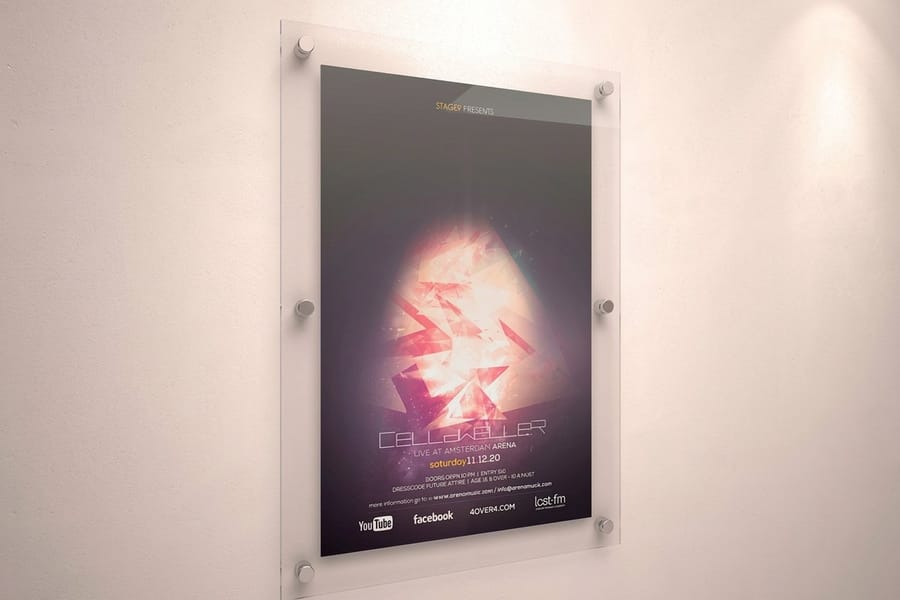
| Framed | Print finished in a moulding, ready to hang out of the box. | Flat, glazed and corner protected. | Offices, reception walls and anything staying up for years. From $87.86. |
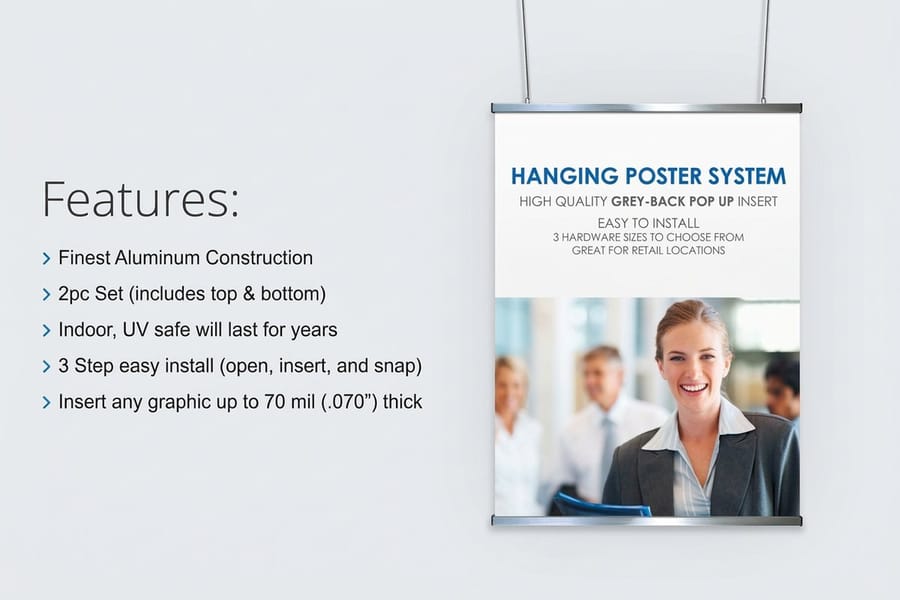
| Hanger or display | Print paired with hardware that grips top and bottom. | Rolled print plus hardware. | Rotating artwork, retail bays and anywhere you want to swap the print without touching the wall. From $53.83. |
Read the third column before the price column. Shipping is where the surprise usually lands: a rolled large format poster travels cheaply in a tube, while a mounted poster has to go flat in a box sized to the artwork. If you are mounting anyway, our gator board and foam board guide explains why a lightweight foam core board dents at the corners and a denser board does not.
Framing is the one people skip and then regret. A framed poster arrives ready to hang, which sounds like convenience and is really about flatness: nothing you frame yourself six months later will sit as flat as a print mounted and framed while it is fresh.
How Big a Poster Can Go Before It Becomes a Different Product
The ceiling on a single piece poster is the press roll width. One dimension can run long, because the roll feeds continuously, but the other cannot exceed the width of the material. That is why a printer will happily quote 36 by 96 and refuse 60 by 60 on the same machine.
Past that point, three things change. Paper stops being the right material, because a sheet of poster stock over about four feet wide flexes and tears under its own weight when handled. Mounting becomes a structural decision rather than a finishing one. And installation stops being tape, which is where hanging poster displays or a wood poster hanger frame earn their cost by carrying the load along the full top edge instead of at four corners.
There is a quieter limit too. A very large poster viewed from very close, which happens in narrow corridors and lift lobbies, is the one case where the low ppi rule breaks down. Someone standing two feet from a wall sized print sees exactly what a small poster reader sees, so the file has to hold up at that distance across the section they are near. Design for the closest realistic viewer, not the average one.
If the piece is going outdoors, a poster is the wrong product entirely. Paper and weather have no relationship worth building on. Move to a vinyl or mesh material from the large format range, and if the goal is a display that travels, look at the sign and banner options rather than trying to weatherproof a poster.
Turnaround, Cutoffs, and the Delays That Are Actually Your Fault
Poster production is quick. The queue and the courier are what make a deadline. Judge a printer on the in-hand date it will commit to, not on the production number in the banner at the top of the page.
Three things extend a poster job past the promised production window, and two of them are on your side of the desk. A file that arrives without bleed goes back for a fix and loses a day. A file in RGB with saturated brand color needs a conversation before anyone presses go. A finishing step, mounting or framing or hardware, adds a stage that has to set properly and cannot be rushed by asking nicely.
What you can control is the cutoff. Every printer has a time of day after which today becomes tomorrow, and hitting it is worth more than any expedite fee. Our turnaround and order tracking guide shows where each stage sits, and same day printing lists what genuinely qualifies. When the date is immovable, rush delivery buys transit time, which is usually the part that is actually short.
One last piece of counter advice. If a poster is for a fixed date, order the reprint tolerance up front: one spare in the same run costs a fraction of a rush reorder, and it covers the crease, the spill and the last minute change of venue. If you are still weighing suppliers, where to print posters compares the routes side by side.
Wally explains poster printers
Measure the roll, then measure the wall
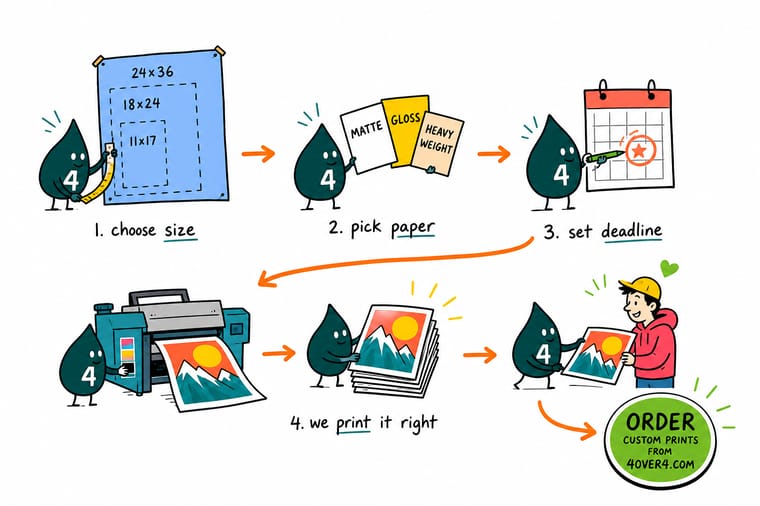
Wally asks the roll width first, because that is the one number a printer cannot argue with. Then he checks the stock shelf: a matte, a gloss, a photo grade and a rigid board means somebody is choosing for your job. He looks at the proof to confirm the trim, not the colour, and he asks what happens to an RGB file before he uploads one. Last he asks for the ship cutoff, because a two day print that arrives on day five is a five day print.
Configure a large format poster →Specs and pricing
Poster options, sizes, and starting prices
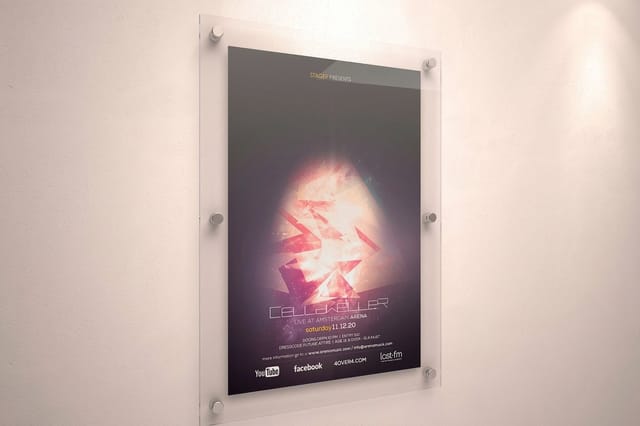
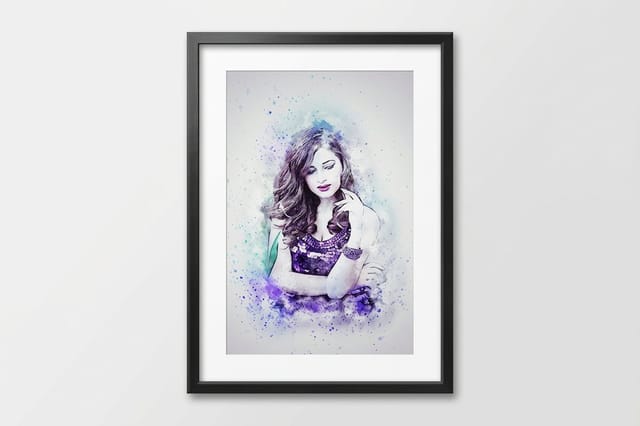
Rolled, mounted and framed side by side, with live configuration choices and starting prices straight from the 4OVER4.COM configurator.



Print it
Order the poster that suits the job

Explore more
Where to go next

By the numbers
Rolled, mounted and framed from one roll width
Common Questions
Your poster printing questions, answered
What should I ask a poster printer before I order?
Four questions cover most of the risk. What is the maximum print width, because that caps one side of your poster. What stocks and finishes are available, and can you see them before committing. Do you get a proof, and is it a digital proof or a printed one. What is the ship cutoff for the date you need it in hand, not the production time in isolation. A shop that answers all four in plain numbers is worth more than one advertising a lower headline price.
What resolution does a poster file need?
It depends on how close people stand. At arm reach, which covers an 11 by 17 in a hallway or a retail counter card, aim for 300 ppi at final size. At about four feet, 200 ppi holds up. At eight feet and beyond, which is how a 24 by 36 in a lobby is actually seen, 150 ppi looks sharp and keeps the file manageable. Vector logos and type stay crisp at any size, so the ppi rule really applies to the photography. The full explanation is in our guide to image resolution for printing.
Is a mounted poster better than a paper poster?
Better for a different job. A mounted poster is bonded to a rigid board, so it stands on an easel, hangs without a frame, and will not ripple in a humid room. That rigidity is also the drawback: you cannot roll it, so it ships flat in a large box and costs more to send. If the poster is going behind glass in a frame, or is being posted on a wall for a week, plain paper is the right call and Mounted Posters at $39.99 are money spent on nothing.
Matte or gloss for a poster?
Gloss deepens color and makes photography pop, and it also mirrors every ceiling light. In a bright retail space or under gallery spots, that glare can wipe out half the artwork. Matte holds detail in even light, handles fingerprints better, and is the safer default for anything with a lot of small text. If the poster is mostly a big photograph and the lighting is controlled, gloss wins. Our matte versus gloss comparison walks through the trade in more depth.
How fast can a poster actually be printed?
Large format printing is fast in production because there is no bindery step: the file goes to the printer, the sheet is trimmed, and it is packed. Same day production is realistic on standard sizes when the file is clean and the order lands before the cutoff. What is not fast is anything with mounting, framing, or a hardware assembly, because those add a finishing stage that has to dry or set. Build a day of slack for those, and check the rush delivery options rather than assuming.
Why does one poster cost almost as much as three?
Because the setup does not shrink. Loading the roll, running a color check, trimming, and packing take the same time whether you print one poster or four, and a single unit carries that whole cost. This is why the per poster price falls steeply for the first few units and then flattens out. If there is any chance you will want a spare, order it in the same run rather than reordering later at full setup cost again.
Get Started
Order a hanging poster display from $53.83
Pick your size, choose matte or gloss, and add mounting or a frame if the poster has to stand on its own. We print and ship from New York.
Legal Disclaimer
Gold Standard guarantees apply to all standard orders placed through 4over4.com. Price match requires verifiable proof of a competitor's published price for an equivalent product with matching specifications and turnaround time. Satisfaction guarantee covers manufacturing defects and print quality issues. Contact support with order number and documentation. On-time delivery rate based on tracked orders 1999 to 2026. Individual results may vary based on shipping carrier performance.
