
NCR Paper, How Carbonless Sets Copy and What Ruins Them


The paper behind every 2, 3 and 4 part business form: what the coatings do, what the part colors mean, and the handling mistakes that turn a box of blank sets into scrap.
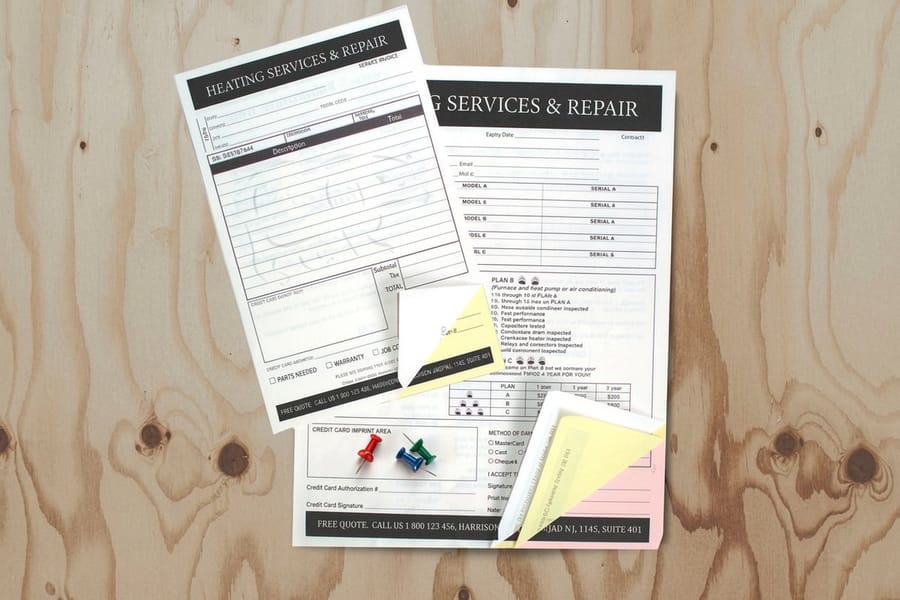
NCR paper is carbonless copy paper: the back of each sheet holds microscopic capsules of colorless dye, the front of the sheet below holds a reactive clay, and pen pressure bursts the capsules so your writing develops on every part underneath. No carbon sheet, no ribbon, no power. The cost of that simplicity is that the paper copies any pressure at all, including a carton stacked on the box, and a laser printer fuser darkens a whole sheet in one pass.
Quick answer
Two coatings that only work when they touch
NCR stands for no carbon required, and the copying chemistry lives in the paper itself. Dye capsules on the back of one sheet, reactive clay on the front of the next, and the pressure of a pen doing the rest. The top sheet gives, the bottom sheet receives, and every sheet in between does both, which is what sets the part count. Order the parts the way the copies get handed out, because the color sequence is the only instruction most people will ever read.
What NCR Paper Is and How the Mark Gets Through
NCR paper is ordinary-looking bond with two chemical coatings that only work when they touch each other. The back of a sheet carries millions of capsules holding a colorless dye. The front of the sheet below carries a reactive clay. Press a pen down and the capsules under the nib burst, the dye runs into the clay, and a mark develops on the lower sheet along the exact line you wrote. Nothing is heated, nothing is powered, and there is no carbon sheet to pull out and throw away.
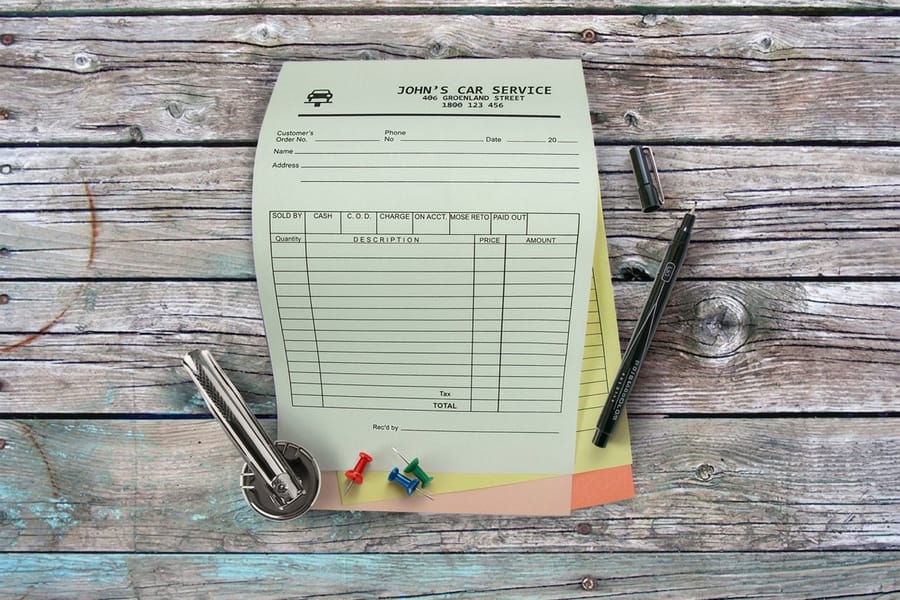
Printers name the sheets by which faces are coated. CB is coated back, the top sheet, which gives but does not receive. CF is coated front, the bottom sheet, which receives but has nothing left to give. CFB is coated front and back, the middle sheets, which do both at once and are the reason a set can run three or four parts deep. A 2 part set is CB over CF. A 4 part set is CB, CFB, CFB, CF.
That naming is not printer trivia. It explains the two things people get wrong most often. You cannot add a copy to a finished set, because the bottom sheet has no coated back. And you cannot reorder the parts to suit a filing habit, because the coatings only line up in one direction.
The chemistry also explains the strange failures. A form that reads clean on part two but ghostly on part four was not written on hard enough. A blank set covered in faint gray scribble sat under something heavy. Both are the paper doing exactly its job, in the wrong place. If you want the full pre-NCR story, our guide to carbon copy paper covers what this replaced.
The Part Colors and Why the Order Never Changes
Sheet color is the cheapest workflow tool in a business. Nobody has to read a form to know which copy they are holding, because the sequence is fixed and everyone in the trade uses it the same way.
| Part | Color | Who normally takes it | Why that copy exists |
|---|---|---|---|
| 1 | White | The customer | The original, written on directly, so it is the sharpest and the one handed over. |
| 2 | Canary | The office | The working copy that goes into the day's paperwork and gets reconciled. |
| 3 | Pink | The driver, tech, or job file | Travels with the work rather than with the money, so the person doing the job keeps proof. |
| 4 | Goldenrod | The permanent file | Never leaves the building. It is the copy you still have when the other three are lost. |
Choose the part count by counting hands, not by hoping. Two parts covers a straight cash sale where only you and the customer need a record. Three parts is the everyday invoice, work order and delivery note, because a third person almost always touches the job. Four parts is for the runs where a form crosses departments, and for anything that a regulator or an insurer might ask about later.
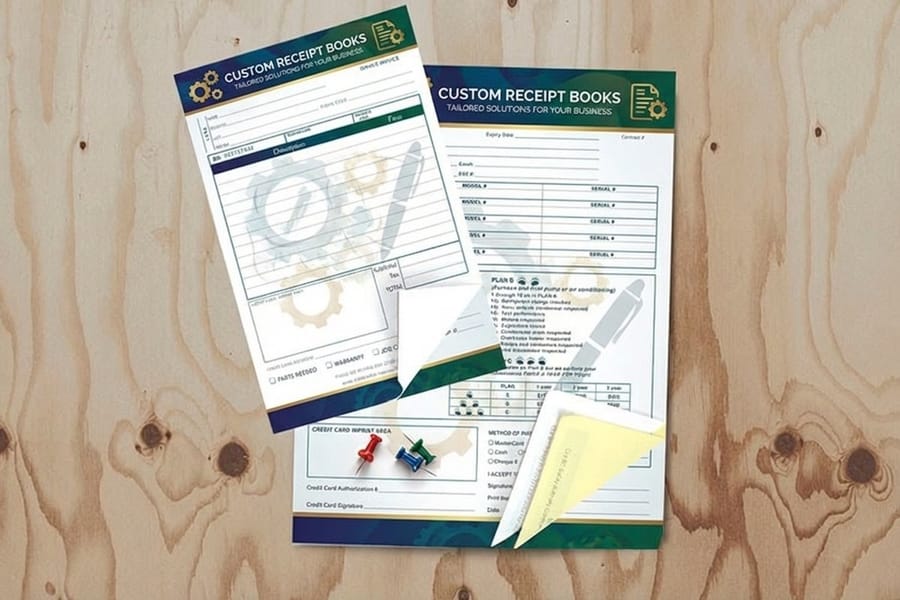
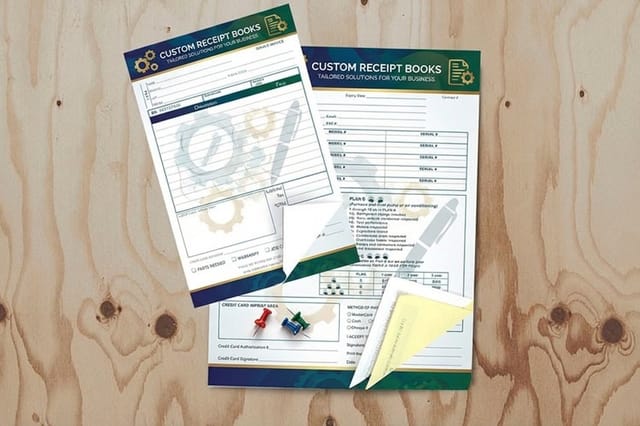
Print a copy legend on each part so the color is backed up in words, something like CUSTOMER COPY on the white and FILE COPY on the goldenrod. It costs nothing at design time and stops a new hire handing over the wrong sheet in their first week. We set this up every day on carbonless forms and on custom receipt books, which are the same paper fastened into a tear-off book with a wrap cover. If you are torn between two and three parts, the 2 part versus 3 part comparison works through it case by case.
What NCR Paper Will Not Do
The weaknesses all come from the same place as the strength. Carbonless paper copies pressure, and it cannot tell whose pressure it is or where it came from.
- A laser printer will wreck a sheet. The fuser heats the page to bond toner, and that heat bursts capsules across the entire surface. What comes out is gray, blotchy and worthless. Anything variable belongs in the print run, not in your office printer.
- Weight in storage leaves ghost marks. Cartons stacked on top, a tight rubber band, or a box that took a corner hit in transit will all print themselves onto the sets inside. Keep the boxes flat and unloaded until you open them.
- Soft nibs barely transfer. Felt tips and markers spread pressure over too wide an area. Gel pens glide, which is pleasant to write with and terrible for part four. Use a ballpoint and write on a hard surface.
- The copy fades faster than the print. The written image is dye, not toner. Heat and direct sun age it, so a set left in a truck cab for a season loses legibility long before one that went straight into a drawer.
- The stack has a depth limit. Four parts is where a pen realistically stops. Beyond that the job needs an impact printer that strikes the page rather than a hand that presses it.
- A single part feels thin on its own. The stock is deliberately light so pressure can reach the bottom, which means one loose sheet has no substance to it. Add the sturdiness in the finishing, not the paper.
None of that argues against carbonless. It argues for using it where it wins: a signature captured in a driveway, a receipt written at a market stall, a work order finished in a basement with no signal. Where the form is really an office document that gets typed and printed, plain letterheads or a printed notepad do the job better and cost less. Forms that have to hold up as evidence deserve a look at the security features built into multi-part forms before you print a box of them.
Numbering, Perforation and How the Set Is Held Together
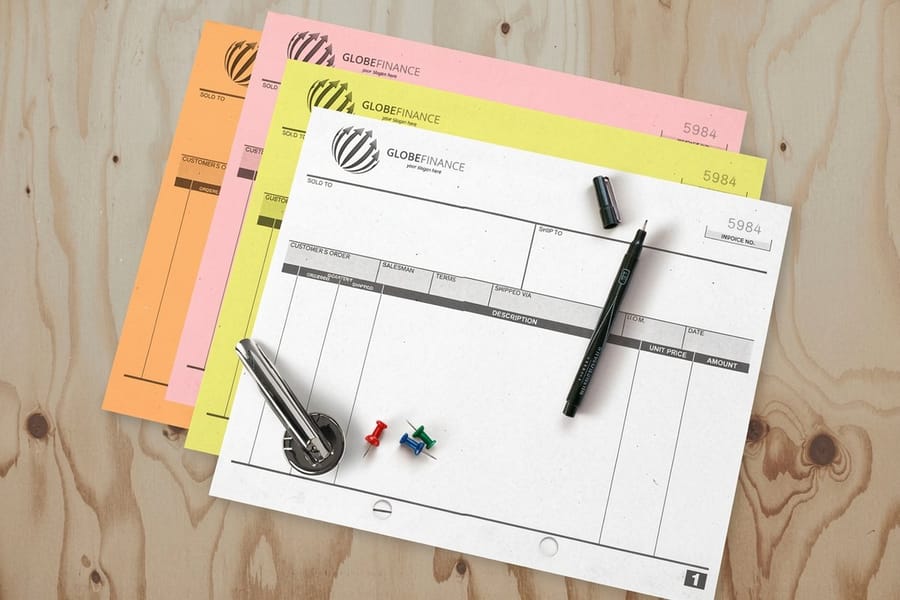
Sequential numbering is what turns a stack of paper into a record you can audit. The number prints in the same position on every part of a set, so the customer copy and the file copy carry the same reference and can be matched months later. Four things decide whether that works.
The start number. On a reorder, tell us the last number you used and the new run begins at the next one. Restarting at 001 creates two forms with the same number in the same ledger, which is the kind of error that surfaces at the worst possible time.
The digit count. Pick more digits than you think you need. Going from three digits to four later renumbers the whole scheme and breaks the tidy sort in your records.
The position. Top right corner is standard because it stays visible when the book is closed, half turned or clipped to a board.
Whether the sequence continues across books. Order six books at once and they can run as one unbroken sequence, or restart per book if you deliberately want a separate range per vehicle, per site or per collector. Say which, because the default is one continuous run.
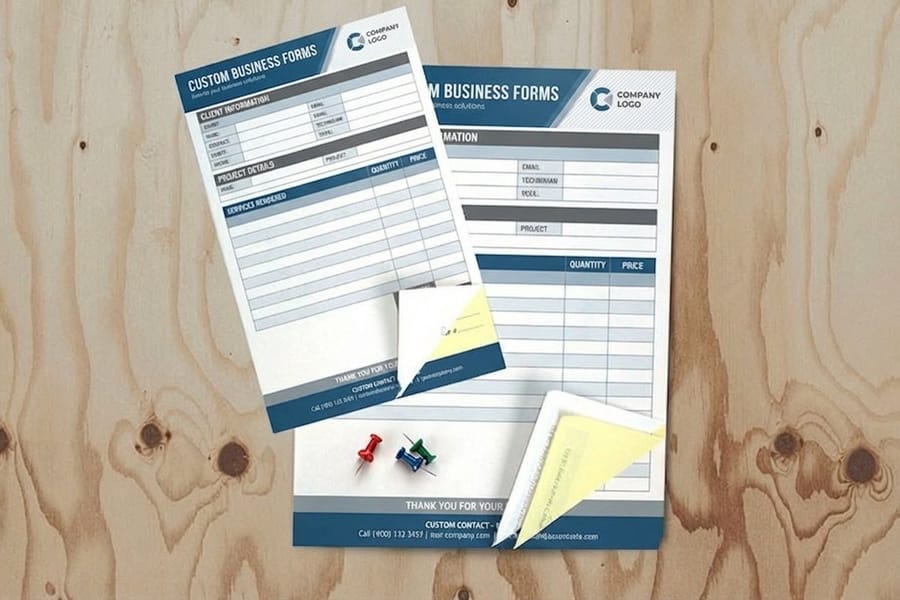
Finishing is a separate decision. Loose sets stay flat and suit a clipboard or a register drawer. Padded sets are glued along one edge so a whole set lifts off the top. Booked sets are bound with a wrap cover you slide behind the last part, which is what stops the pen writing through into the set underneath, and it is the reason receipt books come booked as standard. Perforation lets a copy tear away along a clean line instead of being pulled out of the glue. Choose the bound edge for how the form gets written on: top bound for a clipboard, left bound for a counter, bottom or right bound when the form is filled in against a steering wheel and the glued edge needs to stay clear of your writing hand. The step-by-step ordering guide runs through these choices in the order the configurator asks for them.
Sizes, Ink and What a Run Actually Costs
Three stock sizes cover nearly every form. The 5.5 by 8.5 inch half sheet fits a cash box, an apron pocket or a register drawer and suits receipts and delivery notes. The 8.5 by 11 inch letter size gives a full page for an itemized order with a terms block. The 8.5 by 14 inch legal size is for job sheets with a long parts and labor list and a signature line under the total. If none of those fit an existing form, custom sizing runs up to 11 by 14 inches.
Ink comes four ways: black on the front, black on both sides, full color on the front, or full color front with a black back. Black front is the working default, and it is usually the right one, because a form is read under a fluorescent light by someone in a hurry. Full color earns its place when the sheet crosses a counter as a piece of branding as well as a receipt. Anything on the back is nearly always terms and conditions, which is what the two-sided options are for.
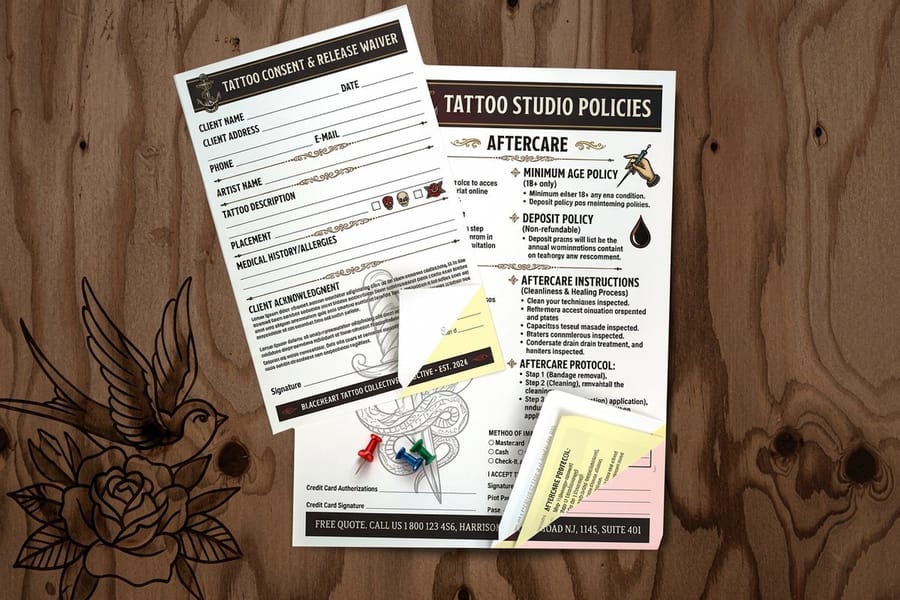
Carbonless forms start at $120.82 for 100 sets, and the per-form cost falls hard with volume: 400 sets run $142.79, 3,000 sets $395.42, and 5,000 sets $593.13, which works out around $0.12 a form against $1.21 apiece at the smallest run. Standard production is 5 business days, with 4-day and 3-day rush when a date closes in. The same pricing and turnaround apply to custom business forms and to ready-made sets like tattoo consent forms, where the layout is already drawn and you are only choosing parts and quantity.
Set the file up at the real trim size with bleed and safe margins, and keep rules and boxes well inside the cut, because a form that loses the right edge of its total column is a reprint. Start from a blank form template if you are drawing the layout yourself, take a free online proof before the run, and add a hardcopy proof when you want the actual paper in your hand first. The whole family sits together on carbonless forms printing if you want to compare formats side by side.
Wally explains NCR paper
Capsules on the back, clay on the front, pressure does the rest
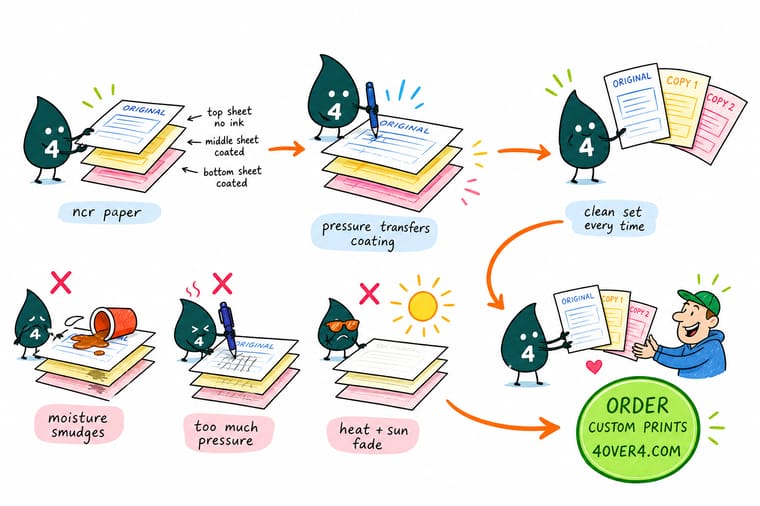
Wally writes on the white sheet. Under his pen, tiny capsules of colorless dye burst and meet a clay coating on the canary sheet below, so the same words appear there without a scrap of carbon in between. Pink and goldenrod follow, a little fainter each time, which is why four parts is as deep as a pen can go. He keeps the box flat and off the radiator, because this paper copies anything that presses on it, not just him.
Order carbonless NCR forms →Specs and pricing
Part counts, sizes, and starting prices
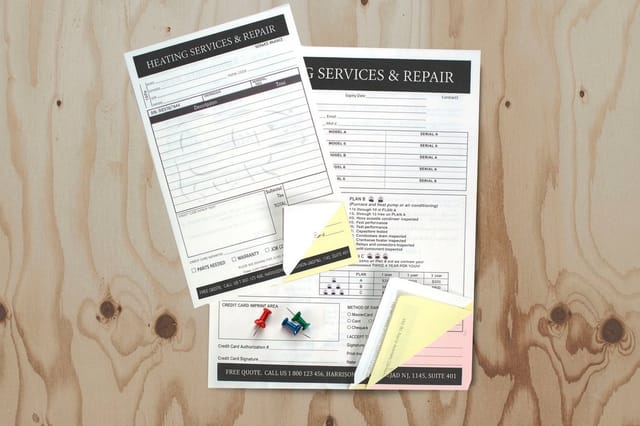
Build the set you need with live configuration choices and starting prices straight from the 4OVER4.COM configurator: 2, 3 or 4 parts, three stock sizes, ink on one side or both, and sequential numbering that picks up where your last run stopped.



Print it
Order multi-part forms that copy cleanly
Explore more
Where to go next

By the numbers
The forms side of a print shop this size
Common Questions
Your NCR paper questions, answered
What does NCR stand for on a form?
No Carbon Required. It is the trade name from the National Cash Register company, whose chemists worked out in the early 1950s how to put the copying chemistry into the paper itself instead of a separate carbon sheet. The name stuck so hard that people now say NCR paper the way they say Kleenex, meaning any carbonless multi-part stock, whoever made it.
Can I run NCR paper through a laser printer?
No, and it is the single most expensive mistake with this stock. The fuser in a laser printer applies heat to bond toner, and that heat bursts the dye capsules across the whole sheet, so a form comes out mottled gray or fully darkened and unusable. Inkjet is safer because nothing is heated, but the ink sits wet on a coated face and can smear. If your form needs variable content, have it printed at the same time as the rest of the layout, or leave a hand-written field for it.
Why did my blank forms develop gray smudges in the box?
Because the paper copies pressure, not writing. It cannot tell a pen nib from the corner of a heavy carton stacked on top of the box, a tight rubber band, or a form yanked against a desk edge. Store the sets flat in their original carton, keep nothing heavy on top, and keep them away from radiators, sunny windowsills and van dashboards. Sets that sit for years are worth rotating so the oldest gets used first.
Which pen works best on carbonless forms?
A ballpoint. It is a pressure instrument by design, which is exactly what the capsules need. Gel and rollerball pens flow so easily that a light hand leaves the third and fourth parts faint. Felt tips and markers spread the load across a soft wide nib and often transfer almost nothing. Pencil works fine, though it defeats the point on anything a customer signs. Whatever you use, write on a hard flat surface, never on a stack of other sets.
How long does the copy stay readable?
The written copy is a dye image, not toner, so it is not as permanent as a photocopy. Kept in a file drawer it will outlast most retention periods comfortably. Left on a dashboard, taped to a sunny window or stored somewhere hot, it fades faster than the printed layout around it. For records that have to survive an audit years out, scan or photocopy the office part when it is filed and keep the paper as the backup.
Can I add a fourth copy to a 3 part form later?
No. The last sheet of any set is coated on the front only, so there is nothing on its back to transfer to a new sheet slipped underneath. The part count is fixed the moment the set is collated at the plant. If you think a job might grow a copy for a driver or a second department, order 4 part from the start. Our carbonless forms cost the same $120.82 to start whether the set is 2, 3 or 4 parts, so the part count is a workflow decision rather than a budget one.
Why does NCR paper feel thinner than copier paper?
It is meant to. Every extra bit of thickness is one more layer for the pressure to fight through on the way down the stack, so carbonless sheets run lighter than the 20 lb bond you load in an office copier. The trade-off is that a single part on its own feels flimsy and shows what is printed on the back. If a form has to stand up to a clipboard in the rain or a year in a folder, put the weight in the finishing instead, with a book cover or a heavier wrap rather than a heavier sheet.
Get Started
Carbonless sets start at 100 for $120.82
Pick 2, 3 or 4 parts, choose your size and bound edge, add sequential numbering that continues from your last run, and we print sets that stay legible to the bottom sheet.
Legal Disclaimer
Gold Standard guarantees apply to all standard orders placed through 4over4.com. Price match requires verifiable proof of a competitor's published price for an equivalent product with matching specifications and turnaround time. Satisfaction guarantee covers manufacturing defects and print quality issues. Contact support with order number and documentation. On-time delivery rate based on tracked orders 1999 to 2026. Individual results may vary based on shipping carrier performance.
