
How to Choose, Size and Hang Custom Wall Decor


Four printed formats cover almost every wall in a home or an office. Each behaves differently, and the sizing and hanging numbers decide whether it looks right, and the file specs that keep a wall size print sharp.
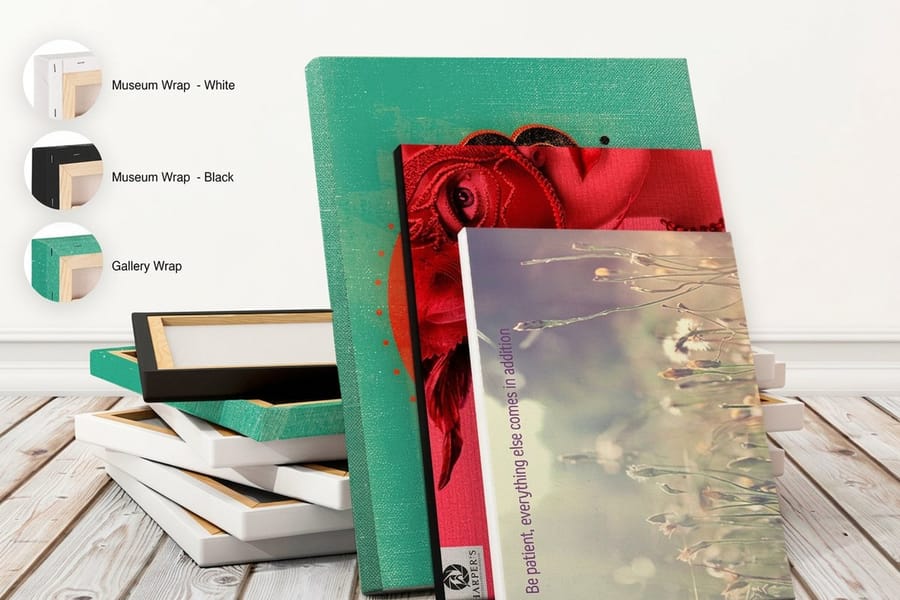
Custom wall decor is four printed formats: stretched canvas, framed prints, acrylic panels and adhesive wall graphics. Pick canvas for a bright room because its matte weave kills glare, acrylic for saturated color on a wall with controlled light, framed prints where a defined border suits the room, and wall graphics when nothing may be drilled. Size the piece to about two thirds of the furniture below it, leave a 6 to 8 inch gap above that furniture, and supply the file at 150 ppi at final size.
Quick answer
Two thirds of the furniture, an 8 inch gap, and the format that suits the light
The format decides how the piece behaves and the measurements decide whether it looks right. Canvas is matte and light and hangs off a single hook. Acrylic is glossy, heavy, and reflects a window straight back at you. Framed prints give a border, wall graphics give coverage with no hardware. Then size to roughly two thirds of the furniture width, hold a 6 to 8 inch gap above it, and let the center height fall where that puts it rather than forcing the 57 inch gallery number.
The Four Formats, and What Each One Is Really For

Every wall piece we print falls into one of four families, and they are not interchangeable. The choice is driven by the light in the room, the weight the wall can carry, and whether the piece has to come down again.
| Format | Surface and feel | How it hangs | Starts at |
|---|---|---|---|
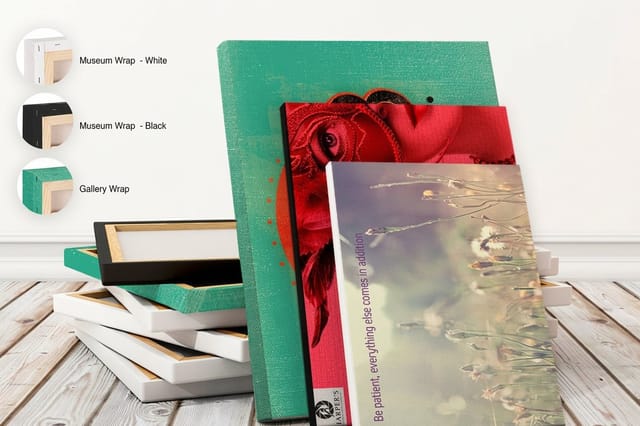
| Stretched canvas | Matte woven texture, no glass, image wraps the edges. | Light. One hook, or two for anything over 40 inches wide. | $59 |
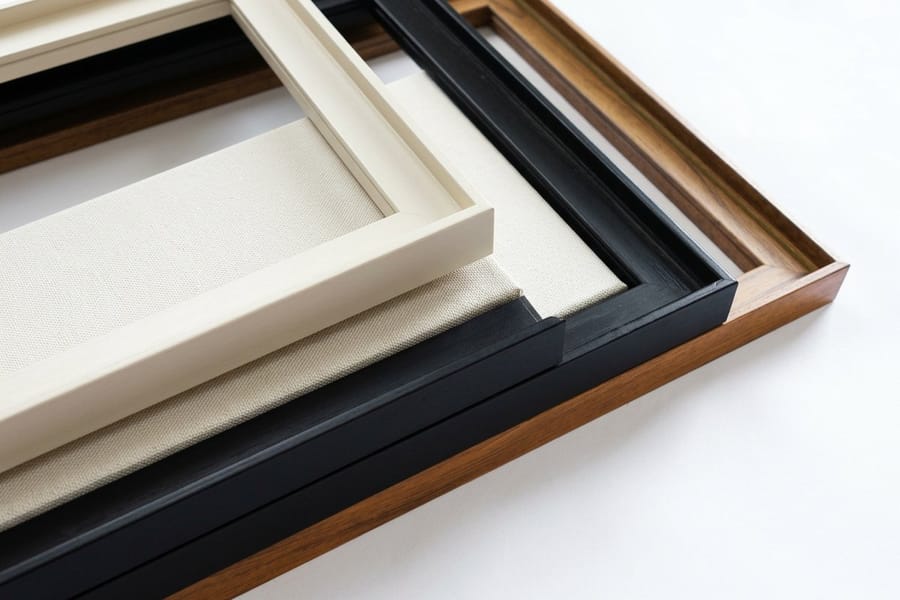
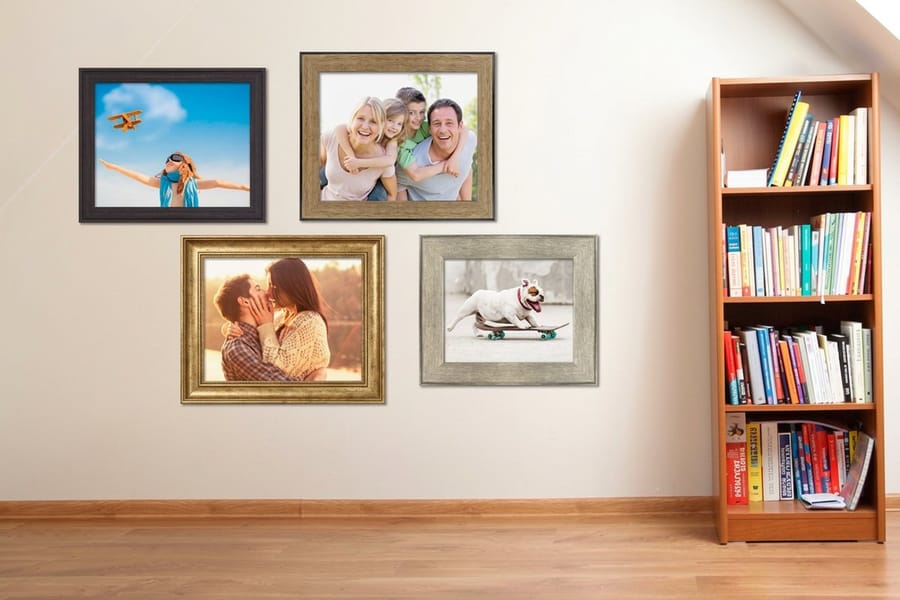
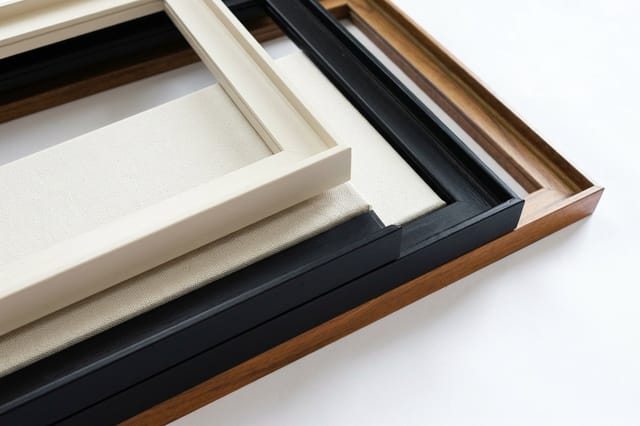
| Framed prints | Flat paper behind a moulding, a defined border around the image. | Wire or sawtooth, weight rises with glazing and size. | $73.57 |
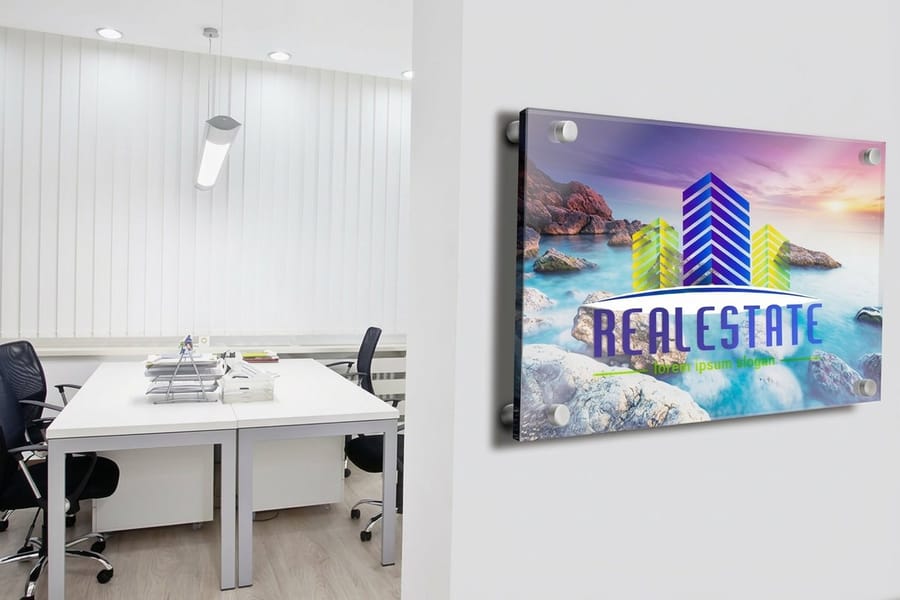
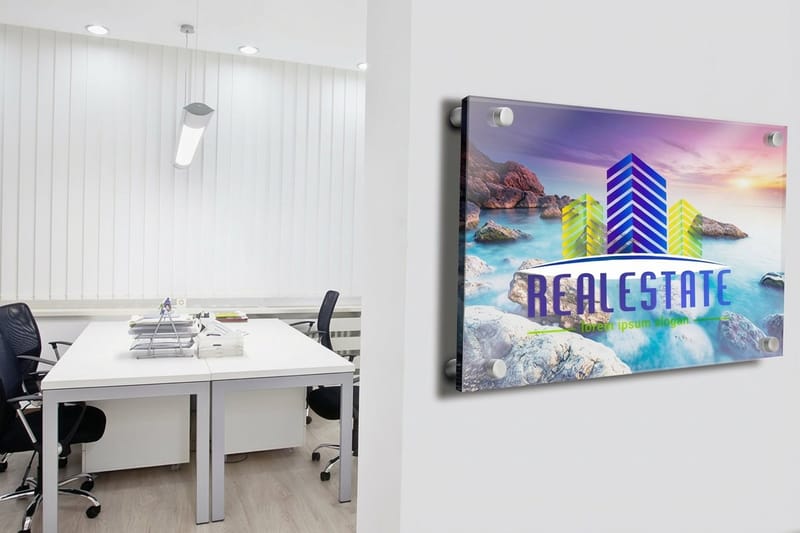
| Acrylic prints | Glossy panel, color reads deeper, reflects like glass. | Heavy. Standoffs into anchors, or a cleat into a stud. | $152.72 |
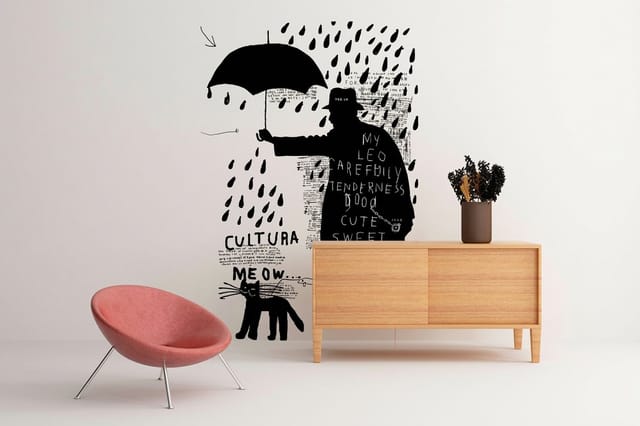
| Wall graphics | Adhesive vinyl or fabric, sits flat against the paint. | No hardware at all. The wall itself holds it. | $25 |
Read the third column before the first. A rented office where nothing may be drilled points straight at adhesive wall fabric, which repositions while you work and lifts off without residue. A conference room with track lighting rules out acrylic unless the fixtures aim away from the wall. A living room where the art is the only soft thing on a plaster wall is exactly where canvas belongs.
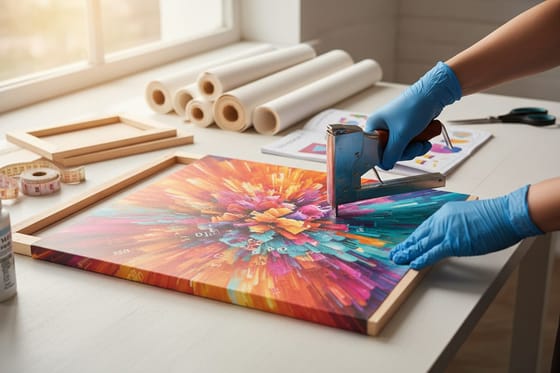
Budget sits in that last column too. Rolled canvas starts at $25 because you stretch it yourself or hand it to a local framer, and mounted posters start at $39.99 for a rigid piece that needs no frame. Both are honest answers when the piece is seasonal rather than permanent. Browse the full range on the posters and wall art hub.
Size the Piece Before You Print It, Step by Step
Undersized art is the single most common mistake on a finished wall, and it costs nothing to avoid. Work through these five steps with a tape measure before you upload anything.
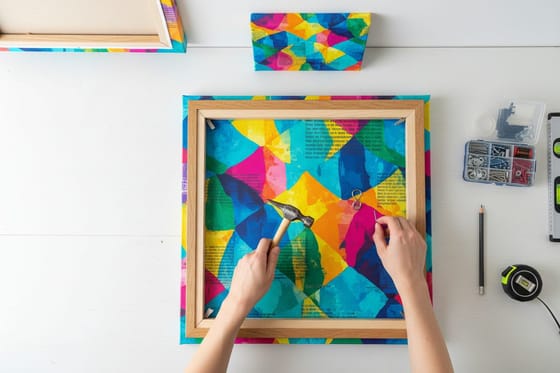
- Measure the furniture, not the wall. If the piece hangs above a sofa, a bed, a console or a credenza, that item sets the width. An 84 inch sofa wants art around 56 inches wide, because two thirds of the furniture width is the proportion that reads as deliberate.
- Set the gap at 6 to 8 inches. Measure from the top of the sofa back or the console surface to the bottom edge of the frame. Closer than 6 inches and the two objects merge, further than 8 and the art floats away from the group it belongs to.
- Only then check the center height. On an empty wall, center at 57 to 60 inches off the floor. Above furniture the gap rule wins, which usually puts the center nearer 50 inches. Both are right in their own context.
- Decide one panel or three. A single canvas is simpler to hang level. Three panels give you the same coverage in a smaller printed area and read better on a long wall. Keep gaps at 2 to 3 inches and treat the outer edges of the whole block as the piece.
- Tape the outline on the wall. Painter tape at the exact finished dimensions, left up for a day, will change your mind about size more reliably than any rule in this list.
One caution on aspect ratio. A 56 by 20 inch canvas is not a 3:2 photograph, so cropping to a wide wall shape can cut the head off the subject or throw the horizon out of the frame. Crop the file to the finished proportions first, look at it, and only then order the size. Our blank template library gives you correctly proportioned layouts to work into.
Hanging It So It Stays Straight and Stays Up
Hardware is chosen by weight, and weight is a property of the format rather than of the size. A big canvas is often lighter than a small acrylic panel, which surprises people every time.
A stretched canvas is pine bars and coated fabric, so even a large one is a few pounds and a single picture hook into drywall carries it. Use two hooks spaced about a third in from each edge on anything over 40 inches wide, because one central hook lets a long piece pivot every time a door slams. Quarter inch acrylic is a different animal: it weighs roughly a pound and a half per square foot, so a 24 by 36 panel is close to nine pounds and belongs on a stud, a toggle bolt, or the standoff hardware sized for it. Studs sit 16 inches on center in most American framing, and a magnet dragged across the wall finds the screw heads faster than a stud finder.
Wall graphics have no hardware and a longer list of conditions. The paint must be fully cured, which means three to four weeks after the last coat rather than three days. The wall must be smooth, because adhesive on an orange peel texture only touches the high points and the corners lift within a month. Wipe with isopropyl alcohol rather than a household cleaner, since the surfactants in most sprays leave a film that defeats the adhesive. Then squeegee from the center outward so the air goes somewhere. Adhesive wall fabric is more forgiving than vinyl here: it lifts and repositions while you are still hanging it, which matters when the graphic is 8 feet wide.
For posters going up without a frame, we cover the low-damage methods in the guide on hanging posters without a frame. Anything that has to survive a lease inspection is worth reading first.
Getting the File Right at Wall Size
Wall pieces are viewed from 4 to 8 feet away, so they need far less resolution than a business card does. The number that matters is pixels at final size, not the ppi tag saved in the file.
Work at 150 ppi at the finished dimensions for canvas, which puts a 24 by 36 at 3600 by 5400 pixels. The weave of the canvas softens fine detail anyway, so pushing further buys you nothing you can see. For acrylic prints and framed prints, where the surface is smooth and people walk right up to them in a lobby, 200 ppi is the better target. What actually ruins a large print is source quality rather than pixel count: an image that has been through a messaging app has been recompressed, and its blocking artefacts get magnified along with everything else. The full picture is in our guide to image resolution for printing.
Two format-specific rules save reprints. On a gallery wrapped canvas, the image continues around the bars, so keep faces, text and horizons at least 2 inches inside the visible face or the wrap will eat them. On wall graphics, build the artwork at final size in a vector program where you can, because a logo that is sharp on a business card is a mess at 6 feet wide unless it is vector art. If you are placing a graphic around a light switch or a door frame, measure those obstructions and mark them on the file rather than trusting the installer to improvise.
Color is the last one. A saturated blue that glows on a backlit screen will land quieter on matte canvas and brighter on acrylic, because the acrylic surface reflects light back through the ink. If a corporate color has to be exact across a lobby set, order one small piece first and match to it. For a broader look at how our large format work is set up, see the large format printing range.
Which Format Earns Its Cost, and Where It Does Not
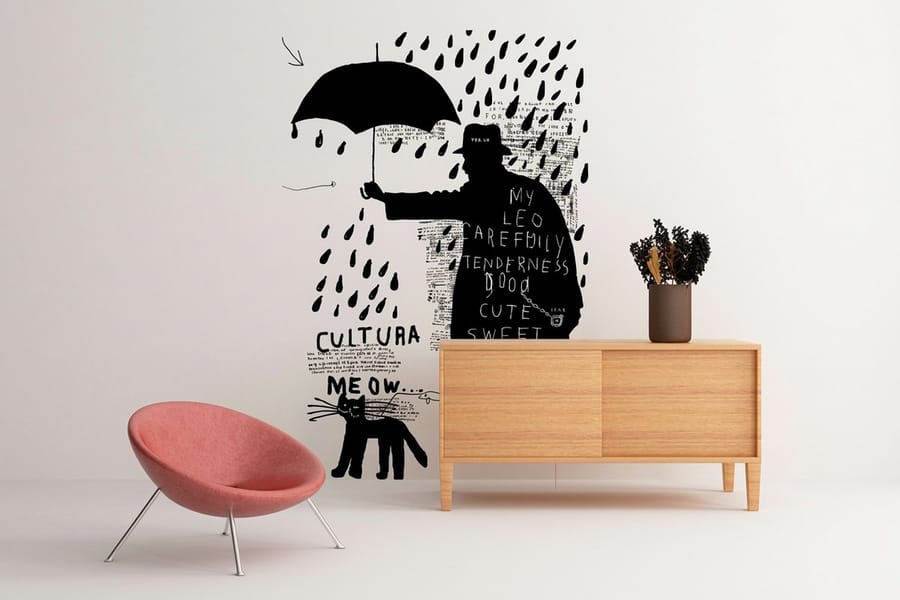
Price per square foot inverts as pieces get bigger, which is why the cheapest format at small size is rarely the cheapest way to cover a wall.
Canvas is the value pick for a single statement piece. Stretched canvas starts at $59 arriving ready to hang, and framed canvas starts at $50.33 when you want the floater frame border. Neither needs glass, which is what keeps the shipping weight and the risk down. See the whole range in the canvas printing collection.
Acrylic earns its $152.72 entry in exactly two situations: photography where the depth of color is the product, and reception areas where the piece is read as a signal of spend. It does not earn it in a sunlit room, in a corridor where it gets knocked, or anywhere the artwork changes with the season. The acrylic printing collection shows what it looks like in place.
Wall graphics win on area. At $25 to start, a wall graphic covers a surface no hanging piece can match, and it is the only option that fills an awkward stairwell or a wall broken up by switches and vents. The cost is permanence: it belongs to the wall, so it goes when the wall is repainted, and it will not survive a move. Rotating seasonal artwork in a retail space is exactly its use case, and a mixed approach, one canvas that stays and graphics that change, usually beats picking a single format for everything.
Wally hangs it properly
Measure the sofa, not the wall
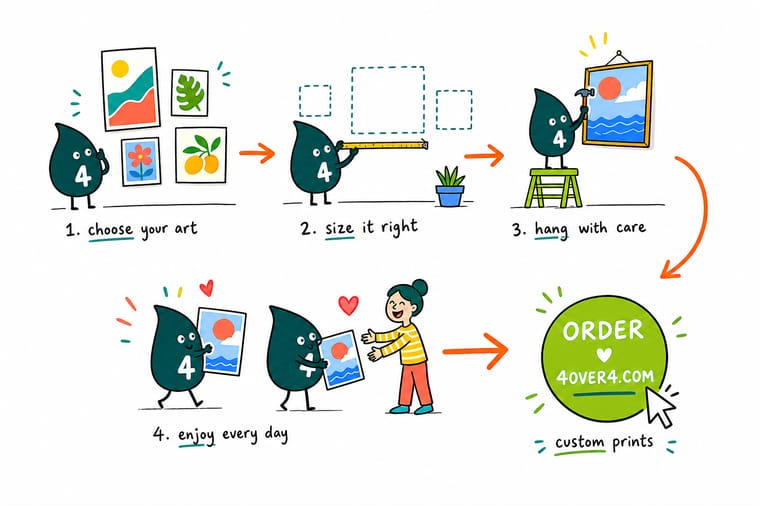
Wally does it in the same order every time. Tape measure across the sofa first, because two thirds of that width is the size of the piece. Then 6 to 8 inches of clear wall above the back, which is where the bottom edge goes. Only then does he check the center height, and above furniture it lands nearer 50 inches than the 57 inch gallery number. Two hooks on anything wide, one on anything small, and a stud or a toggle for acrylic because a quarter inch panel is heavier than the whole canvas next to it.
Order a stretched canvas →Specs and pricing
Sizes, materials and starting prices for each wall format
Compare canvas, framed prints and acrylic side by side, with live configuration choices and starting prices straight from the 4OVER4.COM configurator.

Print it
Put something on the wall this week
Explore more
Where to go next
By the numbers
Where wall art sits among a thousand products
Common Questions
Your wall decor questions, answered
What size art should go above a sofa?
Aim for roughly two thirds of the sofa width, then leave 6 to 8 inches between the top of the sofa back and the bottom of the frame. On a common 84 inch sofa that means a piece around 56 inches wide, which you can hit with one large canvas or with three panels separated by 2 to 3 inch gaps. When you use multiple panels, measure the whole block including the gaps and center that block on the furniture, not the middle panel on its own.
How high should wall art hang?
On an open wall, center the piece 57 to 60 inches off the floor, which is average standing eye level and the height most galleries use. Above furniture, that rule loses to the gap rule: keep 6 to 8 inches between the furniture and the art and let the center fall where it falls. In a dining room or anywhere people are seated most of the time, dropping the center a couple of inches lower looks better than obeying the number.
Will a wall graphic pull the paint off when I remove it?
It can, and the paint is usually the reason rather than the vinyl. Latex wall paint needs roughly three to four weeks to cure before adhesive vinyl goes on top, and applying it to fresh paint is the most common way a removal takes the finish with it. Textured or orange peel walls are the other failure: adhesive only contacts the high points, so the graphic lifts at the corners within weeks. Smooth, cured, degreased wall, applied with a squeegee from the center out, and removal at a low angle with a little heat is the routine that works.
Canvas or acrylic for a bright room?
Canvas, almost always. A canvas surface is matte and textured, so a window or a downlight opposite it scatters rather than mirrors. An acrylic face is glossy and behaves like glass, which is what makes the color look so deep, and also what makes it throw a reflection of whatever is behind the viewer. Acrylic belongs on a wall with controlled or indirect light, or on a wall that faces away from the window.
What resolution does a 24 by 36 inch print need?
At 150 ppi a 24 by 36 needs a 3600 by 5400 pixel file, and that is the sensible target for canvas because the weave hides fine detail anyway. Push to 200 ppi, or 4800 by 7200 pixels, for acrylic and framed prints where the surface is smooth and someone might stand close. A file smaller than that is not automatically unusable at wall size, but a heavily compressed image will show its JPEG artefacts long before it shows a lack of pixels.
Can I print a photo from my phone at wall size?
Often yes, if you send the original file. A recent phone shooting 12 megapixels gives you about 4000 by 3000 pixels, which is 26 by 20 inches at 150 ppi, so a medium canvas is comfortable. The trap is where the file came from: an image pulled out of a messaging app or downloaded from social media has been recompressed and resized, sometimes to under 1500 pixels wide, and no amount of upscaling puts that detail back. Pull the original off the phone or out of the cloud library, and send it untouched.
Does canvas need a frame?
No, and that is the point of a gallery wrap: the image continues around the sides of the bars so the piece is finished without a frame. A floater frame is a style choice that adds a shadow gap around the canvas and reads as more formal, which is why it turns up in offices and lobbies more than in living rooms. If you want the frame, order it as framed canvas rather than trying to fit a stretched canvas into a standard frame afterwards, since frame rabbets are cut for flat art and not for a 1.5 inch deep bar.
Get Started
Adhesive wall fabric ships in 3 business days, framed prints in 4
Send the file, pick the size, and we print canvas, framed, acrylic or adhesive graphics that arrive square, ready to hang, and matched to the light in the room.
Legal Disclaimer
Gold Standard guarantees apply to all standard orders placed through 4over4.com. Price match requires verifiable proof of a competitor's published price for an equivalent product with matching specifications and turnaround time. Satisfaction guarantee covers manufacturing defects and print quality issues. Contact support with order number and documentation. On-time delivery rate based on tracked orders 1999 to 2026. Individual results may vary based on shipping carrier performance.
