
6 Warning and Hazard Labels That Stay Readable on Steel, Drums and a Dark Dock
One material does not cover a plant. A cabinet door indoors, a corrosive drum in the yard and a gate somebody meets by torchlight all want different builds. Here are the six we would put in a starter set, with the failure mode of each one named.
A warning and hazard label set is three material builds plus one signal word decision. Coated paper for indoor panels and guards, a laminated synthetic for drums and outdoor plant, and a retroreflective face for anywhere a person arrives carrying their own light. Add a posted aluminum sign for the hazards that have no surface to stick to. The signal word ranks the risk: DANGER for a hazard that will injure, WARNING for one that could, CAUTION for minor injury, NOTICE for damage with nobody hurt.
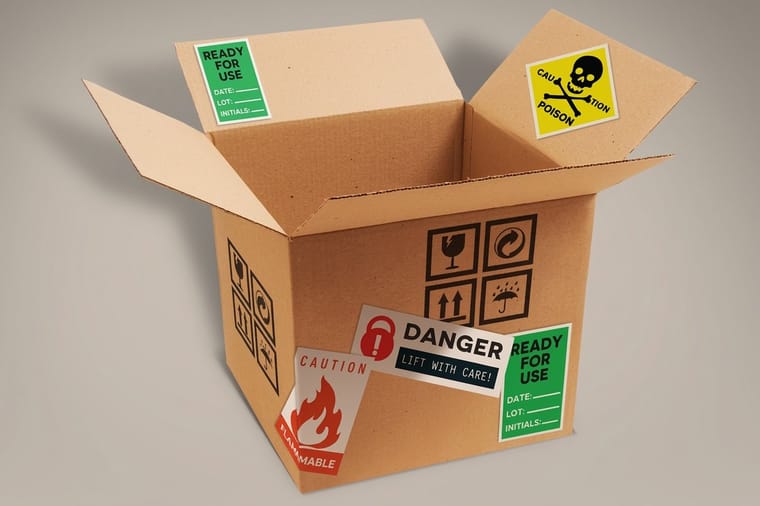
The picks
Six label builds, from uncoated paper to reflective aluminum
Read the number, then the reason. Each pick is priced from the configurator and drops as the quantity climbs. Start with the build that matches the surface and the cleaning routine, then add the reflective piece for anywhere staff work after dark. If you would rather not start on a blank page, our design templates give you a signal word panel already laid out.
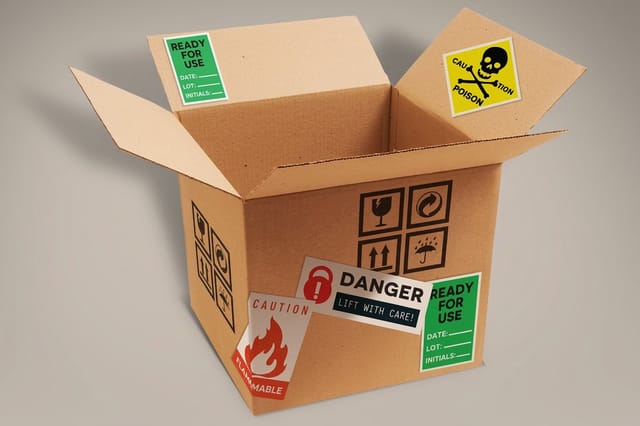
- 1 Standard Warning Labels from $23.88 Coated paper on sheets. The right answer for a panel door, a guard or a lockout point inside a dry building, and the wrong answer anywhere a hose reaches. Read the detail →
- 2 Premium Warning Labels from $29.16 The same label with a laminate over the print. Five dollars more per order buys you a face that survives a solvent wipe every shift. Read the detail →
- 3 Premium Waterproof Labels from $84.68 Synthetic face plus laminate for drums, valves, tanks and outdoor plant. This is the build that stops a chemical warning turning into a gray smear by August. Read the detail →
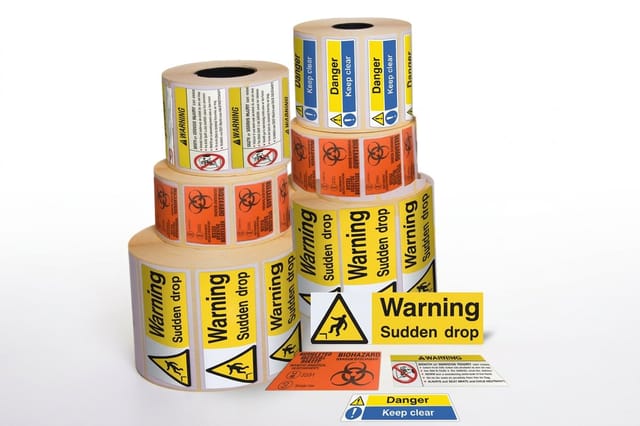
- 4 Roll Warning Labels from $322.98 Wound on a core for an applicator. High entry price, lowest per-label cost in the set, and only worth it once someone is peeling labels all day. Read the detail →
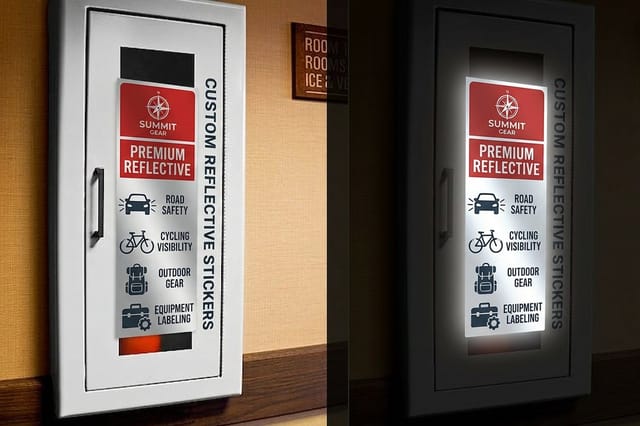
- 5 Reflective Stickers from $29 A retroreflective face that throws a torch beam straight back at the person holding it. Buy it for dark spaces, not for a lit corridor. Read the detail →
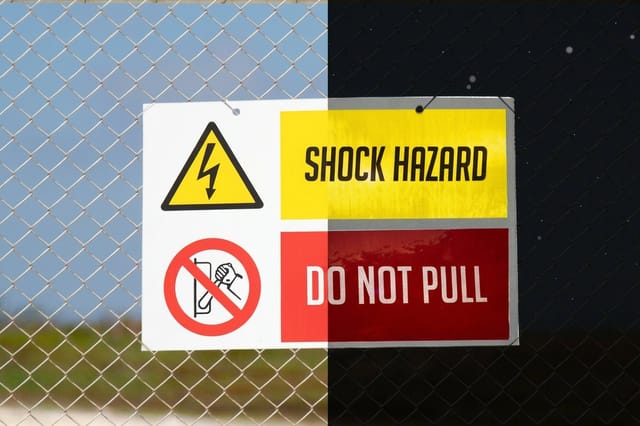
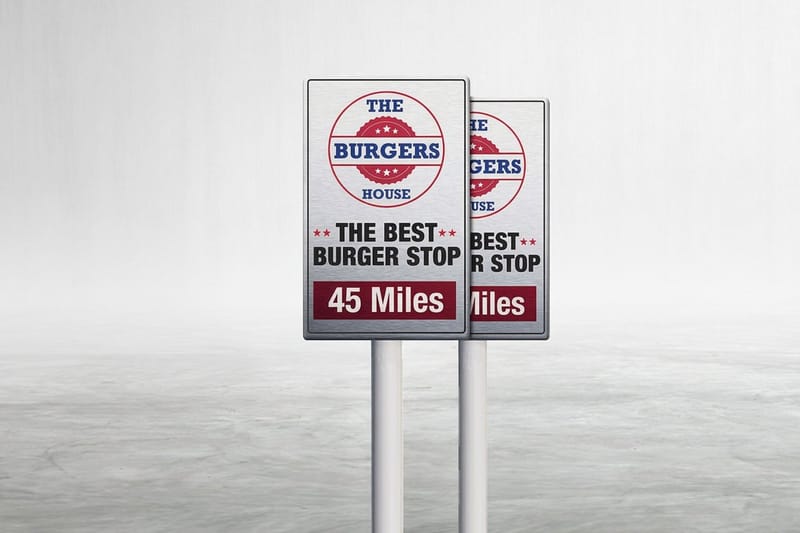
- 6 Reflective Aluminum Signs from $41.02 The posted warning for a hazard with no flat clean surface to stick to: a trench, a yard gate, a tank farm, a bay a truck reverses into. Read the detail →


Start here
Pick the build by what cleans the surface, not by the weather
Most warning labels die indoors. They are killed by the solvent rag that wipes a machine every shift, or by a wash-down hose, long before anything outside gets a chance at them. So the first question is not where the label lives, it is what touches it. Work down the list in the order a hazard escalates: an indoor panel, a machine that gets cleaned, a drum in the yard, then the places where the only light is the one a person brought with them. Everything in this set is also available through our label printing and sticker printing ranges if you need a shape or a size the stock builds do not cover.
Material and placement
Which warning label goes where, and where each one gives up
Six builds, and for each one the thing the datasheet does not say: where it stops working. Tap a pick to jump to the full detail, then order for the harshest thing that surface will ever meet, because a label you have to replace twice costs more than the one you should have bought.
| Pick | Face and finish | Where it holds and where it fails |
|---|---|---|
| 1. Standard warning labels | Coated paper, no laminate | Holds on indoor panels, guards and cabinet doors. Fails against a pressure washer, a solvent rag or six months of direct sun. |
| 2. Premium warning labels | Coated paper with a gloss or matte laminate | Holds through daily wipe-downs and handling. Fails at the cut edge, where solvent can wick under the face if the label is trimmed tight to the copy. |
| 3. Premium waterproof labels | Synthetic face with a laminate | Holds on drums, IBCs, valves and outdoor equipment. Fails if it is applied cold, wet or onto a surface still carrying release oil. |
| 4. Roll warning labels | Paper or synthetic on a wound roll | Holds anywhere the sheet versions do. Fails as a purchase when the run is small, because the entry price starts at $322.98. |
| 5. Reflective stickers | Retroreflective adhesive vinyl | Holds attention when a torch, a headlamp or a headlight is the light source. Fails under overhead high bays, where it reads duller than plain white vinyl. |
| 6. Reflective aluminum signs | Rigid aluminum panel, reflective face | Holds on a post, a fence or a wall for years outdoors. Fails on anything curved, vibrating or moving, which is where a label belongs instead. |
1. Standard warning labels, the indoor sheet you reorder
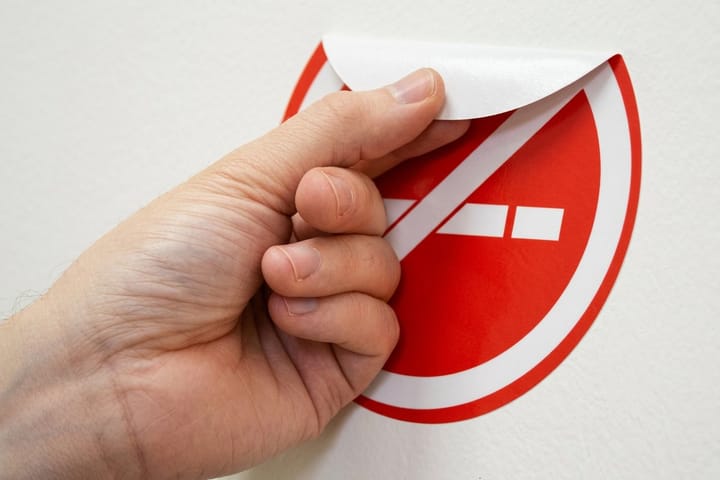
Start here for lockout points, panel doors, guards and cabinet interiors in a dry building. Standard warning labels come cut to size on sheets with a coated paper face and a permanent adhesive, and on a painted panel that never meets weather they stay crisp for years. At $23.88 a run they are cheap enough that you can afford to label every hazard rather than only the ones that got flagged in the last audit.
Paper is also the first thing in this set to give up. A pressure washer takes it off in seconds, isopropanol dulls the ink, and a label on a machine that gets wiped with solvent every shift is unreadable inside a month. Ask what cleans the equipment before you ask what the weather does to it, because indoors is where most warning labels actually die.
Get the wording and the color right before you get the material right. Our guide to designing compliant warning labels covers the signal word panel, the safety alert triangle and the message hierarchy, and OSHA safety colors and ANSI color codes explains why red, orange and yellow are not interchangeable. If you are labeling a whole site from scratch, read our guide to custom safety labels first.
2. Premium warning labels, the laminate that survives the solvent rag
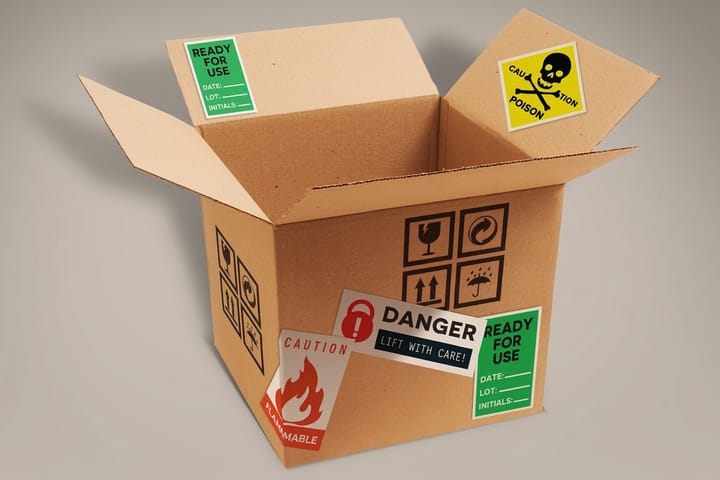
Premium warning labels are the same shapes and the same adhesive with a clear laminate laid over the printed face. That layer is what stops solvent, water and abrasion from reaching the ink, and for the roughly five dollars a run it adds over the standard build it is the single upgrade that decides whether a label is still legible at the next inspection.
Here is the part nobody mentions at the counter: the laminate protects the face, not the edge. Every label is die cut, and the cut edge leaves the paper core exposed all the way around. Solvent finds that edge and wicks under. Two things help. Leave a margin of at least an eighth of an inch of clear laminate outside your artwork so the wick has somewhere harmless to travel, and specify rounded corners, because a square corner is the only place on a label a fingernail or a hose can get purchase.
Choose the laminate deliberately as well. Gloss keeps contrast high and beads water, which suits a red DANGER panel. Matte kills glare under a work light, which matters on a label an operator has to read at arm's length, but it shows finger burnish as a permanent shiny patch. There is no finish that does both. Our walkthrough on how to design warning stickers covers the layout side, and what BOPP label material is explains the film option when paper plus laminate is not enough.
3. Premium waterproof labels, for drums, valves and everything outside

Once the label goes outdoors or onto a container of anything hazardous, paper stops being an option. Premium waterproof labels use a synthetic face with a laminate over it, so the sheet itself does not soften when it gets wet and the print underneath does not run. This is the build for drums, IBC totes, valve tags, outdoor plant and any container that goes in the back of a truck.
Name your standard before you order rather than after. If your drums travel by sea, the marine label specification is BS5609, which is a three-month seawater immersion test applied to a certified material and printing system, not something a general waterproof label can be assumed to satisfy. The same goes for a GHS chemical label, where the pictogram, signal word, hazard statement and supplier details all have to survive the whole journey legibly. Tell us the requirement on the order and we can talk about whether a stock build covers it.
Surface preparation decides the rest. A permanent adhesive wants a clean, dry surface above roughly 50F and about an hour to flow into it before anything gets moved or chilled. Powder-coated steel, a freshly molded drum and anything that has met a silicone release agent will all reject a label that looked perfect going on. Wipe with isopropanol, let it flash off, then apply. More on face stock choice sits in how to order waterproof stickers and choosing outdoor sticker materials that survive sun and rain.
4. Roll warning labels, for when peeling by hand becomes the bottleneck
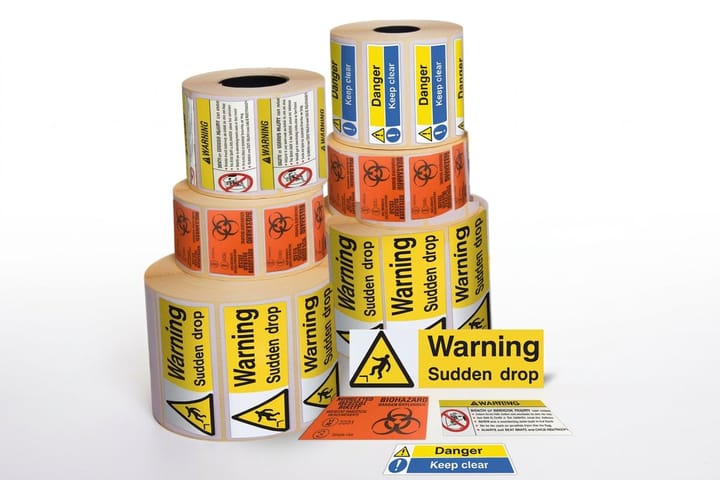
Roll warning labels arrive wound on a core instead of cut onto sheets, which is what a hand applicator or a bench-top labeler needs to feed. The entry price is $322.98 against $23.88 for the sheet-cut version, and that is the honest trade: the highest starting cost in this set and the lowest cost per label once you are past a few thousand pieces.
Two lines on the order form decide whether the roll runs at all. Core size has to match the mandrel on your applicator. Wind direction, meaning which edge of the label leaves the roll first and whether the face points out or in, has to match how the machine presents the label to the container. Get either wrong and you own a technically perfect roll that has to be rewound by hand before anyone can use it.
Do the crossover math before you commit. A one-off batch of two hundred drum labels is a sheet job every time. A production line applying the same corrosive warning to every container that leaves the building is a roll job, and the labor saved is usually a bigger number than the print. Roll stickers versus sheet stickers versus die cut lays out where the lines cross, and inventory labeling best practices covers keeping the numbering and the placement consistent once volume climbs.
5. Reflective stickers, readable when a torch is the only light
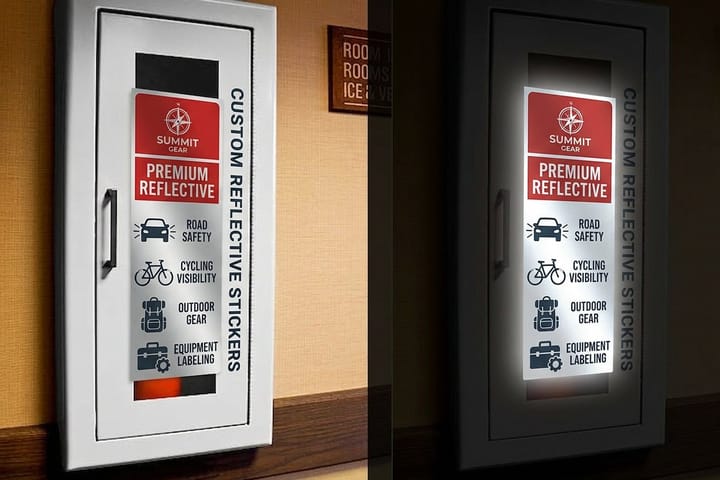
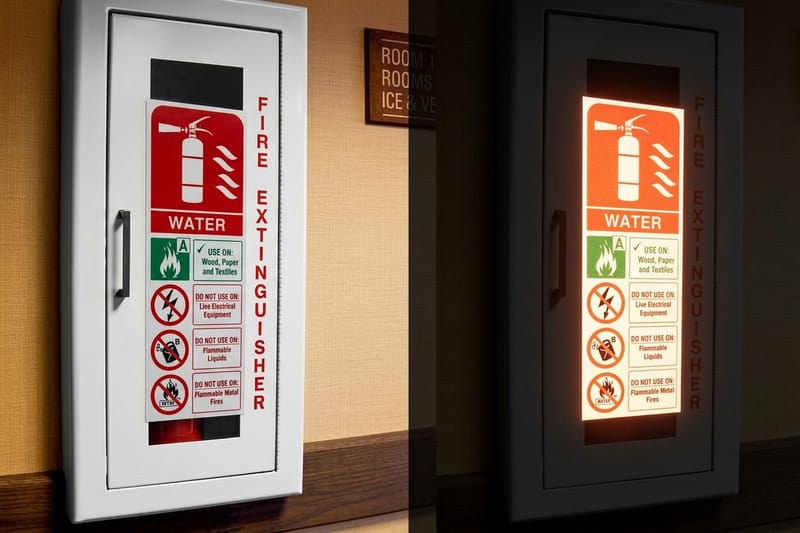
Reflective stickers print on retroreflective vinyl, a face that returns light along the path it arrived on instead of scattering it. Point a headlamp, a torch or a set of headlights at one from thirty feet away in the dark and it lights up like it is powered. That is what puts a hazard warning in front of someone during a power cut, a night shift or a walk through a tank farm at 3am.
The trade-off is the thing most people find out after they order. Retroreflection only works when the light source sits close to the viewer's eye. Under a warehouse high bay, where the light comes from above and your eyes are below it, a reflective label bounces the beam back at the ceiling and reads flatter and duller than ordinary white vinyl. It is a poor choice for a lit corridor and an excellent one for anywhere a person arrives carrying their own light.
Match it to the job: helmets and hard hat shells, plant room doors, gate posts, trailer sides, cable trays above head height. Where you need the same behavior on a temporary board rather than a sticker, reflective coroplast gives you a staked panel for a few weeks of works, and the rest of the range sits in our reflective printing collection.
6. Reflective aluminum signs, the warning you post rather than stick

Some hazards have nowhere to take a label. A trench, a yard entrance, an overhead line, a bay a truck reverses into: there is no flat, clean, permanent surface anywhere near the danger. Reflective aluminum signs solve that by carrying the warning on a rigid panel you drill and post, with a reflective face so headlights find it after dark.
The limitation is the same one that makes it useful. A rigid sign cannot follow a curve, will not stay on a vibrating machine guard and needs a post, a fence or a wall plus fixings before it does anything. It also has to be read from further away, so size the type to the distance. Sign shops work to roughly one inch of capital letter height for every thirty to fifty feet of reading distance, which means a warning meant to be read from a hundred feet needs letters two to three inches tall, and that number sets the panel size long before the artwork does.
Two neighbors finish the job. Floor decals put the boundary of a hazard zone on the ground where people are already looking, and they need an anti-slip laminate rather than plain vinyl or the marking becomes the hazard. For the material comparison behind the panel choice, read the most durable sign materials and safety signs in the workplace, and if vehicles are involved, truck crossing and warning signs covers placement distances.
Specs and pricing
Compare the two you will reorder most
The everyday indoor label and the outdoor synthetic are the two most plants buy again and again, and they sit at opposite ends of the price ladder. Here are the live specs and quantity breaks for both, straight from the configurator.


| Quantity | Price Per Unit | Total |
|---|---|---|
| 25 | 95.5¢ | $23.88 |
| 50 | 72.9¢ | $36.44 |
| 100 | 42.7¢ | $42.72 |
| 150 | 32.7¢ | $49.01 |
| 200 | 27.6¢ | $55.29 |
| 250 | 24.6¢ | $61.57 |
| 300 | 22.0¢ | $65.97 |
| 400 | 17.6¢ | $70.36 |
| Quantity | Price Per Unit | Total |
|---|---|---|
| 1 | $84.68 | $84.68 |
Wally explains the three builds and the sign
Order for the harshest thing the surface will ever meet
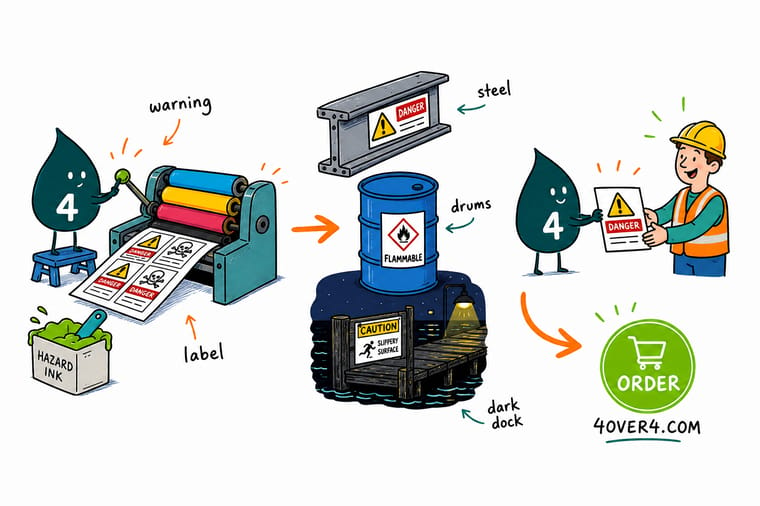
Wally walks the site the way a hazard does. The cabinet door indoors gets coated paper, because nothing worse than a duster ever reaches it. The machine that gets wiped with solvent every shift gets a laminate over the print, with a clear margin outside the artwork so the cut edge has somewhere harmless to wick. The drum in the yard gets a synthetic face, applied warm and dry on clean steel. The dark doorway gets a retroreflective sticker, which only lights up when the person carries their own torch. And the trench with no surface to stick to gets a posted aluminum sign. Match the build to the surface and the warning is still legible at the next inspection.
Shop reflective printing →See it in use
Warning labels plants have applied






Explore more
Where to go next

By the numbers
What a hazard warning can be printed on
Common Questions
Common questions about warning and hazard labels
What is the difference between DANGER, WARNING and CAUTION on a label?
They rank how bad the outcome is and how certain it is. DANGER is reserved for a hazard that will cause death or serious injury to anyone who is exposed to it, such as a live bus bar behind an open panel. WARNING covers a hazard that could cause death or serious injury, which is most guarded machinery and most corrosive chemicals. CAUTION covers minor or moderate injury. NOTICE covers damage to equipment with no injury involved, and it is the one that does not carry the safety alert triangle. The mistake worth avoiding is printing DANGER on every label in the building, because once four labels on one machine all shout the same word an operator stops reading any of them.
Do printed warning labels satisfy OSHA requirements?
A printed label can carry compliant content, but the compliance sits in what the label says and where it is placed, not in the fact that it was printed. OSHA hazard communication rules set what has to appear on a shipped chemical container, and the ANSI Z535 standards set the format most workplace safety labels follow. We print what you specify at the size and material you specify. Have your safety officer or your EHS consultant sign off the wording, the pictograms and the placement before the job goes to print, because a reprint is cheap and a failed inspection is not.
Which warning label survives solvent and pressure washing?
A laminated build, and for anything hosed down at pressure a synthetic face rather than paper. Premium warning labels put a clear laminate over the ink, which handles a daily wipe. Premium waterproof labels use a synthetic face underneath that laminate, so the sheet does not soften even when it stays wet. The weak point on both is the die-cut edge, so leave a clear laminate margin outside your artwork and ask for rounded corners, since a square corner is the first thing a pressure washer lifts.
Do reflective labels work under warehouse lighting?
Not the way people expect. Retroreflective material sends light back toward its source, so it only appears bright when the light is coming from beside the viewer, as with a headlamp, a torch or vehicle headlights. Under a high bay fixture mounted above head height, the reflected light goes back to the ceiling and the label looks duller than plain white vinyl. Use reflective stickers for dark plant rooms, night yards, power cuts and anywhere staff carry their own light, and use a high contrast non-reflective label in a well lit corridor.
What size should a hazard label be?
Size it to the distance a person needs to read it from. For close-range labels applied to a machine or a container, the message has to be legible from where the operator actually stands, which is usually within about six feet, so the signal word carries the panel and the body copy can be small. For a posted sign read from further away, the working rule is roughly one inch of capital letter height for every thirty to fifty feet of viewing distance. That number sets the panel size before you draw anything.
Can I put a warning label on a hot surface or an engine?
Not the labels in this set. Standard pressure-sensitive adhesives are rated for ordinary ambient service, and heat softens them, so a label on a manifold, a steam line or an oven housing creeps and then lifts. Paper faces scorch and laminates can blister. Where the surface runs hot, the answer is either a high-temperature label specification or an engraved or stamped plate mechanically fixed near the hazard rather than on it. Tell us the surface temperature before you order rather than discovering it in service.
When do roll warning labels beat sheet labels?
When a machine is applying them, or when the hours somebody spends peeling by hand cost more than the price difference. Roll warning labels start at $322.98 against $23.88 for the sheet-cut version, so the roll only pays back once the quantity is in the thousands and the per-label price has crossed over. A one-off batch of two hundred drum labels is a sheet job. A line labeling every container that leaves the building is a roll job.
How do I mark a hazard zone on a floor?
With floor decals rather than a wall sign, because people walking through a plant look at the ground far more than at the walls. The specification that matters is the laminate: a floor graphic needs an anti-slip top layer, otherwise a printed vinyl panel on polished concrete becomes slick when it is wet and the marking creates a hazard of its own. Keep the shapes simple, keep them clear of the wheel path where pallet trucks turn, and expect to replace them in a high traffic aisle sooner than anything on a wall.
Get Started
Order 25 premium warning labels, out in 3 business days
Print the six-piece warning and hazard set at 4OVER4.COM. Pick your shapes, face stocks and finishes, and watch every price update live as you build the order.
Legal Disclaimer
Gold Standard guarantees apply to all standard orders placed through 4over4.com. Price match requires verifiable proof of a competitor's published price for an equivalent product with matching specifications and turnaround time. Satisfaction guarantee covers manufacturing defects and print quality issues. Contact support with order number and documentation. On-time delivery rate based on tracked orders 1999 to 2026. Individual results may vary based on shipping carrier performance.
