
The 7-Piece Real Estate Site Sign Bundle That Sells the Listing From the Curb
One panel on a post is not a sign package. A listing has to be read at four distances: the car at 35 miles an hour, the corner two streets back, the walk to the front door, and the hand that takes a flyer. Here are the seven pieces that cover all four, from $16.48 for 50 postcards.
A real estate site sign bundle is seven printed pieces that live at the listing itself: the sign panel in the post or H-frame, an aluminum version of it for long listings, directional yard signs at the corner, a Signicade A-frame on the walk, a feather flag at the curb on open house day, flyers for the tube box, and business cards stapled to those flyers. Order them in one run and the same color, headshot, and type land on every piece from the street to the buyer’s hand.
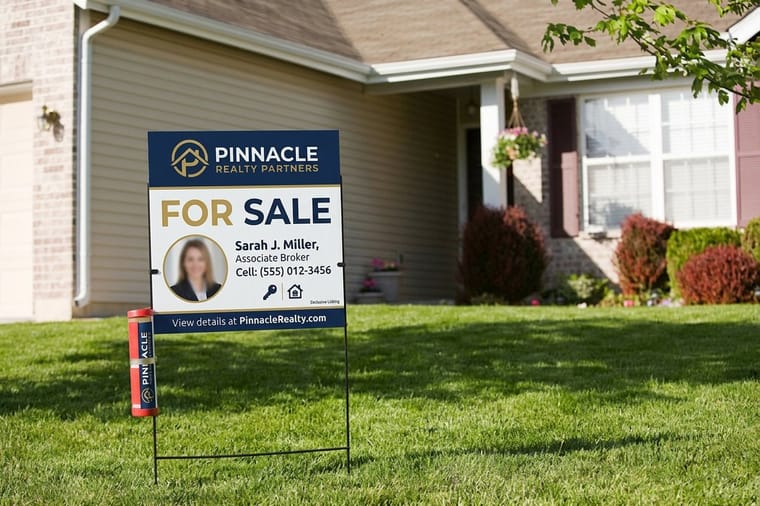
The picks
Seven pieces, from $16.48 postcards to a $108.75 flag
Start with whichever piece the listing is missing, or print the whole bundle at once so nothing on the street looks borrowed. Each product below can be laid out from scratch in our free online designer, or built from a realtor-ready design template. Prices come straight from the configurator and fall as the quantity climbs.
-
 1 Real Estate Signs From $25
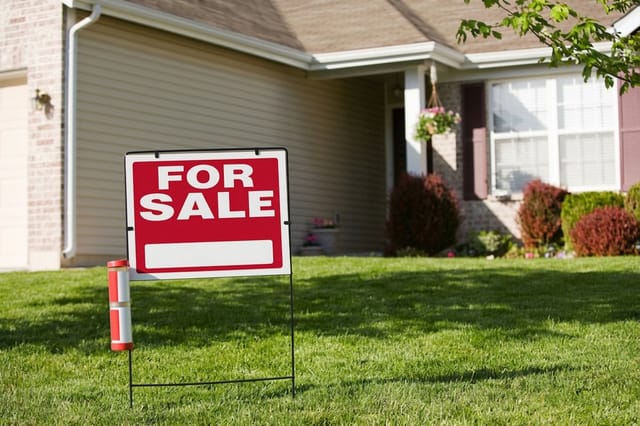
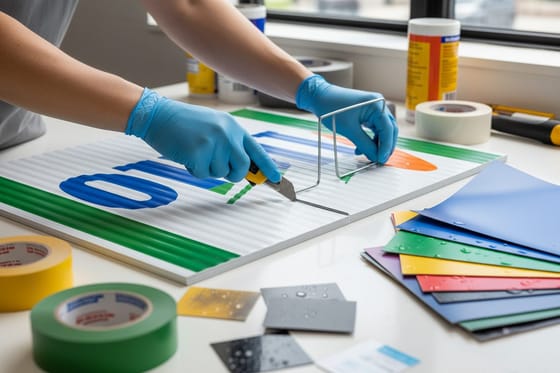
The panel that hangs in the post or the H-frame. Coroplast, printed both sides, replaced every few listings without a second thought about the cost.
-
 2 Aluminum Signs From $36
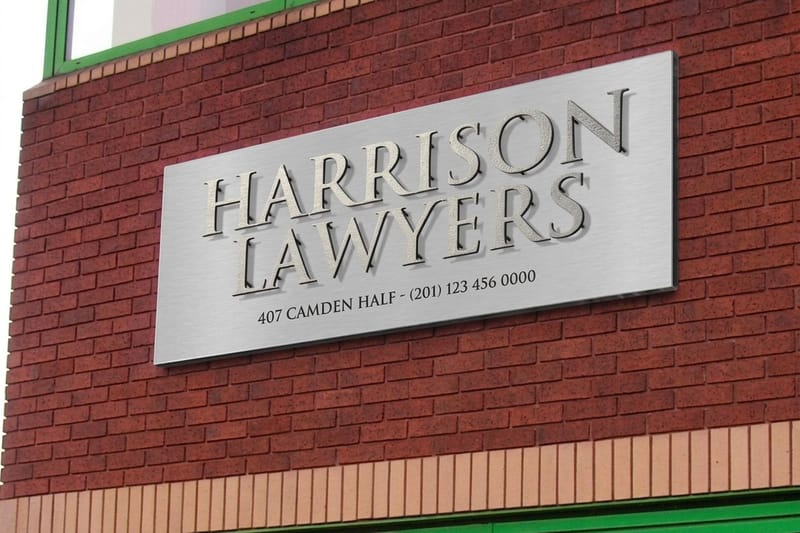
The same panel in metal for the listing that will sit through a whole season. It stays flat in the frame and shrugs off a freeze that makes plastic brittle.
-
 3 Yard Signs From $25
Directional arrows on H-stakes at the corner and every turn. Cheap enough to buy in tens, which matters because some of them will not come home.
-
 4 Signicade A-Frames From $182.32
The weighted sidewalk sign that holds the open house hours at the foot of the walk. Buy it once and swap the printed insert per listing.
-
 5 Real Estate Flags From $108.75
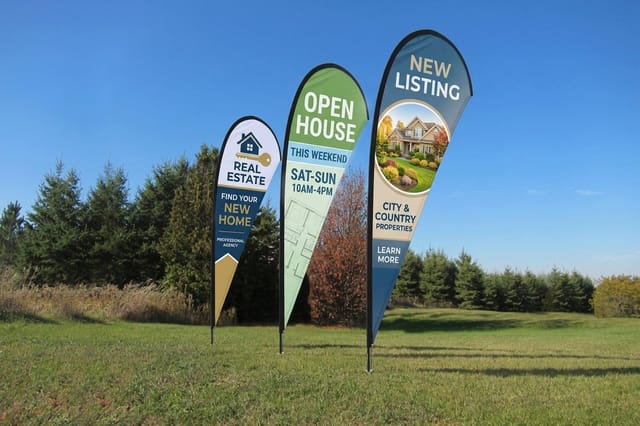
A feather flag at the curb is the only piece in the bundle that moves, and movement is what a driver catches before they can read anything.
-
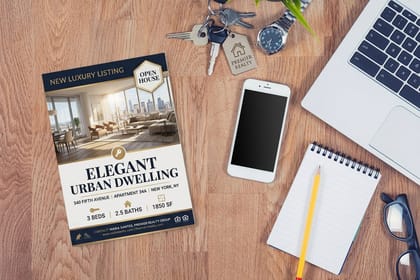 6 Real Estate Flyers From $39.54
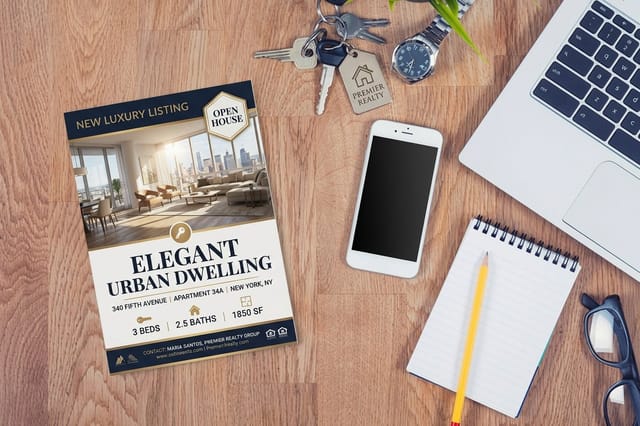
What goes in the tube box under the panel. Price, square footage, three photos, your number, printed heavy enough to survive a damp weekend.
-
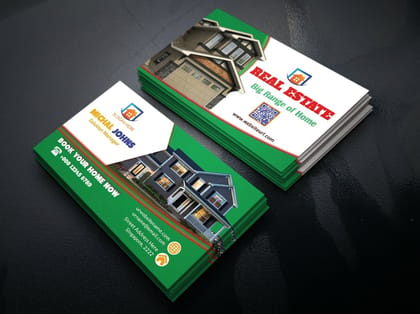 7 Real Estate Business Cards From $17.57
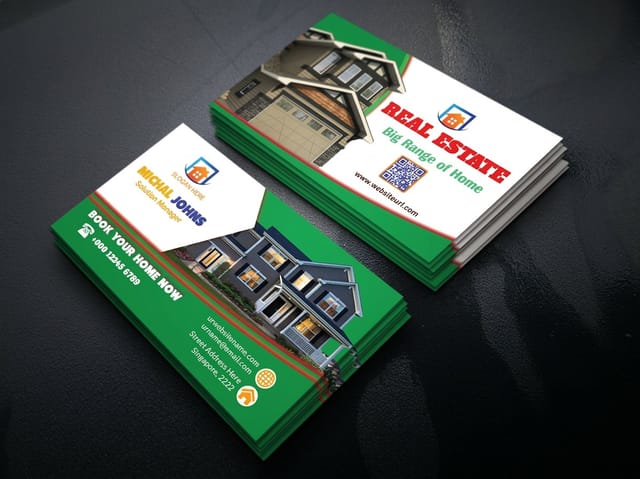
Stapled to the flyer and handed at the door. It is the piece that gets kept after the listing sells and the sign comes down.

Sizes and placement
What each piece is, what size it runs, and where it sits
Every piece in the bundle has a size it is normally ordered at and a spot on the property it is meant to hold. Read the row, tap the piece to jump to its section, then order the size that matches the distance you need it read from.
| Piece | Common size | Where it sits at the listing |
|---|---|---|
| 1. Real estate signs | 24 in x 36 in hanging panel, 18 in x 24 in for a small frame | In the post or H-frame at the front of the lot, square to the street the traffic comes from, printed on both faces. |
| 2. Aluminum signs | 18 in x 24 in or 24 in x 36 in rigid panel | The same frame, used when the listing is going to be out there for months or the frame belongs to the office. |
| 3. Yard signs | 18 in x 24 in coroplast on a wire H-stake | At the corner, at every turn between the main road and the door, and one at the driveway mouth. |
| 4. Signicade A-frame | 24 in x 36 in printed inserts in a weighted plastic frame | On the walk or the curb strip during the open house, then back in the trunk when you lock up. |
| 5. Real estate flags | Feather flag on a pole, ground spike or cross base | At the curb on open house day only, one or two, close enough to the panel that the eye moves from flag to name. |
| 6. Real estate flyers | 8.5 in x 11 in, one or two sides | The tube box on the post, the kitchen island during the showing, and the folder every buyer leaves with. |
| 7. Real estate business cards | 3.5 in x 2 in standard | Stapled to the flyer, on the counter at the open house, and in the pocket of anyone who walked the yard. |
Start here
How the seven pieces hand a buyer along
Read the bundle as a route, not a shopping list. The flag and the post panel work the road. The directional yard signs work the corner and the turns behind it. The A-frame works the last twenty feet of walk. The flyer and the card work the hand, and they keep working after the visitor has driven off. Below we walk the whole set in the order a buyer actually meets it.
1. Real estate signs: the panel everything else points at
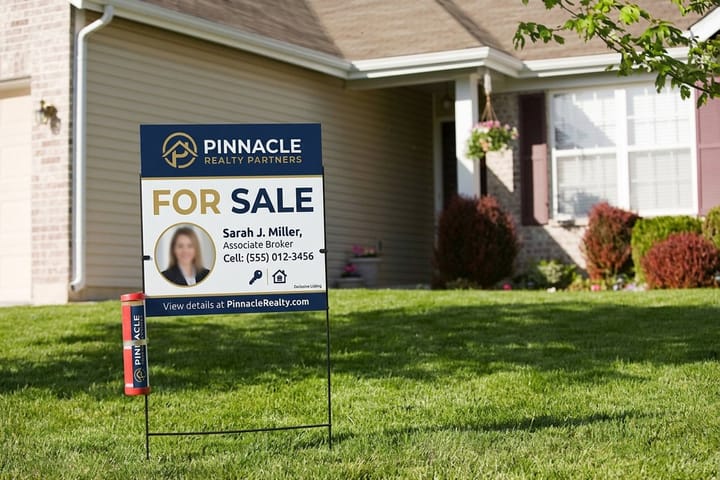
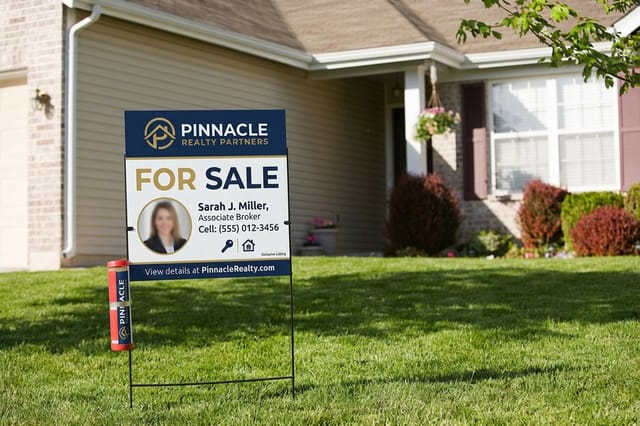
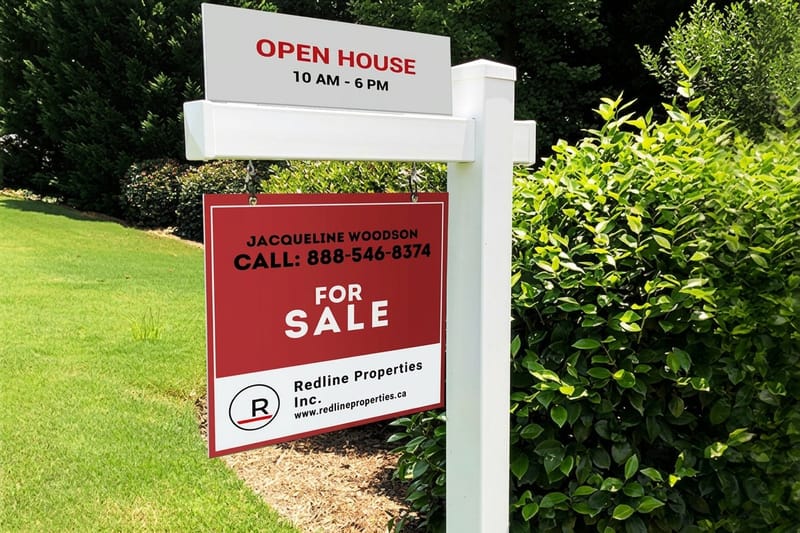
This is the sign people mean when they say "the sign." A real estate sign panel hangs in the post or H-frame at the front of the lot and carries three things: the brokerage mark, your name, and a phone number big enough to read from a moving car. Everything else on it is decoration.
Order it printed on both faces. Traffic comes from two directions on most streets, and a blank back is a sign that only works half the time. Then think about which way the flutes run, because corrugated plastic bends along them. A panel hung from two holes at the top wants the flutes running top to bottom or it bows in the middle by the second month, while a panel going onto an H-stake wants them running across so the wire legs slide in. Printers will run it either way if you say so on the order, and they will guess if you do not.
Sizes settle around 24 in x 36 in for a standard hanging frame and 18 in x 24 in for a smaller one, though your local code may cap the face area, so check before you order fifty. Our guide to real estate yard sign rules and design covers the placement limits agents run into most, and which materials last outdoors explains what each substrate does in sun and rain.
2. Aluminum signs: the same panel for the listing that will not move
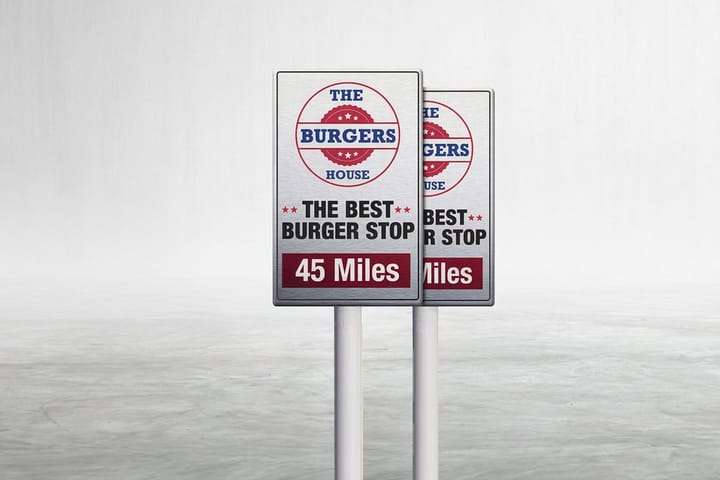
Coroplast is the right call on a house that will be gone in three weeks. It is the wrong call on a lot listing, a commercial space, or anything you expect to still be showing after the first frost. That is where an aluminum sign earns the difference: it holds a straight edge in the frame, it does not go chalky and brittle in a freeze, and the corner grommet holes do not tear out the way they do on plastic after a windy month.
The trade is real. Aluminum starts at $36 against $25 for the plastic panel, it dents if a mower throws a stone at it, and you cannot staple anything to it. So most offices buy a small stack of aluminum for long listings and reusable frames, and keep buying coroplast for the fast ones. If you want the full comparison against the other two outdoor formats, we set it out in yard signs vs A-frames vs banners.
One habit worth keeping either way: order the panel and the directionals in the same run. Two different printers, two months apart, gives you two slightly different reds on the same street corner, and that is the kind of thing a seller notices before you do.
3. Yard signs: the arrows that get people from the main road to the door
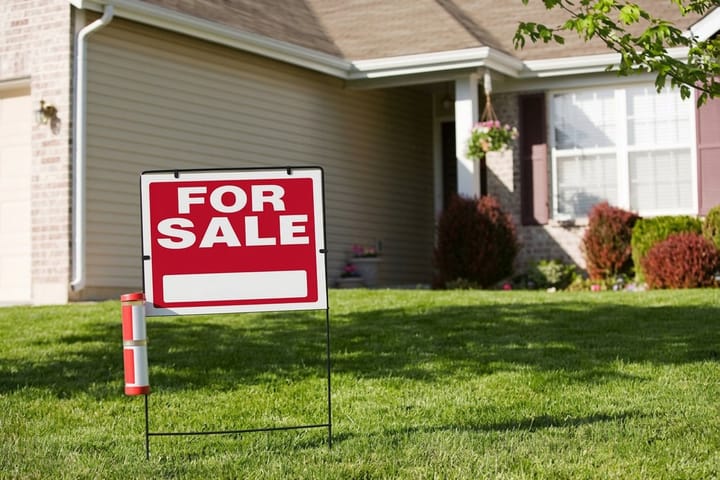
The post panel only works on people already driving past the house. Directional yard signs work on everyone else. Stake one at the corner off the main road, one at every turn after it, and one at the driveway mouth, and a listing two streets back from traffic gets the same drive-by volume as one on the boulevard.
Keep the copy to an arrow and one word. A driver taking a corner has about a second on your sign, and anything past OPEN or the arrow is not being read. Put the arrow on the outside edge pointing the way the car should turn, use the same two colors as the post panel, and stake it far enough back from the curb that a plow or a mower does not take it out on the first pass.
These are consumables. Buy ten more than the route needs, count them back into the trunk on Sunday, and expect a few to go missing anyway. On color, the palette does more work outdoors than the layout does, and our piece on the best colors for real estate yard signs shows which combinations still read at 40 miles an hour. If you want to see the substrate options side by side first, the yard signs printing category lists them all.
4. Signicade A-frame: the sign that says the door is open right now

A staked sign says a house is for sale. A Signicade A-frame at the foot of the walk says come in now, and that is a different message. It takes 24 in x 36 in printed inserts, it is weighted so it stays put in a gust, and it is the piece a visitor reads while they are already walking toward you.
At $182.32 it is by far the most expensive item in the bundle, and it should be, because you buy the frame once and then only reprint the insert. Most agents run two inserts: a generic OPEN HOUSE face that never changes, and a per-listing face with the address, hours, and headshot. When a Friday listing needs a new insert for Saturday morning, same-day printing is the difference between a printed sign and a handwritten one.
The catch is weight and storage. It fills a chunk of a trunk, it has to be carried out and carried back at every showing, and left on a public sidewalk after hours it will eventually be gone. Treat it as equipment you load, not signage you install. For the wider open house setup around it, the realtor open house kit covers the pieces that work indoors once people are through the door.
5. Real estate flags: the only piece on the lot that moves

A yard full of still signs is easy for a driver to filter out. A feather flag is not, because it moves. That is the entire job of real estate flags in this bundle: catch the eye from further down the block than any printed panel can, then hand the look over to the sign with your name on it. Set the flag within a few feet of the post so the eye travels between them.
Pick the base for the ground you actually have. A ground spike is quick and invisible, but in soft wet lawn a tall flag leans by the second hour and looks abandoned. On a driveway or a curb strip you need a cross base with a weight bag on it, which is heavier to carry and the reason most agents own both.
The limit worth naming: a flag reads as an event. Leave it standing every day for a month and it stops meaning "we are open today" and starts meaning nothing. Put it out on open house morning, take it down when you lock up, and it keeps its punch. If you want the harder numbers on how on-site signage performs against other lead sources, they are in our real estate marketing benchmarks.
6. Real estate flyers: the sheet that leaves in someone else’s car
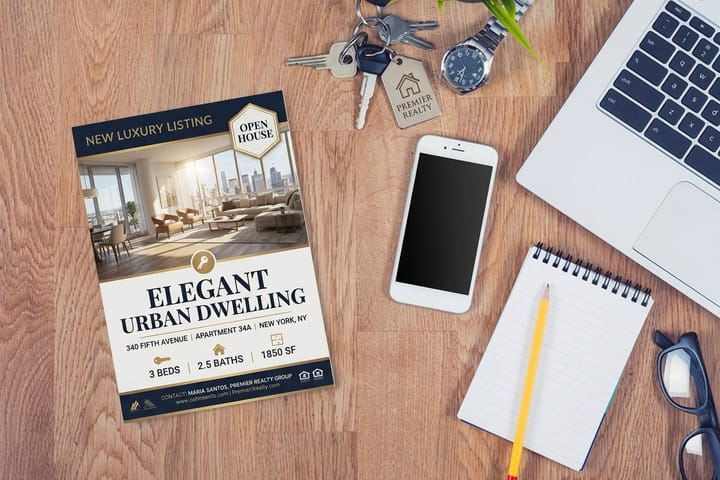
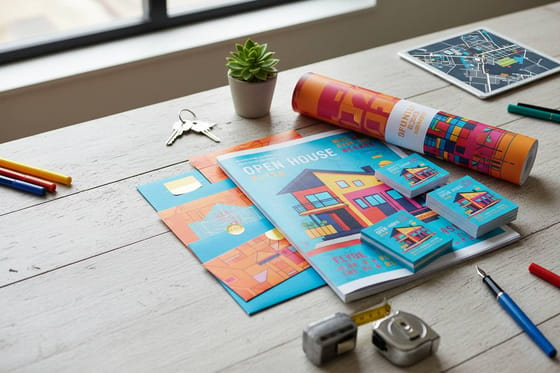
Every piece above brings someone to the house. The real estate flyer is the only one that leaves with them. It sits in the tube box under the panel, and it needs to hold the price, the beds and baths, the square footage, three good photos, and your phone number without looking cramped.
Put the price on it. A flyer without one sends the reader to a search engine, and once they are searching they are looking at someone else's listings too. The other habit that pays: print heavier than you think you need. A thin sheet in an open tube box on a humid Saturday curls into a tube by Sunday and reads as neglect, which is exactly the wrong signal on a listing.
Count what you leave and restock on your route. Twenty in the box, checked every few days, beats a hundred that go pulpy in one rain. For a luxury listing where a single sheet undersells the property, step up to real estate brochures, and when the goal is the neighborhood rather than the passer-by, real estate postcards do the just-listed and just-sold work by mail. You can build any of them from a design template instead of starting from a blank page.
7. Real estate business cards: the piece that outlives the listing
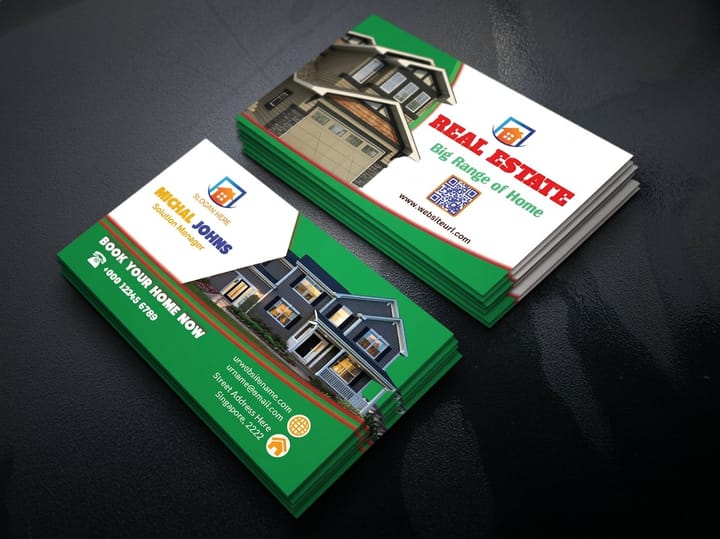
The sign comes down the week the house closes. The card stays in a wallet. At $17.57 a real estate business card is the cheapest item here and the one with the longest life, which is why it belongs in the bundle rather than in a separate order six months later.
Staple one to every flyer before the flyers go in the box, and keep a stack on the counter at the open house. Give the back a job: a QR code to the listing page, or to your current inventory once this house sells, turns a contact card into an entry point. Match the stock and the finish to the flyer so the two pieces read as one set in the hand.
What not to do is put eight ways to reach you on it. One number, one email, one QR code, and the brokerage mark. There are stronger layout ideas in our roundup of real estate business card design ideas, and if you want the card to be part of a wider farming effort rather than a listing leave-behind, the realtor local marketing pack is the next set to look at.
Specs and pricing
Compare the two panels: coroplast and aluminum
The listing panel is the piece you reorder most, and the only real decision on it is the material. Aluminum holds a season outdoors and corrugated plastic is the cheaper swap, and both are sized and quoted the same way below.

| Quantity | Price Per Unit | Total |
|---|---|---|
| 1 | $25.00 | $25.00 |
| Quantity | Price Per Unit | Total |
|---|---|---|
| 1 | $36.00 | $36.00 |
Wally walks the bundle from the road to the door
Seven pieces, four reading distances
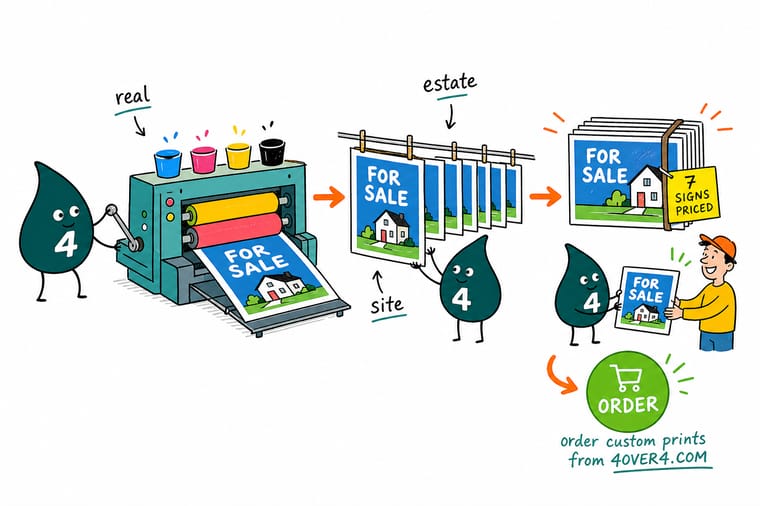
Wally starts at the curb where the flag moves and the panel names you, follows the arrow signs back to the main road, plants the A-frame on the walk, then puts a flyer and a card in the visitor’s hand. No single sign closes a listing on its own. Printed together in one order, they carry a buyer the whole way from a moving car to a phone call, and they all look like they came from the same office.
Shop real estate printing →See it in use
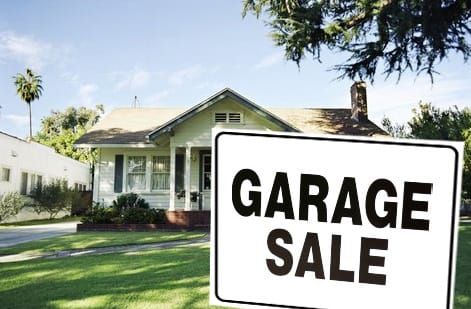
Yard signs already staked at listings



Explore more
Where to go next


By the numbers
What a listing can be printed on, curb to hand
Common Questions
Common questions about real estate site signs
What goes in a real estate site sign bundle?
Seven pieces, each sized for a different reading distance: a real estate sign panel for the post or H-frame, an aluminum version of that panel for long listings, directional yard signs for the corner and every turn, a Signicade A-frame for the walk on open house day, a feather flag at the curb, flyers for the tube box, and business cards stapled to those flyers. You can order any one on its own, but printing them together is what keeps the color and the type matched from the street to the buyer’s hand.
How much does a real estate site sign bundle cost?
Every price updates live in the configurator as you change size, material, finish, and quantity. Starting points at 4OVER4.COM are $25 for real estate sign panels, $36 for aluminum signs, $25 for yard signs, $182.32 for a Signicade A-frame, $108.75 for real estate flags, $39.54 for flyers, and $17.57 for business cards. The A-frame is the one-time buy in that list, since you reprint only the insert afterwards.
Should the listing panel be coroplast or aluminum?
Coroplast for anything that turns over in a few weeks, aluminum for anything that sits. Aluminum costs about eleven dollars more per panel, but it stays flat in the frame, it will not go brittle in a freeze, and its mounting holes do not tear out after a windy stretch the way corrugated plastic does. Most offices carry both and choose by expected days on market.
Which way should the flutes run on a corrugated plastic sign?
It depends on how the sign is mounted, and it is worth putting on the order. On a wire H-stake the flutes have to run left to right so the legs slide into the channels. On a panel hung from two holes in a frame you want them running top to bottom, because a hung panel with horizontal flutes bows in the middle after a month of weather. Aluminum sidesteps the question entirely since it has no flutes.
How many directional signs does one listing need?
Count the turns. One at the corner where a driver leaves the main road, one at each turn after that, and one at the driveway, which is usually three to six for a suburban listing. Then add spares, because directionals get mown, snapped, and taken. Ordering ten or fifteen at once is cheaper per sign than reordering three at a time all season.
Can I get a new A-frame insert printed before a weekend open house?
Yes. Inserts, directional yard signs, and flyers are exactly the pieces same-day printing exists for, so a Thursday listing can have matching signage on the walk Saturday morning. Have the artwork sized correctly before you order and the turnaround is the only variable left.
How do I keep flyers from going soft in the tube box?
Print heavier and restock more often. A light sheet in an open box curls within a couple of humid days and starts reading as a stale listing, so choose a thicker stock with a coating, load about twenty at a time, and check the box on your regular route rather than filling it once and forgetting it. Keep the spares flat in the car, not standing in a door pocket.
Get Started
Print the whole listing at once
Order the seven-piece site sign bundle as one run at 4OVER4.COM. Pick your sizes, materials, and finishes, and watch every price update live as you build the order.
Legal Disclaimer
Gold Standard guarantees apply to all standard orders placed through 4over4.com. Price match requires verifiable proof of a competitor's published price for an equivalent product with matching specifications and turnaround time. Satisfaction guarantee covers manufacturing defects and print quality issues. Contact support with order number and documentation. On-time delivery rate based on tracked orders 1999 to 2026. Individual results may vary based on shipping carrier performance.
