
Mastering Paid Marketing Metrics With 5 Print Picks You Can Actually Track
Every metric on this list is one number divided by another. Print gets called unmeasurable because the piece usually carries neither number, which is a design decision and therefore fixable. These are the five products that fix it, starting at $16.48 for 50 postcards.
Offline campaigns become measurable the moment each printed piece carries its own code and its own short URL. Spend and quantity already come with the invoice, so the code supplies the responses and the sales, and cost per response, CPA and ROAS turn into arithmetic. Five products do that work at 4OVER4.COM: direct mail postcards from $89.68 for a known denominator, standard postcards from $16.48 for a cheap split test, standard flyers from $39.54 for volume, door hangers from $290.41 for a geographic holdout, and standard rack cards from $42.84 for per-venue reporting. The five start at $478.95 together, or $188.54 without the door hangers.
The picks
Five pieces, from $16.48 postcards to $290.41 door hangers
Buy them in this order, not all at once. Counter postcards are cheap enough to learn on, the mailing is where your numbers get graded, and door hangers only earn their place once you have two matched routes and someone to walk them. Prices come from the configurator and fall per piece as the quantity climbs.
Direct mail postcards from $89.68
The only piece in the kit that hands you the bottom of the fraction for free. You mailed 2,000 to a named list, so a response rate is arithmetic rather than a hunch, and every metric under it becomes calculable.
Standard postcards from $16.48
Cheap enough to be wrong about twice in a week. At this starting price you can run a genuine A and B split with one variable changed, which is the only honest way to learn what moved the number.
Standard flyers from $39.54
The best cost per piece in the kit and the worst attribution. Nothing here buys more paper per dollar, and nothing here tells you less about who saw it unless you put a distinct code on every drop point.
Door hangers from $290.41
The one piece that supports a real holdout test. Hang two matched routes, leave a third alone, and the difference in orders by street is a controlled result no digital channel gives you at this scale.
Standard rack cards from $42.84
One code per host location turns a rack of partners into a ranked channel report. Cheap to reprint per venue, which is what makes per-venue tracking affordable in the first place.



The arithmetic
Where a printed campaign's CPA actually comes from
Four inputs feed every metric worth quoting. Two of them are handed to you when the job ships. The other two have to be built into the artwork before it goes to press, and that is the whole difference between a measured channel and an argument at a meeting.
Spend and quantity are free. The invoice tells you what the job cost and the order form tells you how many pieces exist, so cost per piece is settled before anybody sees the artwork. Responses and sales are the two that go missing, because a printed piece with no code produces no row anywhere in your analytics, and a channel with no rows always loses the budget argument to one that reports itself. The definitions behind each ratio, and which of them mean anything offline, are in our paid marketing metrics guide.
Be strict about the numerator. Spend is the print invoice plus postage plus the hours you or your staff put into delivering the thing, valued at what you actually pay for those hours. A door hanger campaign where two people walk 600 doors on a Saturday has a labor cost several times the print cost, and a CPA that ignores it is not conservative, it is wrong. The same applies to a mailing, where postage is routinely the larger of the two lines.
Then be equally strict about the denominator. Pieces printed is not pieces delivered, and pieces delivered is not people reached. Print the run, log what actually went out, and use that log as your base. If a metric needs a number you did not record, do not estimate it and quote it as measured; drop the metric and use one you can defend, which for print is almost always cost per response.
Piece by piece
What each pick can measure, and how solid its denominator is
The five pieces differ less in what they cost than in what they can prove. Read the row, tap the piece to jump to its section, and start with whichever measurement gap is currently costing you a budget conversation.
| Piece | What it can measure | How solid the denominator is | Starts at |
|---|---|---|---|
| Direct mail postcards | Response rate, cost per response, CPA, ROAS | Exact. The mailed quantity is on the order. | $89.68 |
| Standard postcards | Split test lift between two versions | Good, if you batch one code per 250 handed out. | $16.48 |
| Standard flyers | Cost per response only | None once it is posted. Reach is unknowable. | $39.54 |
| Door hangers | Incremental lift against a holdout route | Exact by route, if you log doors per route. | $290.41 |
| Standard rack cards | Channel share by host location | Soft. Cards taken, not cards read. | $42.84 |
1. Direct mail postcards: the only channel that gives you the denominator
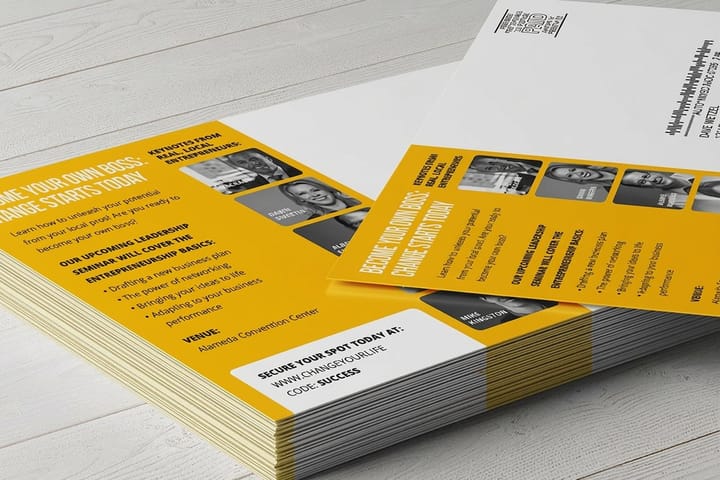
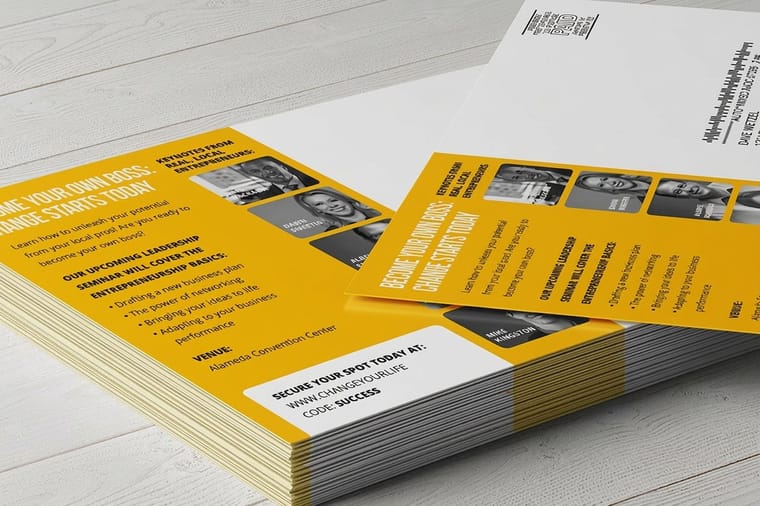
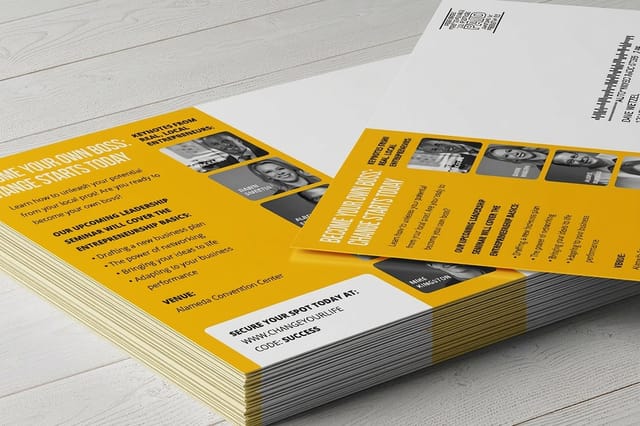
Direct mail postcards from $89.68 are where an offline campaign stops being a guess. Mail is the one print channel where you know exactly how many pieces went out, to whom, and on what day, so response rate, cost per response, CPA and ROAS are all just division. Everything else in this kit is trying to imitate that.
Give each drop its own promo code and its own short URL, and keep the pair on the piece rather than in your head. A code like SPRING24 tells you the season. A code like PC-0412-A tells you the piece, the drop date and which half of the split it belonged to, which is what you will actually want three months later when someone asks why you are still mailing. Our breakdown of direct mail cost per piece shows how the print line and the postage line move independently as the quantity climbs.
Two constraints come from the post office rather than from design. Cards mail at USPS card prices from 3.5 by 5 in up to 4.25 by 6 in within the thickness limits, and a larger piece such as a 6 by 9 in mailer is rated as a letter or a flat, which changes your cost per piece before a single word is written. The address panel then takes the right side of the back plus the barcode clear zone along the bottom, so plan the code and the offer around what is left.
The honest limit is speed. A mailed piece can sit on a fridge for a fortnight, so a result read on day four is not a result, it is a scare. Give the drop a full month, keep the code live well past that, and never judge two drops against each other unless they went out in the same week. List quality moves the number more than the artwork does, which is the case our mailing list guide makes in detail, and the response-side tactics are in how to lift direct mail results.
2. Standard postcards: the cheapest unit you can run a real test on
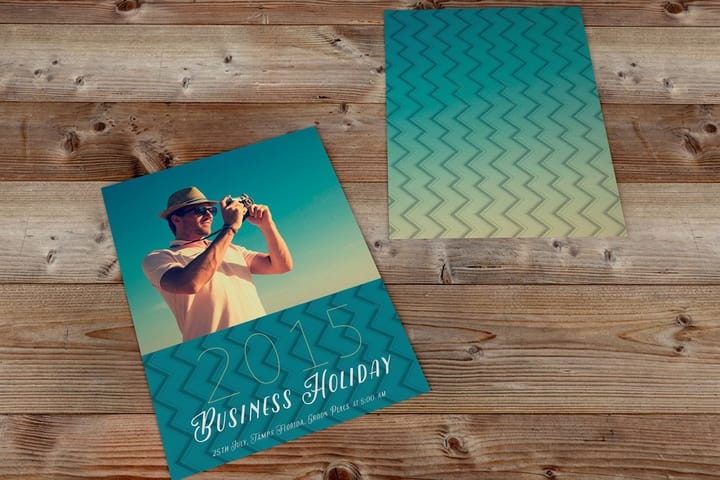
A test costs whatever the losing version costs. Standard postcards from $16.48 make that number small enough that you can afford to be wrong, which is why the split test belongs here rather than on the expensive pieces. Print version A and version B, change exactly one thing between them, and give each version its own code.
One thing means one thing. Offer against offer is a test. A new offer with a new photo and a new headline is three changes and a wasted print run, because whatever the codes tell you afterwards, you will not know which change did it. The usual first test worth running is the offer itself, since it moves response further than any layout decision you can make.
Handed out rather than mailed, a postcard loses its exact denominator, and you can get most of it back with batching. Bundle 250 cards to a code, hand the bundle out at one place over one week, and the response rate for that bundle is real to within the few cards that went in a bin unread. Label the code so the reader knows what the scan does, keep the quiet border around it clear of artwork, print it at 1 in or larger for something held in the hand, and scan the printed proof with two phones before the run. The export settings that keep the modules crisp are in our steps for generating QR codes in InDesign, and there are counter-ready layouts to start from in our design templates. More sizes and stocks sit in the postcard printing range.
3. Standard flyers: best cost per piece, worst attribution

Standard flyers from $39.54 buy more printed surface per dollar than anything else in this kit. At 8.5 by 11 in there is room for the problem, the offer, the catch and the action, and no postage bill sits on top of the print. That is the whole appeal, and it comes with a real cost.
Pinned to a community board, a flyer has no denominator at all. You cannot count who walked past, so cost per thousand impressions is a number nobody can honestly produce for it, and any agency that quotes you one for print is quoting a wish. What you can produce is cost per response, which needs a distinct code per drop point. Ten cafes, ten codes, and by the end of the month you know which three are worth restocking and which seven were paper spent on a wall.
Use the size on hierarchy rather than on more words. One element is clearly the largest thing on the sheet, the offer is second, the action is third, and everything else is quiet enough to skip. Build the artwork at 300 ppi at final size with 0.125 in of bleed on every edge, keep the code and all type 0.125 in inside the trim, and when an offer is tied to a date, same-day printing is what keeps a Thursday decision on the street by Friday. The wider comparison of what each channel can and cannot report is in digital versus traditional marketing.
4. Door hangers: the holdout test you can actually run
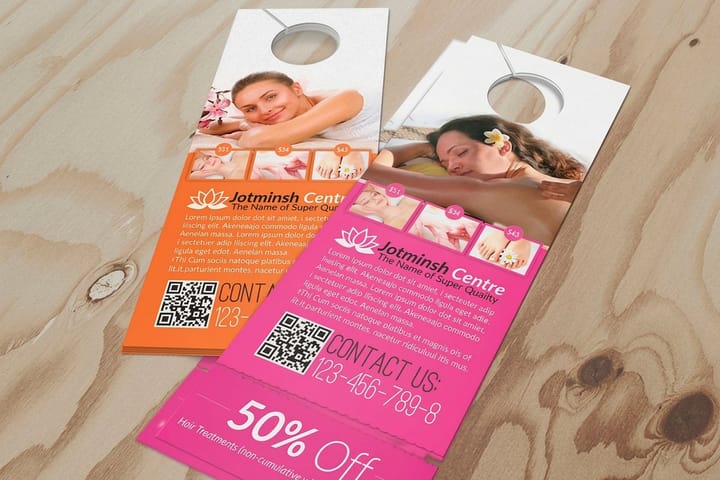
Every marketer wants incrementality and almost nobody gets to test for it. Door hangers from $290.41 are the exception, because a walking route is a clean geographic unit. Hang route A, hang route B, deliberately leave route C alone, then compare orders by street over the following six weeks. The gap between the hung routes and the untouched one is lift, not correlation.
Two things make that test hold up. Match the routes on the things that matter to your business, usually housing type and rough income band, since comparing a street of apartments against a street of detached houses measures the street rather than the campaign. Then log the doors per route as you walk, because the count on the order form is what you printed, not what you delivered, and the delivered count is your denominator.
Now the catch, and it is the one most people leave out of the spreadsheet. Hanging is labor, and labor is usually the bigger half of the spend. Two people covering 600 doors in an afternoon cost more than the print did, and none of it appears on the 4OVER4 invoice, so a CPA calculated from the print bill alone flatters the channel badly. Put the hours in the numerator at whatever you actually pay for them, then compare. If the answer is still good, it is genuinely good. Our overview of how direct mail marketing works covers the same discipline for mailed pieces, where postage plays the role labor plays here.
5. Standard rack cards: a ranked report on your partner channel

Standard rack cards from $42.84 print at the 4 by 9 in size that standard brochure racks are built around, which is what lets you put them in hotels, visitor centers, gyms and clinics without asking anyone to modify their display. The measurement trick is one code per host, not one code per campaign.
Do that and the rack stops being a hopeful pile of paper and becomes a channel report. Twelve venues, twelve codes, and after a season you can see that four earn their restock, five are flat and three have never produced a scan. Reprinting a single venue's card is cheap at this starting price, which is exactly why per-venue tracking is affordable here and not on a large-format piece.
The soft spot is what a code can and cannot see. A card taken from a rack and pocketed is not a response, and it is not a read either. Nothing counts until somebody scans, so rack cards under-report their own influence and you should expect that rather than argue with it. Treat the scan count as a floor, compare venues against each other rather than against your mailing, and remember that rack traffic is seasonal in most towns. Where the piece fits into a broader plan is laid out in our small business marketing plan guide, and the rest of the mailed and handed formats sit in the direct mail services collection.
Specs and pricing
The two pieces your numbers will live on
Mailed postcards give you the clean denominator and counter postcards give you the cheap test, so those two get reordered more than anything else once a tracked program is running. Here are the live specs and price ladders from the configurator.


| Quantity | Price Per Unit | Total |
|---|---|---|
| 50 | 33.0¢ | $16.48 |
| 100 | 24.2¢ | $24.16 |
| 200 | 15.9¢ | $31.86 |
| 300 | 12.8¢ | $38.45 |
| 400 | 11.3¢ | $45.04 |
| 500 | 10.3¢ | $51.62 |
| 600 | 9.89¢ | $59.31 |
| 700 | 9.57¢ | $67.00 |
| Quantity | Price Per Unit | Total |
|---|---|---|
| 50 | 79.1¢ | $39.54 |
| 100 | 57.1¢ | $57.11 |
| 200 | 37.3¢ | $74.69 |
| 300 | 28.6¢ | $85.68 |
| 400 | 24.4¢ | $97.76 |
| 500 | 21.8¢ | $108.75 |
| 600 | 18.7¢ | $112.03 |
| 700 | 16.5¢ | $115.33 |
Wally does the division
Spend on top, coded responses underneath
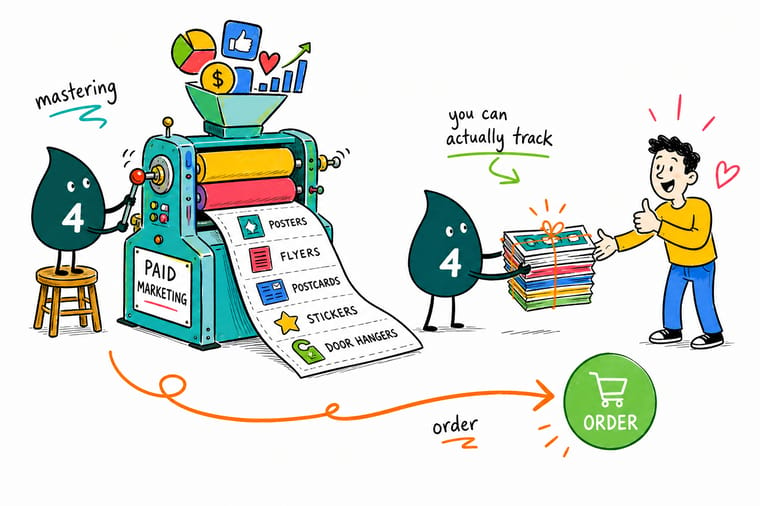
Wally once mailed 2,000 postcards with no code on them, then spent a month arguing with himself about whether they worked. Now every piece leaves with a code and a short link of its own: the mailer, the counter card, the flyer on the cafe board, the door hanger, the rack card in the hotel lobby. Same landing page, five paths, five counts. The invoice gives him the top of the fraction and the codes give him the bottom, and the argument is over before it starts.
Shop the direct mail collection →See it in use
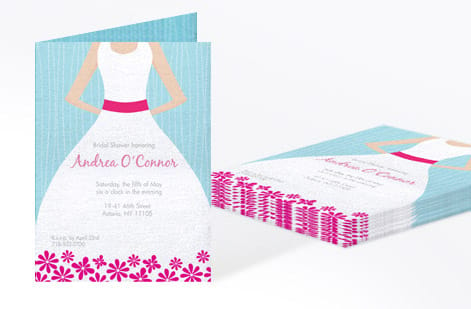
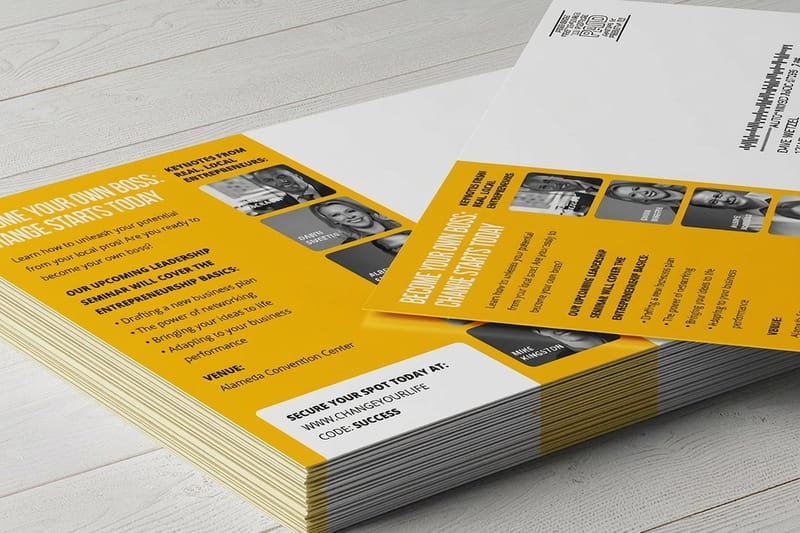
Postcards printed with a tracked code







Explore more
Where to go next


By the numbers
The catalog behind a measurable print run
Common Questions
Common questions about measuring print campaigns
Which metric should I judge a printed campaign on?
Cost per response first, then cost per acquisition. Impressions cannot be counted on paper, so CPM and click-through rate have no honest denominator offline and any figure quoted for them is estimated rather than measured. Cost per response tells you whether the creative and the offer are working, and CPA tells you whether the channel deserves the budget. Use ROAS only once you have enough coded sales for the number to be stable, because two extra orders can double it on a small drop.
How do I calculate CPA for a print drop?
Add every dollar the drop consumed, then divide by the sales that carried its code. The print invoice is the easy part. Postage on a mailing, the hours spent hanging door hangers or restocking racks, and any design time you paid for all belong in the numerator, and leaving them out is the single most common reason a print CPA looks better on a spreadsheet than it did in the bank account.
How long should I wait before reading direct mail results?
Give a mailing a full month before you call it, and keep the code live for months after that. Mail gets pinned to a fridge, put in a drawer and found again, so the response curve is long and lumpy in a way a paid search campaign is not. Reading a drop at day four produces a panic rather than a result, and reprinting on that panic is how a working piece gets killed.
Should each piece have its own QR code or its own URL?
Give it both, pointing at the same landing page through its own short path on your own domain. The path is what the analytics count, and the QR code is only a fast way to type it. That way a person who reads the URL and types it manually still lands in the same bucket as the person who scanned, and one landing page keeps all your traffic together instead of splitting it across five thin pages that never gather enough visitors to compare.
How big does a QR code need to be on a printed piece?
A code reads at roughly ten times its own width, so work back from the distance. A postcard or rack card held in the hand at about 10 in is fine with a 1 in code. A door hanger read at arm length wants a little more. Keep the quiet border around the code free of artwork, keep the whole code at least 0.125 in inside the trim so the cutter cannot clip a module, and scan the printed proof with two different phones before approving the run.
Can I compare print against paid search on the same numbers?
At CPA and ROAS, yes, as long as both sides count all their costs the same way. At CPM, CPC and click-through rate, no, because those need an impression count and print does not have one. The comparison people usually want is whether the next $1,000 does more in an ad account or in the mail, and cost per acquisition answers that without pretending print has an impression figure.
What does the five-piece kit cost to start?
The five starting prices add up to $478.95 at 4OVER4.COM: direct mail postcards from $89.68, standard postcards from $16.48, standard flyers from $39.54, door hangers from $290.41 and standard rack cards from $42.84. Leaving door hangers until you have a route worth testing brings the other four to $188.54 together. Every per-piece price falls as the quantity climbs, and the configurator updates live as you change size, stock and finish.
Why is my print CPA worse than my ads CPA in the first month?
Usually two reasons, and both are timing rather than performance. The design work and any list rental are one-time costs sitting on a single drop, so they land entirely in month one instead of being spread across the reprints that follow. The response window is also longer, so sales that belong to the drop arrive after you closed the spreadsheet. Compare the second drop against the first before deciding anything, and keep the code live so the late orders find their way home.
Get Started
Print the pieces your spreadsheet can read
Order the five-piece kit as one tracked set at 4OVER4.COM. Standard postcards start at $16.48 for 50 on 14pt gloss cover in 3 business days, and each other piece is configured for size, stock and finish on its own page.
Legal Disclaimer
Gold Standard guarantees apply to all standard orders placed through 4over4.com. Price match requires verifiable proof of a competitor's published price for an equivalent product with matching specifications and turnaround time. Satisfaction guarantee covers manufacturing defects and print quality issues. Contact support with order number and documentation. On-time delivery rate based on tracked orders 1999 to 2026. Individual results may vary based on shipping carrier performance.
