
How to Scale With YouTube Ads Using 6 Print Products
Two things break when a YouTube campaign gets bigger: you run out of fresh creative, and you stop being able to see where the revenue came from. These six printed pieces attack both, starting at $19.77 for 25 ecommerce thank you cards.
Scaling YouTube ads is a creative supply problem and a measurement problem, not a budget problem. Print solves both from the edges: a backdrop, a swappable banner panel, and a fixed wardrobe turn one shoot day into several distinct-looking variants, while a mailer box, a die-cut sticker, and an insert card carrying one printed code per campaign report the buyers the view-through window drops.
The picks
Six pieces, from $19.77 thank you cards to $711.78 mailer boxes
Buy them in the order your program breaks. If you cannot produce enough variants, start with the backdrop and the stand. If you cannot tell which campaign produced a sale, start with the insert card, which is the cheapest of the six. Each piece can be laid out from scratch in our free online designer or started from a design template, and every price below updates in the configurator as the quantity climbs.
Sizes and stages
What each piece is, and where it lands in the loop
Three of these six exist to raise creative output on shoot day. The other three ride along with the product and bring back either footage or a number. Read the row, tap a piece to jump to its section, then order the size that matches the job rather than the one that looks impressive on a quote.
| Piece | Spec and starting price | Where it does its work |
|---|---|---|
| 1. Step-and-repeat banners | 8 ft x 8 ft fabric wall, logo tile repeating on a 45 degree grid. From $217.50 | Behind the presenter on shoot day. One wall gives every talking-head variant the same authority frame, so the thing being tested is the hook and not the room. |
| 2. Retractable banner stands | 33 in x 80 in printed cassette in a weighted base. From $139 | Just off the presenter shoulder. Change the cassette between takes and the same corner of the same room reads as a different scene in the feed. |
| 3. Premium T-shirts | Ring-spun cotton, left-chest mark or full front. From $21.96 | On camera, and in the seeding box. A fixed wardrobe across variants keeps the A/B read clean; a small chest mark keeps a creator cut looking native. |
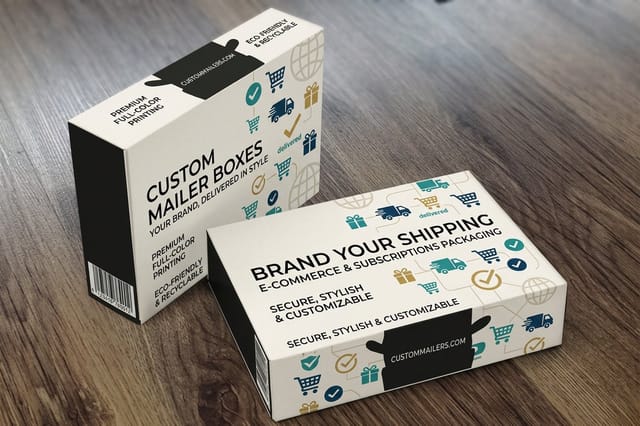
| 4. Custom mailer boxes | Die-cut corrugated, printed inside and out. From $711.78 | Creator and reviewer seeding, once you are sending hundreds rather than dozens. The inside print is what ends up on camera when the lid comes off. |
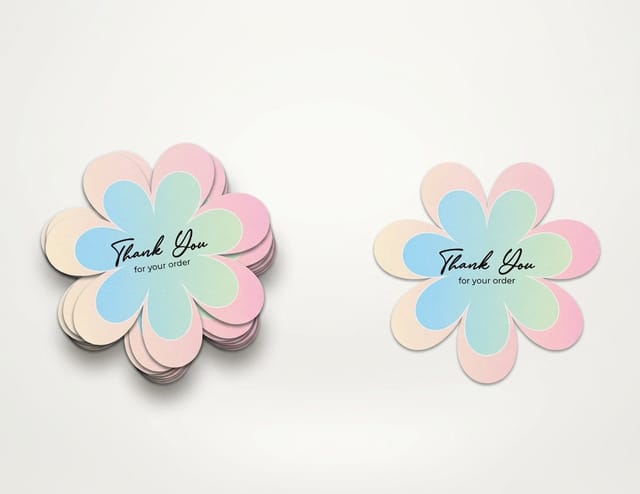
| 5. Die-cut stickers | Cut to the artwork outline, 2 in to 4 in typical. From $93.37 | In every box, at a cost low enough to include with no argument. It is the cheapest thing you own that ends up in somebody else’s footage. |
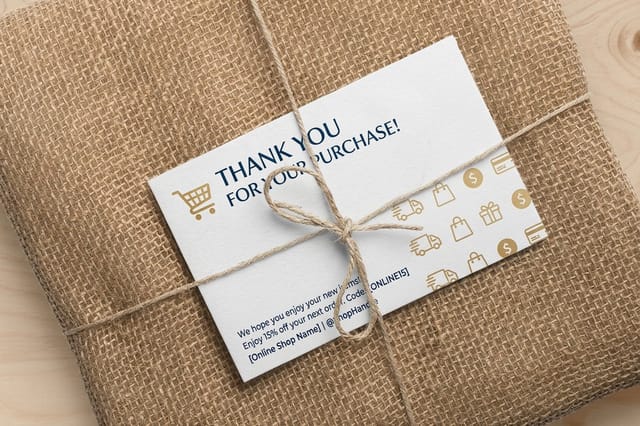
| 6. Ecommerce thank-you cards | 4 in x 6 in insert, one printed code per campaign. From $19.77 | On top of the product, facing up. This is the piece that reports the buyer who watched on a TV and typed your brand into a search bar two days later. |
Start here
Why a paid video channel needs anything printed at all
A scaling campaign eats creative faster than a small one, and it hides revenue better. Both problems live outside the ad account, which is why nothing inside the ad account fixes them. The first three picks below cut the cost of producing a new variant, because the expensive part of a shoot is the setup rather than the take. The last three ride out with the product and come back as either usable footage or an attributed sale. If you want the account-side thinking that sits alongside this kit, our paid marketing strategy guide covers budget stepping and creative testing, and mastering paid marketing metrics covers what to measure once the spend is real.
1. Step-and-repeat banners: the wall that makes a spare room look like a studio
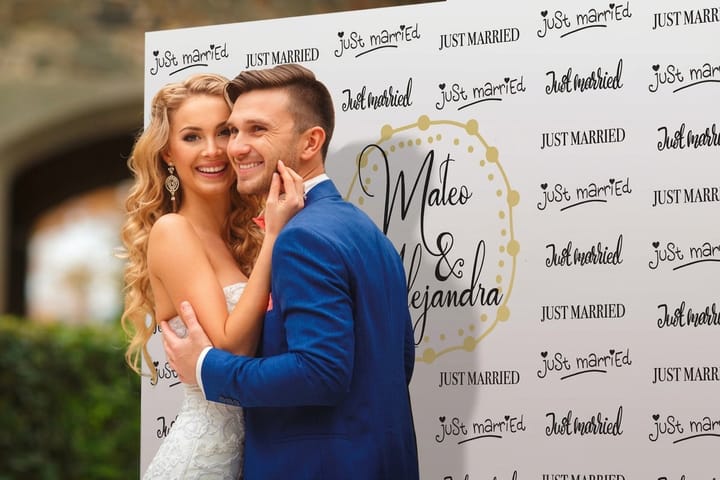
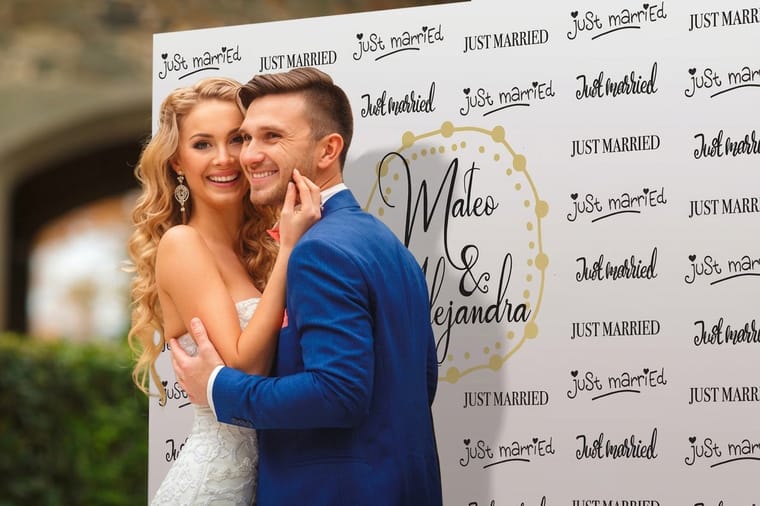
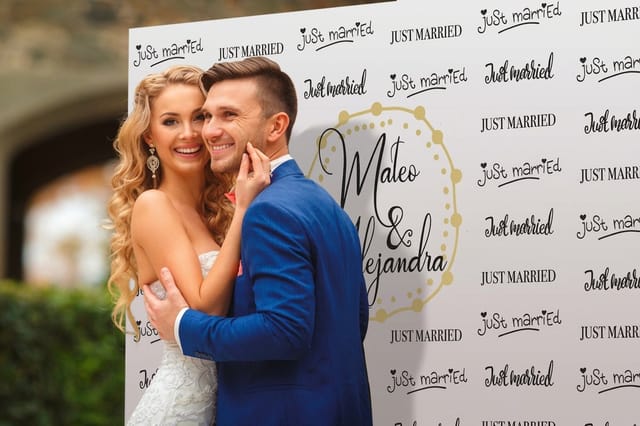
The fastest way to make a home-office corner stop looking like a home-office corner is to put a printed wall behind it. A step-and-repeat banner gives you an 8 ft x 8 ft branded surface that fills the frame at a normal talking-head focal length, and it goes up on a pole kit in about ten minutes. Order it in fabric rather than gloss vinyl. Vinyl throws your key light straight back into the lens as a hot spot that no grade will fix, and matte polyester absorbs it.
Lay the logo out on a 45 degree grid with the tile repeating roughly every 12 to 14 inches. Bigger tiles look like a poster and a presenter blocks half of one; smaller tiles turn into visual noise at YouTube’s mobile bitrate and go soft on the first pan. Keep the repeat off-center from where the presenter stands, so at least one whole logo is always readable over a shoulder.
Here is the limit nobody mentions. A repeating logo grid reads as a press wall, which is exactly right for an authority ad, a testimonial cut, or a founder explainer. It is wrong for a UGC-style variant that has to look like a person filming in their kitchen, and running a press wall behind a supposedly casual creator cut is the most common reason those variants underperform. Shoot the polished spots against the wall and the native-looking ones against a real room. Sizing, pole kits and stand options are covered in our custom backdrop and step-and-repeat banner guide, and the artwork setup, including the tile math, is in how to design step-and-repeat banners.
2. Retractable banner stands: one cassette swap equals one new scene
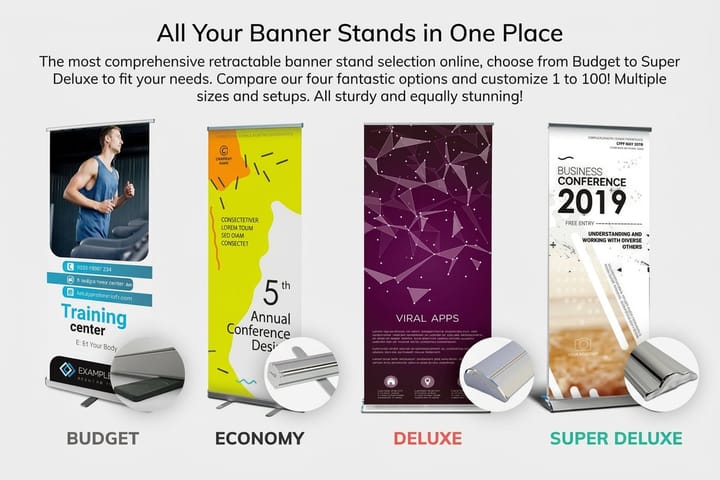
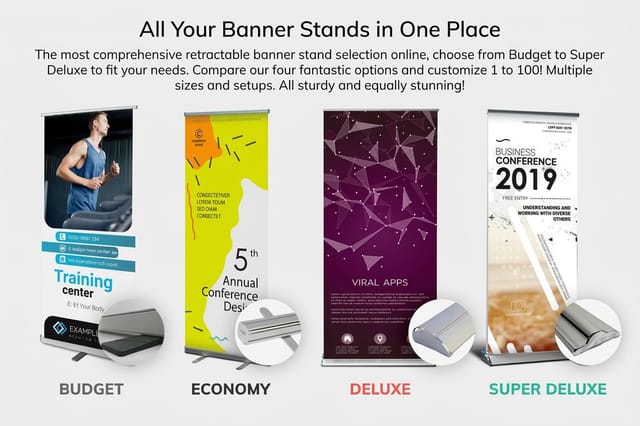
This is the piece that multiplies your shoot day. A retractable banner stand is a 33 in x 80 in printed panel that pulls out of a weighted base, and the printed cassette is a separate part from the hardware. Buy one base, buy three panels, and the same corner of the same room becomes three different-looking scenes in the time it takes to reload it.
Put the stand at the edge of frame, angled about 20 degrees off the wall so the light rakes across it instead of flattening it. Set it back far enough that it falls slightly out of focus. A perfectly sharp sales banner beside a presenter announces a commercial; a soft one just adds depth and brand color. Keep the top third of the panel clear, because that is the band a vertical 9:16 crop keeps and a 16:9 crop throws away.
The honest trade-offs are two. Retractable film curls at the leading edge after enough roll and unroll cycles, so a panel that lives in a car and gets used weekly starts waving at the top within a season; the fix is a fresh panel, not a new base, which is why the cassette-and-base split matters. And the standard base is weighted for indoor use only, so an outdoor shoot needs a water bag or the first gust puts your banner on the ground. Setup takes about two minutes once you have done it, walked through in how to set up a retractable banner stand, and the layout rules for a tall narrow panel are in how to design a pull-up banner.
3. Premium T-shirts: fixed wardrobe on camera, currency in the seeding box
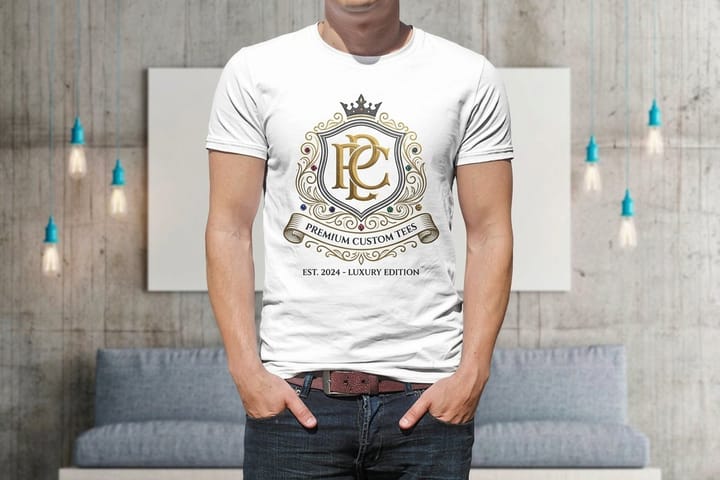
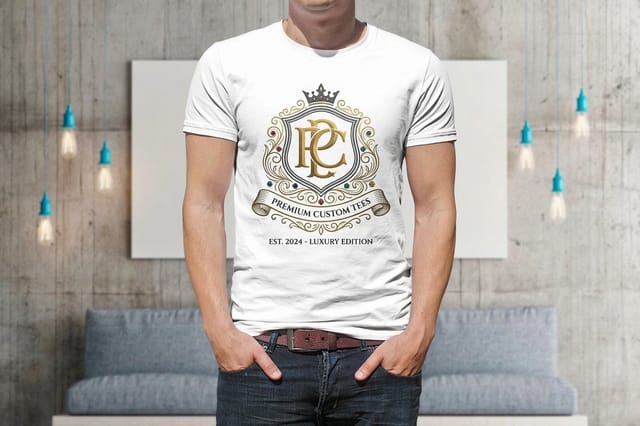
A branded tee does two separate jobs in a YouTube program, and they need two different prints. On camera, the point is consistency. If the presenter wears the same shirt across every variant you cut from a shoot, then when one hook beats another you know it was the hook. Change the shirt between takes and you have quietly added a second variable to a test you are paying to run. Premium T-shirts in ring-spun cotton hold their shape through a long shoot day and do not go glossy under a softbox the way a cheap polyester blend does.
The second job is the seeding box, and there the print needs to be smaller. A full-front logo turns a creator’s unboxing clip into an obvious sponsorship, which is the thing that flattens UGC-style ad performance. A left-chest mark about 3 in wide reads as a brand the person actually likes. Print the loud version for your own authority spots and the quiet version for everything you mail out.
One production note that costs people a reprint: thin white type on a dark shirt fills in. Screen ink spreads slightly into the weave, so any stroke under about 2 pt closes up and a fine serif turns into a smudge at arm’s length, let alone at 1080p. Thicken the strokes or pick a heavier weight before you approve the proof. If you are still deciding on the artwork, there are workable directions in our branded T-shirt ideas, and the ink-on-fabric color pairs that survive video compression are in 29 T-shirt and ink color combinations.
4. Custom mailer boxes: the prop that shows up in other people’s footage
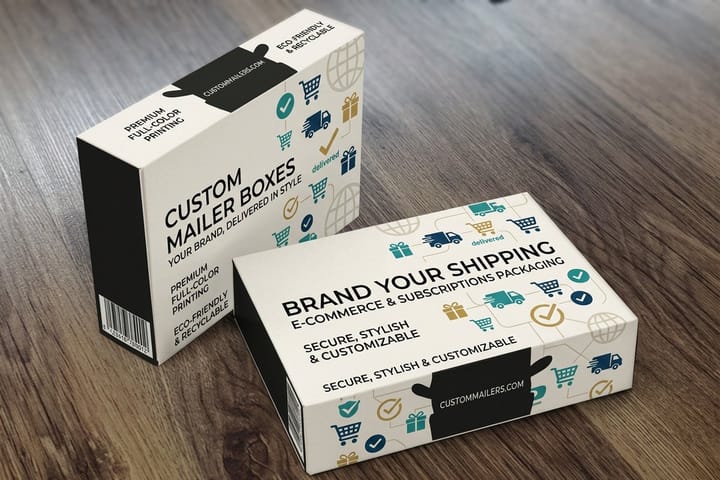
Once you are seeding creators to generate ad footage, the package is part of the shoot whether you budgeted for it or not. Every person you send product to films the lid coming off, and the inside of a plain brown box is three seconds of nothing. Custom mailer boxes print on the interior as well as the exterior, so the reveal has your color and a line of copy in it, and that clip is usable as an ad instead of being cut.
Now the part that decides whether you should buy them at all. Mailer boxes are a die-cut, tooled item, so the entry order runs to a few hundred units and starts at $711.78. If you are seeding ten people this quarter, that is the wrong line on the budget. Ship those ten in a plain box and spend the money on what goes inside it, because the insert card and the sticker do most of the visible work at a fraction of the cost. The box earns its price when you are mailing hundreds and the per-unit figure falls to something a marketing line item can carry.
Design it for a camera, not a shelf. The most-filmed surface is the inside of the lid, so put the message there rather than on the outside where a shipping label will cover it, and specify a matte finish so the overhead light in somebody’s apartment does not blow out the panel. There is a run of layouts worth stealing in mailer box design ideas for a memorable unboxing, and the material call between cardstock and corrugated is explained in cardstock vs corrugated boxes.
5. Die-cut stickers: the cheapest thing you own that keeps filming itself
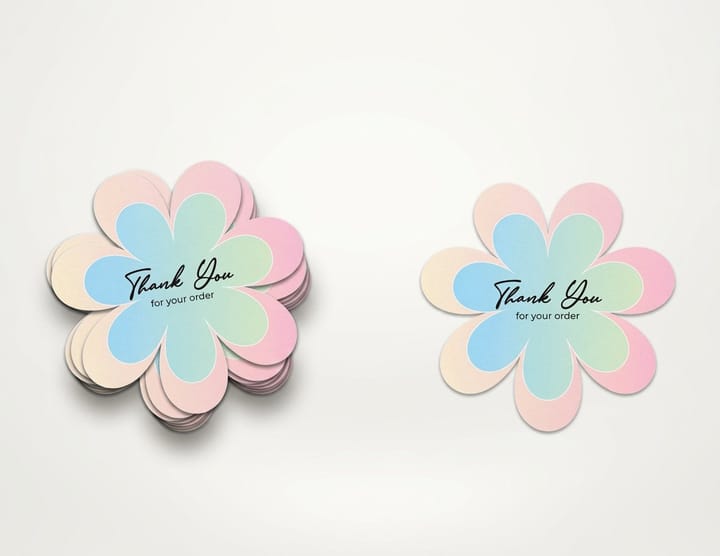
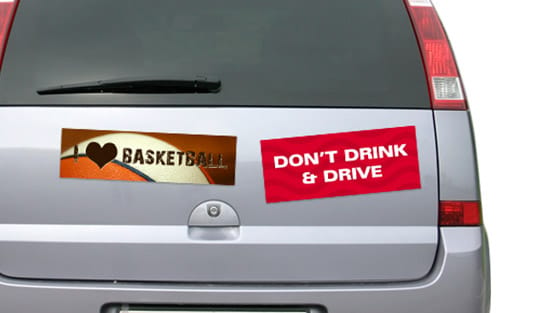
A sticker costs a fraction of everything else in this kit and has the longest tail. Die-cut stickers are cut to the outline of your artwork rather than to a square, which is the whole point: on a laptop lid in the corner of somebody’s vlog, a die-cut mark reads as your logo, while a rectangle reads as a rectangle with a logo inside it. That difference is the entire reason to pay for the cut.
Include one in every seeded box and every fulfilled order. It is the only piece here where nobody at your company will argue about the cost, and the payoff is that your mark keeps turning up in footage you did not pay to shoot. For creator kits, send two: people put one on a laptop and give the other away.
The limit is a curve. Vinyl this size lays flat on a laptop, a notebook or a hard case, but on a water bottle or a travel mug anything much over 3 in across starts to wrinkle at the edges because the sticker is flat and the surface is not. Keep bottle stickers under 3 in or accept the pucker. Material choice also decides whether it survives a dishwasher or fades on a car window, which is unpacked in choosing the right sticker material. For the distribution side, our take on sticker advertising covers where they actually get placed.
6. Ecommerce thank-you cards: the printed code that reports the sale YouTube missed
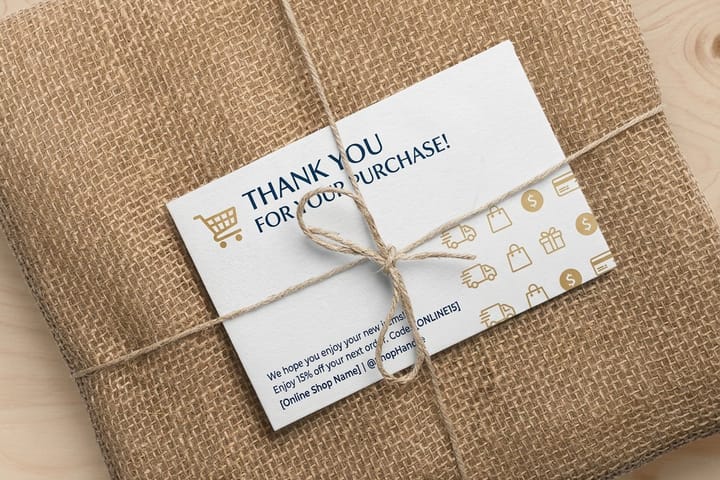
This is the piece that pays for the rest. YouTube counts a conversion inside its view-through window, and a real chunk of your buyers fall outside it: somebody watches the ad on a living-room TV, does nothing, and three days later types your brand name into a search bar on a laptop. That sale lands in your analytics as organic or direct, your reported YouTube return looks worse than it is, and you throttle a campaign that was working. An ecommerce thank-you card with a code unique to that campaign is how you get the sale back on the right line.
Print two things on it, not one. A QR code pointing at a tagged landing page, and a short human-readable code in plain type. Most people open a package with their phone in another room, and a QR alone under-reports for exactly that reason. Give the code four or five characters, avoid any pairing of O with zero or I with one, and print it at 12 pt or larger so nobody has to squint at a card in one hand and a keyboard under the other.
Give the code a reason to be used. A discount on the second order turns a measurement tool into a repeat-purchase driver, and it means the card is still working a month after the box went out. Change the code each time you launch a new creative batch and the insert becomes a running ledger of which batch is actually producing revenue. There is more on tracked print in creative ways to use QR codes in print, and the wider insert format options are in custom packaging inserts.
Specs and pricing
The two set pieces you will reprint most: backdrop and banner panel
The wall goes up once and stays. The banner panel is the consumable, because that is the piece you swap to get a new scene and the piece that curls first. Both ship in 3 business days, so a swap never holds up a shoot day.

| Quantity | Price Per Unit | Total |
|---|---|---|
| 25 | 79.1¢ | $19.77 |
| 50 | 50.5¢ | $25.27 |
| 100 | 42.8¢ | $42.84 |
| 200 | 25.8¢ | $51.62 |
| 300 | 20.1¢ | $60.42 |
| 400 | 17.3¢ | $69.20 |
| 500 | 15.6¢ | $77.99 |
| 600 | 15.4¢ | $92.26 |
| Quantity | Price Per Unit | Total |
|---|---|---|
| 1 | $21.96 | $21.96 |
| 2 | $16.47 | $32.93 |
| 3 | $16.46 | $49.39 |
| 4 | $15.93 | $63.71 |
| 5 | $15.93 | $79.63 |
| 6 | $15.93 | $95.56 |
| 7 | $15.85 | $110.94 |
| 8 | $15.38 | $123.02 |
Wally explains the loop
Print on the shoot side, print on the shipping side
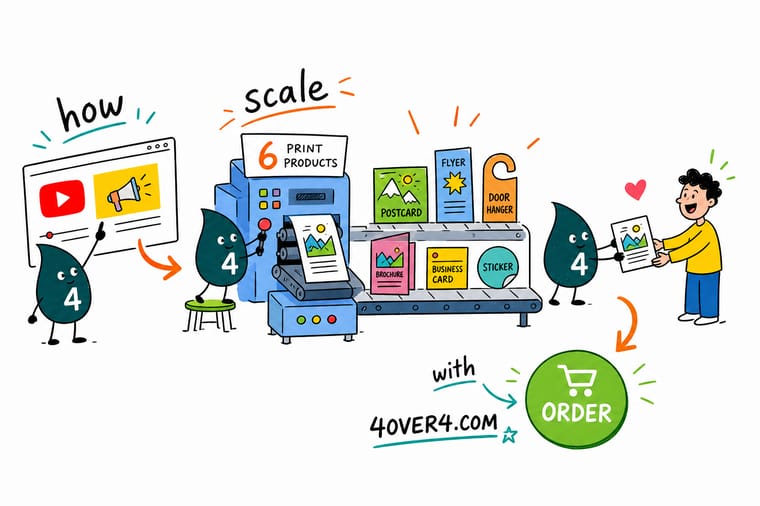
Wally walks it the way a campaign runs. The backdrop and the swappable banner panel let one shoot day produce several variants, so the ad account never runs dry. The tee stays the same across every take, so a win is a win for the hook and not the wardrobe. Then the box, the sticker, and the insert card go out with the product and come back as footage and as a redeemed code, which is the sale YouTube counted as organic. Six pieces, two jobs, both of them outside the ad account.
Shop marketing materials →See it in use
Die-cut stickers printed for creators

Explore more
Where to go next
By the numbers
What a shoot day can be printed on
Common Questions
Common questions about printing for a YouTube ads program
Does printing anything actually improve YouTube ad performance?
Not directly. No printed piece changes your CPM, your bid, or how the auction ranks your ad. What print changes is the two things around the ad: how many distinct-looking variants one shoot day can produce, and how much of the resulting revenue you can attribute back to the campaign. Both are the real constraints once spend goes up, which is why they are worth money.
How many creative variants do I need before a YouTube campaign scales?
More than most people plan for, because winners fatigue and the account needs fresh material continuously rather than in one batch. The practical move is to design the shoot so it yields several variants instead of one: a backdrop, a swappable banner panel behind the presenter, and a fixed wardrobe give you multiple distinct scenes from a single session in a single room.
What size backdrop do I need for a YouTube ad shoot?
An 8 ft x 8 ft step-and-repeat wall is the standard because it fills the frame behind a standing presenter at a normal talking-head focal length with room to move. Order it in matte fabric rather than gloss vinyl. Vinyl reflects your key light straight back into the lens as a hot spot, and no amount of color grading removes it afterwards.
How do I track sales from a YouTube ad when the buyer converts days later?
Print a code. YouTube credits conversions inside its view-through window, so a viewer who sees the ad on a TV and comes back through search days later gets logged as organic or direct. A thank-you card carrying one unique code per campaign, plus a QR to a tagged landing page, is how that purchase gets attributed to the right creative batch instead of disappearing into direct traffic.
Are custom mailer boxes worth it for creator seeding?
Only at volume. Mailer boxes are die-cut and tooled, so the entry order runs to a few hundred units starting at $711.78, and if you are seeding ten people this quarter the money is better spent on the insert card and the sticker inside a plain box. Once you are mailing hundreds a quarter, the printed interior becomes the most-filmed surface in the shipment and the per-unit price drops to something reasonable.
Should the presenter wear a branded shirt in a YouTube ad?
It depends which variant. For authority spots, founder explainers, and testimonial cuts, a branded shirt helps and the same shirt across every variant keeps your creative test honest. For UGC-style ads meant to look like a real person filming at home, a full-front logo announces the sponsorship and usually flattens performance. Print a small left-chest mark for those and keep the loud version for the studio.
What sticker size works on a water bottle without wrinkling?
Keep it under about 3 inches across. A die-cut vinyl sticker is flat and a bottle is not, so past roughly 3 inches the edges start to pucker as the material fights the curve. Laptop lids, notebooks, and hard cases are flat enough to take a 4 inch sticker cleanly, so size by the surface rather than picking one size for every placement.
Can I get this kit printed before a shoot next week?
The paper pieces yes, the fabricated ones need more room. Thank-you cards, stickers, and the retractable banner panel move on standard production turnarounds, and time-sensitive reprints are what same-day printing exists for. Custom mailer boxes are die-cut and tooled, so plan those well ahead of a shoot date rather than treating them as a last-minute add.
Get Started
Print the shoot day, then print the box
Order the six pieces as one branded set at 4OVER4.COM. Pick your sizes, materials, and finishes, and watch every price update live as you build the order.
Legal Disclaimer
Gold Standard guarantees apply to all standard orders placed through 4over4.com. Price match requires verifiable proof of a competitor's published price for an equivalent product with matching specifications and turnaround time. Satisfaction guarantee covers manufacturing defects and print quality issues. Contact support with order number and documentation. On-time delivery rate based on tracked orders 1999 to 2026. Individual results may vary based on shipping carrier performance.
