
5 Dual Raised Print Products That Stack Foil and Gloss on One Velvet Card
Dual raised is the finish people notice with their hands. Five products carry it, all on the same stock, and the price per piece drops hard once the run gets past a hundred. Here is the whole set with real prices, the sizes, and the three places the finish will let you down.
Dual raised means two raised effects on the same face of one card: two raised foil colors side by side, or one raised foil next to a raised spot UV gloss. Five 4OVER4 products carry it, all on a 16pt velvet laminated cover. Business cards start at $149 per 100, hangtags at $159, invitations at $249, postcards at $339 and greeting cards at $629, with gold, silver and holographic foil available in either position.

The picks
Five products that take two raised passes, $149 to $629 per 100
Ordered by price, cheapest first, so you can start where your budget lands. Every one of them prints on the same 16pt velvet laminated cover with two raised passes on the front, and every price below is the live configurator price for a run of 100. Start from a design template or build the layout from scratch in the online designer.
| Pick | Starting price | Why this one |
|---|---|---|
| 1. Dual Raised Business Cards | From $149 per 100 | The cheapest way to put the finish in somebody’s hand. At 1,000 the run costs $509, which is about 51 cents a card for a two-effect specialty piece. |
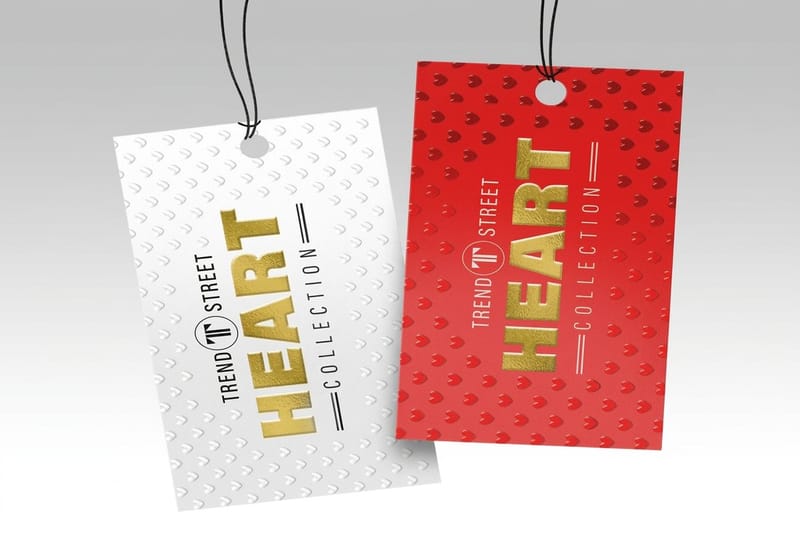
| 2. Dual Raised Hangtags | From $159 per 100 | A 2 in x 3.5 in tag, drilled with a 1/8 in hole, that does the job of packaging. Drops to roughly 53 cents a tag at 1,000. |
| 3. Dual Raised Invitations | From $249 per 100 | Two sizes, a 3.5 in x 5 in RSVP card and a 5 in x 7 in main card, so one order covers a full suite instead of two. |
| 4. Dual Raised Postcards | From $339 per 100 | The mailer that stops a hand mid-sort. 4 in x 6 in or 5 in x 7 in, and about $1.18 a card once the run reaches 1,000. |
| 5. Dual Raised Greeting Cards | From $629 per 100 | A 5 in x 7 in folded card, printed flat at 10 in x 7 in and scored. The per-card price falls to roughly $1.86 at 500. |
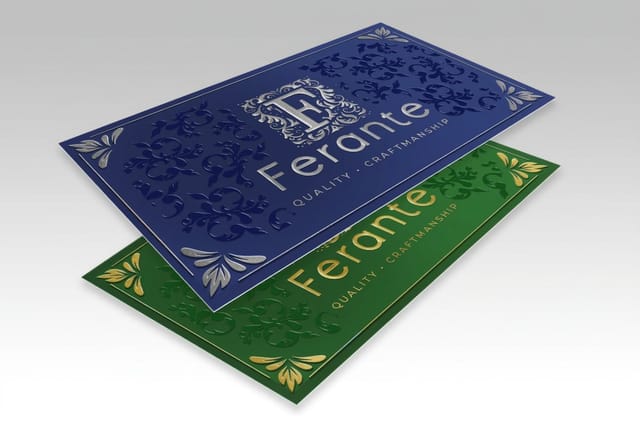


How it is built
Two passes, one face, one stock
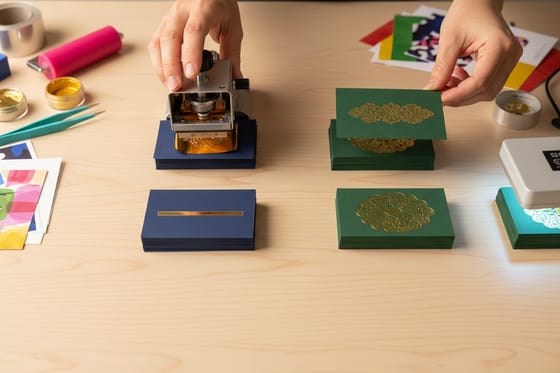
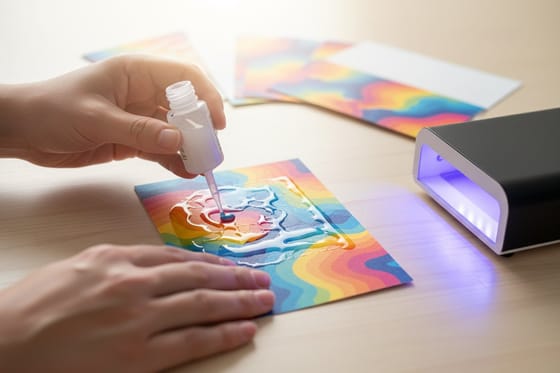
A dual raised piece is printed in full color first, then the raised passes are applied on top of the velvet laminate. Each effect is a separate pass with its own setup, which is why the artwork has to arrive as separate layers and why the two effects should never butt directly against each other. The edge view below is what the finish actually looks like under magnification.
Sizes and price ladders
The five products side by side
Same finish, same stock, five different jobs. Read the row for the size and the quantity where the price stops hurting, then jump to the section for the trade-off that comes with it.
| Product | Finished size | From | At volume | What it is for |
|---|---|---|---|---|
| Business cards | 3.5 in x 2 in | $149 / 100 | About $0.51 each at 1,000 | Handed across a table, where the raised edge does its work in the first second. |
| Hangtags | 2 in x 3.5 in, 1/8 in drilled hole | $159 / 100 | About $0.53 each at 1,000 | Strung on a garment, a bottle or a gift box to raise the perceived price. |
| Invitations | 3.5 in x 5 in and 5 in x 7 in | $249 / 100 | About $0.90 each at 1,000 | Weddings, galas and launches, where the envelope opening is the whole moment. |
| Postcards | 4 in x 6 in and 5 in x 7 in | $339 / 100 | About $1.18 each at 1,000 | Direct mail that has to beat a flat card on feel rather than on offer. |
| Greeting cards | 5 in x 7 in folded, flat 10 in x 7 in | $629 / 100 | About $1.86 each at 500 | Holiday sends and thank-yous that get kept on a shelf. |
1. Dual Raised Business Cards, from $149 per 100

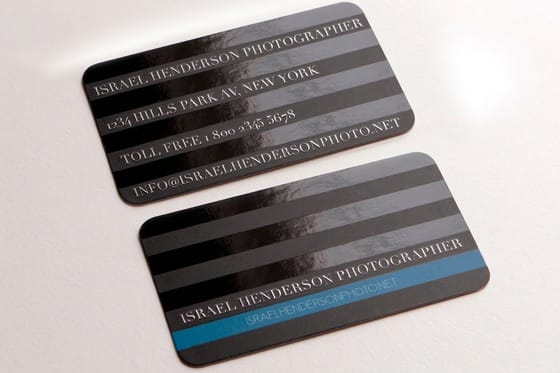
Start here, because this is the piece that gets touched the most for the least money. Dual Raised Business Cards put two raised effects on the front of a 16pt velvet laminated cover: either two raised foil colors set beside each other, or a raised spot UV gloss next to one raised foil. Run a thumb across the front and there is a real ridge. That is the difference between a card somebody files and a card somebody turns over.
The price ladder is the reason to think in bigger runs. A set of 100 is $149, so $1.49 a card. 250 is $179, 500 is $259, and 1,000 is $509, which works out near 51 cents a card. The raised finishing is set up once for the run, so the third-hundred cards cost almost nothing next to the first hundred. If you print cards twice a year anyway, one order of 1,000 beats four orders of 250 by a wide margin.
The limit worth knowing before you design: velvet laminate is a film, and ballpoint ink skates on it. If somebody on your team writes a mobile number or a job number on the back of a card, that habit will smear. Leave the back for printed information, or keep a box of plain raised foil business cards for the person who writes on everything. For the difference between a raised foil card and a stamped one, our guide on foil stamping versus raised foil covers where each process wins.
2. Dual Raised Hangtags, from $159 per 100

A tag is the last thing a shopper reads before they decide the price is fair. Dual Raised Hangtags finish at 2 in x 3.5 in on the same 16pt velvet laminated cover, drilled with a single 1/8 in hole so they string straight onto a garment, a bottle neck or a gift box. A logo can sit under raised foil while a border or a pattern rises in raised spot UV, so the tag reads as part of the product rather than a sticker of a price.
At $159 for 100 they are about $1.59 each, sliding to roughly 53 cents at 1,000. For a boutique that is the difference between a tag you use on the hero product only and a tag you use on the whole rack. Buy the season in one run.
Two things to check in the artwork. Keep both raised effects clear of the drill area, because a hole punched through a foil dome chips the edge of it. And keep the tag design chunky: fine hairlines and small serif type lose their definition when they are raised, since the effect is a dome rather than a flat layer. The setup rules are the same ones in our guide to setting up design files for foil.
3. Dual Raised Invitations, from $249 per 100
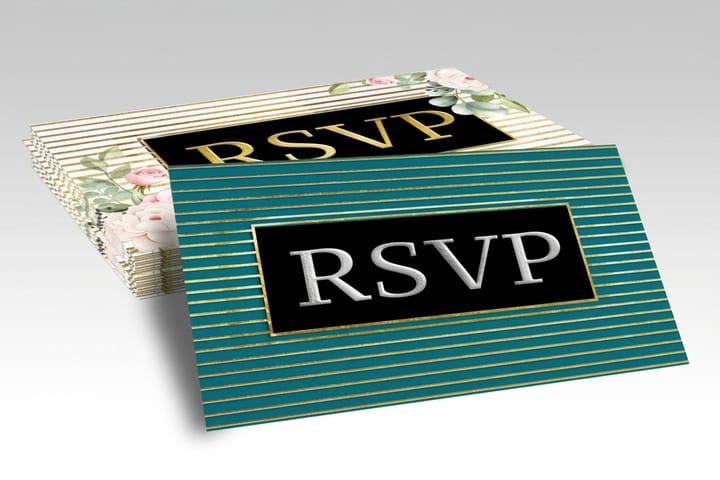
Dual Raised Invitations come in two sizes, a 3.5 in x 5 in RSVP card and a 5 in x 7 in main card, both on the 16pt velvet laminated cover. That pairing is the practical reason to pick this product over a plain card: one order covers the suite, and the monogram on the main card and the small mark on the RSVP card come off the same two raised passes, so they match exactly instead of nearly.
100 cards start at $249, about $2.49 each with the raised foil built in, and the per-card cost falls to roughly 90 cents at 1,000. A 200-guest wedding is priced closer to a 100-guest one than most people expect, so order the spares in the same run rather than reprinting a short second batch at the top of the ladder.
Here is the catch nobody mentions until the RSVPs come back. Guests write on RSVP cards, and velvet laminate resists ballpoint the same way it does on the business card. If your RSVP asks for a handwritten name and a meal choice, expect ink that sits wet on the surface, so use check boxes a guest can mark with a felt pen, or print the RSVP on an uncoated stock and keep the dual raised finish for the main card. For the rest of the suite, our roundup of the best print finishes and when to use each is a useful sanity check before you commit.
4. Dual Raised Postcards, from $339 per 100

Dual Raised Postcards print at 4 in x 6 in or 5 in x 7 in, full color on the front with a blank back or full color on both sides. In a stack of mail this is the card that gets separated from the pile by touch, before anybody has read the offer. 100 start at $339 and the per-card price slides to about $1.18 at 1,000.
Mail this one with your eyes open on postage, because the stock is the issue. USPS charges the postcard price only for a piece between 0.007 in and 0.016 in thick, and 16pt cover is 0.016 in before the velvet laminate goes on. Add the film and you are at or over the ceiling, so budget the letter rate rather than the postcard rate. The 5 in x 7 in size settles it outright: the postcard price tops out at 4.25 in x 6 in, so a 5 in x 7 in card always mails as a letter. Our guide on how to mail a postcard has the address and clear-zone rules, and postcard sizes and dimensions covers where each size lands.
That extra postage is not a reason to skip it. It is a reason to send fewer, to a better list. A flat postcard competes on the offer alone. This one competes on the two seconds before the offer is read, which is exactly where most mail loses. If you want the effect on one side only for a lower cost per piece, raised spot UV on a smaller format is the step down.
5. Dual Raised Greeting Cards, from $629 per 100
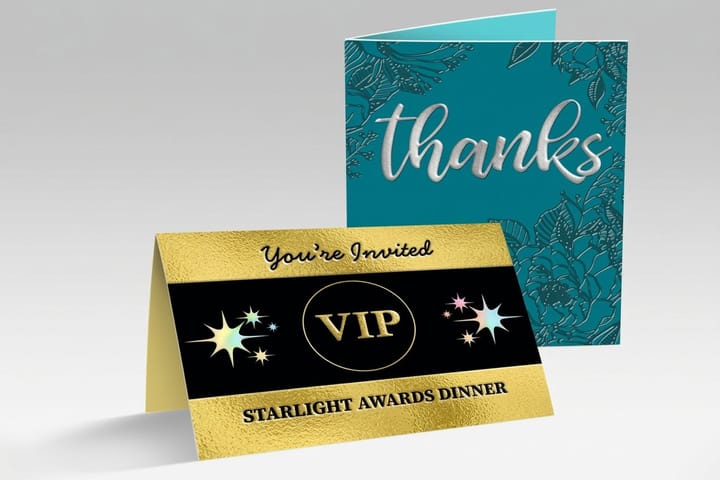
Dual Raised Greeting Cards print flat at 10 in x 7 in and score down the middle into a classic A7 card, 5 in x 7 in folded, on the 16pt soft velvet laminated cover. This is the most expensive piece in the set at 100 cards, $629, or $6.29 each. It is also the one people keep, which is a different kind of value than a mailer.
The ladder matters more here than anywhere else in the set. 500 cards are $929, so about $1.86 each. Between 100 and 500 the price per card falls by roughly two thirds, which means a hundred-card holiday send is the worst possible quantity to order. If your list is 150, print 500 and use the rest through the year for thank-yous and client welcomes.
One design rule specific to a folded card: keep the raised passes off the score line. A raised dome sitting on a fold gets stressed every time the card is opened, and foil on a crease can crack. Design the front panel as a front panel, with the foil and the spot UV comfortably inside the edges. If the effect is what you are after but the format is not, the same finishing shows up across the dual raised printing collection.
Where dual raised is the wrong call

Four situations where you should print something else, said plainly.
- You need it this week. Standard turnaround is 7 business days with a 4 business day rush. That is the finishing, not the queue. When the date will not move, use same-day printing on a flat stock and keep the texture for the next run.
- Somebody has to write on it. Velvet laminate is a film. Ballpoint sits on top of it and smudges. Appointment cards, punch cards and write-in RSVPs belong on an uncoated stock.
- The artwork is delicate. Raised effects build a dome, so thin script, hairline rules and small serifs lose their edges. If the mark is fine, a flat raised foil or a plain spot gloss will hold detail better. The difference between the two gloss options is laid out in spot gloss versus spot UV.
- You only need 25. Every product in the set starts at 100. Below that quantity the specialty finish is not the expensive part, the short run is.
Everything else about the process, from how the raised medium is applied to what it does to a printed image underneath, is in our explainer on the raised foil printing process and in what spot UV printing is and how it works.
Specs and pricing
Compare the two most ordered: cards and postcards
Business cards and postcards are the two pieces most brands reorder, and they sit at opposite ends of the price ladder. Here are the live specs and the quantity breaks for both, straight from the configurator.


| Quantity | Price Per Unit | Total |
|---|---|---|
| 100 | $1.49 | $149.00 |
| 250 | 71.6¢ | $179.00 |
| 500 | 51.8¢ | $259.00 |
| 1,000 | 50.9¢ | $509.00 |
| Quantity | Price Per Unit | Total |
|---|---|---|
| 100 | $3.39 | $339.00 |
| 250 | $1.60 | $399.00 |
| 500 | $1.28 | $639.00 |
| 1,000 | $1.18 | $1,179.00 |
Wally explains the two raised passes
Feel it first, read it second
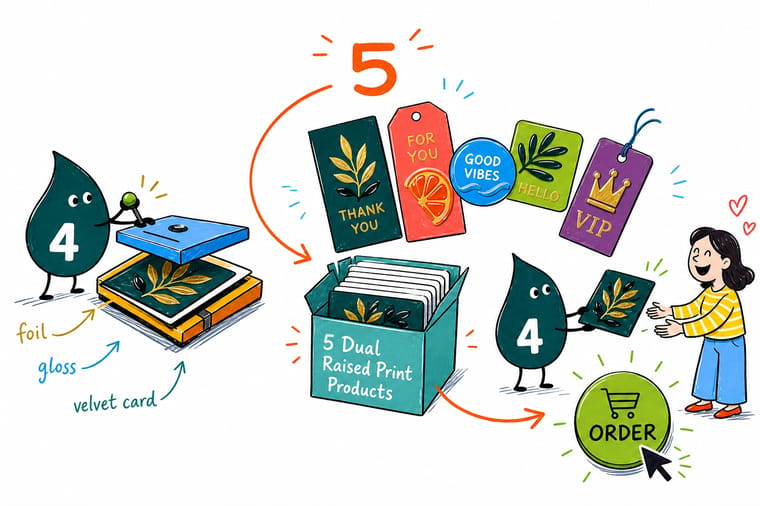
Wally puts a thumb on the front of the card, because that is how a dual raised piece is really judged. One pass lays down raised foil in gold, silver or holographic. The second lays down a raised clear gloss, or a second foil color. Both stand off the velvet laminate, and both are set up once for the whole run, which is why a thousand cards cost so much less per piece than a hundred. Pick the format that fits the job and let 4OVER4 print the texture.
Shop dual raised printing →Explore more
Where to go next


By the numbers
What the dual raised set gives you
Common Questions
Common questions about dual raised printing
What does dual raised printing actually mean?
Two raised effects on the same face of one card. You either get two raised foil colors set side by side, or one raised foil next to a raised spot UV gloss. Both stand off the surface, so the piece has texture you can feel with a fingertip, not just a shiny area you can see. At 4OVER4.COM it runs on five products: business cards, hangtags, invitations, postcards and greeting cards.
Which foil colors can I use, and can I mix them?
Three raised foils are available, gold, silver and holographic, and either foil position can take any of them. So a card can carry raised gold next to raised silver, raised gold next to raised holographic, or a single raised foil next to a raised spot UV gloss. The choice is per position, not per order, so both effects can differ on the same card.
Can the raised effect go on the back as well as the front?
No. The raised passes run on one face of the sheet. The back prints as normal full color, or stays blank if you prefer. Design accordingly: put the mark that has to be felt on the front, and treat the back as the place for the address panel, the offer detail or the contact block.
Do dual raised postcards mail at the postcard rate?
Usually not, and you should budget for the letter rate. USPS gives the postcard price to pieces between 0.007 in and 0.016 in thick, and a 16pt cover is 0.016 in before the velvet laminate is applied, which pushes it to the ceiling or past it. The 5 in x 7 in size is decided already, because the postcard price stops at 4.25 in x 6 in. Confirm the piece with your post office or mail house before you buy postage.
How much cheaper does dual raised get in a bigger run?
Substantially, because the raised finishing is set up once for the run rather than charged per piece. Business cards are $149 for 100 and $509 for 1,000, which moves the per-card cost from $1.49 to about $0.51. Hangtags fall from about $1.59 to about $0.53 at 1,000, and greeting cards drop from $6.29 at 100 to about $1.86 at 500. If you are close to the next tier, step up.
How fast can I get a dual raised order?
Standard production is 7 business days, with a 4 business day rush available. That is the finishing time rather than a queue, so it does not compress further. When a date is fixed and close, print the piece flat and keep the texture for the reorder.
Can I write on a dual raised card with a pen?
Not reliably. The 16pt stock is velvet laminated, and laminate is a film that ballpoint ink sits on top of rather than soaks into, so handwriting smears. Use a felt tip if you must write on one, design check boxes instead of write-in lines on an RSVP, or run write-on pieces on an uncoated stock.
How do I set up artwork with two raised effects?
Supply the print artwork as normal, then supply each raised effect as its own separate layer or file, solid black on white, showing only the shapes that should rise. Keep a small gap between the foil area and the spot UV area so a slight shift between the two passes never shows as an overlap, keep both effects away from the trim, any fold and any drilled hole, and avoid hairlines and small serif type that a raised dome will fill in.
Get Started
Print the set people can feel
Five products, one 16pt velvet laminated cover, two raised passes on every front. Pick your size, your foils and your quantity, and watch the price per piece fall as the run climbs.
Legal Disclaimer
Gold Standard guarantees apply to all standard orders placed through 4over4.com. Price match requires verifiable proof of a competitor's published price for an equivalent product with matching specifications and turnaround time. Satisfaction guarantee covers manufacturing defects and print quality issues. Contact support with order number and documentation. On-time delivery rate based on tracked orders 1999 to 2026. Individual results may vary based on shipping carrier performance.
