
The 6-Piece Construction Site Safety Sign Pack Every Jobsite Needs
A fenced site needs six signs, and they are not interchangeable. Each one is a different substrate doing a different job at a different distance, from the mesh banner the public reads from the sidewalk to the decal stuck on a finished floor. Here is the whole pack, in the order you install it, priced live.
A working construction site safety sign pack is six pieces, and the substrate is chosen by how long each sign stays in one place. A mesh banner on the fence for the public, a vinyl rules board at the gate, bolted aluminum signs for the permanent entry requirements, rigid hazard panels inside the work zone, staked coroplast yard signs that move with the work, and floor decals once fit-out starts. Print them as one set and every sign on the site matches.
The lineup
The 6-piece jobsite safety sign pack, priced live
Order the whole pack at mobilization, or start with the piece your site is missing. Every item below is priced from the configurator and the number drops as the quantity climbs. If your safety manager has approved artwork already, upload it as-is. If not, start from a design template and set the signal word, the colors and the letter height before you order.

Start here
How the six pieces fit a fenced site
Install them from the fence inward, in the order the site gets built. The mesh banner and the gate rules board go up at mobilization, before a single trade is on site. The aluminum signs get bolted the same week and stay put. The hazard panels and staked yard signs move with the trades through the frame and the rough-in. The floor decals go down last, when there is a finished floor to protect and a walk route to keep clear. Below is each piece, what it is made of, and where it fails.
Sizes and placement
Jobsite sign sizes and where each one goes
Six pieces, six substrates, six positions on the site. The size in each row is the one most sites order it at, chosen so the sign is still legible from the distance it has to work at. Tap a piece to jump to its section, then set the size to your own read distance before you order.
| Piece | Common size | Where it sits on the site |
|---|---|---|
| 1. Mesh banners | 3 ft x 20 ft is the usual fence run, 4 ft x 8 ft for a single panel | Zip-tied to the chain link along the sidewalk side, high enough that scaffold and stacked material do not block it. |
| 2. Construction banners | 3 ft x 6 ft or 4 ft x 8 ft for the rules board, up to 4 ft x 10 ft as one piece | Beside the gate where every worker and delivery driver walks past, at eye level rather than up on the mast. |
| 3. Aluminum signs | 18 in x 24 in and 24 in x 36 in for the permanent gate and boundary signs | Bolted to the gate frame, the fence posts at each corner, and the trailer door. Never on anything that moves. |
| 4. Construction signs | 18 in x 24 in rigid panels, 12 in x 18 in for equipment and doorways | At the head of the work zone, at the base of every hoist and ladder, and wherever a trade crosses into another trade. |
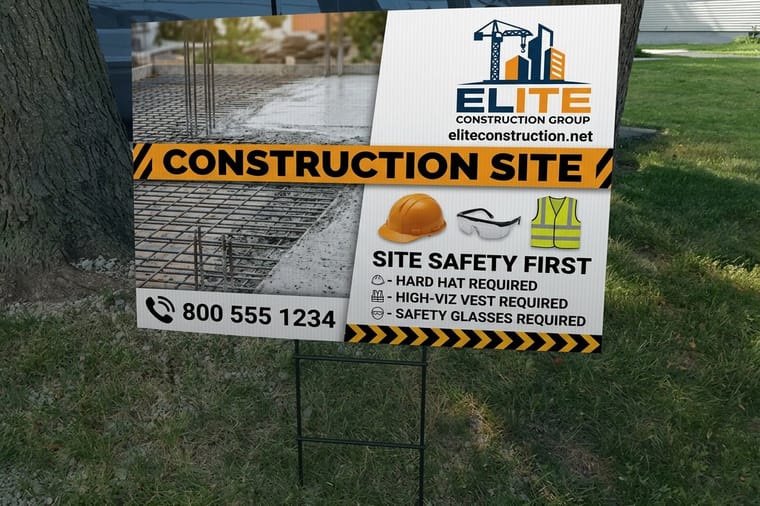
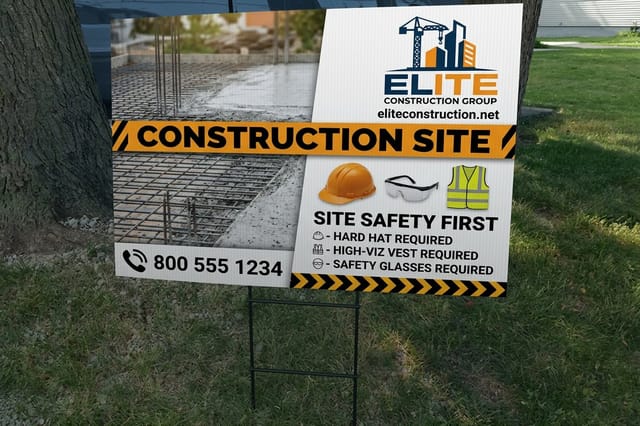
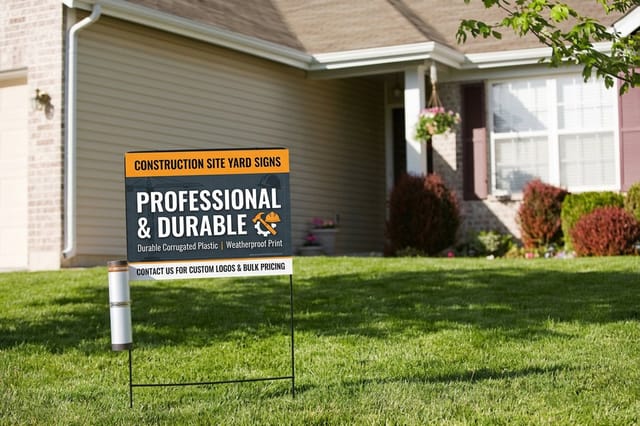
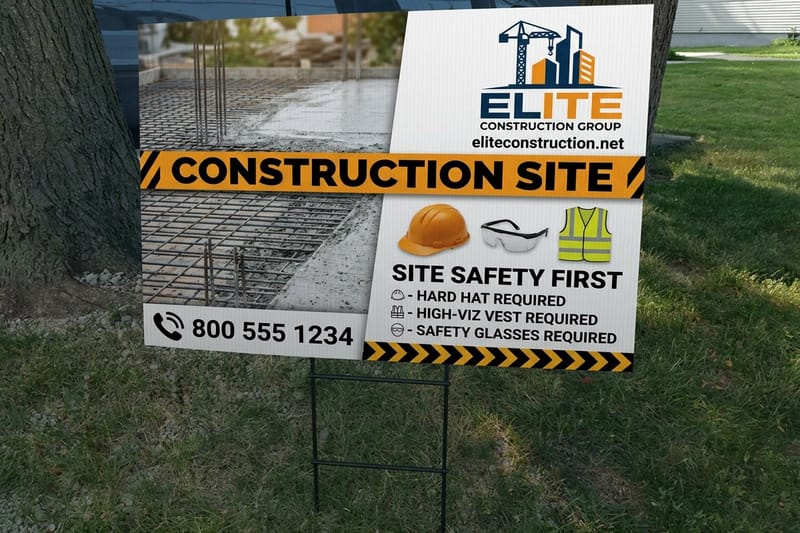
| 5. Construction yard signs | 18 in x 24 in coroplast on an H-stake, 24 in x 36 in at the entry drive | Staked in the dirt beside the open trench, the fresh pour, the spoil pile. Pulled and moved as the work moves. |
| 6. Floor decals | 12 in and 24 in circles, or 12 in x 18 in rectangles for walkway markings | On finished slab during fit-out: the walk route through the space, keep-clear zones at doors and panel boards. |
1. Mesh banners: the fence line the public reads first
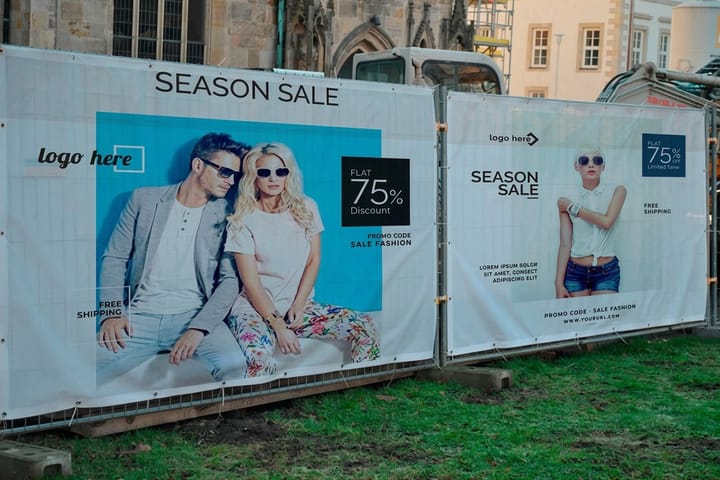
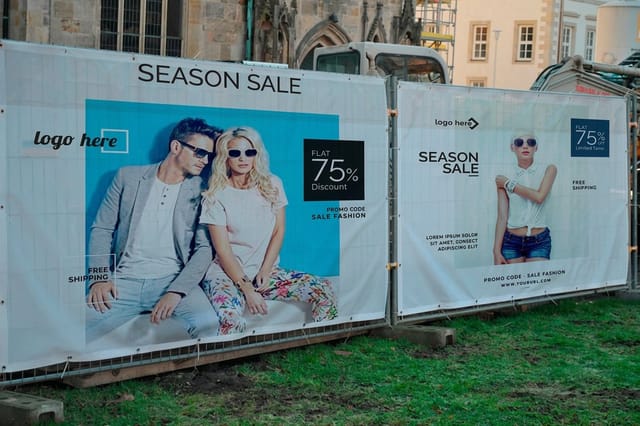
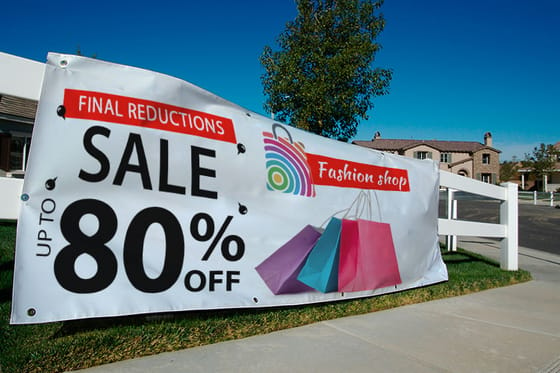
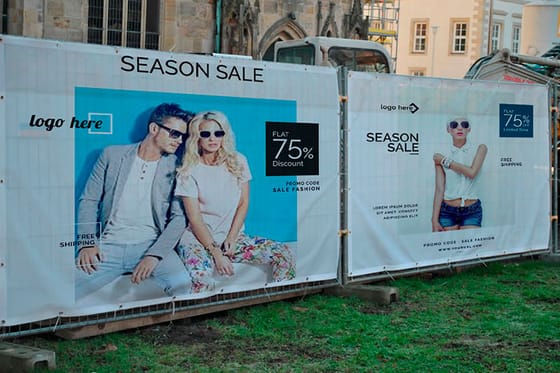
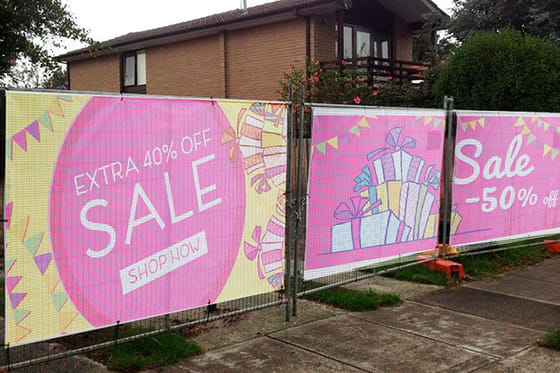
The first safety sign on any site is the one facing the sidewalk, and it belongs on the fence. A mesh banner runs the length of the chain link with the message the public needs before they get close: hard hat area beyond this point, no unauthorized entry, the general contractor and the emergency number.
Mesh instead of solid vinyl for one reason. A solid banner laced to a fence catches wind like a sail, and the load goes straight into the grommets and the fence posts. The perforations in mesh let air pass, so the banner stays flat and the hem stays in one piece through a windy month. The cost is print detail: those same holes soften small type and fine logo work, so keep the fence banner to short lines in heavy weight and put the legal small print somewhere it can be read up close. The full comparison sits in our guide to vinyl banners versus mesh banners, and the fabric itself is broken down in mesh banner material explained.
Order it hemmed all the way around with grommets every 2 feet plus one in every corner, then hang it with UV-rated zip ties rather than rope. Rope stretches, the banner sags, and a sagging banner reads as a site that is not being watched. Tension and mounting are covered in how to hang banners, and the grommet spacing itself in how to place grommets on banners.
2. Construction banners: the site rules board at the gate
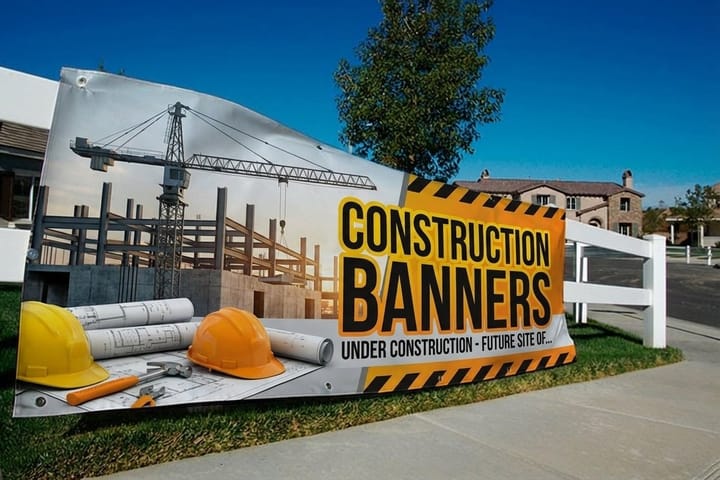
Every worker and every delivery driver walks through one gate, and that is where the rules board goes. A construction banner at eye level beside the gate carries the site rules in one block: required PPE, the sign-in point, the speed limit inside the fence, the muster point, who to call.
Vinyl prints up to 10 feet on the short side as a single piece, so a 4 ft x 8 ft rules board comes off the roll with no weld running through the middle of a line. Keep it to eight rules or fewer. A board with twenty lines on it is read once on the first morning and never again, which makes it decoration rather than a control.
Heavyweight vinyl is the right call here even though this banner is not in the wind the way the fence run is, because it hangs for the length of the build and gets handled every time the fence line moves. If the same board also has to carry the project rendering and the developer logos, print that as a separate vinyl banner and keep the safety board clean. Material choices are compared in how to choose banner material.
3. Aluminum signs: the permanent ones that outlast the build
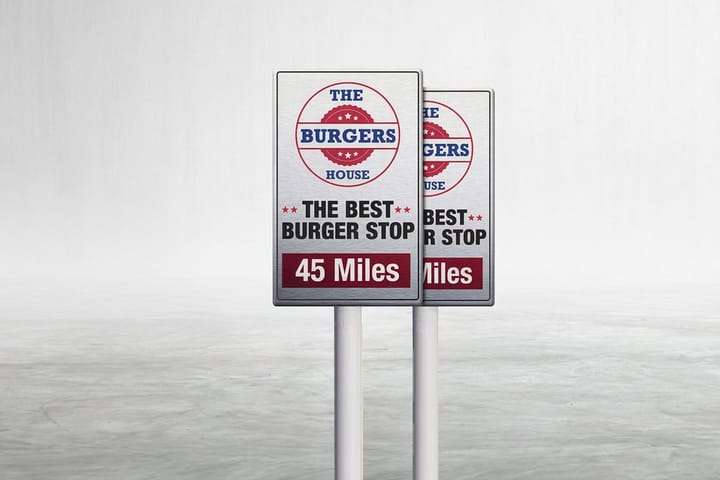
Some signs never change for the whole job: no trespassing, hard hat and eye protection required, authorized personnel only, the OSHA poster frame by the trailer door. Those go on aluminum signs, bolted, and then forgotten about.
Aluminum costs more per sign than coroplast, and that is the whole trade. It does not go brittle in UV, it does not crack when a gust folds a corner, it survives a pressure wash, and it comes off the fence at the end of the job in good enough shape to bolt onto the next one. Coroplast on the same post for eighteen months chalks, fades and starts splitting along the flutes. Buy aluminum for the boundary and the gate, coroplast for everything that moves. The material-by-material breakdown is in aluminum signs versus coroplast versus PVC and most durable sign materials.
Two practical notes before you order. Mount with fender washers so wind load spreads instead of tearing the hole out, and check the local rules on what has to be posted and how big before you set the sizes, because a permit or fence-line requirement can override your layout. Our state-by-state overview is in how to get sign permits.
4. Construction signs: the hazard panels inside the fence
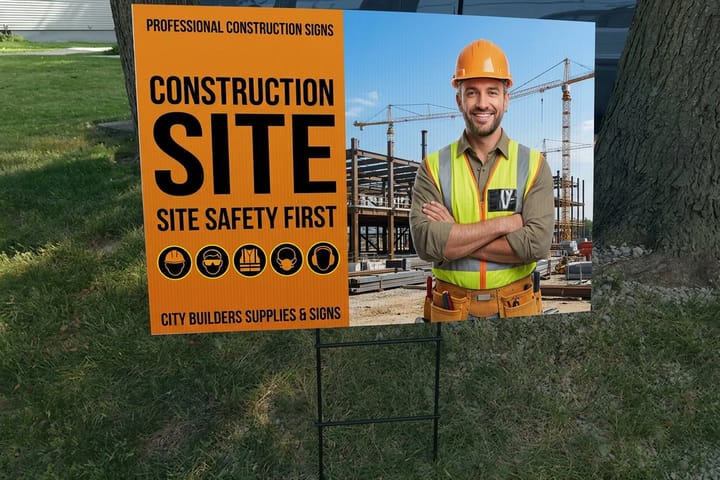
Inside the fence, signage stops being about the public and starts being about the crew. Construction signs are the rigid panels that mark the specific hazard at the specific place: the open shaft, the overhead work, the live panel, the crane swing radius, the fall edge.
Wording follows the ANSI Z535 signal-word hierarchy, and getting it right matters more than the graphics do. The four levels crews are trained to read:
- DANGER, white on red. Immediate hazard that will kill or seriously injure. Use it sparingly or it stops meaning anything.
- WARNING, black on orange. Could kill or seriously injure. Most fall, crush and overhead hazards live here.
- CAUTION, black on yellow. Minor or moderate injury. Trip hazards, low clearance, wet surfaces.
- NOTICE, white on blue. A site rule with no injury hazard behind it, such as sign in at the trailer.
Send the approved artwork and we match those colors and that layout exactly. What we do not do is sign off on your site plan: the signal word, the wording and the placement are your safety manager's call and your inspector's, and the sign shop is the last place that decision should be made. The workplace side of the same subject is covered in safety signs in the workplace, and label wording in how to design compliant warning labels.
Size to the read distance, not to the space on the post. One inch of capital-letter height per 10 feet is the working rule, so a panel read from 20 feet needs 2 inch caps and there is no room left for a paragraph. If the crew is bilingual, run two panels side by side rather than stacking English over Spanish in one, because stacking halves the height you have to work with.
5. Construction yard signs: the warnings that move with the work

The trench that needs a sign today is backfilled next week, and the pour that needs one tomorrow is in a different corner. That is what construction yard signs are for: 18 in x 24 in coroplast on an H-stake, pushed into the dirt where the hazard is and pulled when it is gone.
One detail decides whether the stake holds. Coroplast has hollow flutes running one direction, and the H-stake legs slide inside them. Order the sign with the flutes running vertically for a staked install, so the legs seat the full height of the sign, and horizontally only when it is getting zip-tied flat to a fence. Get that backwards and the sign wobbles on two inches of grip and folds in the first storm. More on the substrate in what are coroplast signs and which materials last outdoors.
Order more than you think you need in one run. Stakes disappear, corners crack when a loader clips them, and reordering six at a time costs far more per sign than adding twenty to the original order. The same signs double as wayfinding for deliveries and inspectors, which is worth planning as one set rather than piecemeal: see the wayfinding signage planning guide. For proof that staked signs also pull work in, read how a construction company won leads with yard signs.
6. Floor decals: keep-clear zones once the slab is finished
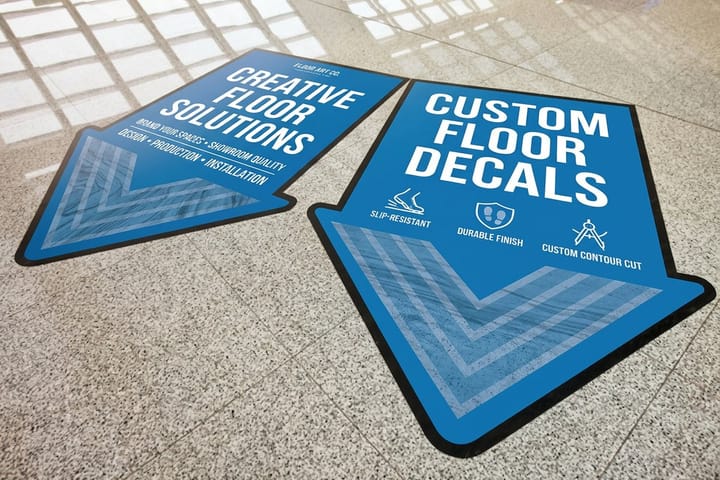
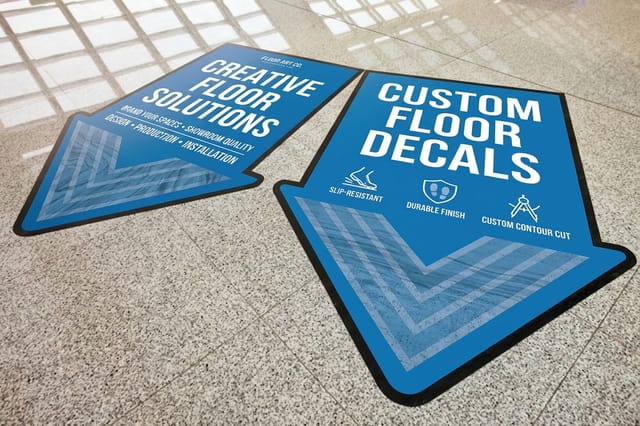
Once the fit-out starts and there is a finished floor, a stake in the ground is no longer an option and the marking has to go down flat. Floor decals carry the walk route through an active space, the keep-clear box in front of an electrical panel or an exit door, and the watch-your-step warning at a level change.
They only work on a clean, cured, sealed surface. Rough broom-finish concrete, a floor still gassing off from a fresh sealer, or a slab with a film of drywall dust will not hold adhesive, and the corner will curl within a day. Sweep, wipe with isopropyl, let it dry, then squeegee from the center out. Keep them out of the path a pallet jack turns on, because a turning caster is what lifts an edge and starts the peel.
Ask for the non-slip textured laminate rather than a plain gloss face. The texture is what keeps the decal from becoming its own hazard when someone walks in with wet boots, and it takes the abrasion of foot traffic without scuffing the print gray in a fortnight. For interior surfaces where you want the same instruction on glass or a door rather than the floor, door decals cover the same job at eye level.
Specs and pricing
Compare the two you reorder most: yard signs and fence banners
Staked coroplast signs get damaged and moved, and fence banners come down every time the fence line changes. Those two are the reorders. Construction yard signs start at $25 and construction banners at $79, on 5 and 3 business day turnarounds.

| Quantity | Price Per Unit | Total |
|---|---|---|
| 1 | $25.00 | $25.00 |
| Quantity | Price Per Unit | Total |
|---|---|---|
| 1 | $75.00 | $75.00 |
Wally walks the fence line
Six signs, six substrates, one site
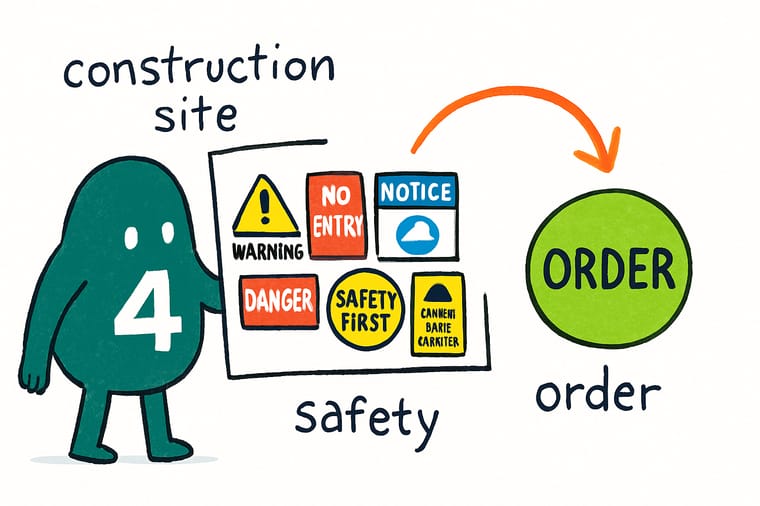
Wally starts at the sidewalk with the mesh banner the public reads, steps through the gate past the rules board and the bolted aluminum signs, crosses the work zone where the rigid hazard panels sit, steps around the staked yard sign at the open trench, and finishes on the floor decal in the fit-out. Same brand, same colors, six different materials chosen by how long each sign has to survive. 4OVER4 prints the pack as one order.
Shop construction printing →See it in use
Sign and banner work from the gallery





Explore more
Where to go next

By the numbers
Printing that holds up on an open jobsite
Common Questions
Common questions about construction site safety signs
What safety signs does a construction site actually need?
Six pieces cover a standard fenced site: a mesh banner along the fence line for the public, a rules board banner at the gate, bolted aluminum signs for the permanent boundary and entry requirements, rigid hazard panels inside the work zone, staked coroplast yard signs that move with the day-to-day work, and floor decals once fit-out starts. What is legally required on your specific site comes from OSHA, your safety manager and the local authority having jurisdiction, and that list can be longer. We print to the artwork and specification you approve.
Why use a mesh banner instead of vinyl on the fence?
Because a solid vinyl banner tied to chain link acts as a sail. The wind load goes into the grommets, the hem and the fence posts, and one storm is enough to tear a corner out. Mesh is perforated so the air passes through and the banner stays put. The trade-off is print detail: the holes soften small type and fine logo work, so a mesh fence banner should carry short lines in heavy weight and nothing that has to be read from arm’s length.
How big do the letters need to be on a jobsite sign?
Work backward from the read distance using one inch of capital-letter height for every 10 feet. A hazard panel read from 20 feet needs 2 inch caps, a gate sign read from 30 feet needs 3 inch, and a fence banner meant to be read from across the street needs about 10 inch caps. That rule is also why long wording fails: at 10 inch caps a 3 ft tall banner holds roughly three lines, so the message has to be cut to fit.
Aluminum or coroplast for construction site signs?
Match the substrate to how long the sign stays in one place. Aluminum for anything bolted for the length of the build, because it holds color, survives a pressure wash and comes off at the end reusable. Coroplast for anything that moves with the crew, because it is inexpensive enough to treat as consumable. Coroplast left on the same post for a year and a half chalks, fades and splits along the flutes, and that is the failure most sites run into.
Can I get bilingual construction safety signs printed?
Yes, and the layout question matters more than the translation. Stacking English over Spanish inside one panel halves the letter height you have to work with, which pushes the sign below the read distance it was sized for. Print two panels side by side at full height instead, or size the panel up so both languages keep their required cap height. Send both versions in your approved artwork and we match them.
Will floor decals stick to a construction floor?
Only to a clean, cured, sealed surface. Broom-finish concrete, a slab with drywall dust on it, or a floor still curing under fresh sealer will not hold the adhesive and the corners lift within a day. Sweep, wipe with isopropyl, let it dry fully, then squeegee from the center outward. Ask for the non-slip textured laminate so the decal does not become a slip hazard under wet boots.
How many yard signs should I order for a site?
Count the hazards you will mark at any one time, then add roughly a third again for cracked corners, lost stakes and the second location a hazard moves to. Ordering the spares in the first run is the cheaper move: construction yard signs start at $25 at 4OVER4.COM and the per-sign price falls as the quantity climbs, so twenty in one order costs far less per piece than four reorders of five.
How fast can I get replacement site signs?
Fast enough to matter for an inspection. Coroplast yard signs, rigid hazard panels and banners are exactly the pieces that get damaged and need replacing on short notice, and same-day printing covers that gap. Have the print-ready file saved from the original order so a reprint is a reorder rather than a new setup, and check our same-day printing cutoff before you commit to a date.
Get Started
Sign the site before the first trade arrives
Print the six-piece safety sign pack as one order at 4OVER4.COM. Set your sizes, substrates and finishing, and every price updates live as you build the order.
Legal Disclaimer
Gold Standard guarantees apply to all standard orders placed through 4over4.com. Price match requires verifiable proof of a competitor's published price for an equivalent product with matching specifications and turnaround time. Satisfaction guarantee covers manufacturing defects and print quality issues. Contact support with order number and documentation. On-time delivery rate based on tracked orders 1999 to 2026. Individual results may vary based on shipping carrier performance.
