
Step-and-Repeat Banners vs Fabric Tube Displays for Photo Walls and Booths


One is a flat printed wall built to be photographed. The other is a one piece fabric skin on an aluminum frame built to be walked past. Each one has a price, a failure mode, and an artwork setup of its own.
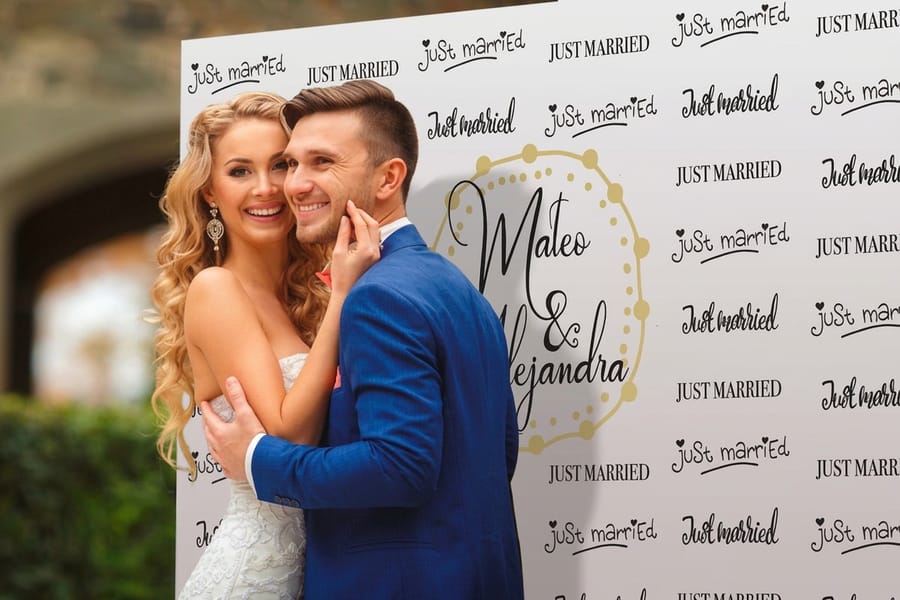
Print a step-and-repeat when the camera is the audience, and a fabric tube display when the aisle is. A step-and-repeat tiles your logo edge to edge on 13oz smooth blockout vinyl or 9oz wrinkle-free fabric, 8 by 8 feet from $217.50, with pole pockets sewn top and bottom. A fabric tube display is an 8.8oz tension fabric skin pulled drum tight over a push-fit aluminum frame, 36 by 90 inches from $163.67, sold as a kit with the hardware and a carrying bag.
Quick answer
A photo wall and a booth wall are not the same purchase
Buy the step-and-repeat for photographs and the tube display for floor presence. The step-and-repeat is print alone, so it covers width cheaply: 8 by 8 feet from $217.50, or $192.22 for the version that ships with its own stand. The tube display is hardware plus a one piece 8.8oz fabric skin, from $163.67 for a 36 by 90 inch tower, and it earns the extra money over many shows rather than one night. Material settles the rest, since gloss vinyl throws a flash back at the lens and woven fabric scatters it.
What Each One Actually Is
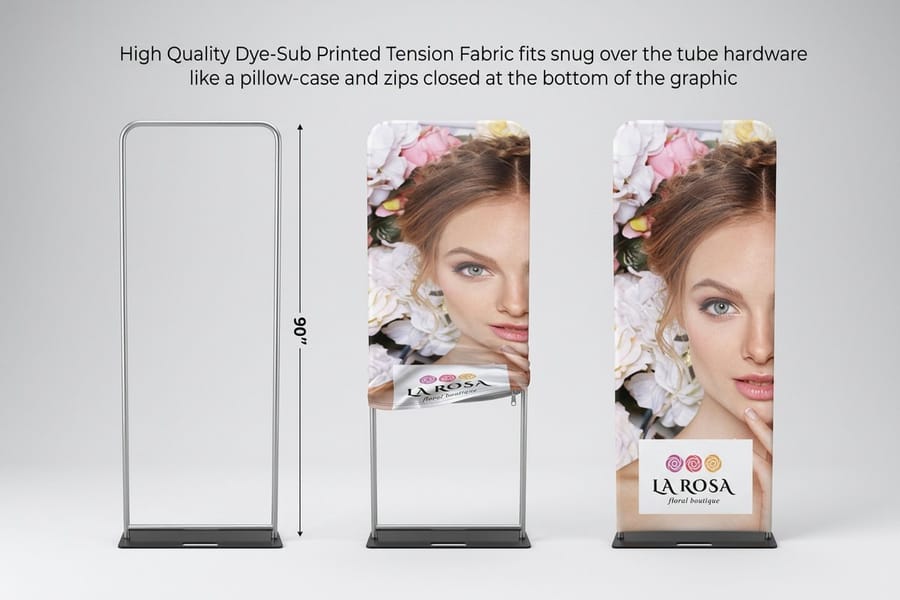
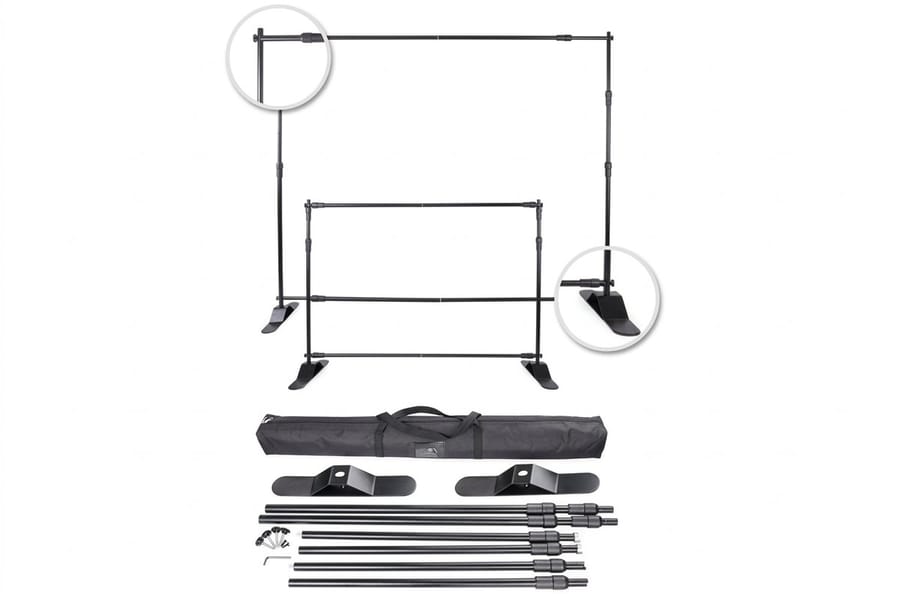
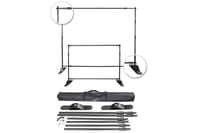
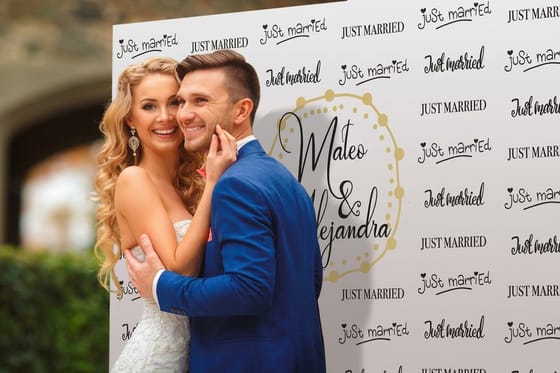
A step-and-repeat banner is a single printed sheet with your logo tiled across the whole surface, so a camera catches the brand no matter where a guest stands or how tight the crop runs. It prints on 13oz smooth blockout vinyl or 9oz wrinkle-free fabric at 8 by 8 feet, 8 by 10 feet, or a custom size up to 120 by 96 inches, with pole pockets sewn top and bottom. On its own it is just the graphic. Hang it from a crossbar, or order step-and-repeat banner stands from $192.22, which is the same printed backdrop with an adjustable frame in the box.
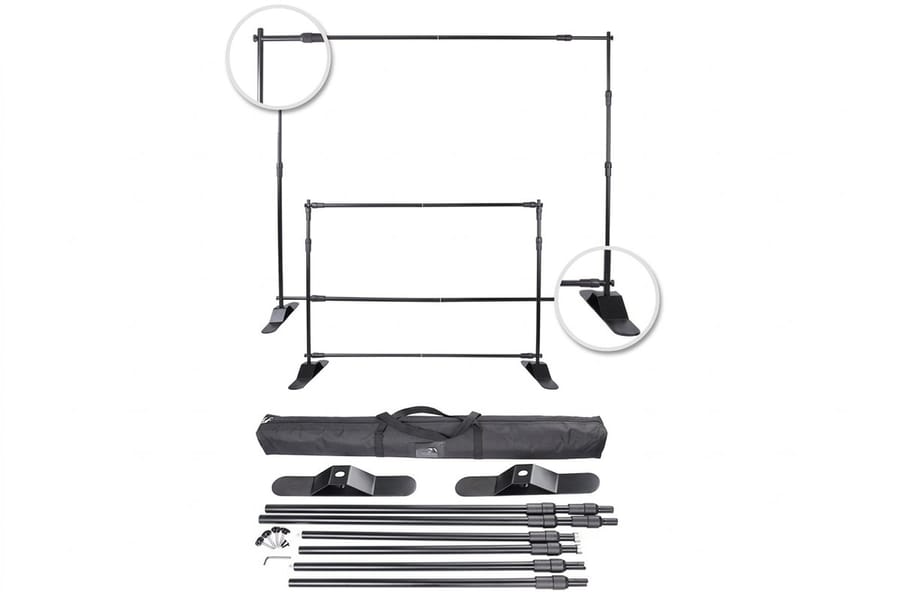
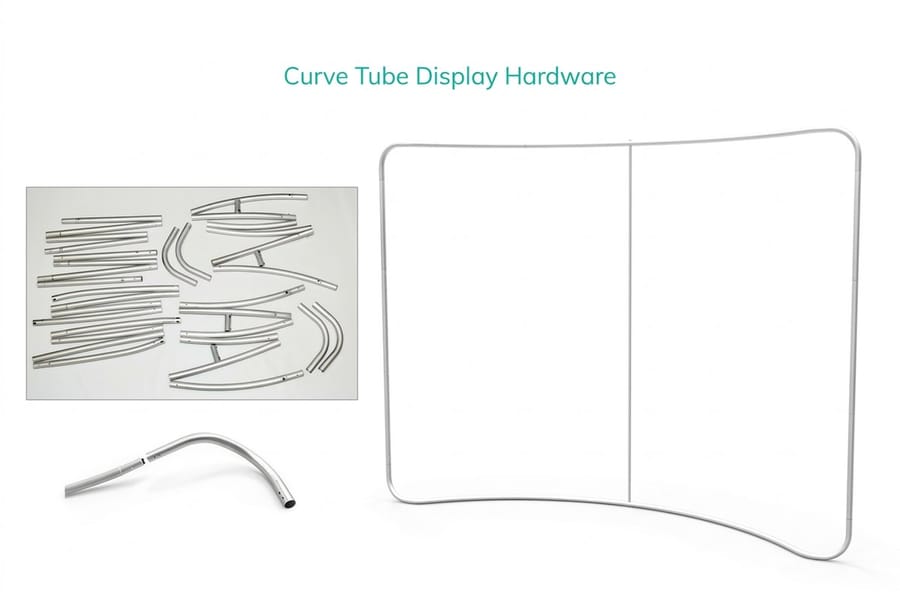
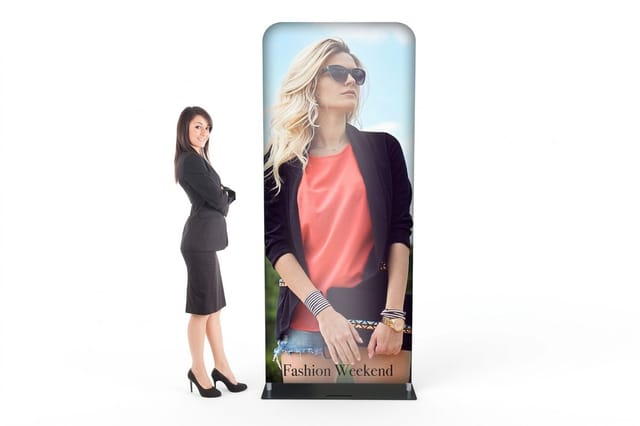
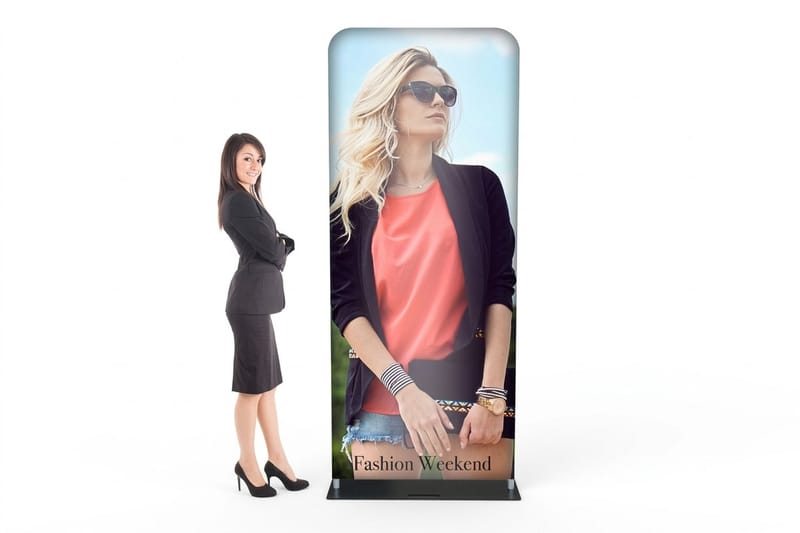
A fabric tube display is hardware first. Push-fit aluminum tubes click together without tools, then an 8.8oz tension fabric skin slides over the frame like a pillowcase and zips shut at the base. The tension is what makes it work: the fabric sits drum tight, there is no seam anywhere across the face, and the woven surface is matte. Fabric tube displays start at $163.67 for a 36 by 90 inch tower, and the kit includes the frame, the printed graphic and a carrying bag.
Both are portable. Only one of them is a photo wall. The rest of this page is about the places where that difference costs money. If you want the mechanics of the frame itself, our guide to how a tension fabric display frame works takes the hardware apart.
The Six Ways to Print a Branded Wall, Compared
The choice is wider than two products. These are the six we print for the same job, with what you actually get in the box.
| Product | Graphic and frame | Sizes | Starts at | Where it wins |
|---|---|---|---|---|
| Step-and-Repeat Banners | Graphic only, pole pockets top and bottom, stand optional. | 8 by 8 ft, 8 by 10 ft, custom to 120 by 96 in. | $217.50 | The photo wall, when you already have something to hang it from. |
| Step-and-Repeat Banner Stands | Printed backdrop plus the adjustable stand, one box. | 8 by 8 ft, 8 by 10 ft. | $192.22 | Ballrooms and open floors with nothing to attach to. |
| Fabric Step-and-Repeat | Made-to-order backdrop, 13oz vinyl or 9oz wrinkle-free fabric. | 8 by 8 ft, 8 by 10 ft, custom to 120 by 96 in. | $217.50 | Press lines and galas where flash hits the wall all night. |
| Fabric Tube Displays | Tube frame, 8.8oz tension fabric skin, carrying bag. | 36 by 90 in, 48 by 90 in. | $163.67 | A tall booth anchor that reads over a crowd. |
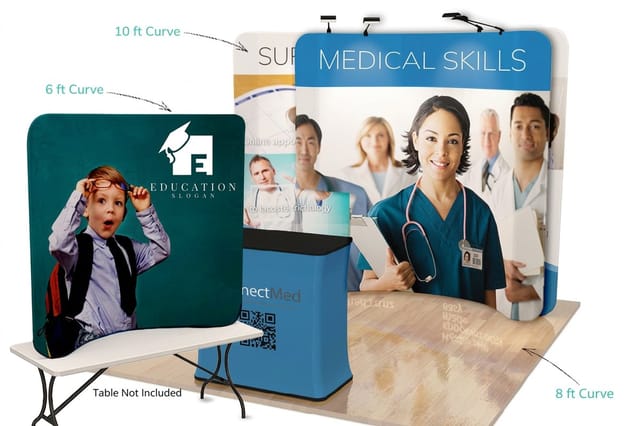
| Curve Tube Displays | Curved push-fit frame, tension fabric skin, canvas bag. | 6 ft, 8 ft, 10 ft across the curve. | $548.09 | Island booths and corners, where the aisle sees you at an angle. |
| Straight Tube Display | Straight aluminum frame, tension fabric skin, bag or hard case. | 8 ft, 10 ft, 20 ft wide. | $635.96 | The full back wall of a booth, unbroken across 20 feet. |
Read the last two columns together. The tube displays cost more because the price includes aluminum, a case and hardware that survives a season of freight. The step-and-repeat products cost less because you are buying print. Neither is better value in the abstract; it depends on how many times the thing has to stand up. Browse the full range on displays printing and banners printing.
Glare, Creases, and What the Lens Sees
Two material problems ruin more backdrop photos than bad design does, and both are solved at checkout rather than in the file.
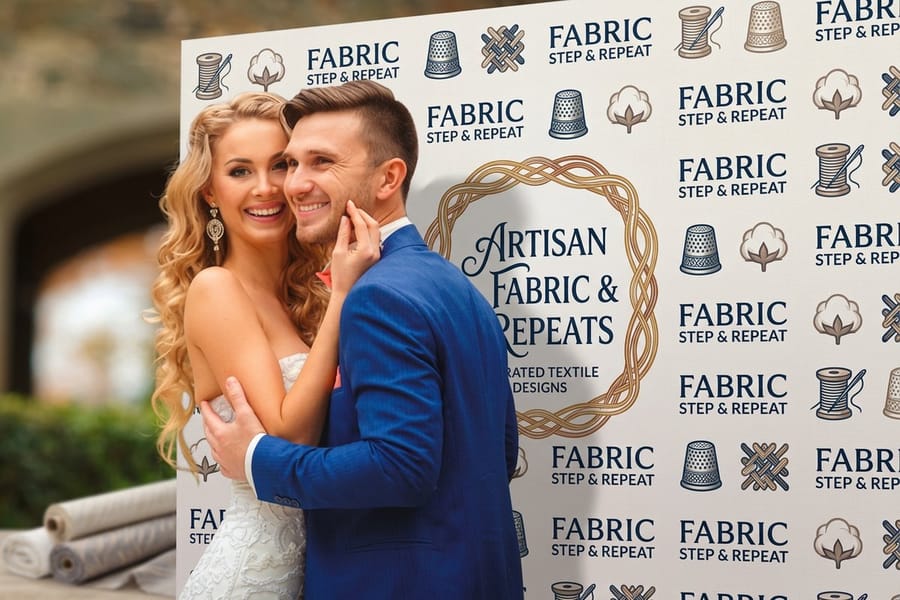
Sheen. Smooth blockout vinyl has a slight gloss. Point a flash at it and the light comes back as a bright patch sitting over whichever logos happen to face the lens, which is exactly the part of the wall the photographer framed. Woven fabric scatters the same light. That is the whole argument for ordering a fabric step-and-repeat when there will be cameras with flashes, and for the matte 8.8oz skin on every tube display. The trade is opacity: 13oz blockout vinyl stops light passing through, so if a lit doorway or a window sits behind the backdrop, the vinyl hides it and the fabric will glow.
Creases. A vinyl banner folded into a box holds the fold. The line catches light in every shot and it does not hang out overnight. Roll vinyl around a tube instead, printed side out, and it stays clean. Fabric behaves the opposite way: it packs flat in a bag, and the frame tension on a tube display or the weight of a filled pole pocket pulls most of the pack marks out within an hour. A pass with a hand steamer clears the rest. Our guide on vinyl vs fabric vs polyester banners goes deeper on how each surface ages.
One more thing the lens notices: seams. A tube display has none, because the skin prints as one piece. Cover the same width with several separate panels and every joint shows up in a wide shot.
What It Costs to Cover the Same Wall

Price per product hides the real number, which is price per foot of wall.
Take nine feet of coverage. One 8 by 8 foot step-and-repeat starts at $217.50 and gets you close in a single piece. Three 36 inch fabric tube towers at $163.67 each come to $491.01, and you get two visible gaps where the towers meet. Go to a genuine one piece fabric wall and straight tube displays start at $635.96, roughly three times the flat banner, for a face that has no joint anywhere across it.
The arithmetic flips as soon as you count events. A vinyl backdrop that gets folded, stored badly and taped to a wall a few times is close to disposable. A tension fabric skin folds into a bag, launders, and slides back onto the same frame for years, and the frame is the expensive half you only buy once. Twelve shows a year makes the aluminum look cheap. One gala does not.
Turnaround belongs in the same decision. Step-and-repeat banners run a 3 business day standard with 2-day and next-day rush; the printed stand kit runs a 1 business day standard; tube displays run 4 business days with 3-day, 2-day and next-day rush available. When an event date is nine days out, the flat banner is the calmer order. Sizing the wall first is worth ten minutes: our guide to choosing the right backdrop size works through ceiling height, camera distance and how many people have to fit in frame.
Setting Up Artwork for Each One
The two products want opposite files, and handing a printer the wrong one is where most reprints start.
For a step-and-repeat, build a grid, not a layout. Size each logo so a chest-up crop holds at least two complete marks, which lands around 6 to 10 inches tall on an 8 foot backdrop. Offset every second row by half a repeat so no empty vertical alley runs behind a guest's head. Keep the bottom 24 inches quiet, since bodies cover it. Allow for the sewn pole pockets top and bottom, which take a few inches of artwork out of sight. If two sponsors share the wall, alternate them across the grid rather than splitting the wall in half, or half your guests will stand in front of one brand all night. The step-and-repeat design guide has the grid mechanics, and blank templates give you a correctly sized starting file.
For a tube display, respect the wrap. The skin pulls around the frame tube on both sides, so keep type and logos well clear of the outer strip and let a flat background color run into it. Put the message between roughly 40 and 65 inches off the floor, which is eye level for a person walking an aisle, and leave the bottom foot clear because a table or a crowd will block it. On a curve, the outer thirds bend away from anyone standing straight in front, so the logo goes in the middle of the arc and the supporting art wraps outward.
Both formats print large and get read close, so supply full size artwork with the fonts converted to outlines. The trade show signage guide covers how the backdrop should relate to the rest of the booth graphics.
The Verdict
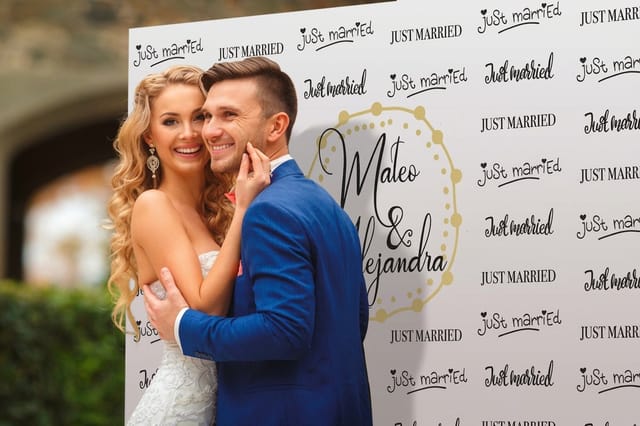
If the point is photographs, print a step-and-repeat. Red carpets, press lines, galas, grand openings, wedding photo booths. Order the 9oz wrinkle-free fabric rather than the vinyl whenever a flash is likely, and add the stand unless a truss or a wall is already waiting. That is step-and-repeat banners from $217.50, or the stand kit from $192.22.
If the point is a booth, print fabric on a frame. A 36 inch tower at $163.67 anchors a small stand, a curve wraps an island, and a straight tube fills a 10 or 20 foot back wall with no joint in it. The graphic survives folding, the frame goes up without tools, and both travel in a bag rather than a tube you have to carry through an airport.
The honest middle case: a fabric step-and-repeat on an adjustable stand does both jobs. It photographs well and it looks fine behind a table. What it gives up is tension. A pole-pocket backdrop hangs, it does not pull tight, so it moves when the air conditioning kicks in and it will never look as crisp up close as a drum-tight skin. That is the compromise, and for most one-night events it is the right one. Shop the wider ranges on trade show printing and banner stands.
Wally sizes up the two walls
One gets photographed, one gets walked past
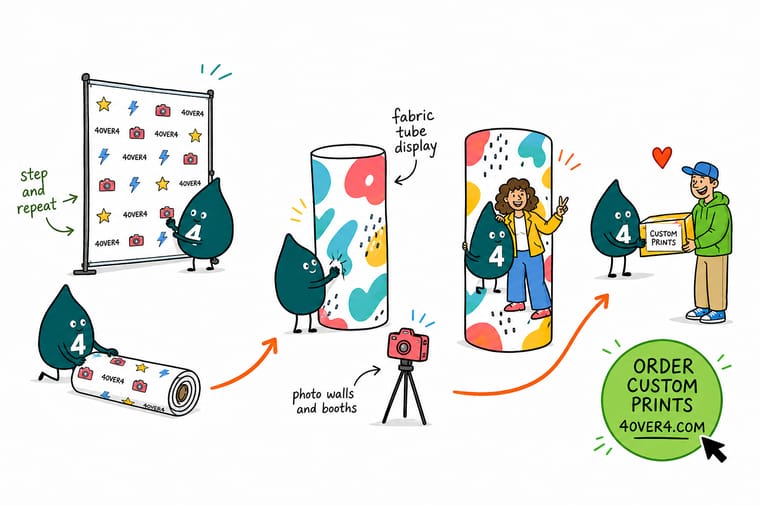
Wally hangs the step-and-repeat from its pole pockets, steps back, and every logo in the grid faces the camera. Then he slides the fabric skin over the tube frame, and the outer strip of the print curls around the tube and out of sight. That is the whole difference. Flat print for photos, tensioned fabric for a booth wall, and matte fabric any time a flash is going to fire.
Order a step-and-repeat banner →Specs and pricing
Sizes, materials and starting prices, side by side
Configure each option and watch the price move with size, material and quantity, straight from the 4OVER4.COM configurator.

Print it
Order the wall your event actually needs
Explore more
Where to go next
By the numbers
Banner walls and tension fabric frames
Common Questions
Backdrop questions we get asked before every event
Can I print a step-and-repeat pattern on a fabric tube display?
You can, and people do it for booths that double as a photo spot, but you have to redraw the grid for it. The printed skin pulls around the frame tube on both sides, so anything within roughly the outer inch and a half rolls away from the room and the outer column of logos disappears. On a curve tube display the outer thirds also angle away from a head-on camera. Set the repeat tighter in the middle, treat the wrap strip as background color, and accept that a wide flat banner still gives a cleaner photo.
Which one photographs better under a flash?
Fabric, both times. Smooth 13oz blockout vinyl has a slight sheen, and a direct flash bounces off it as a bright patch that lands on whichever logos sit nearest the lens. The 8.8oz woven tension fabric on a tube display and the 9oz wrinkle-free fabric option on a step-and-repeat are matte, so they diffuse the same flash. If a press line, a photo booth or a gala step-off is the plan, order the fabric material rather than the vinyl.
Do I need a stand with a step-and-repeat banner?
Only if nothing else is holding it up. The banner ships with pole pockets sewn top and bottom, which is enough when you have a truss, a crossbar or a wall to hang from. If you are working a hotel ballroom or an open floor with nothing to attach to, order the version that includes the adjustable stand: step-and-repeat banner stands start at $192.22 for the 8 by 8 foot size with the graphic printed, and one person can set the whole thing up.
How big should the logos be on a step-and-repeat?
Size the repeat so a chest-up photo catches at least two complete logos, which usually puts each mark somewhere between 6 and 10 inches tall on an 8 foot wide backdrop. Stagger every second row by half a repeat so no blank vertical alley runs down the wall behind a guest. Keep the bottom 24 inches plain, because bodies cover it, and remember the sewn pole pocket takes a few inches of art out of view at the top and bottom edges.
Can either one be used outdoors?
The step-and-repeat can, with care. 13oz smooth blockout vinyl handles weather, and pole pockets over a rigid frame hold it steady, though any solid backdrop that size behaves like a sail once the wind gets under it. Fabric tube displays are indoor gear. The aluminum tube frame is light enough to travel in a bag, which is the same reason it will not stand up to a gust on a sidewalk. For outdoor branding, a mesh or vinyl banner tied down on all four corners is the safer print.
What is the cheapest way to cover a 10 foot wall?
A step-and-repeat, ordered as a graphic. It comes in 8 by 8 feet, 8 by 10 feet, or any custom size up to 120 by 96 inches, and the range starts at $217.50, so the wider size is the low-cost way to fill 10 feet of wall. A 10 foot fabric wall costs several times that, because you are also buying the aluminum frame, the case and the hardware: straight tube displays start at $635.96 and curve tube displays start at $548.09. Buy the frame when the graphic has to travel to a dozen shows, not when it has to work one night.
Get Started
Fabric tube displays cost $163.67, step-and-repeat stands $192.22
Pick the size, choose blockout vinyl or wrinkle-free fabric, add a stand if you need one, and we print a backdrop that reads clean in every photo taken in front of it.
Legal Disclaimer
Gold Standard guarantees apply to all standard orders placed through 4over4.com. Price match requires verifiable proof of a competitor's published price for an equivalent product with matching specifications and turnaround time. Satisfaction guarantee covers manufacturing defects and print quality issues. Contact support with order number and documentation. On-time delivery rate based on tracked orders 1999 to 2026. Individual results may vary based on shipping carrier performance.
