
PVC Posters and Why Rigid Board Outlasts Paper


Rigid PVC board turns a poster into something that hangs itself and survives the weather. PVC is a specific material, it sits between paper, foam board and metal, and it fails in a predictable way.
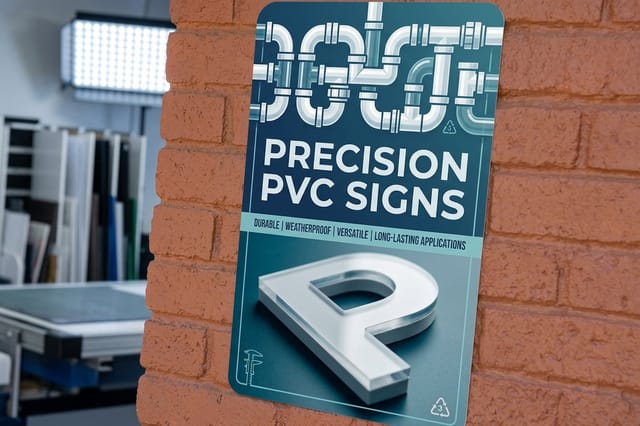
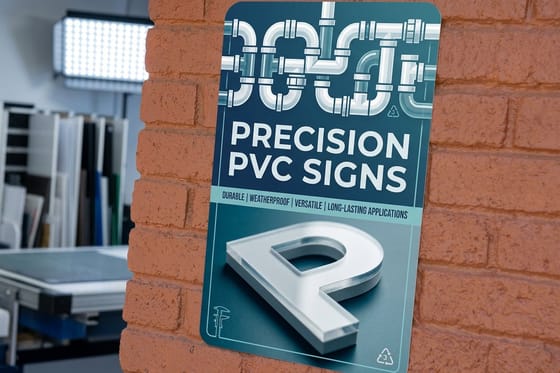
A PVC poster is your poster artwork UV printed straight onto rigid expanded PVC board instead of paper, so the print is also the mount. It stands up with no frame, rain runs off it, and it hangs on tape, screws or standoffs. Against paper it wins on life and rigidity, against foam board it wins on weather and reuse, and against aluminum it wins on price and weight. The ink fades before the board does, and heat movement, not water, is what bends a badly fixed panel.
Quick answer
A poster that is its own mounting board
PVC posters swap paper for a sheet of expanded plastic, so the print arrives rigid, weatherproof and ready to hang. The ink cures on the surface rather than soaking in, which keeps fine type crisp. The board takes rain without swelling, unlike paper and foam board, and it drills, routes and wipes clean. What it will not do is ignore heat: PVC moves as it warms, so a long panel screwed tight at both ends bows, and a thin sheet hung from two corners droops. Choose the gauge for the fixing and the failures disappear.
What a PVC Poster Is and How It Gets Printed
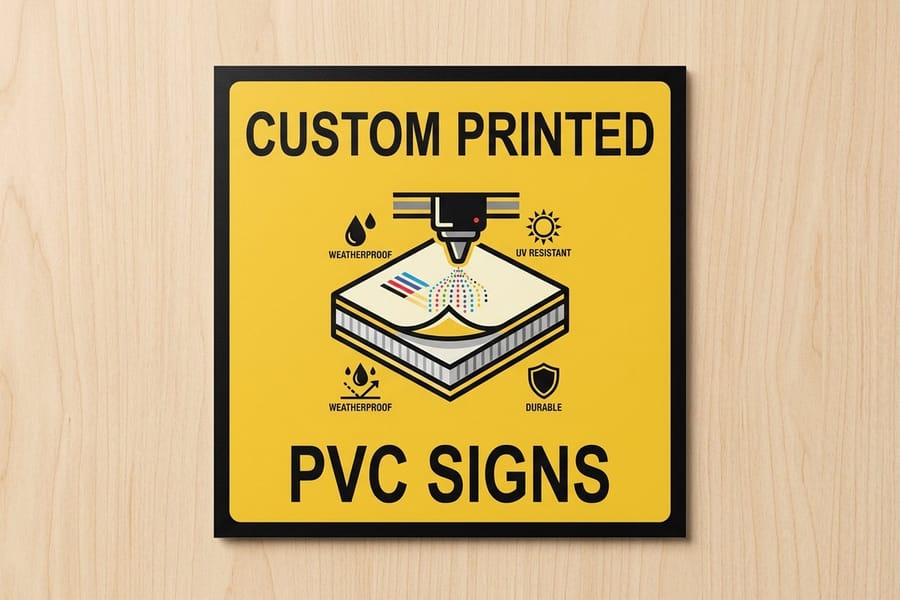
Expanded PVC is a foamed plastic sheet with a dense, smooth skin on both faces and a light cellular core in between. In the trade it goes by brand names, Sintra, Komatex, Celtec, and by the plain description sign board. It arrives white, it cuts like a thick card on the right saw, and it holds a straight edge without any frame behind it.
Printing happens on a UV flatbed. The board lies still on a vacuum table, the heads pass over it, and lamps cure each pass of ink instantly. Two things follow from that. The ink never soaks in, so a hairline rule or 8 point legal text lands exactly as drawn instead of spreading into the fiber the way it does on uncoated poster paper. And because curing is instant, the sheet comes off the table dry, ready to be trimmed, drilled or routed the same hour.
Standard gauges are 3mm, 6mm and 10mm, roughly an eighth, a quarter and three eighths of an inch. The thickness guide covers each one in detail, and the diagram above carries the summary: thickness decides how the panel is fixed, not how good the print looks. A 3mm and a 10mm board carry an identical image.
Because it is plastic rather than layered paper, the board can be cut to shape rather than to a rectangle. Rounded corners, a die cut silhouette, a drilled hole pattern for standoffs, all of it happens on the same router bed. That flexibility is why PVC Signs get used for lobby panels and menu boards as often as for posters, and why PVC Rigid Plastic shows up in retail fixtures.
PVC Against Paper, Foam Board, Coroplast and Aluminum

Every rigid poster question lands on the same five materials, and people confuse them constantly because they all arrive as a flat white board. The fastest way to sort them is to ask two questions: does it stand up without help, and what happens when it gets wet.
| Material | How it behaves | Outdoors | Starts at |
|---|---|---|---|
| Paper poster | Limp. Needs a frame, a mount or a wall of tape. Best color depth of the group. | No. Water ripples it and wind tears it. | $25 |
| Mounted poster | Paper print laminated to a board, so it is rigid but the surface is still paper. | Short term only, edges lift first. | $39.99 |
| Foam board | Lightest of the rigid boards. Paper faces over polystyrene, dents permanently. | No. Faces bubble and delaminate. | $49.99 |
| PVC board | Rigid, solid plastic, wipes clean, drills and routes without splitting. | Yes. The ink ages before the board does. | $25 |
| Coroplast | Fluted polypropylene. Cheapest outdoor board, but the flutes read through a flat color. | Yes, for a season. Flexes in wind. | $25 |
| Aluminum | Stiffest and flattest. Heavy enough to need real fixings. | Yes, for years. The long life option. | $36 |
Read the last column with care. Those are entry prices at different sizes and quantities, not a like for like comparison, so price the exact panel you need on each product before deciding. What the table does settle is the behavior. If the piece lives indoors for a week, foam board is enough and it costs less to throw away. If it lives outdoors for a season on stakes, coroplast is the honest answer. If it lives outdoors for years bolted to a wall, aluminum earns the extra money. PVC owns the wide middle: rigid, weatherproof, printable on both faces, and light enough that one person can hang it. Our foam core against PVC comparison takes those two head to head.
How Long It Lasts and the Two Ways It Fails

Indoors, a PVC poster outlives whatever it was advertising. There is nothing in it to absorb humidity, no paper face to scuff off, and the surface takes a wipe with a damp cloth. Panels come down after a promotion and go back up somewhere else for years.
Outdoors, the board is not the thing that wears out. UV ink on an uncoated board fades under direct sun long before an expanded PVC sheet loses its structure, and heavy dark coverage goes first because it absorbs the most energy. A laminate or a UV clear coat slows that down, which is the same logic behind weatherproofing a poster. If the panel faces north or sits under an awning, plain is fine.
Two failures show up again and again, and both are mounting problems rather than material problems.
- Heat movement. PVC expands and contracts noticeably more than aluminum. Fix a long panel with tight screws at both ends and the first hot afternoon leaves it bowed between them. Drill the holes oversize, use washers, and let the sheet slide.
- Sag over an unsupported span. A 3mm sheet hung from two top corners in a warm room will droop in the middle over weeks. Go to 6mm, or frame the edge, or add a fixing point in the middle.
Two more things worth knowing before you commit. Some venues, hospitals and schools especially, ask for a flame spread rating on anything mounted to an interior wall, so check the requirement before ordering rather than after. And PVC is not accepted by most curbside recycling programs, which is a fair argument for foam board or paper on a genuinely disposable job.
Sizing, Mounting and Setting Up the File

PVC sits between foam board and metal on weight. A 3mm poster panel is a one hand job. A 6mm sheet at 48 by 96 inches takes two people and mechanical fixings, and no adhesive strip made will hold it on a painted wall.
Pick the fixing before you pick the size. Foam tape and hook strips are quick and reversible, and they work on smooth sealed surfaces, not on chalky or freshly painted drywall where they take the paint with them. Screws through the face are the cheapest permanent option and look industrial, which sometimes suits the design. Standoff hardware holds the panel off the wall on barrels and reads as the most finished, but it needs clean holes at each corner and wall anchors rated for the load. Frames, cable systems and A-frame inserts all want 6mm so the edge stays straight.
File setup is the same discipline as any large format job. Build at full size with bleed, keep live text well inside the trim, and supply artwork at a resolution that holds up at viewing distance rather than at arm's length. If the panel will be drilled, leave a clear margin at every hole so a screw head does not land on a letter. Start from a correctly sized layout in the blank template library, and the large format printing guide covers how the flatbed and roll presses differ.
One advantage over paper that people forget: PVC is opaque. Print both faces and neither shows through, so a single panel can hang from a ceiling in a store and work in both directions. A double sided paper poster cannot do that at any weight. Browse sizes across the poster printing range, or read PVC signage explained for the wider family of panels the same board is used for.
Wally explains PVC posters
Same artwork, printed on board instead of paper
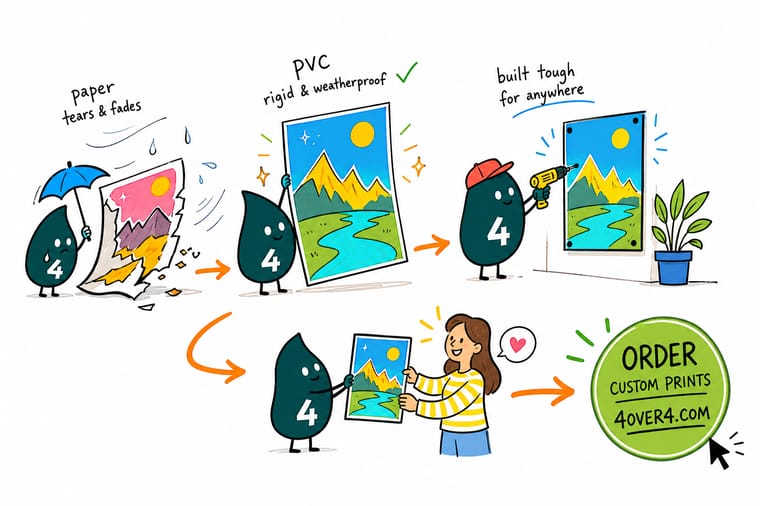
Wally prints your poster onto a sheet of foamed PVC, so it comes off the flatbed already stiff. No frame, no mount board, no glass. He hoses it down and nothing happens, because there is no fiber to swell. Then he screws it to a hot wall too tightly, watches it bow in the sun, and drills the holes a size bigger so the panel can move. Thickness picks the fixing: 3mm flat on a wall, 6mm for frames and standoffs, 10mm when it has to stand on its own.
Order PVC signs →Specs and pricing
Rigid boards, sizes and starting prices
Compare the three rigid poster options side by side, with live configuration choices and starting prices straight from the 4OVER4.COM configurator.


Print it
Order a poster that hangs itself


Explore more
Where to go next

By the numbers
PVC, coroplast, foam core and aluminum panels
Common Questions
Your PVC poster questions, answered
What is a PVC poster?
It is poster artwork printed directly onto a sheet of expanded PVC, a lightweight foamed plastic board with a smooth white skin. You may see it sold as PVC board, rigid poster, sign board, Sintra, Komatex or Celtec, all of which describe the same family of material at different thicknesses. Unlike a paper poster it needs no frame, no backing and no mounting board, because the substrate you print on is already stiff enough to hang on its own.
Can a PVC poster go outside?
Yes, and that is the main reason people order one. PVC does not absorb water, so rain runs off it, and it will not swell, ripple or delaminate the way paper and foam board do. What ages outdoors is the printed ink, not the board. For a seasonal promotion the print is fine as it comes. For a piece that stays up for years in direct sun, ask for a laminate or a UV clear coat, and expect a dark, heavily inked design to fade faster than a light one.
PVC or foam board for an indoor poster?
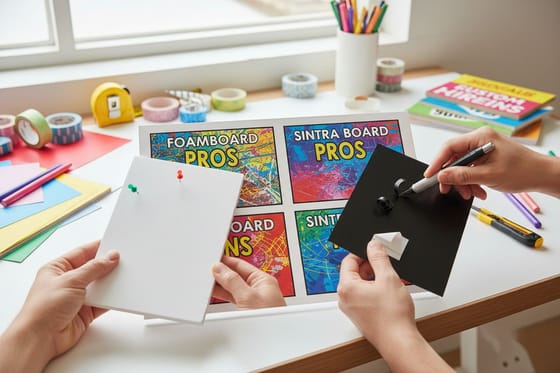
Foam board is lighter and cheaper, so it wins for a one week event, a presentation board or anything you will throw away afterwards. PVC wins the moment the poster has to survive handling, humidity or a second use. Foam board has paper faces over a polystyrene core, and once a corner is dented or a face is scuffed there is no fixing it. PVC takes a knock, wipes clean, and can be unscrewed and rehung somewhere else.
How thick should a PVC poster be?
Match the thickness to how it hangs. 3mm is right for a panel that lies flat against a wall on tape or screws, up to poster sizes you can carry with one hand. 6mm is the safe default for anything that hangs from cables, sits in a frame or an A-frame, or gets standoff hardware, because it holds a straight edge instead of waving. 10mm is for freestanding panels, routed shapes and cut letters where the edge itself is part of the design.
Can you hang a PVC poster without drilling?
On a smooth, sealed, clean wall, heavy duty foam tape or hook and loop strips will hold a small to medium panel. Two cautions. On fresh or chalky paint the adhesive pulls the paint off when you remove it, and on anything large the weight plus a warm room will let it creep down over weeks. Above roughly a 24 by 36 inch panel, or on any outdoor wall, use mechanical fixings or standoffs instead.
Is a PVC poster cheaper than a framed paper poster?
Usually, once the frame is in the sum. PVC Signs start at $25 at 4OVER4.COM and Mounted Posters start at $39.99, while a paper poster starts cheap and then needs a frame, a mount board or glass before it can go on a wall. Entry prices always depend on the size and quantity behind them, so configure the exact dimensions you want on both products and compare the real numbers rather than the starting prices.
Get Started
Pick a rigid board in the poster configurator
Pick your size, choose a PVC gauge that suits the fixing, and we print a rigid panel that goes straight on the wall and stays flat.
Legal Disclaimer
Gold Standard guarantees apply to all standard orders placed through 4over4.com. Price match requires verifiable proof of a competitor's published price for an equivalent product with matching specifications and turnaround time. Satisfaction guarantee covers manufacturing defects and print quality issues. Contact support with order number and documentation. On-time delivery rate based on tracked orders 1999 to 2026. Individual results may vary based on shipping carrier performance.
