
How to Run a Festive Print Campaign That Lands Before the Holidays


The seasonal calendar counted backwards, the offers that hold your price, and the mix of postcards, cards and counter pieces that make a December campaign work.
Run a festive print campaign backwards: fix the date the piece should be in someone’s hand, then subtract mail transit, print turnaround and proofing, and the order date falls out of the arithmetic. Split the season into waves rather than one mailing, because a Black Friday offer, a December greeting and a gift certificate on the counter do three different jobs. December transit is the risk, not the press, so pay for First Class when the date decides whether the offer still means anything.

Quick answer
Fix the in-home date, then subtract
A festive campaign is a scheduling problem before it is a design problem. Decide when the piece should be in someone’s hand, subtract mail transit, print turnaround and a day or two of proofing, and you have the order date. Split the season into waves so each piece carries one job, use offers that add value instead of cutting price, and treat December transit as the part you do not control. When the date is tight, First Class postage buys certainty that Marketing Mail does not promise.
Build the Calendar Backwards From the In-Home Date

Pick the day the piece should be in someone’s hand. Everything else is subtraction, and the order date is the answer rather than the starting point.
- In-home date. A Black Friday teaser wants to land the week before Thanksgiving, while the household is still deciding where to spend. A holiday card reads best in the first ten days of December, before every other card arrives at once.
- Mail transit. This is the stage you do not control. Marketing Mail carries no delivery commitment, and the spread between a fast delivery and a slow one is widest in December.
- Print turnaround. A few business days on standard cards and postcards. Add time for any coating, die cut or folded format, because those are finishing passes after the press.
- Proof and file fixes. Budget a day or two for the round trip on a file with a missing bleed or a low-resolution logo. Almost every campaign loses a day here, and almost nobody plans for it.
Do it forwards instead and the failure is predictable. You approve artwork on December 8, the job prints in three business days, transit takes what it takes, and a card wishing someone a happy Christmas arrives between Christmas and New Year.
Four waves cover most of the season without competing with each other. A Black Friday offer on Black Friday postcards in the second half of November, a relationship piece on business Christmas cards in early December, gift certificates running on the counter until Christmas Eve, and a January thank-you that most businesses skip entirely. Our guide to building a direct mail campaign covers the structure underneath all four.
Seasonal Offers That Get Redeemed Without Cutting Your Price

The offer decides whether the print pays for itself, and the most common seasonal offer is also the weakest. A percentage-off card works once. Mail it three Decembers in a row and your regulars simply wait for it, which means you have converted full-price buyers into discount buyers and paid postage for the privilege.
Added value holds the price instead. Christmas gift certificates start at $42.84 and do something a discount cannot: they take money in December and bring the person back in January, when the shop is empty and the staff are standing around. A free add-on, a priority booking slot, or an early-access window for regulars all work the same way, because the customer gains something without your margin moving.
Whatever the offer, put a real date on it. A seasonal piece without a deadline gets set aside and forgotten, and the piece with the deadline gets acted on. One offer per piece, stated large enough to read at arm’s length, with the redemption instruction directly under it. If you need a second offer, that is a second wave, not a second panel.
The other half of redemption is the follow-through. A Christmas thank-you card at $19.77 handed over with the purchase costs almost nothing and gives you a reason to be in the mailbox again in January. Design specifics for the offer panel itself are in our postcard design guide.
The Print Mix, and What Each Piece Is Actually For

Every piece in a festive campaign has one job. Confusing the jobs is why campaigns produce a pile of print and no result, so here is the mix with the order timing and the starting price attached.
| Piece | The job it does | When to order | Starts at |
|---|---|---|---|
| Black Friday postcards | One deadline offer, read in three seconds at the mailbox. | Second half of October. | $16.48 |
| Christmas postcards | Seasonal reach at the lowest cost per piece, offer optional. | Late October to early November. | $16.48 |
| Business Christmas cards | Relationship, not sales. Your name in front of clients with no ask attached. | Early November. | $17.57 |
| Christmas gift certificates | Revenue in December, footfall in January. | Any time from November, they sell until Christmas Eve. | $42.84 |
| Christmas door hangers | Local reach with no postage and no address list. | Late November, still workable in December. | $252.51 |
Read the third column against your own calendar before the fourth. Printing is rarely what breaks a seasonal campaign, and it is rarely the largest line in the budget either. Postage and list quality usually cost more than the paper, which is why a smaller, better-targeted mailing normally beats a bigger one.
If a piece has to carry addresses, variable data and postal sorting, order it as direct mail postcards at $89.68 and let the mailing be handled with the print instead of running to the post office with boxes in the last week of November. For the storefront side of the campaign, Christmas window clings at $30 put the same offer in front of people already walking past. Sizes and folded formats for the card run are on the greeting card printing category, and you can lay artwork out on a correctly sized blank template before anything goes to press.
Mailing in December Without Missing the Window
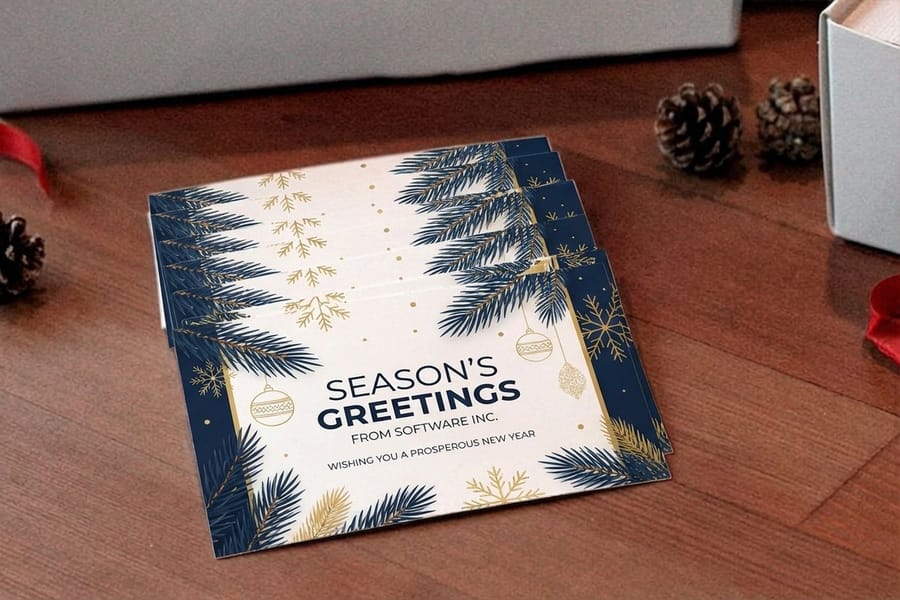
December is the month when the mail stream is fullest and the delivery estimate is loosest. That is the entire risk in a festive campaign, and it is worth planning around explicitly rather than hoping.
Three choices decide how exposed you are. Postage class is the first: Marketing Mail is cheaper and uncommitted, First Class is dearer and behaves, and the correct answer depends on whether a late arrival makes the offer worthless. List quality is the second, because a piece mailed to an address nobody lives at is a total loss no matter how fast it moves. Format is the third: a flat postcard sorts and travels more simply than an odd size or a thick folded card, and odd sizes can cost more to mail.
Address the pieces properly or the class you paid for stops mattering. Our guide to postcard postage and USPS rules covers the address block, the clear zones and the size limits that decide the rate, and the mailing list guide covers where the names come from in the first place. Mail your own customers first, every time. They already bought once.
If you want local coverage without a list at all, Every Door Direct Mail delivers to whole carrier routes, which suits a shop that draws from a handful of surrounding neighborhoods. And if the calendar has already slipped past the first week of December, stop mailing. Move the budget to door hangers, window clings and counter pieces, all of which reach people without a postal service in the middle. More seasonal planning sits under our marketing strategy guides.
Wally plans the festive season
Pick the delivery date first, then count backwards
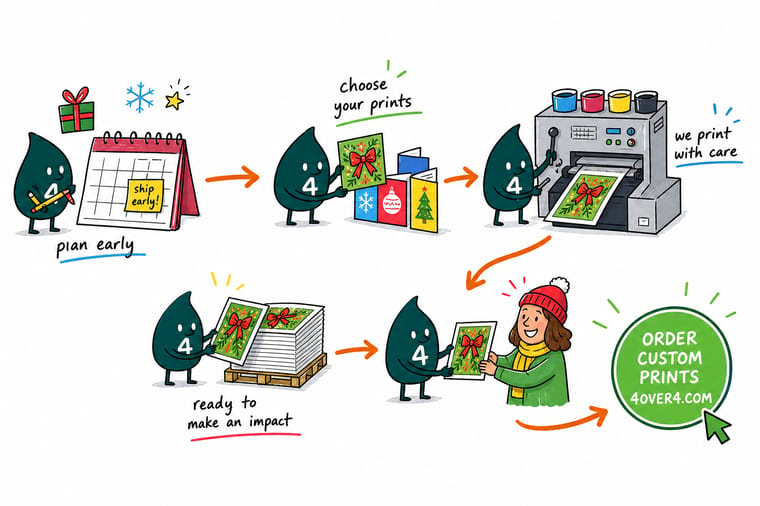
Wally puts a pin in the day the card should land, then walks back along the calendar: a few days for the post, a few business days on press, a day or two for the proof. Where his finger stops is the day to order. He runs the season as waves too, a Black Friday postcard, a December card, gift certificates on the counter, so each piece has one job. And when the calendar slips past the first week of December, he stops mailing and starts hanging door hangers instead.
Order Christmas postcards →Specs and pricing
Sizes, stocks and starting prices for the season
Configure the three pieces most festive campaigns are built on, with live options and starting prices straight from the 4OVER4.COM configurator.



Print it
Order the pieces the season runs on


Explore more
Where to go next




By the numbers
Seasonal printing you can schedule around
Common Questions
Your festive campaign questions, answered
When should I order holiday cards and postcards?
Work back from the in-home date rather than from a month on the calendar. A Black Friday postcard wants to land the week before Thanksgiving, which means the file leaves your hands in the last third of October once you allow for proofing, printing and mail transit. A holiday card reads best in the first ten days of December, before the mailbox fills with everyone else, so late October or early November is the comfortable order window. If you are ordering in the second week of December, switch to First Class postage or hand delivery and stop counting on Marketing Mail.
Should I mail holiday postcards First Class or Marketing Mail?
Marketing Mail is cheaper per piece and has no delivery commitment attached to it, which matters far more in December than in June. First Class costs more and moves faster, and it forwards or returns undeliverable pieces so you learn which addresses are dead. The practical rule: if missing the date makes the offer worthless, such as a Black Friday teaser or a December event invitation, pay for First Class. If the piece is a general seasonal greeting that still works a week late, Marketing Mail is fine.
Is it too late to run a festive campaign in December?
Not for everything. Mailed pieces get difficult after the first week of December because transit is the part you do not control. What still works is anything that skips the mail: gift certificates on the counter, window clings on the storefront, door hangers walked through a nearby neighborhood, and thank-you cards handed over with the purchase. Christmas gift certificates start at $42.84 and Christmas door hangers at $252.51, and both reach people without a postal service in the middle.
What offer works better than a discount?
Anything that adds value without moving your price. A gift certificate sells at full value now and gets redeemed in January when your shop is quiet. A free add-on, a priority booking window, or a bundled item all convert without teaching the customer that your prices drop every December. Discounts have their place on slow-moving stock, but a business that mails a percentage-off card three years running has trained its own regulars to wait for it.
Do I need separate designs for Black Friday and Christmas?
Yes, and it is the cheapest improvement most campaigns can make. Black Friday is a deadline message: one offer, one date, large type, minimal decoration. A Christmas card is a relationship message: your name, a thank you, and nothing that looks like a coupon. Putting both on one piece produces a card that gets read as an ad and thrown away. Two short print runs of a 4 by 6 postcard cost less than most people expect, because the setup is the same either way.
How many pieces should I mail, and to whom?
Mail your own customer list first, in full, because it is the only list where you already know people bought from you. Only then buy or rent reach. If you are going wider, Every Door Direct Mail covers whole carrier routes without addresses, which suits a shop that draws from a few surrounding neighborhoods. A rented list of 5,000 strangers usually performs worse than 800 past customers, and it costs more.
Get Started
Order 50 Christmas postcards from $16.48
Pick the in-home date, count backwards, and get the postcards, cards and gift certificates on press with room to spare before December fills up.
Legal Disclaimer
Gold Standard guarantees apply to all standard orders placed through 4over4.com. Price match requires verifiable proof of a competitor's published price for an equivalent product with matching specifications and turnaround time. Satisfaction guarantee covers manufacturing defects and print quality issues. Contact support with order number and documentation. On-time delivery rate based on tracked orders 1999 to 2026. Individual results may vary based on shipping carrier performance.
