
7 Poster Advertising Tips That Get Your Message Noticed


Seven tips that decide whether a poster gets read or walked past, in the order you should apply them: distance, placement, hierarchy, headline, tracking and stock.
Poster advertising works when the size matches the distance people read it from and the headline lands in one glance. Size the capital letters at roughly one inch for every ten feet of viewing distance, hang the poster where people already stand still, hold the layout to three levels of type, and add a QR code so the spend can be measured. Then pick the stock for the weather it will meet, because paper is an indoor material.

Quick answer
Distance sets the size, placement sets the result
Every decision on a poster campaign follows from one measurement: how far away the reader is standing. That distance fixes the capital letter height, the letter height fixes the poster size, and the poster size fixes the stock and the display you need to hold it. Get those right and a plain layout works. Get them wrong and no amount of design rescues an 18 by 24 poster hung at the end of a 40 foot corridor.
Tip 1. Use a Poster Where a Screen Cannot Follow People
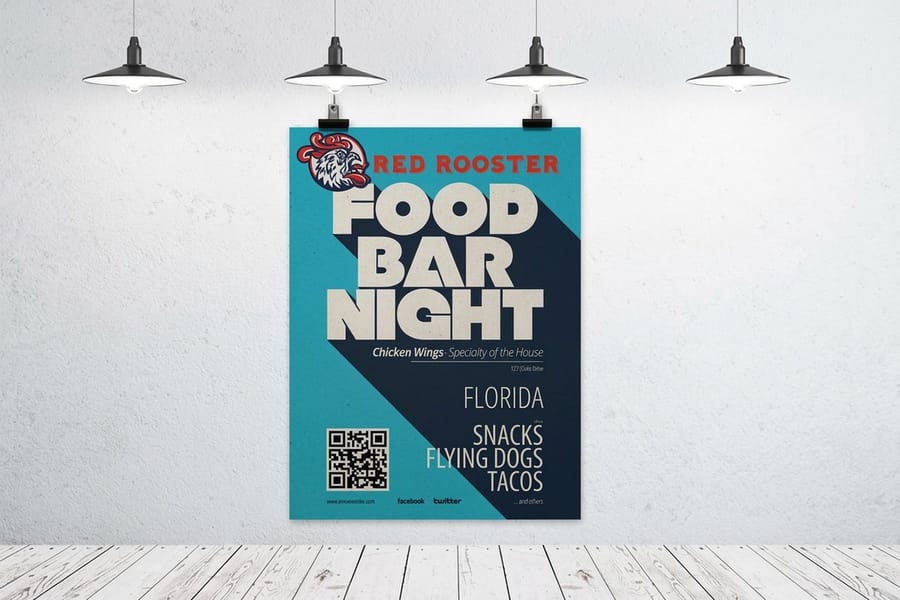
A poster earns its keep in the places a phone screen does not reach: the queue at a counter, the wall beside a lift, the window a hundred people pass on the way to the train. You pay once and it works every hour it is up, with no bidding, no cost per click and nobody scrolling past it.
The trade-off is real and worth saying out loud. A poster cannot be targeted, cannot be paused, and tells you nothing about who saw it unless you build measurement in, which is what tip 6 is about. It also has a shelf life: a promotion that ended three weeks ago is still hanging there, telling people you do not pay attention.
So use posters where the audience is defined by the location rather than by data. A gym notice board reaches gym members. A cafe window reaches the street it faces. A campus corridor reaches students. That is targeting by geography, and it is the one thing print does better than anything on a screen. Start from the full range in posters and wall art and pick the format the location can actually hold.
Tip 2. Let the Viewing Distance Choose the Size and the Stock
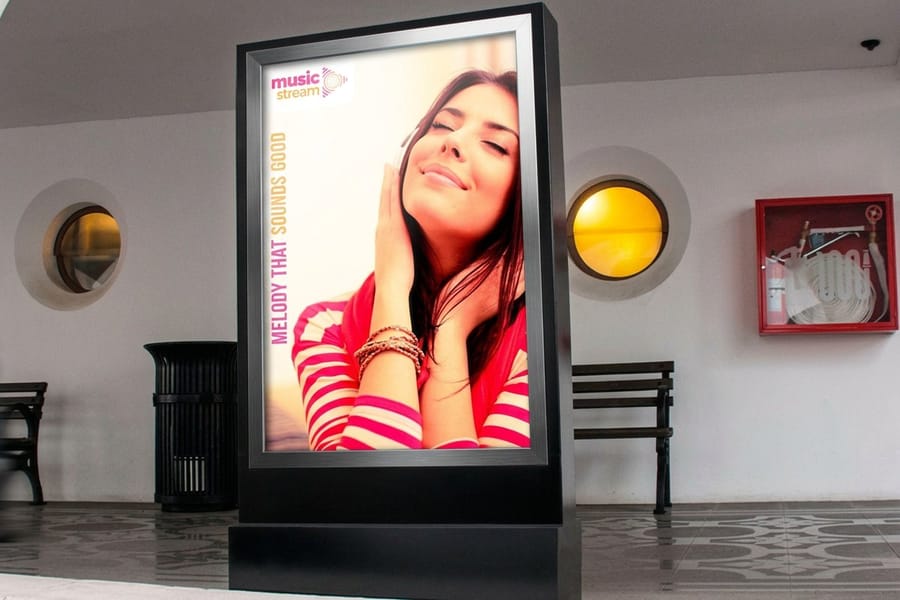
Most weak posters are the right design at the wrong size. Before you open a layout, stand where your reader will stand and measure the gap. Signmakers size type by a simple ratio, about one inch of capital letter height for every ten feet of viewing distance, and the headline that ratio gives you is what determines the poster size, not the other way round.
| Placement | Read from | Poster size | What to print it on |
|---|---|---|---|
| Counter, lift door, restroom door | About 5 ft | 11 x 17 in | Paper poster, or a laminate if hands will touch it. |
| Indoor wall, shop window | 10 to 15 ft | 18 x 24 in | Large Format Posters, from $25. |
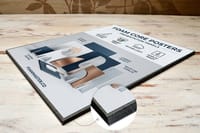
| Lobby, sidewalk A-frame, easel | About 25 ft | 24 x 36 in | Foam Core Posters, from $49.99, because they stand without a frame. |
| Across a street or a car park | 50 ft and up | 36 x 48 in and larger | Large format on a durable stock, or a banner once you pass 4 ft. |
Stock changes the job as much as size does. A plain paper poster is for a wall it will be taped to and replaced from. Laminated Posters start at $25 and add a wipe-clean surface that survives a kitchen, a gym or a school corridor. Mounted Posters start at $39.99 and stay flat on an easel instead of curling off it. Standard Posters start at $108.75 and suit a print run you are distributing rather than a single display piece.
If you want the full size chart before you commit, the poster sizes in inches guide lists every standard dimension, and the trade show poster size guide covers the case where an aisle sets the distance for you.
Tip 3. Hang for Dwell Time, Not for Wall Space
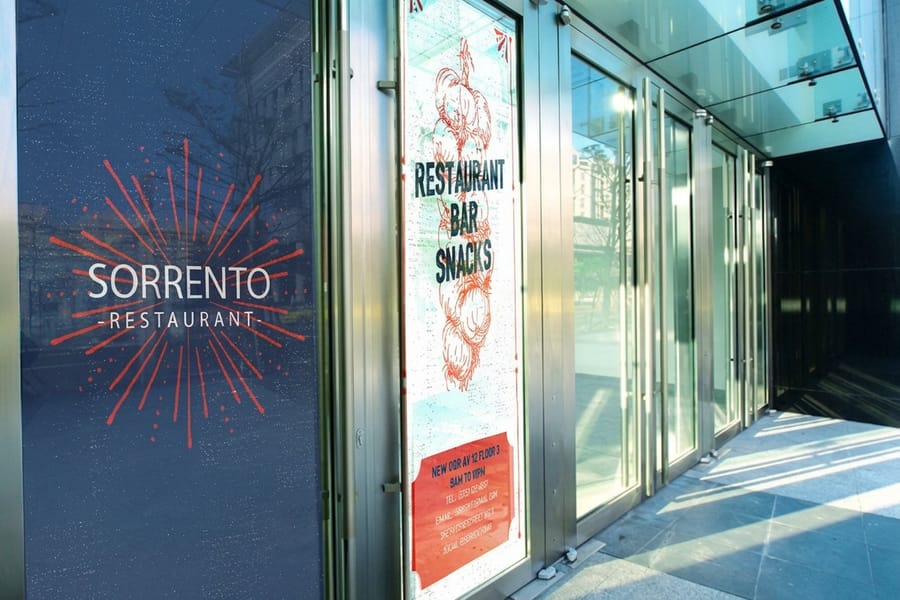
The best poster in the building fails on a wall people walk past at speed. The average one wins next to a queue, because a person waiting four minutes will read anything in front of them. Map the places where your audience stops moving, then put the posters there.
Reliable dwell points: the line at a till, the wall facing a lift, the inside of a toilet door, a waiting room, a bus stop, and the stretch of window a pedestrian passes at walking pace. Hang the center of the poster at eye level, around 57 to 60 inches from the floor, which is the height galleries use because it suits most standing adults. A poster above a door frame is decoration.
Outside your own door, the display matters as much as the print. A Signicade A-Frame starts at $182.32, holds a poster on both sides at pavement level, and comes in at night, which is why it works in places a wall-mounted sign is not permitted. On the glass itself, Clear Window Clings start at $30, peel off without residue and let you change a message weekly without touching the paint.
Get permission before you hang anything you do not own, and write an end date on the back of every poster you put up. If your campaign is going to spill onto the pavement or a lawn, the yard sign guide covers the ground-level version of the same problem.
Tip 4. Build Three Levels of Type and Stop There

A poster is read in the order of contrast, not the order you wrote it. Give it three levels and no more: a headline anyone can read at the distance you measured, one supporting line that adds the offer or the date, and one small details block carrying the address, the times and the fine print.
Everything else is subtraction. One focal image, not three. One accent color against a plain field, because a poster competing with a busy wall needs a flat area to win with. Real margin, at least an inch on a 24 by 36, so the design does not run into the frame or the tape. If you find yourself adding a fourth type size, something in the second level is doing a job the headline should be doing.
Set the file up the way any press wants it: full size at 300 dpi, CMYK, 0.125 inch bleed on every edge, and text pulled at least 0.25 inch inside the trim so nothing important gets cut. Fonts converted to outlines removes the most common cause of a reprint. Start from a correctly sized layout in the blank template library, and if you want the full layout sequence, designing a poster in 8 steps walks it through in order.
Tip 5. Write the Headline for Someone Already Walking Past
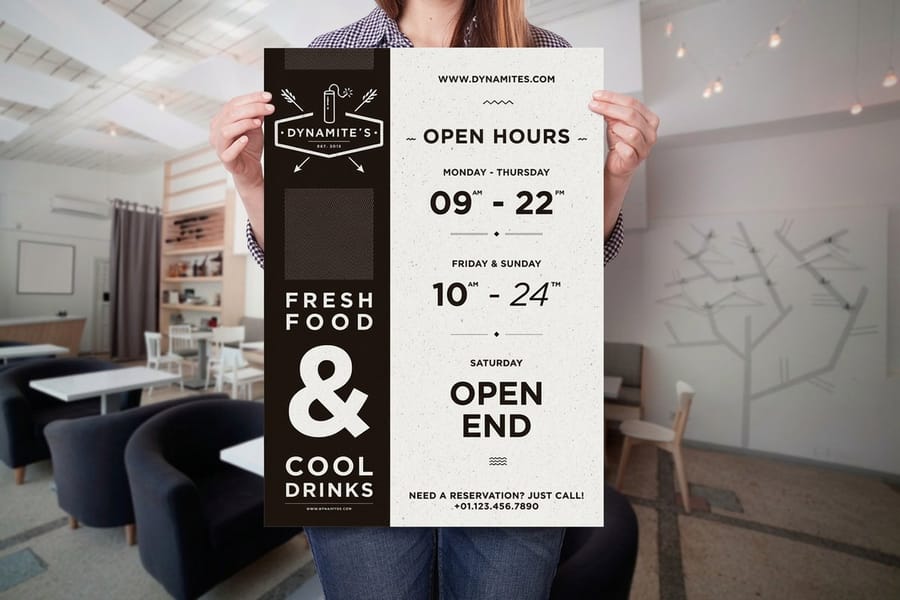
You get one line. Spend it on the thing that would make a stranger slow down: the offer, the date, or the problem you solve. Clever headlines that need a second read are the ones that fail at 25 feet, because there is no second read when the reader is moving.
Say what it is, who it is for, and what to do next. A poster reading Free hearing tests, Saturdays, no appointment does all three in six words. One reading Sound decisions start here does none of them. Put a date or a deadline on it wherever there is one, because a deadline is what turns interest into an action today rather than an intention for later.
Then make the next step physical. The call to action should tell the reader what their hands do: scan the code, take a tab, walk in, ring the bell, text a short word to a number. A web address alone asks a person to memorize a string while walking, which is why it usually goes nowhere. That is the gap the QR code fills, and it is the next tip.
Tip 6. Put a QR Code on It So the Campaign Can Be Measured
Print advertising is usually accused of being unmeasurable, and a QR code is the cheapest way to make that untrue. Point the code at a landing page or a tracked link that only appears on the poster, and every scan tells you which location, which week and which version pulled.
Three things decide whether it works. Size it by the scanning distance: a code reads from roughly ten times its own width, so one inch handles about ten feet, and a poster read from 25 feet wants a code closer to 2.5 inches. Keep the quiet zone, a clear margin about four modules wide, empty on all four sides, and never print the code across a photograph or a gradient. And give the code a promise next to it, because Scan for this week’s menu gets pointed at and a bare black square does not.
Place it low enough to be comfortable, roughly between waist and chest height on a wall-mounted poster, and test it printed rather than on screen. Our complete QR code guide covers dynamic codes and tracking, using QR codes on flyers and postcards covers the same rules at smaller sizes, and you can build one on the free 4OVER4.COM QR code generator.
Tip 7. Match the Material to the Weather It Will Meet
Paper is an indoor material. Uncoated poster stock takes on moisture, cockles into waves, and lets the ink bleed the first time it rains. Sun does the rest, pulling the cyan and magenta out within weeks. If the poster is going outside, choose the substrate before you choose the size.
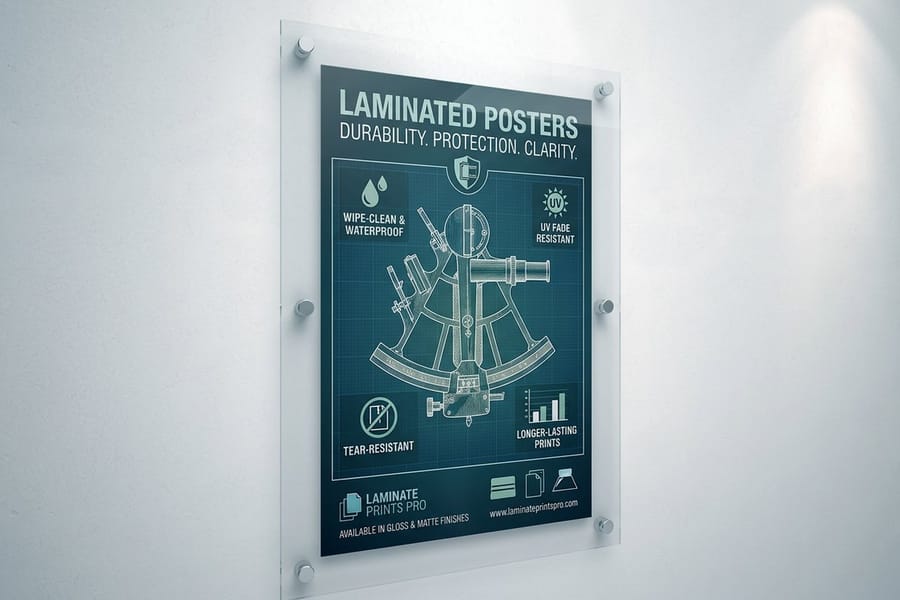
Indoors, the only real material decision is glare. Matte suits anything under downlights or facing a window. Gloss deepens photographs and is worth it in even, indirect light. Where the poster will be handled, wiped or hung somewhere humid, Laminated Posters from $25 solve grime and glare together. On an easel or a stand, Foam Core Posters from $49.99 stay rigid instead of bowing across the middle.
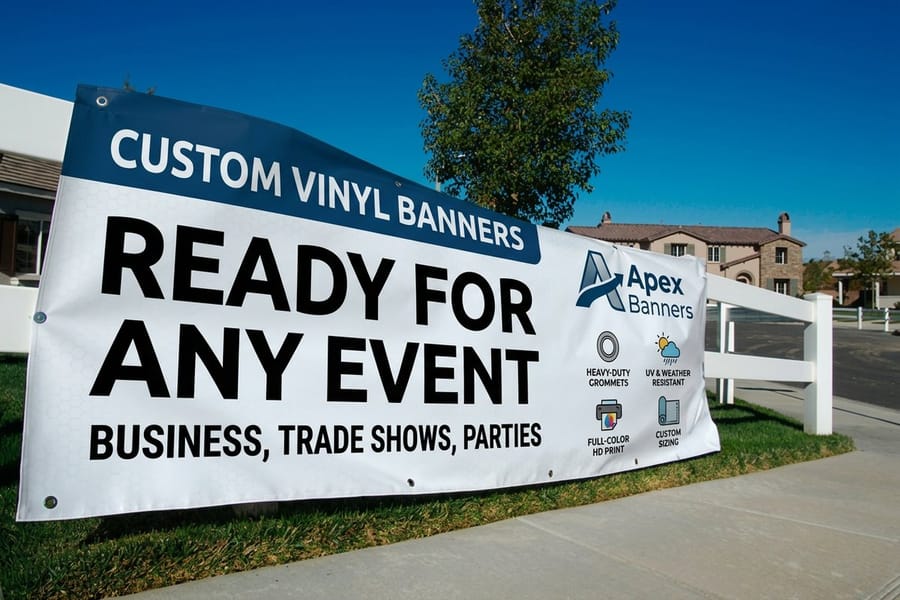
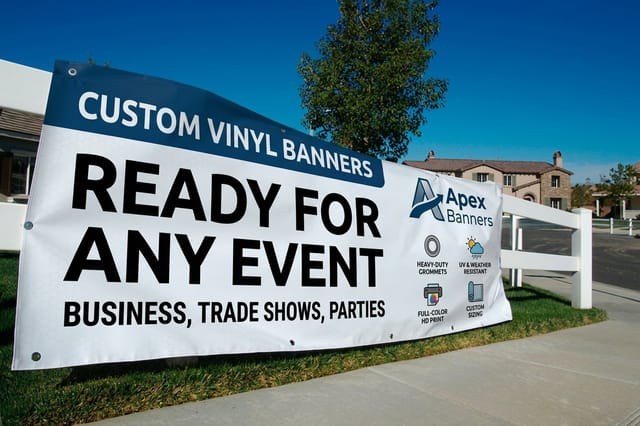
Outdoors, work up in three steps. A laminated poster survives a sheltered doorway. Coroplast handles ground-level signage in weather, which the coroplast signs guide explains. Once the piece passes roughly four feet in any direction, or has to face open weather for a season, move to Vinyl Banners from $79 with hemmed edges and grommets. The banner size guide covers what to order there, and the large format printing category lists every stock that runs at those dimensions.
Wally explains poster advertising
Measure the distance first, design second
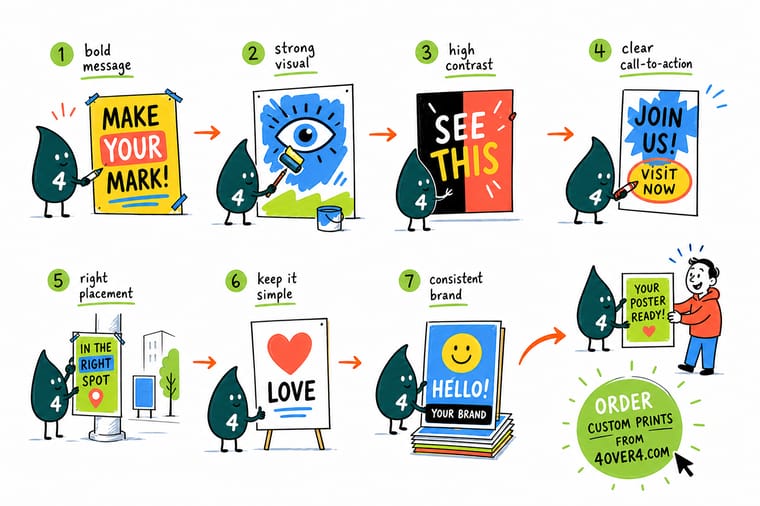
Wally walks back from the wall to where a real person will stand, counts the feet, then divides by ten to get the capital letter height his headline needs. Only then does he choose the poster size, because the type has to fit the paper and not the other way round. He hangs it where people already wait, keeps three levels of type, adds a QR code big enough to scan from that same distance, and picks a laminate the moment the poster is going anywhere near weather or fingers.
Print large format posters →Specs and pricing
Poster stocks, sizes and starting prices
Compare the three poster stocks that cover most advertising jobs, with live configuration choices and starting prices straight from the 4OVER4.COM configurator.

Print it
Order the poster the placement actually needs


Explore more
Where to go next



By the numbers
Posters laminated, mounted or rolled to order
Common Questions
Your poster advertising questions, answered
What size poster works best for advertising?
Work backwards from where people will stand. At arm’s length, next to a till or on a lift door, 11 by 17 inches is plenty. For an indoor wall or a shop window read from ten to fifteen feet, 18 by 24 inches is the usual pick. For a lobby, a sidewalk A-frame or a corridor read from about 25 feet, go to 24 by 36. Anything read from across a street or a car park starts at 36 by 48 and climbs from there. The size follows the headline: pick the capital letter height the distance demands, then buy the poster big enough to hold it.
How much does poster advertising cost to print?
At 4OVER4.COM, Large Format Posters start at $25 and Laminated Posters start at $25, Mounted Posters start at $39.99, Foam Core Posters start at $49.99, and Standard Posters start at $108.75. A Signicade A-Frame to stand one of them in starts at $182.32 and is reusable for years, so the frame is a one-off and the poster inside it is the recurring cost. Budget for the display as well as the print, because a poster taped flat to a glass door is the version that gets ignored.
Where am I allowed to put advertising posters?
Anywhere you have permission, and nowhere else. Your own window, your own wall and your own A-frame on your own frontage are free. Community boards, gyms, cafes, campus boards and salons usually say yes if you ask the manager and offer to take it down on a date. Lamp posts, bus shelters and construction hoardings are almost always somebody else’s property, and many cities treat flyposting as a fine-able offense. Ask first and put an end date on the poster, because a faded poster from a dead promotion damages the brand more than no poster.
Do QR codes on posters actually get scanned?
They get scanned when they are big enough and placed low enough. The practical rule is that a code can be read from roughly ten times its own width, so a code one inch wide works at about ten feet and needs to grow for a poster read from further back. Keep a clear quiet zone around it, avoid printing it over a busy photograph, and write what happens when the code is scanned right next to it. A code with no promise beside it is a shape nobody points a phone at.
Matte or gloss for an indoor poster?
Matte for anything under downlights or near a window. Gloss makes colors snap and photographs look richer, but it also mirrors ceiling lights, and a reader who has to move sideways to dodge a hotspot usually just keeps walking. Gloss earns its place on posters hung in even, indirect light, or behind glass in a frame that already carries a reflection. If the poster will be touched, wiped or hung in a kitchen or a gym, a laminate solves glare and grime at the same time.
Will a paper poster survive outdoors?
Not for long. Uncoated poster paper absorbs moisture, cockles into waves and lets the ink bleed the first time it rains, and direct sun fades it within weeks. If the poster has to live outside, use a laminated poster in a sheltered spot, a coroplast sign for anything ground-level, or a vinyl banner for anything larger or exposed. The honest test is whether the piece would still be worth looking at after a wet weekend.
Get Started
Order a large format poster, printed in 2 business days
Pick the size the viewing distance calls for, choose a paper, laminate or rigid board, and we print posters that still read from the far end of the room.
Legal Disclaimer
Gold Standard guarantees apply to all standard orders placed through 4over4.com. Price match requires verifiable proof of a competitor's published price for an equivalent product with matching specifications and turnaround time. Satisfaction guarantee covers manufacturing defects and print quality issues. Contact support with order number and documentation. On-time delivery rate based on tracked orders 1999 to 2026. Individual results may vary based on shipping carrier performance.
