
Design and Print Custom Playing Cards That Feel Right in the Hand


Poker size, stock thickness, the rotation test every back has to pass, photo resolution, and the box depth nobody measures until the lid will not close.
A custom playing card deck is a 2.5 by 3.5 inch poker size card printed on 14pt or 16pt laminated stock with rounded corners, 54 unique fronts, one rotationally symmetrical back, and a box sized to the finished stack. At 4OVER4.COM the card body is our trading card product, from $11.25, with silk lamination from $94.74 for the finish closest to a real playing card. Set every file up at 2.75 by 3.75 inches to carry bleed, and give the back a 3/8 in border so the roughly 1/16 in stack cutting drift never shows.
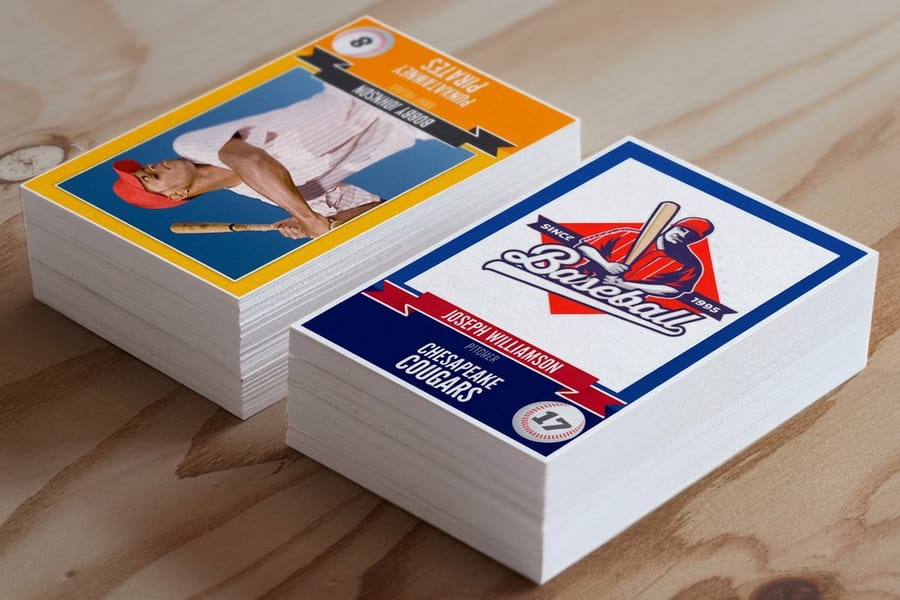
Quick answer
Poker size, laminated stock, and a back that survives a 180 degree turn
A deck is 54 cards trimmed at 2.5 by 3.5 inches, and the two decisions that matter are the lamination and the back geometry. Silk film gives the consistent slip that lets a deck fan and shuffle, where raw coated stock goes sticky once hands warm it. The back has to look identical rotated 180 degrees, or a single flipped card is readable from behind, and it needs a border wide enough to swallow the roughly 1/16 in the blade drifts when cards are cut in stacks. Everything else, stock weight, box depth, photo resolution, follows arithmetic you can do before you open a design file.
What a Custom Deck Is Really For
Three jobs account for almost every custom deck we print. A company hands them out at trade shows because a deck survives on a desk in a way a flyer never does. A designer is publishing a card game and needs 54 or 108 unique faces printed and collated. Someone is making a gift deck out of family photographs.
Those three want different things, and the difference shows up in the budget line rather than the artwork. The promotional deck lives or dies on the box, because that is the part people see before they decide to keep it. The game needs consistency across a print run so cards from box seven feel identical to cards from box one. The photo deck needs resolution and nothing else.
Here is the part most pages skip: a deck is 54 pieces of print sold as one unit, so the per piece economics are unlike anything else in a catalog. That is why quantity moves the price so hard, and why the honest question early on is not which lamination you want but how many decks you actually need. Fifty decks and five thousand decks are different manufacturing problems.
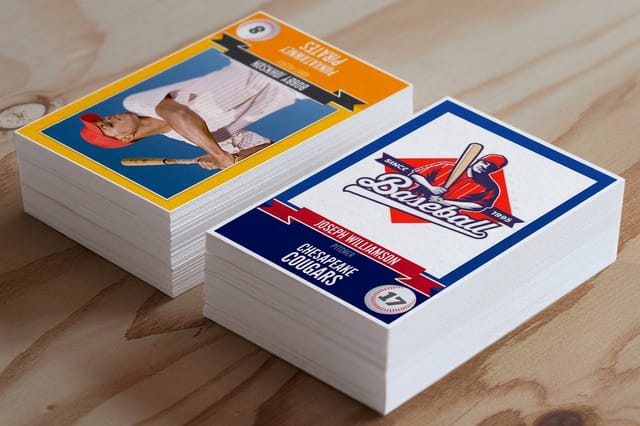
The card body itself is our trading card product, which trims at 2.5 by 3.5 inches, exactly poker size. Everything on the trading card range is available at that trim, and the collation and file rules are the same ones covered in our guide to making trading cards.
Card Stock and Finish, and How Each One Handles
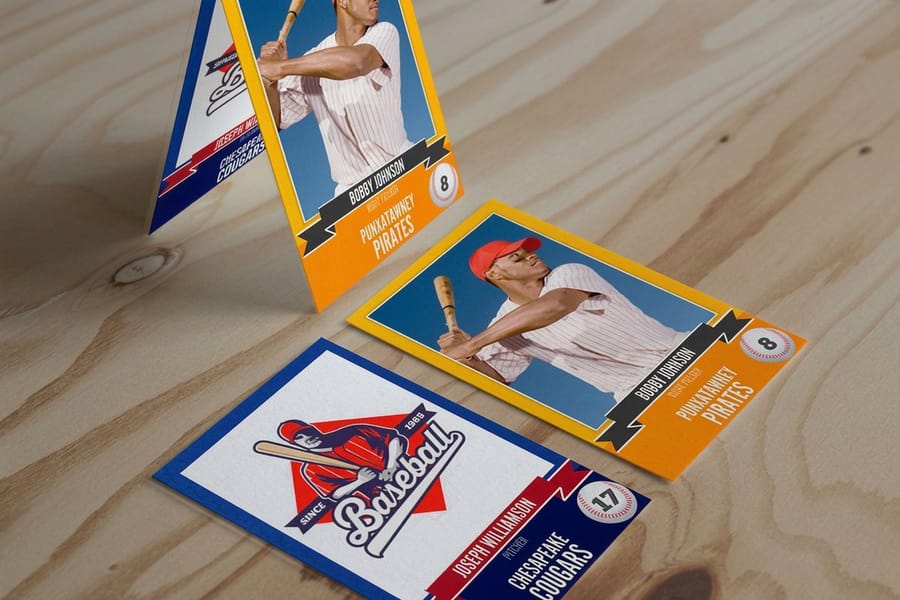
Two numbers describe a deck before anything else: point thickness and finish. Thickness decides how it fans and how tall it stacks. Finish decides how it feels after two hundred hands.
14pt is 0.014 of an inch, near enough to the thickness of a supermarket deck, and a 54 card stack of it comes to roughly 0.76 inches. 16pt goes to 0.016, stacks to about 0.86 inches, and holds up better to bending, at the cost of a deck that feels thick in a child sized hand. Point weights across our whole range are laid out in the cardstock weights guide if you want the full ladder.
| Card option | Surface in the hand | How a deck behaves | From |
|---|---|---|---|
| Trading cards | Coated cardstock with a light sheen. | Slick when new, then picks up finger oil at the corners. The budget deck. | $11.25 |
| Kraft trading cards | Uncoated brown board, visibly fibrous. | Grippy and pleasant, but ink sinks into the sheet so light colors go muddy. | $48.61 |
| Silk laminated | Low sheen film on both faces. | Closest thing we make to a real playing card. Resists fingerprints, slides without sticking. | $94.74 |
| Suede trading cards | Soft touch velvet film, almost chalky. | The most impressive on first handling and the first to show a scuff. A display deck. | $94.74 |
| 30mil white plastic | Rigid PVC, 0.76 mm. | Waterproof and permanent. Will not shuffle. A 54 card stack is over 1.6 inches. | $226.11 |
If you only take one thing from that table, take the third row. Silk lamination is the finish that behaves like a playing card, because the film gives the card a consistent slip that raw coated stock loses as soon as hands warm it up. Suede looks better in a photograph and worse after a week of play.
Rounded corners are not optional on a deck. A square corner splits along the fold of the lamination within a few dozen shuffles, and the split then peels. The rounded corner comparison is written around business cards, but the mechanics are the same and the argument is stronger here because a deck gets handled hundreds of times more.
Designing 54 Faces and One Back

Set every card up at 2.75 by 3.75 inches. That is the 2.5 by 3.5 trim plus a 1/8 in bleed on all four sides, and it is the same arithmetic explained in bleed and trim explained. Keep type and pips 1/8 in inside the trim line. Correctly sized starting files for card products live in the blank template library.
The faces are the easy half. Put the index, meaning the rank and the small suit pip, in the top left corner and repeat it rotated in the bottom right, so the card reads whichever way it is picked up and stays readable when the hand is fanned to the left or the right. Left handed players fan the other way, which is the whole reason four corner indices exist on some decks. Keep the index small and keep it high: if it sits more than about a quarter inch in from the corner, a tight fan hides it.
The back is where decks go wrong. It has to pass two tests. First, rotate it 180 degrees. If the rotated version is distinguishable from the original, then one card accidentally inserted upside down becomes readable from behind, and the deck is marked whether you meant it or not. Logos, text and any asymmetric mark fail this test, which is why classic backs are lattices, medallions and mirrored ornament.
Second, give it a border. Cards are cut in stacks and the guillotine wanders by roughly a sixteenth of an inch, so a design that runs to a 1/8 in margin can end up with 0.05 in on one edge and 0.19 in on the other. Fanned, that looks like a manufacturing defect. Push the border to 3/8 in and the same drift becomes 0.34 against 0.48, which nobody sees. The wide white frame on every traditional deck is a tolerance decision, not a style choice.
Build the files in CMYK before you send them. Deep blues and rich reds are exactly the colors that shift most between screen and press, and a deck gives you 54 chances to notice. The color profile guide covers the conversion and what to expect from saturated solids.
Photo Decks and Branded Decks Fail Differently
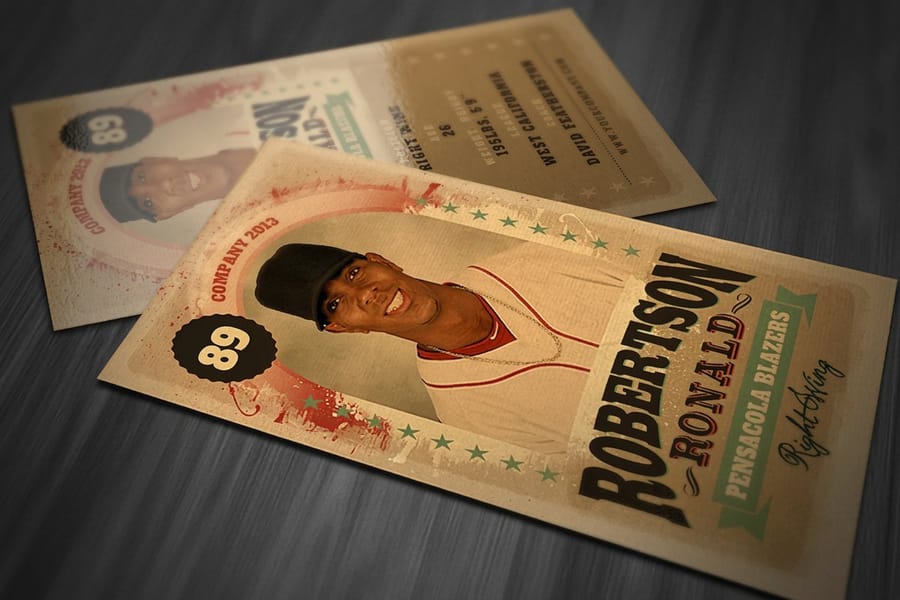
A photo deck is a resolution problem. At 300 ppi, a 2.5 by 3.5 inch card with bleed needs 825 by 1125 pixels. Any phone from the last decade clears that by a wide margin, so the failures are never the camera. They are screenshots, images saved from a messaging app, and pictures pulled off a social feed, all of which have already been resized down and recompressed. Crop from the original file every time, and crop to 11 by 15 proportions before you place the image so the press is not choosing what to cut off.
Faces matter for the crop. A vertical portrait dropped into a card and then bled to the edge loses about an eighth of an inch all round, and that eighth is often the top of someone's head. Leave headroom.
A branded deck is a consistency problem instead. If your identity rests on one large flat mid tone, a corporate navy or a soft gray, you are asking the press to hold that exact solid across 54 positions on the sheet and then across every sheet in the run. Ink density varies slightly across a press sheet, and a large unbroken area of mid tone is the single hardest thing to keep identical. Cards from opposite corners of the same sheet can sit a hair apart. Break the field with a pattern, a texture or a gradient and the eye stops policing it.
The other branded deck trap is the back that is really a logo. It fails the rotation test, and enlarging the logo makes it worse. Take the brand mark, turn it into a repeating motif with two fold symmetry, and you get a back that reads as yours from across a table and still passes.
The Box Is Where a Deck Is Won or Lost
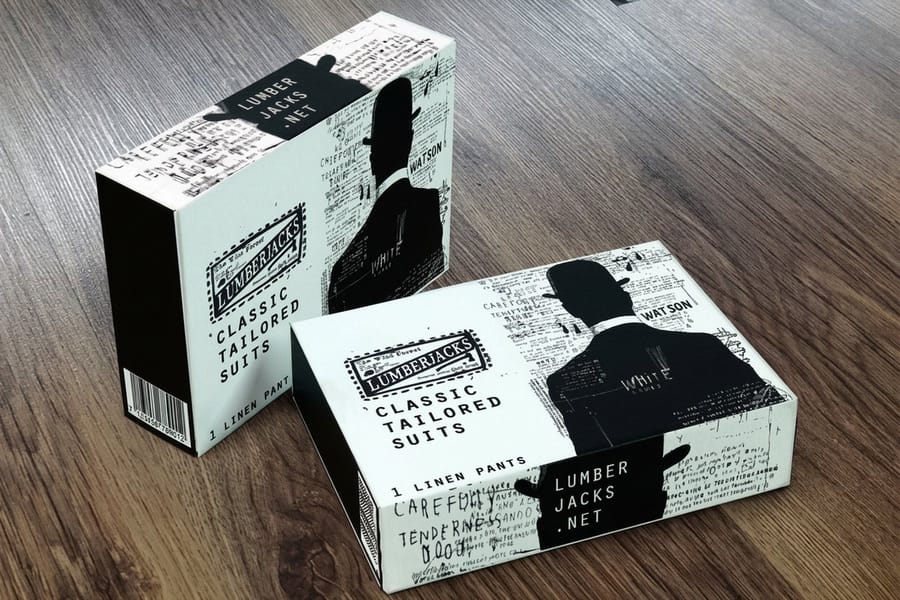
Measure the stack first. 54 cards at 14pt come to about 0.76 in, at 16pt about 0.86 in, and you want a sixteenth of slack so the deck slides out without a fight and does not rattle. A tuck box specified to the exact stack height is a box that will not close once the cards have been handled a few times and no longer sit perfectly flat.
Three routes exist, and they split by run size rather than by taste.
- Printed band or belly wrap. A short strip of card printed both sides and wrapped around a shrink wrapped deck. Cheapest by a distance, fine for a giveaway, and it does nothing to protect the corners.
- Sleeve or clear case. Plastic card sleeves start at $246.31 and protect the deck properly. They read as functional rather than retail, so they suit a game prototype or an internal launch better than a shelf product.
- Custom printed box. Roll end tuck top boxes start at $711.78 and are printed to your dimensions, which is the route for anything that has to sit on a shelf next to competitors. The whole box range is on custom box printing.
The honest limit: we do not hold a stock straight tuck end box cut to deck size, so a custom box is a custom box, with the minimums that implies. Below a few hundred decks the arithmetic usually favors a sleeve or a band, and the money is better spent on silk lamination that people feel every time they play. Above that, the box earns its place. The nine packaging types guide walks through the constructions if you are deciding between them, and the packaging collection lists what we run.
Ordering a Custom Deck at 4OVER4.COM

Order the deck as a trading card job. Choose 2.5 by 3.5 as the trim, pick your stock and lamination, and set the quantity in cards rather than in decks. A 54 card deck ordered 100 times is 5,400 cards, and reading the quantity that way stops the most common ordering mistake by a wide margin.
Supply the fronts as 54 individually named files at 825 by 1125 pixels, CMYK, plus one back. Number them in collation order. If the deck includes duplicated cards, say a game with four copies of a resource card, name them so the duplication is obvious rather than leaving it to be worked out. Configuration options and live starting prices for each stock are in the specs block above, straight from the configurator.
Two things worth doing before the full run. Order free paper samples and handle the silk and suede stocks yourself, because the difference between them is entirely tactile and no photograph conveys it. Then, if the deck is going to be sold rather than given away, run a small first quantity and shuffle it for an hour. Corner wear, lamination edge lift and how the ink holds up under thumbnails all show themselves within a few hundred shuffles, and they are much cheaper to discover on fifty decks than on five thousand.
If what you actually need is one durable card rather than a deck, the answer changes completely. 30mil white plastic cards at $226.11 are built for exactly that, and the plastic card materials guide compares white, clear and frosted at the same thickness.
Wally explains custom decks
Fifty four fronts, one back, and one rotation test
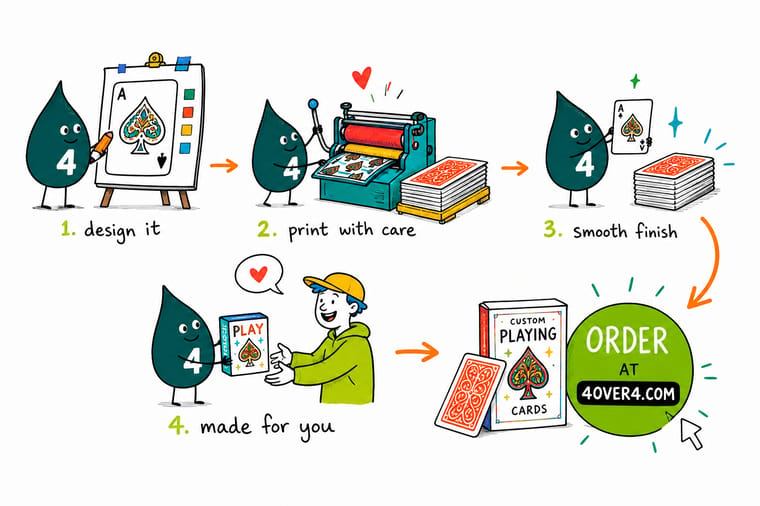
Wally cuts every card at 2.5 by 3.5 inches, the same trim as a trading card. He laminates them in silk so they slide instead of sticking, rounds the corners so the edges do not split, then turns the back upside down. If he can tell the difference, the deck is marked and the design goes back. Last he measures the stack, 0.76 inches at 14pt, and orders a box a sixteenth taller so the lid actually closes.
Configure trading cards at poker size →Specs and pricing
Card stocks, sizes, and starting prices
Compare the three card bodies a custom deck is usually built on, with live configuration choices and starting prices straight from the 4OVER4.COM configurator.


Print it
Order the cards and the box together
Explore more
Where to go next


By the numbers
Deck printing inside a 1,000+ product catalog
Common Questions
Your custom playing card questions, answered
What size is a custom playing card?
Poker size is 2.5 by 3.5 inches and it is what almost every custom deck uses. Bridge size trims narrower at 2.25 by 3.5 inches so a hand of 13 cards fans in a smaller grip, and tarot decks run around 2.75 by 4.75 inches. We print the 2.5 by 3.5 inch trim as a trading card, so a poker deck is ordered as a trading card job with 54 different fronts and one shared back. Set the artboard up at 2.75 by 3.75 inches to carry a 1/8 in bleed on every edge.
What card stock should a custom deck be printed on?
14pt or 16pt laminated cardstock covers nearly every custom deck. 14pt sits at 0.014 in, close to the thickness of a mass market playing card, and it fans more easily. 16pt is stiffer and survives more handling but a full deck of it feels chunky in a small hand. Casino decks use a different material entirely, a black or blue core sheet laminated between two white liners so no light passes through the card. We do not stock core paper, so a heavy dark face against a light back can ghost very slightly when a card is held up to a bright lamp. For a promotional or gift deck nobody notices. For a card game where players sit under a window, design the faces so the darkest ink area sits away from the middle.
Can you print 52 different faces in one order?
Yes. The press does not care whether the 54 fronts are identical or all different, because each card is a separate position on the imposed sheet. What changes is the file prep on your side: 54 named files, all at the same trim and bleed, all in CMYK, all at 300 ppi. Number them in the order you want them collated and say so in the order notes. The one thing to avoid is supplying 54 files at slightly different pixel dimensions, because they then scale by different amounts and the indices land in different places from card to card.
Why do playing card backs have such a wide border?
Because a deck is cut in stacks and the blade drifts. On a 2.5 by 3.5 inch card the drift is usually around 1/16 of an inch, which is invisible against a 3/8 in border and glaringly obvious against a 1/8 in border, where one side ends up at 0.05 in and the other at 0.19 in. Fanned out, that reads as a crooked deck. The second rule is rotational symmetry: turn the back 180 degrees and it must look the same, otherwise a single flipped card is readable from behind and the deck is effectively marked.
Can you print plastic playing cards?
We print 30mil PVC cards, which is 0.76 mm, the same thickness as a credit card. They are waterproof, they do not crease, and they last for years, which makes them excellent as a single premium card, a membership card or a novelty oversized joker. They are the wrong material for a full deck. Stack 54 of them and you are holding a block over 1.6 inches tall that will not riffle or fan. If the appeal is durability rather than plastic specifically, silk lamination on 16pt gets you most of the wear resistance in something that still shuffles.
How much does a custom playing card deck cost?
The card body starts at $11.25 for trading cards at 4OVER4.COM, $48.61 for the uncoated kraft version and $94.74 for silk laminated. Plastic cards begin at $226.11 and custom printed boxes at $711.78. Cost per deck falls sharply with quantity because the setup is spread across the run, and the packaging decision usually moves the total more than the card finish does. A short run wrapped in a printed band lands in a completely different bracket than the same cards in a custom die cut box.
Get Started
250 silk laminated cards cost $94.74, or 38 cents each
Pick poker size, choose silk lamination and rounded corners, upload 54 fronts and one back, and we cut, collate and pack it.
Legal Disclaimer
Gold Standard guarantees apply to all standard orders placed through 4over4.com. Price match requires verifiable proof of a competitor's published price for an equivalent product with matching specifications and turnaround time. Satisfaction guarantee covers manufacturing defects and print quality issues. Contact support with order number and documentation. On-time delivery rate based on tracked orders 1999 to 2026. Individual results may vary based on shipping carrier performance.
