
Trading Cards vs Business Cards and Which One Your Brand Should Print


Two small rectangles, two completely different jobs. The sizes differ, the cards end up in different places, the print costs differ, and a trading card still has to get you called back.
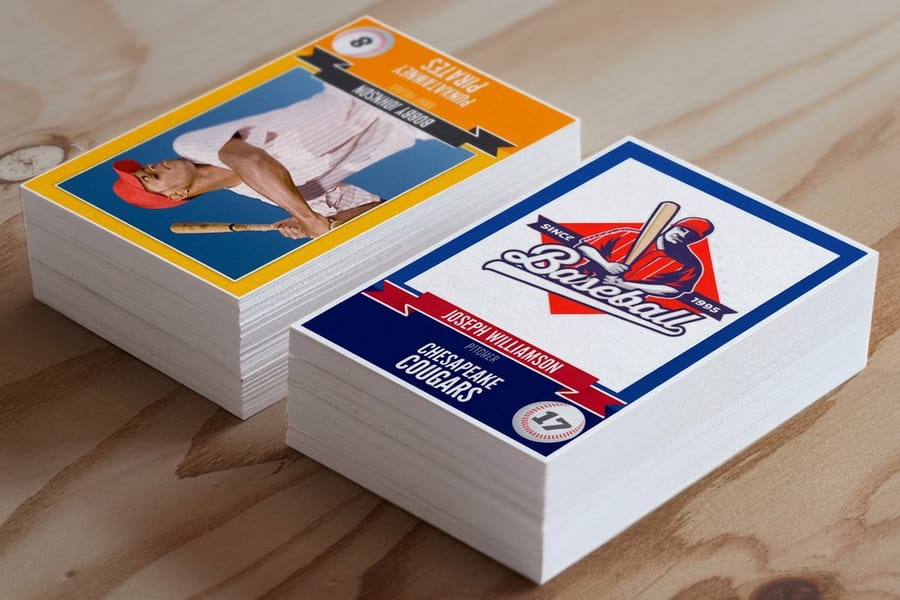
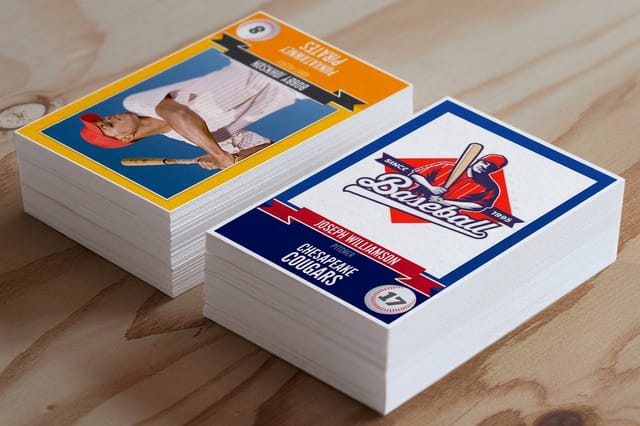
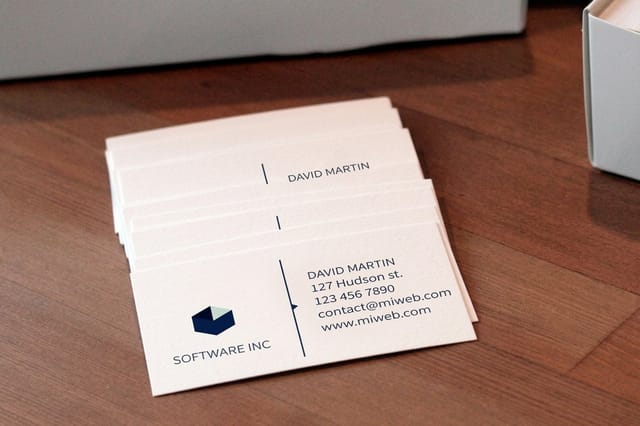
Print business cards when you want to be contacted, and trading cards when you want to be kept. A business card is 3.5 by 2 inches landscape and fits every wallet slot, card file and scanner app ever built for it. A trading card is 2.5 by 3.5 inches portrait, holds 25 percent more printable area, and fits none of them, so it stays out on a desk instead of getting filed. Most brands that print trading cards keep business cards in the badge holder too.
Quick answer
One is built to be filed, the other to be kept
The formats are not interchangeable, and the deciding factor is storage rather than design. A business card trims to 3.5 by 2 inches and slides into a wallet slot, a card file, or a scanning app that crops to that exact rectangle. A trading card trims to 2.5 by 3.5 inches, carries 8.75 square inches against 7, and fits nothing that was built for a business card. That is why it stays visible. Print trading cards for the people you want to impress, business cards for the people who need to look you up in March.
The Size Gap, and What It Costs You
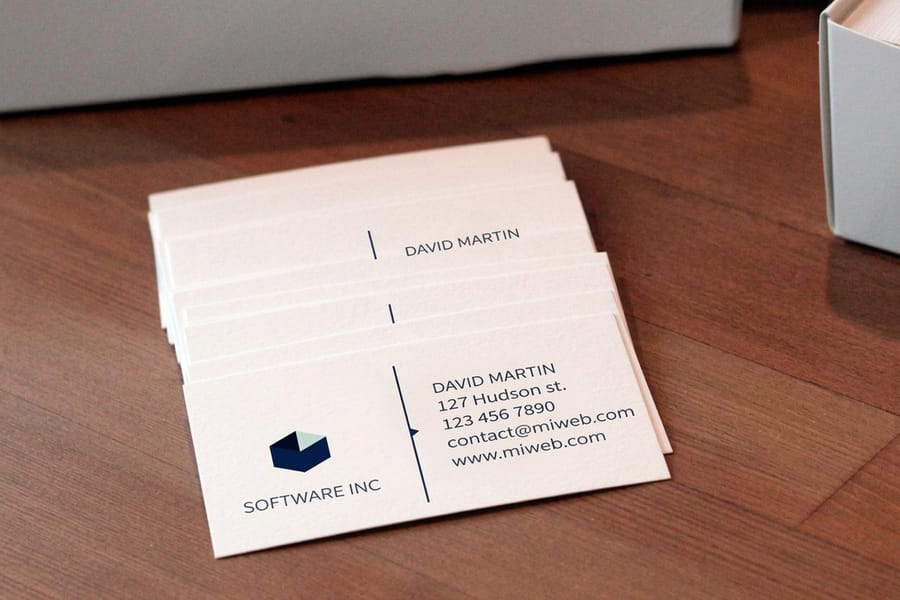
Both cards are small rectangles of cardstock. Everything that follows comes from the fact that one is wider than tall and the other is taller than wide.
| Attribute | Trading card | Business card |
|---|---|---|
| Trim size | 2.5 x 3.5 in, portrait | 3.5 x 2 in, landscape |
| Printable area | 8.75 sq in | 7.0 sq in |
| Where it ends up | Desk, fridge, sleeve, binder | Wallet slot, card file, scanner app |
| Back of the card | Expected to carry content | Often left blank |
| Typical stock | 16pt with gloss or UV | 14pt or 16pt, any finish |
| Starting price | $11.25 | $17.57 |
Read the third row before the price row. A business card is the only piece of print in your marketing that has furniture built for it: the slot in a wallet, the pocket in a badge holder, the plastic sleeves in a card binder, the crop window in every contact scanning app. All of it assumes 3.5 by 2. Hand someone a trading card and none of that infrastructure applies, which is the trade you are making.
What you get back is space and a canvas that suits a face or a product shot. A portrait rectangle is the shape a photograph wants. That extra 1.75 square inches sounds trivial until you try to fit a headshot, a name, a role, and a set number onto a landscape card and watch the type shrink. If you are still deciding on dimensions in general, the business card size guide lays out every trim we print with bleed and safety numbers.
What Each Card Is Actually For
Ask what you want the person to do with the card three days later. That question separates the two formats faster than any spec sheet.
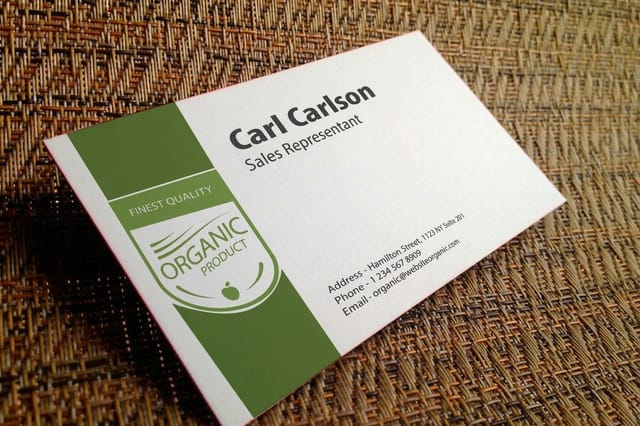
Business card, when you want to be contacted. It is a filing instruction. The person takes it, puts it somewhere findable, and pulls it out when they need a printer, an agent, or a plumber. It works because it disappears cleanly into a slot and reappears months later. Nothing about it is memorable, and that is fine, because it does not need to be.
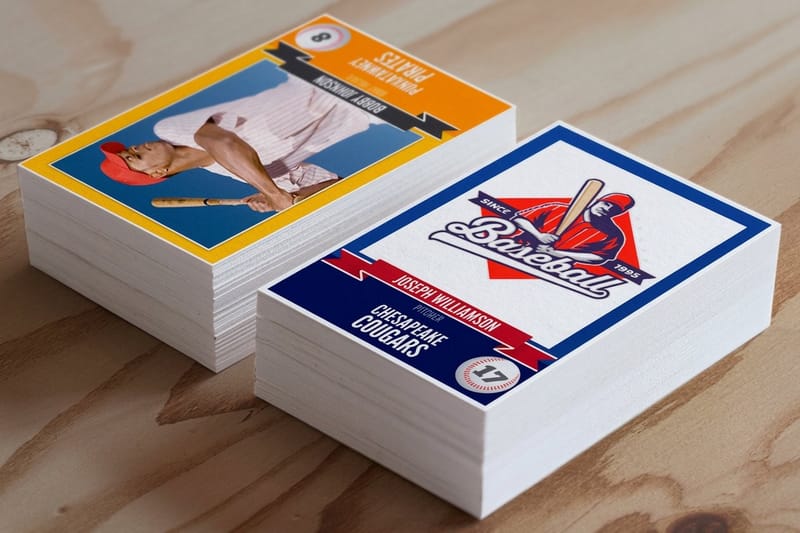
Trading card, when you want to be remembered or shown to someone else. It does not file, so it stays out. Real estate teams print a card per agent with a headshot and a listings record. Coaches print a roster set the parents actually keep. Tattoo artists and illustrators print their own work at full bleed and hand it over like a small print. Bands sell them at the merch table. The format carries a signal: this is worth keeping.
The failure mode is a trading card handed to a purchasing manager at a trade show. She has 40 cards to sort on the flight home, a scanning app that expects a landscape rectangle, and a wallet with no room for a portrait one. Your card is the one that gets left in the hotel. If your event is that kind of event, print standard business cards for the badge holder and keep the trading cards for the people you sit down with. The same logic decides the business cards versus postcards question, just with mailboxes instead of wallets.
Designing a Trading Card That Still Does the Business Card Job
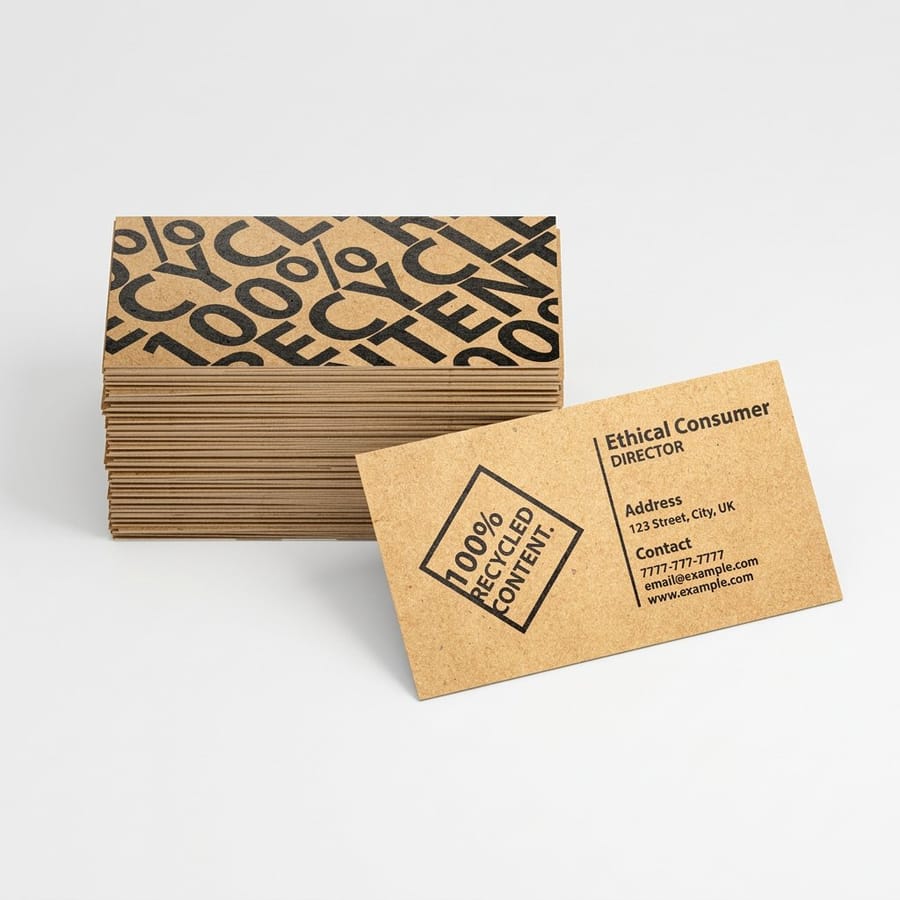
If you print one card and it has to do both jobs, the design carries the whole burden. Four decisions do most of the work.
- Give the front to the image and the back to the facts. Front: photograph or artwork at full bleed, name, one line of role. Back: phone, email, site, QR code, and whatever proof matters, whether that is sold listings, a season record, or a materials list. A trading card with a blank back reads as a half finished job.
- Build the back like a card back, not a business card rotated. The collector format put a stat block on the reverse for a reason. Boxed data reads fast. A short table or a two column list of numbers beats a paragraph, and it gives the card a reason to be flipped.
- Respect the margins on a portrait layout. An eighth of an inch of bleed beyond the trim, an eighth of an inch of safety inside it. Portrait cards get designed with the type running close to the short edges, which is exactly where a trim shift shows. Start from a correctly sized file in the blank template library rather than building the artboard yourself.
- Number the set if there is more than one. Three agents, five services, or eight team members become a set the moment you print 1 of 5 in the corner. People collect sets. They do not collect business cards.
One thing to avoid: shrinking a landscape business card design and rotating it. The hierarchy breaks, the logo ends up floating in the wrong third, and you get a card that looks like a mistake rather than a choice.
Stock, Finish, and What to Order
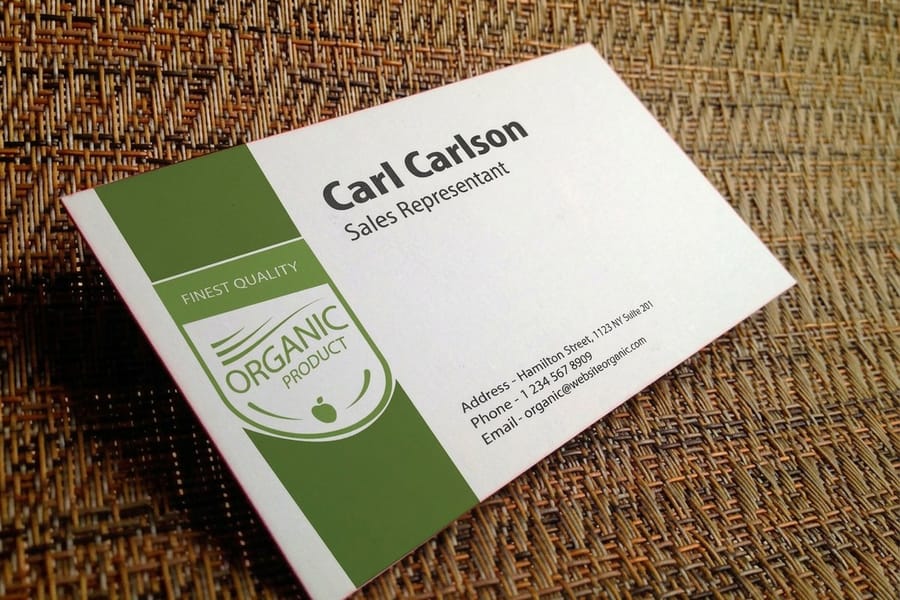
Format decides the shape. Stock decides whether the card is still in one piece a month later.
Go 16pt for a trading card and treat 14pt as the floor. A trading card gets stacked, thumbed, and carried loose, and a lighter sheet cups at the corners quickly. Gloss or UV coating is the traditional choice because it matches what collector cards have used for years and it makes a photograph pop. If the card lives in a purse or a bag, silk lamination is the tougher option: silk laminated business cards start at $74.53 and shrug off fingerprints in a way an uncoated sheet cannot. For a card that has to survive a toolbox or a glovebox, plastic business cards start at $180.02 and do not crease at all.
On quantity, be honest about how many conversations you have rather than how many cards look impressive in a box. Trading Cards start at $11.25 and Premium Business Cards at $17.57, but starting prices sit at different quantities, so run your real number through the configurator on each page before you decide which is cheaper. Design that stays free of dates and prices keeps the leftovers usable next quarter.
If the weight names still feel abstract, the thickness chart puts the point values next to something you can picture, and business card stock explained covers how each surface takes ink. The full range of everyday company print sits in the business basics collection.
Wally sorts the two cards
One goes in the wallet, one goes on the desk
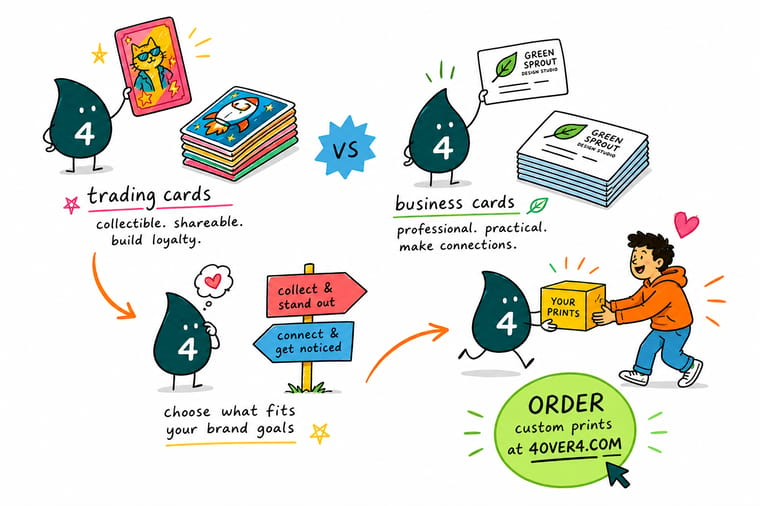
Wally holds a business card at 3.5 by 2 inches and a trading card at 2.5 by 3.5. Only the business card slides into the wallet slot, which is why it survives to be dug out in March. The trading card is a quarter bigger, stands upright like a photograph, and has nowhere to hide, so it stays out where people look at it. Wally prints both: cards for the badge holder, trading cards for the people worth sitting down with.
Print trading cards →Specs and pricing
Sizes, stocks, and starting prices side by side
Configure the exact quantity you need on each product, with live options and starting prices straight from the 4OVER4.COM configurator.
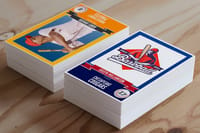
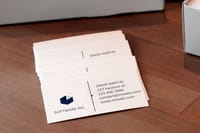
Print it
Order the card that fits the job
Explore more
Where to go next

By the numbers
Trading cards, plastic cards and silk laminated cards
Common Questions
Your trading card and business card questions, answered
What size is a trading card compared to a business card?
A trading card trims to 2.5 by 3.5 inches in portrait. A US business card trims to 3.5 by 2 inches in landscape. The two share a long edge measurement, which is why people mix them up, but the finished shapes are not interchangeable. The trading card holds 8.75 square inches of printable area against 7 square inches on the business card. Both need an eighth of an inch of bleed outside the trim and an eighth of an inch of safety margin inside it.
Can I use a trading card as my business card?
Yes, and people do it in real estate, coaching, tattooing, and music. The catch is storage. A trading card will not go into a wallet card slot or a standard business card file, so it either sits out on a desk or gets thrown away. If you use one, put a full contact block on the back with a phone number, an email, and a QR code, and hand out a normal card as well to anyone who says they will follow up.
Which one is cheaper to print?
It depends on the run, not the format. Trading Cards start at $11.25 at 4OVER4.COM and Standard Business Cards start at $17.57, but those starting prices sit at different quantities, so the honest answer comes from pricing your actual quantity in the configurator on each product page. As a rule, business cards get cheap fast at 500 and 1,000 because that is the volume the format was built around.
What stock should a trading card be printed on?
Heavier than a flyer, at minimum a 14pt or 16pt cardstock. Trading cards get handled, passed around, and stacked, so a thin sheet curls at the corners within a week. Sports and collector cards feel right at 16pt with a gloss or UV coating because that is close to what the collecting world has used for decades. If you want a softer touch, a silk laminate over 16pt is more durable than an uncoated sheet and resists fingerprints.
Do trading cards need rounded corners?
No, and most printed trading cards ship square just like the ones in a pack. Rounded corners help a card survive in a pocket and read as more premium, which is why they show up more often on business cards than on collector cards. Round the corners if the card is going into a bag or a purse. Leave them square if you want the card to look like part of a set.
How many should I order for an event?
Count the people you expect to speak with, not the people who walk past the booth. A two day trade show where you have real conversations with 60 to 80 people does not consume 1,000 cards. Order enough to cover the event plus the month after it, and keep the design free of dates or prices so the leftovers are still usable at the next one.
Get Started
Trading cards run 25 for $11.25, business cards 100 for $17.57
Pick the trim, choose 14pt or 16pt, add a gloss or silk finish, and we print cards that hold their corners through a full season of handshakes.
Legal Disclaimer
Gold Standard guarantees apply to all standard orders placed through 4over4.com. Price match requires verifiable proof of a competitor's published price for an equivalent product with matching specifications and turnaround time. Satisfaction guarantee covers manufacturing defects and print quality issues. Contact support with order number and documentation. On-time delivery rate based on tracked orders 1999 to 2026. Individual results may vary based on shipping carrier performance.
