
Trade Show Exhibit Design Ideas for 10x10, 10x20 and Island Booths


The show tells you how tall you can build before you design anything. Each footprint fits a known set of pieces, one layout keeps the aisle open, and every display carries a printed cost.
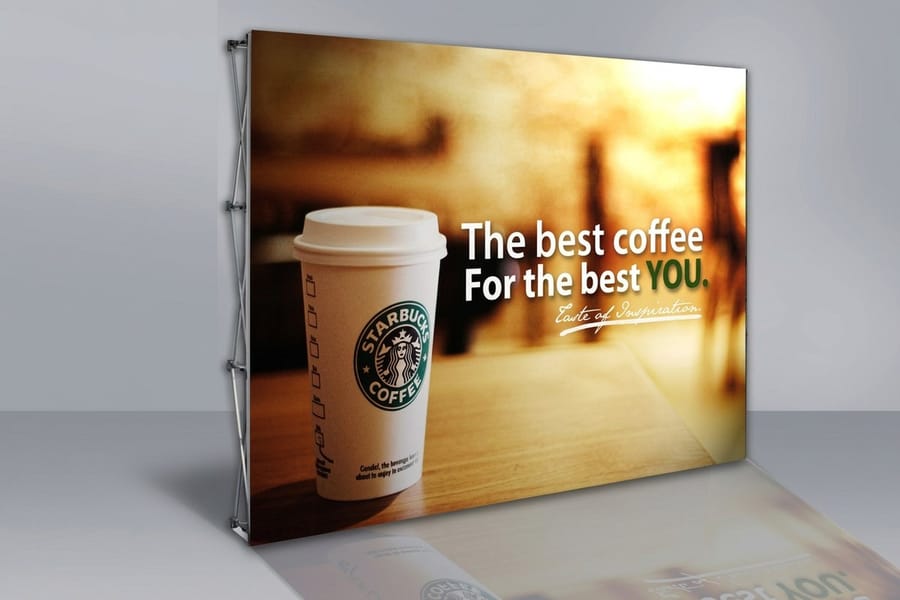
Design an inline trade show booth around two height limits: 8 feet across the rear 5 feet of depth, and 4 feet in the 5 feet closest to the aisle. That puts the back wall graphic and any tall banner at the rear, the table off to one side, and the front of the booth open so people can step in. A 10 by 10 holds a back wall, two banner stands, a 6 foot table and two staff, and no more. Island booths, with aisles on all four sides, commonly allow 16 to 20 feet and no solid back at all.
Quick answer
Two ceilings decide the whole layout
An inline booth is not one open box, it is a tall rear half and a low front half. The rear 5 feet may reach 8 feet, the front 5 feet is capped at 4, and that split tells you where the wall goes, where the table cannot go, and why the aisle edge has to stay clear. Design the plan first, then the graphics, then check the show's exhibitor kit for the height section before anything goes to print.
Start With the Footprint and the Two Height Limits
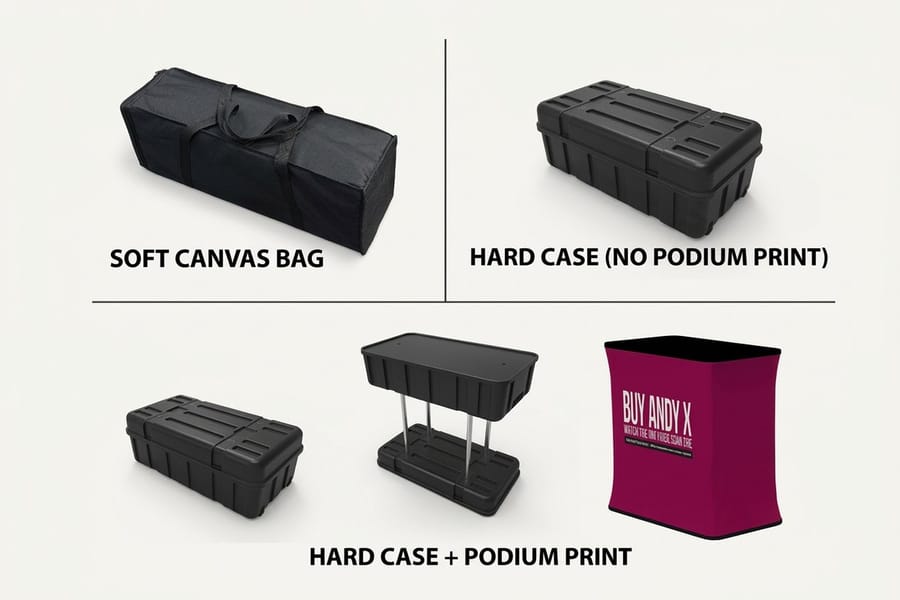
Booth design is a constrained problem before it is a creative one. Your space has a size, and the show has a height rule, and those two together eliminate most of the ideas people arrive with.
The rule that catches everyone is that a linear booth has two ceilings. Under the IAEE display guidelines that most US shows adopt, the rear 5 feet of a 10 by 10 may go up to 8 feet, and the 5 feet nearest the aisle is capped at 4 feet. That second limit exists so your neighbours are not walled off from the aisle, and show floor managers do enforce it. It means a tall banner cannot live at the front corner of an inline booth, no matter how good it looks in the mockup.
| Space | Typical size | Usual height allowance | What it realistically holds |
|---|---|---|---|
| Inline 10 x 10 | 100 sq ft, one aisle | 8 ft rear, 4 ft in the front 5 ft | One back wall, two banner stands, a 6 ft table, two staff. |
| Inline 10 x 20 | 200 sq ft, one aisle | Same 8 ft and 4 ft split | A wall plus a separate demo or seating zone, three to four staff. |
| Peninsula 20 x 20 | 400 sq ft, three aisles | Commonly 16 ft | A hanging or tall center structure, two open approach sides. |
| Island 20 x 20 | 400 sq ft, four aisles | Commonly 16 to 20 ft | Sightlines from every direction, so no solid back at all. |
Sketch the plan before you design a single graphic. Draw the square, mark the rear 5 feet and the front 5 feet, then place objects. If you are ordering an inline booth for the first time, the trade show collection groups everything that fits inside those limits.
Lay Out a 10 by 10 in Five Moves
The difference between a booth people walk into and a booth people walk past is almost never the graphics. It is where the furniture sits.
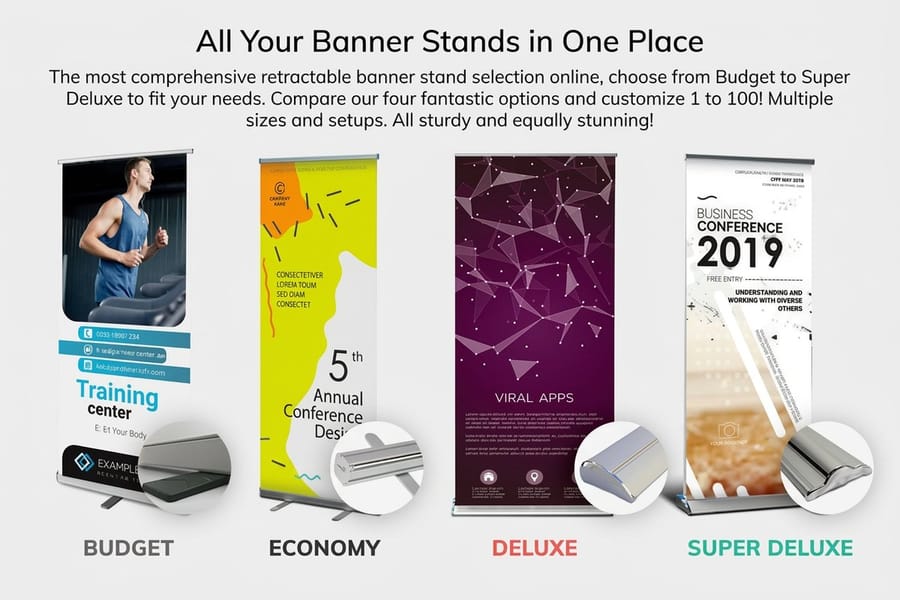
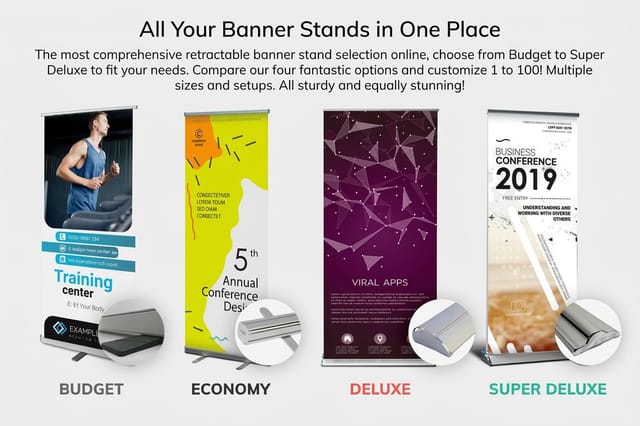
- Put the message on the back wall. An 8 foot pop up display at $752.39 fills the rear span in one piece, and its fabric graphic hides the seams a panel system shows. A cheaper route is two retractable banner stands at $139 each, standing shoulder to shoulder to make a 5 to 6 foot wide wall.
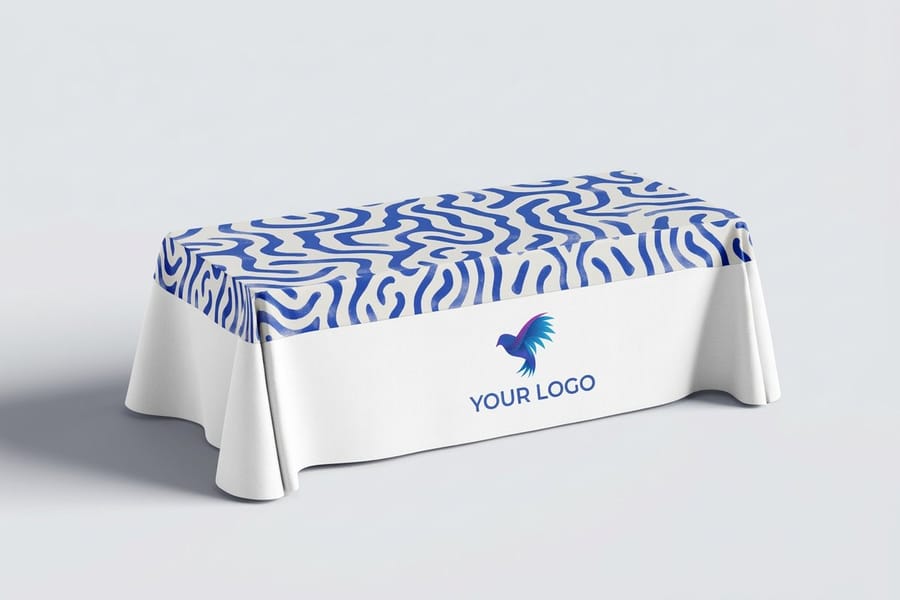
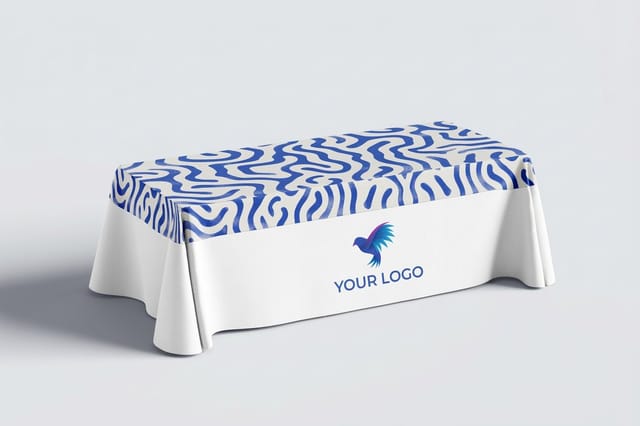
- Move the table off the aisle. A 6 foot table across the front is a barrier, and it is also the fastest way to break the 4 foot rule with whatever gets stacked on it. Turn it 90 degrees against one side wall, or push it to the rear beside the graphic. A printed table throw at $225 covers all four sides and hides the cases underneath.
- Leave a clear step in zone. Aim for at least 30 to 40 square feet of open floor at the aisle. Visitors will not step past a person standing in a doorway sized gap, and staff cannot greet anyone from behind a table.
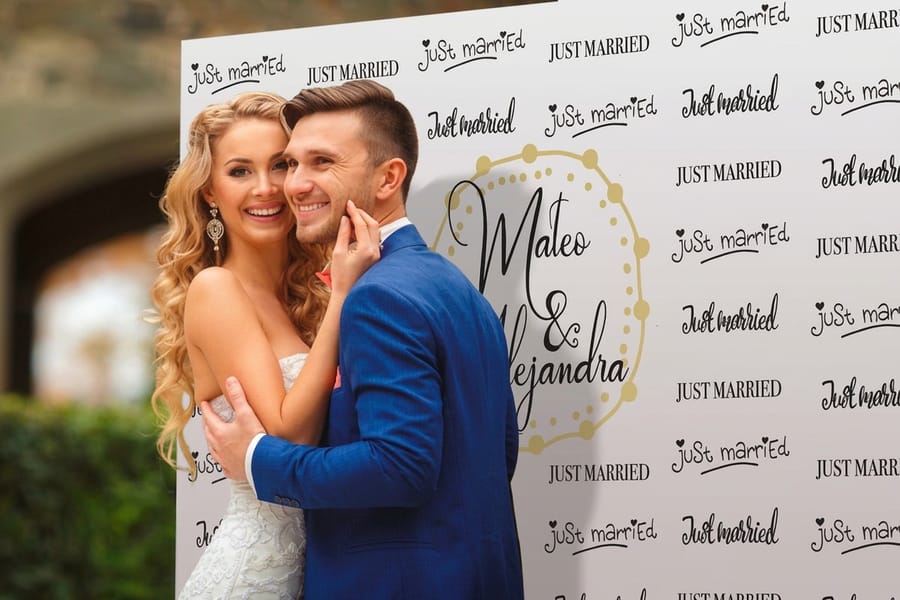
- Add one vertical accent, in the rear zone. A single tall banner or a step and repeat banner at $217.50 gives the booth a focal point. Step and repeat needs about 3 feet of clear floor in front of it for photos, so in a 10 by 10 it competes directly with your open zone. Budget the space or skip it.
- Give people something to carry. The graphics do the attracting, the printed piece does the remembering. Standard brochures start at $57.11 and hold the detail your back wall cannot.
If you have a 10 by 20, do not simply double everything. Use the extra bay for a second function, a demo counter or two chairs, so the space reads as two rooms rather than one long wall.
Display Options, Real Sizes and What Each One Costs
Every booth ends up as a mix of a wall, a table and something vertical. These are the pieces that mix well, with the trade off that decides between them.
| Display | Starts at | Where it belongs | The catch |
|---|---|---|---|
| Retractable banner stands | $139 | Corners of the rear zone, or flanking a table. | Narrow. Two side by side still leave visible gaps against a solid wall. |
| Table throws | $225 | Over a show supplied 6 ft or 8 ft table. | Confirm the table size in the exhibitor kit. A 6 ft throw on an 8 ft table is unusable. |
| Table runners | $97.76 | Over an already skirted show table. | Only covers the front strip, so whatever is under the table stays visible. |
| Step and repeat banners | $217.50 | Photo backdrop, best in a 10 x 20 or larger. | Needs roughly 3 ft of clear floor in front, which a 10 x 10 cannot spare. |
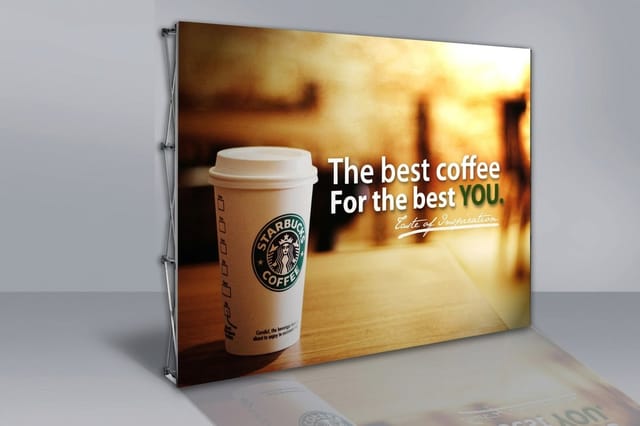
| Pop up displays | $752.39 | The full rear span of an inline booth. | The heaviest thing you will carry, and it wants a case. |
| Trade show booth kits | $2,599 | A repeat exhibitor running several shows a year. | Only worth it once the show schedule justifies it. |
| Feather flags | $108.75 | Outside the hall, in a lobby, or in an island booth. | Almost always taller than the 8 ft inline limit allows. |
Two notes worth knowing before you pick. Fabric graphics on displays are dye sublimated, which means the ink lives in the fiber rather than on top of it, so they can be folded, shipped in a duffel and steamed flat on site. Vinyl banners at $79 give a harder edge and a denser solid, and they are the right call for anything hung outdoors or in a doorway where wind and weather matter. The large format printing guide goes deeper into how each substrate takes ink.
Design Graphics That Read From Across the Aisle
Booth graphics fail for one of two reasons: the type is too small, or there is too much of it. Both come from designing on a screen at 20 percent and forgetting how far away a person actually stands.
Use viewing distance as the ruler. About one inch of cap height per 10 feet of distance is the working rule for signage, and a visitor across the aisle is 12 to 15 feet away. So a headline wants at least 1.5 inch caps, and 3 to 4 inches if you want to pull somebody from two aisles down. Say what you do in five or six words at that size. Everything else, the features, the specs, the case studies, belongs on a brochure or a card that leaves with them.
On file setup, large format forgives resolution but punishes raster type. Build at full size around 100 ppi, or at quarter scale at 400 ppi, which gives identical pixels in a file your machine can open. Keep logos and headlines as vector so they stay sharp at 8 feet. Work in CMYK, and expect a large solid to look slightly different across fabric and vinyl in the same booth, because the two substrates absorb ink differently. Ordering both from one run helps. Start from a correctly sized layout in the blank template library, and if you are new to sending files to a printer, how online printing works walks the whole handoff.
One last thing that costs nothing: check the throw depth against the table height, and check whether the show provides a table at all. Half the booths that look untidy on the floor are just a graphic sitting an inch off the ground.
Wally lays out a 10 by 10
Tall at the back, low at the front, open in the middle
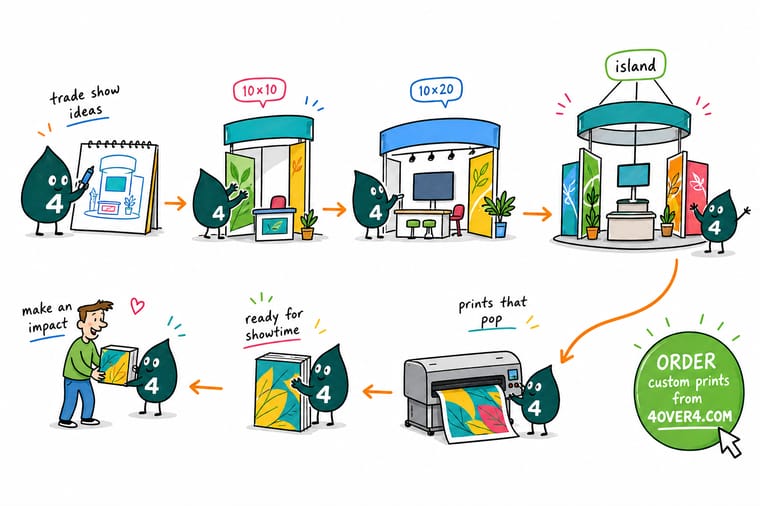
Wally chalks the square first. The rear 5 feet gets the 8 foot back wall and a banner stand in each corner. The front 5 feet stays under 4 feet, so the table turns sideways against a wall and the middle stays empty for people to walk into. Then he prints the headline big enough to read from the far side of the aisle and puts everything else on a brochure. Booth done, and nobody on the floor asks him to take anything down.
Shop the trade show collection →Specs and pricing
Booth displays, sizes, and starting prices
Compare the three pieces most 10 by 10 booths are built from, with live configuration choices and starting prices straight from the 4OVER4.COM configurator.


Print it
Order the booth, one piece at a time
Explore more
Where to go next

By the numbers
Displays, flags and runners for a booth build
Common Questions
Your trade show booth questions, answered
How tall can a trade show booth display be?
In a standard 10 by 10 linear booth, most US shows cap the back wall at 8 feet and cap anything in the 5 feet closest to the aisle at 4 feet, following the IAEE display rules. Island booths, which have aisles on all four sides, usually allow 16 to 20 feet. Peninsula booths sit in between. Those are guidelines, not law, and individual shows change them, so read the height section of the exhibitor kit before you send artwork to print. An 8 foot back wall that arrives at a show with a 7 foot rule is an expensive reprint.
What fits in a 10 by 10 trade show booth?
A back wall or pop up display across the rear, one or two retractable banner stands at the corners, a 6 foot table with a printed throw, and roughly 40 to 50 square feet of standing room. That is the honest limit. Add a step and repeat backdrop or a demo station and you have to give up either the table or the open floor. The most common mistake is filling all 100 square feet with objects and leaving nowhere for a visitor to step in out of the aisle.
Is a fabric display better than a vinyl banner for a trade show?
Indoors, usually yes. Dye sublimated fabric diffuses the overhead spotlights instead of bouncing them back, so photographs on the graphic stay readable from an angle, and the whole graphic folds into a bag rather than shipping in a tube. The trade off is edge sharpness and a slight softening of very fine type, plus wrinkles from the fold that need a few hours hanging or a steamer. Vinyl holds a crisper line and a denser solid, which is why it still wins outdoors and on anything printed at a large size.
How big should the type be on a trade show back wall?
Work from viewing distance: roughly one inch of cap height for every 10 feet a person needs to read from. Someone across a 10 foot aisle is about 12 to 15 feet away, so your headline wants cap heights around 1.5 inches at minimum, and 3 to 4 inches if you want it caught by people two aisles over. Keep that headline to five or six words. Body copy on a back wall almost never gets read, so move it to a brochure or a rack card instead.
What resolution do trade show graphics need?
Large format is viewed from a distance, so it does not need press resolution. Build the file at full size at around 100 ppi, or at quarter scale at 400 ppi, which produces the same pixel count and a far more manageable file. Vector logos and vector type should stay vector all the way through, because that is what keeps a headline crisp when it is enlarged to 8 feet. Set up in CMYK, and add bleed on anything that wraps a frame or a table edge.
How much does a trade show booth cost to print?
At 4OVER4.COM a retractable banner stand starts at $139, a printed table throw at $225, a step and repeat banner at $217.50, a pop up display at $752.39 and a complete trade show booth kit at $2,599. A workable first booth is two retractable banners and a table throw, which lands around $503 in printed goods before shipping. The wall system is the line item worth deferring until you know the show is worth repeating.
Get Started
Pop up displays cost $752.39, feather flags $108.75
Pick the wall, the banners and the table throw, upload artwork at the right size, and we print a booth that fits inside the show's height rules.
Legal Disclaimer
Gold Standard guarantees apply to all standard orders placed through 4over4.com. Price match requires verifiable proof of a competitor's published price for an equivalent product with matching specifications and turnaround time. Satisfaction guarantee covers manufacturing defects and print quality issues. Contact support with order number and documentation. On-time delivery rate based on tracked orders 1999 to 2026. Individual results may vary based on shipping carrier performance.
