
Print Shops Near My Location and What Each Type Can Actually Print


Four different businesses answer the same search, and only one of them prints your job. They are easy to tell apart once you know what to ask, and uploading sometimes beats driving.
A search for print shops near my location returns four different businesses: a copy counter, a sign shop, a commercial print shop, and a production facility that does not take walk-ins. Under about 50 sheets, the counter nearest you is the fastest and cheapest answer. Above a few hundred pieces, or on anything needing press finishes, uploading the file and having it shipped is usually both cheaper and faster, because a local shop spends its first two days quoting and proofing while a production printer is already on press.

Quick answer
Quantity decides this, not distance
Pick the shop by the job, not by the map. One to fifty sheets belongs at the counter down the street, where toner and a cutter finish it while you wait. A few hundred pieces and up belongs on a press, and a press sheet reaches you by carrier whether the press is two miles away or four states away. The clock people forget is the front end: a local commercial shop typically spends two days quoting and proofing before your job reaches the press, which is longer than print plus ground transit from a production facility.
The Four Businesses That All Show Up as a Print Shop
The map pin says print shop. Behind it sits one of four very different operations, and picking the wrong one is how a two day job turns into a two week job.
The copy counter. Toner machines, a laminator, a cutter, a binding comb. Excellent at one to fifty sheets while you wait. It does not run a press, so quantity pricing barely moves and heavy stocks are limited to whatever the machine will feed.
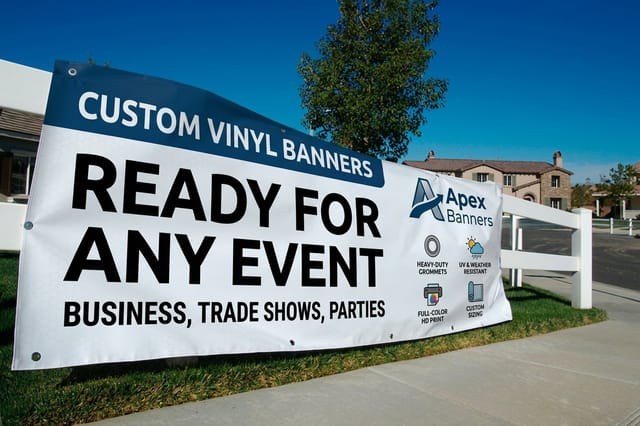
The sign and wide format shop. Roll printers and vinyl cutters. Banners, decals, yard signs, window graphics. Ask it for 2,000 postcards and it will quietly send them elsewhere.
The commercial print shop. A real press, a bindery, a person who will talk about stock weight. This is what most people picture. The catch is scheduling: your 500 flyers sit behind a 20,000 piece run, and the quote and proof cycle adds days before anything reaches the press.
The production facility. Presses running in shifts, in line coating, cutting and folding equipment fed continuously. Almost none of these take walk-in customers, because the economics depend on volume and a queue that never empties. This is the tier a lot of local shops resell without saying so. It is also the tier we run, which is why standard flyers start at $39.54 rather than at a counter price.
Searching for a printing facility near me and expecting to walk in is the mismatch at the center of this whole topic. Facilities take files, not visitors. Our guide to local printing services breaks the same landscape down by job type.
Near You, or Shipped to You, Compared Honestly
Two things get compared badly here. People compare the drive to the shipping, when the real comparison is the whole clock from finished file to finished job, and they compare a counter copy to a press sheet as if they were the same object.
| Route | Realistic clock | Where it wins | Where it costs you |
|---|---|---|---|
| Copy counter | Same hour, plus two drives. | 1 to 50 sheets, a laminate, a single bound copy. | Toner pricing barely improves with quantity, stock choice is thin, no press finishes. |
| Local commercial shop | Two days of quote and proof, then press time, then pickup. | Hand inspection, an unusual stock the owner keeps, a job you need to stand over. | Your run waits behind bigger ones, and small quantities carry the shop overhead. |
| Sign shop | One to three days for most wide format. | A banner or sign you can pick up today and hang tonight. | Paper jobs get resold, which adds a margin and a middleman to the schedule. |
| Online production printer | Turnaround from one business day, then one to five days in transit. | Anything from a few hundred pieces up, plus finishes a counter cannot touch. | No physical proof in your hand before you commit, and a hard file cutoff each day. |
Read the last column before the third. The honest weakness of ordering online is the proof: you approve a screen, not a sheet. That is a real trade, and the answer is to order a sample or a small first run before a big one, especially on color critical work. The honest weakness of the shop near you is that being close does not make it fast when its schedule is full.
Volume settles most arguments. Standard postcards start at $16.48 and standard business cards at $17.57, prices a toner counter cannot approach on a comparable quantity because there is no press behind the counter. Below 50 sheets, walk in and be done. The full breakdown sits in our local versus online comparison.
Emailing Files, and What On Demand Printing Changed

People search for email printing near me because they want to send a file and collect a finished job. That instinct is right. The mechanism is the problem.
Mail servers commonly cap attachments near 25 MB. A press ready PDF with images at 300 dpi and bleed clears that on a single sheet of anything image heavy, so the file gets zipped, shared as a link, or worse, quietly downsampled by whoever sends it. Nothing in an inbox checks whether your artwork has bleed, whether black text is set as rich black, or whether that logo is a 96 dpi screenshot. The first person to see the problem is a prepress operator, a day later, if you are lucky.
An upload form does the checking at the moment of ordering. It knows the trim size for the product you selected, flags missing bleed and low resolution placements, and returns a proof you approve before the job is scheduled. Start from a correctly sized layout in the blank template library and most of those flags never fire. The file rules themselves are in our print ready file guide.
On demand printing is the other half of that shift. Digital presses removed the plate, so a run of 250 no longer carries the setup that made short runs absurd. Print the quantity the campaign needs, change the copy, print the next one. It is why a restaurant orders 500 flyers for one weekend instead of 5,000 that go stale, and why a vinyl banner at $79 makes sense for a single event.
How to Order When the Deadline Is Already Set
Work backward from the date the job has to be in someone's hands, not forward from today. Four steps, in this order.
- Fix the delivery date and subtract transit. Ground from our Queens plant is next day across most of the Northeast and about five business days to the West Coast. That number, not the print time, is usually what decides whether you have room.
- Pick the turnaround that fits what is left. Turnaround options start at one business day on many products. Watch the daily cutoff: a file uploaded after it starts counting tomorrow, which is the single most common way a rush order arrives late. Our rush printing guide covers the cutoffs in detail.
- Send a file that will not bounce back. Full size PDF, fonts outlined, images at 300 dpi, an eighth inch of bleed on every edge, and important text kept a quarter inch inside the trim. A file that needs a fix costs you a day no shipping upgrade will recover.
- Approve the proof the same day it arrives. The clock on most jobs starts at approval, not at upload. Proofs sitting unread over a weekend are the second most common reason a deadline slips.
If the date is genuinely impossible, that is the moment the shop near you earns its existence: print 50 at a counter to cover the meeting, and let the real run arrive by carrier for everything after. For everything else, browse flyer printing or business card printing, upload, and skip the drive. Our same day and rush options guide spells out what rush shortens and what it never does.
Wally explains the near me search
The closest shop is not always the fastest one
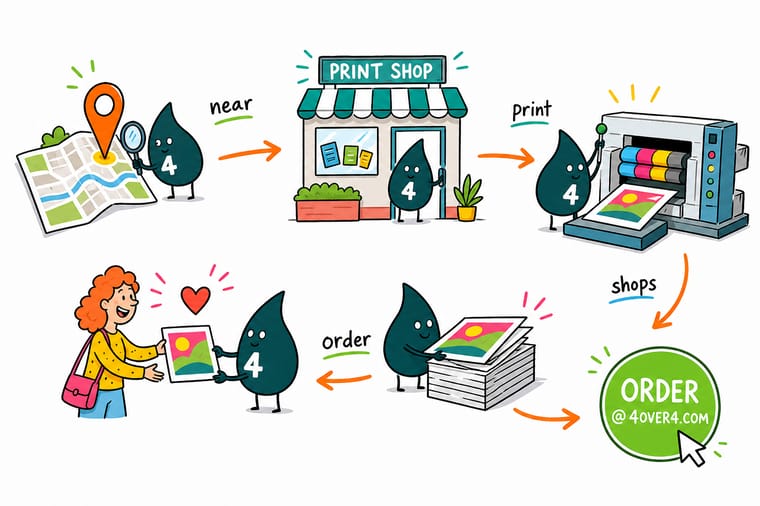
Wally taps the map and gets four pins: a copy counter, a sign shop, a commercial printer, and a facility that never opens its front door to customers. For twenty copies he walks to the counter and is back in ten minutes. For five hundred flyers he uploads the file instead, because the shop two blocks away would spend two days quoting and proofing before it even reached a press. The boxes beat the drive, and they cost less per piece.
Upload your file and print flyers →Specs and pricing
The jobs people drive across town for, priced
Sizes, stocks and starting prices straight from the 4OVER4.COM configurator, for the three products that send most people searching for a shop nearby.


Print it
Order it here and skip the drive

Explore more
Where to go next



By the numbers
A printing facility you never have to drive to
Common Questions
Questions people ask before they drive anywhere
Do I actually need a print shop near my location?
Only for jobs where the handoff itself is the point: one laminated sheet, a passport photo, a document you have to sign and copy in the same hour, or a single poster you are carrying into a meeting. Everything that runs on a press arrives by carrier, and the carrier does not care where you live. If the job is 500 flyers, 1,000 postcards or a box of business cards, the nearest press is irrelevant because the piece ships to you either way.
What can a local shop do that an online printer cannot?
Three things. It can print a single copy in minutes, it can put a physical proof in your hand before you commit, and it can fix a file while you stand there. That last one has real value when the artwork is a Word document and nobody has ever built a print file. What it usually cannot do is match a national printer on price above a few hundred pieces, because the counter machine is toner and the volume math belongs to offset.
Can I email a PDF to a printer instead of uploading it?
Some shops still accept it, and it is the weakest way to send a job. Most mail servers reject attachments over about 25 MB, which a print-resolution file passes easily, so the file gets compressed, dropped into a link, or downsampled by the sender without anyone noticing. An upload form runs the file against the product specs, flags missing bleed and low-resolution images, and produces a proof you approve. Search traffic for email printing near me is really looking for that upload step.
What is on demand printing?
Printing the quantity you need when you need it, with no minimum inventory sitting in a closet. Digital presses made it practical because there is no plate to make, so a run of 100 costs proportionally close to a run of 500. It is how you print 250 event postcards this week and a different 250 next month instead of ordering 5,000 and throwing half away when the address changes.
How fast can printing arrive if no shop is nearby?
Turnaround options at 4OVER4.COM start at one business day on many products, and printing time is separate from transit. Add ground shipping from our Queens plant, which is next day across most of the Northeast and roughly five business days to the West Coast, and a Monday upload is a Wednesday or Thursday delivery on the East Coast. Order rush and expedite the freight when the date is fixed, and check the cutoff time before you assume today counts as day one.
Is online printing cheaper than the shop down the street?
Above small quantities, consistently. Standard business cards start at $17.57, standard flyers at $39.54, standard postcards at $16.48 and vinyl banners at $79, and those prices include the press work a counter machine cannot do at that cost. Below about 50 sheets the comparison flips, because a press has a setup and a copier does not. The other cost people forget is the drive itself: two trips to a shop is an hour you did not spend on the job.
Get Started
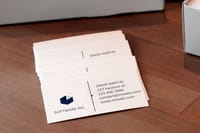
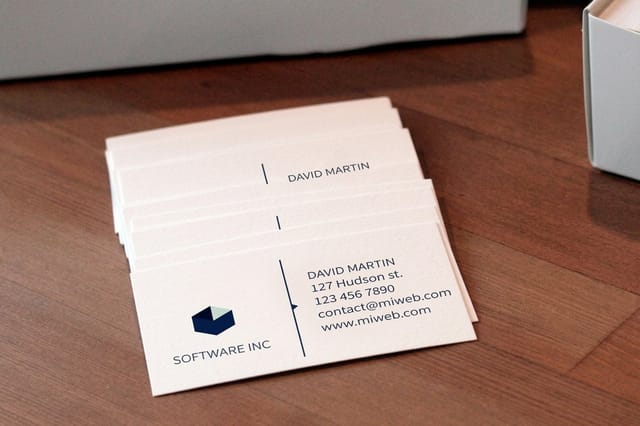
Business cards run 100 for $17.57, three business days
Upload the file, pick a turnaround that fits your date, and we print it on press and ship it to you. No queue at a counter, no second trip across town.
Legal Disclaimer
Gold Standard guarantees apply to all standard orders placed through 4over4.com. Price match requires verifiable proof of a competitor's published price for an equivalent product with matching specifications and turnaround time. Satisfaction guarantee covers manufacturing defects and print quality issues. Contact support with order number and documentation. On-time delivery rate based on tracked orders 1999 to 2026. Individual results may vary based on shipping carrier performance.
