
Kraft vs White vs Metallic Business Cards Compared on Feel, Color and Cost


Three materials, three different sets of rules for your artwork, your budget and your calendar. Each base treats your colors differently, starts at a different quantity, and falls down somewhere.
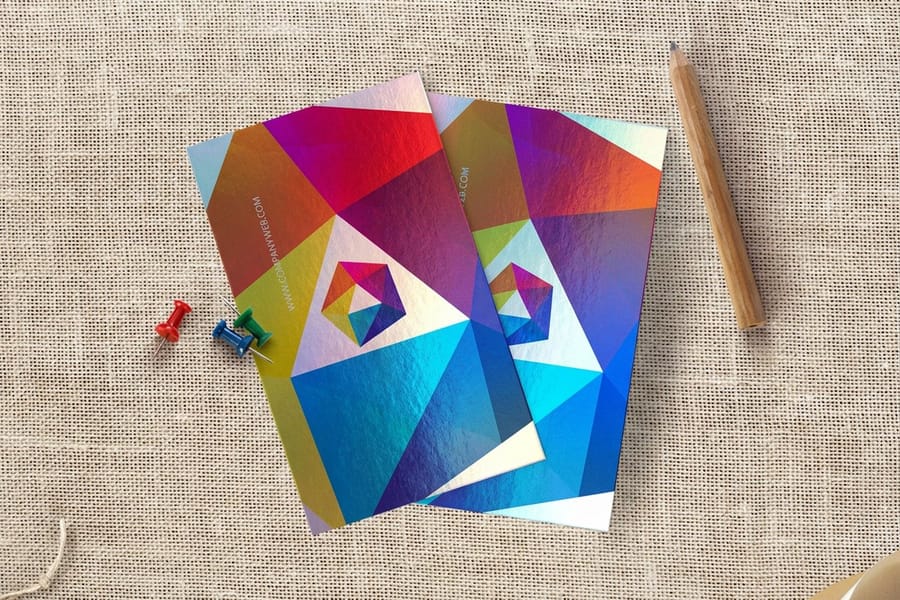
White wins on price, speed and color accuracy, kraft wins on texture and the recycled story, and metallic wins on being remembered. White standard cards start at $17.57 per 100 in 3 business days. Kraft starts at $24.75 per 100 on 18pt uncoated recycled stock in 5 days, and every ink you print shifts toward the brown base. Metallic starts at $126.32 for 500 in 7 days, because a stamped foil accent has setup that a run of 100 cannot pay for.
Quick answer
The base sheet decides everything that follows
Choose white for accuracy, speed and the cheapest way to prove a design. Choose kraft when texture and the recycled story are the message. Choose metallic when the card only has to do one job, which is being remembered. Kraft tints every ink toward brown and needs a white ink pass for light artwork. White is neutral and carries 73 stocks from 14pt to 80pt. Metallic is a white gloss sheet with a stamped foil accent, and it will not sell you fewer than 500 cards.
What Actually Changes Between the Three
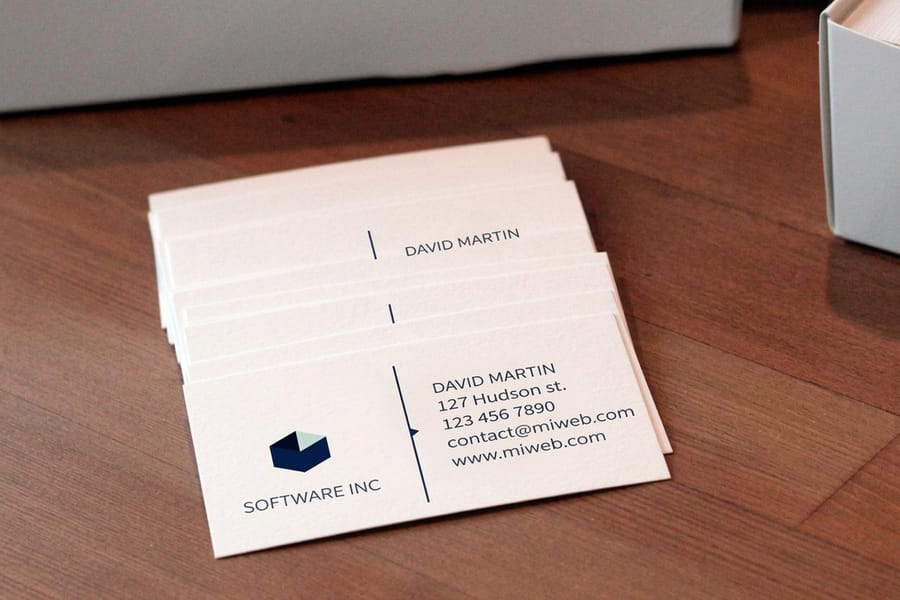
People compare these three as if they were finishes. They are not. Kraft and white are different sheets of paper, and metallic is a white sheet with a second manufacturing step applied to it. That distinction explains every price, every lead time and every artwork headache further down this page.
Kraft Business Cards print on an 18pt uncoated kraft cover made from 100% post-consumer recycled paper. The sheet is brown, and it stays brown everywhere your artwork does not cover it. Standard Business Cards print on any of 73 stocks running from an everyday 14pt to a heavy 80pt, coated or uncoated, and the base is white. Metallic Business Cards print on a bright 16pt gloss cover and then go back through the press for a metallic foil accent stamped onto the front.
So the real question is not which one looks best in a mockup. It is which base your design can survive, how many cards you need before the material makes sense, and how many days you are willing to give up. If you want the wider background on surfaces before you pick, business card stock explained covers what coated, uncoated, linen and pearl each do, and the whole range sits on business cards printing.
Kraft: A Brown Sheet That Tints Every Color You Print
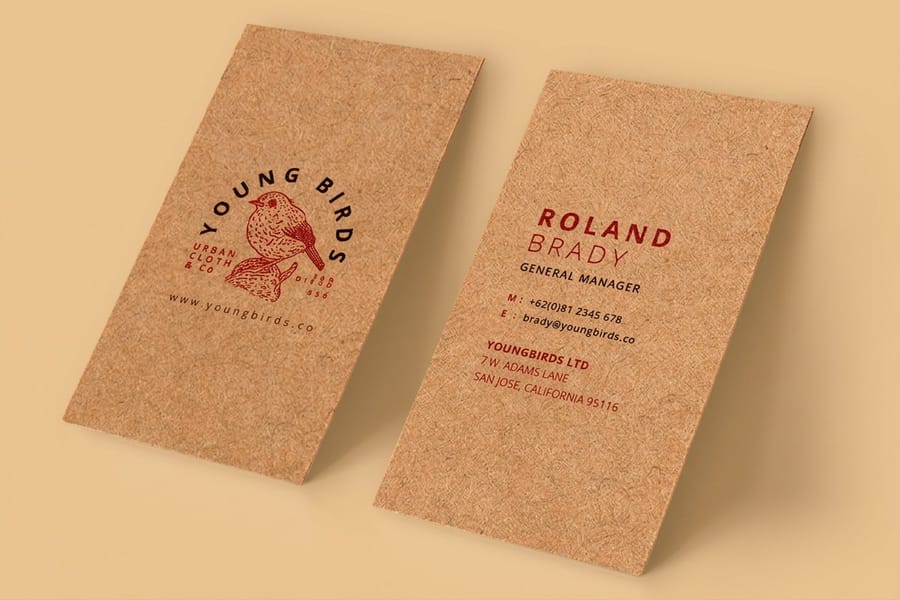
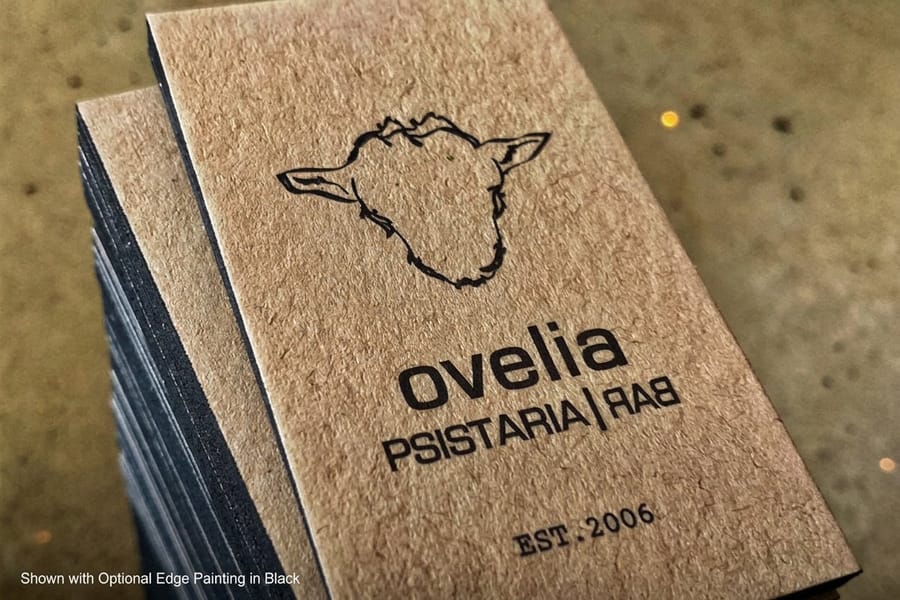
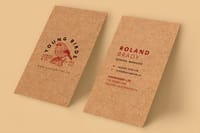
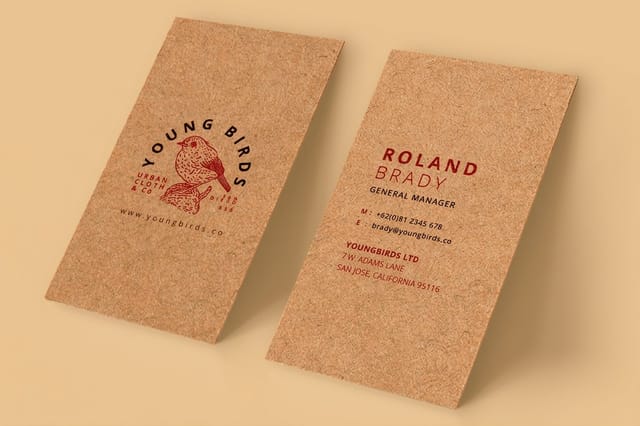
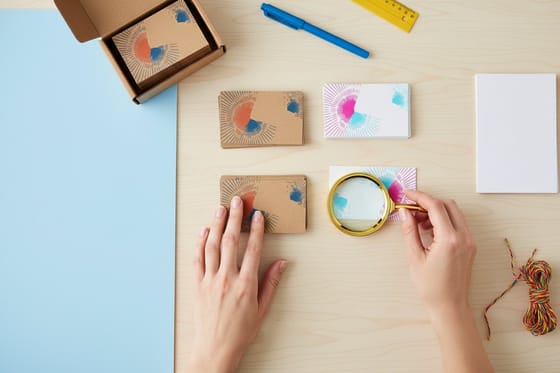
Pick up a kraft card and you know it before you read it. The surface is uncoated and slightly toothy, the color is a warm mid brown, and there is no film between your fingertip and the fiber. That is the whole argument for kraft, and it is a strong one for a roastery, a bakery, a tattoo studio or any brand whose story is made by hand.
The cost of it is your palette. Printing ink is translucent, so on kraft every color mixes with brown before it reaches the eye. Deep reds go rust. Pale blues turn gray green. A photograph loses its highlights, because the highlights were always the paper showing through. Solid black and a heavy single-color logo look superb. A full-bleed product shot looks tired. Our guide on how color prints on kraft paper goes color by color through what survives.
There is a fix, and it is a real one: the 5/0 option prints CMYK plus a white ink pass, so light artwork gets an opaque base to sit on and reads properly against the brown. You can also run 4/0 front only or 4/4 both sides. Six sizes are available, from the standard 2 x 3.5 in down to a 1.5 x 3.5 in slim and a 2 x 2 in square. Kraft Business Cards start at $24.75 per 100 and slide from roughly 25 cents a card toward 13 cents as the run reaches 1,000, on a 5 business day standard turnaround with a 2 business day rush.
If the texture is what you are after but you want more of it, Ultra Thick Kraft Business Cards go from 32pt to 80pt on the same recycled fiber and add 22 edge paint colors brushed into the cut edge, from Metallic Gold to Fluorescent Pink. That is where a kraft card stops being a card and becomes an object.
White: The Widest Stock List and the Lowest Floor Price
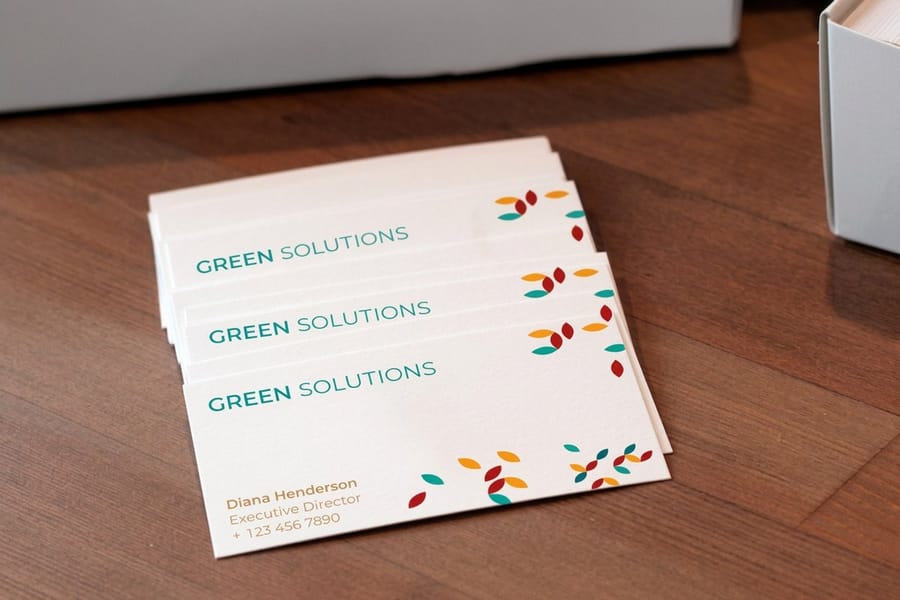
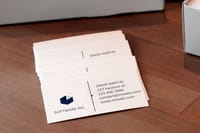
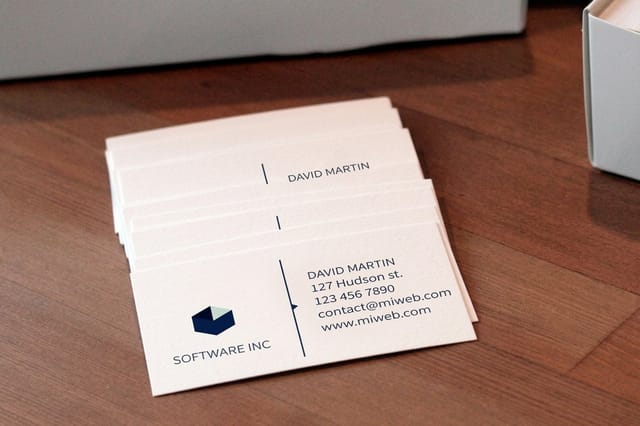
White is the control group. The sheet is neutral, so what you approve on a calibrated screen is close to what the press hands back, and nothing has to be compensated for. That is not a small thing when the card carries a brand color that a client will hold up against a website.
Standard Business Cards start at $17.57 per 100, which works out to about 17.6 cents a card, and the per-card price keeps falling to roughly 1.8 cents at 100,000. The 73 stocks include coated, uncoated, linen and metallic pearl, running from 14pt to 80pt, so the word "white" here covers a soft matte uncoated sheet and a hard gloss one and a shimmering pearl one. The standard turnaround is 3 business days, with 2-day, Next-Day and Same-Day rush available, which is the fastest of the three materials by a clear margin.
The honest weakness of white is that it is unremarkable by default. Nobody has ever turned a plain white card over because the paper surprised them. Everything memorable has to come from the design, the finish or the thickness, which is why the finish question matters so much on this stock. Matte or gloss covers the surface decision, and 14pt vs 16pt vs 32pt covers what caliper actually buys you.
White is also the right place to prove a design. Print 100, hold them, find the typo, then move the settled artwork onto a more expensive material. Start from a correctly built file in the blank template library or a layout from design templates, and check the measurements against the business card size guide before you upload.
Metallic: A Real Foil Accent, and a 500 Card Minimum
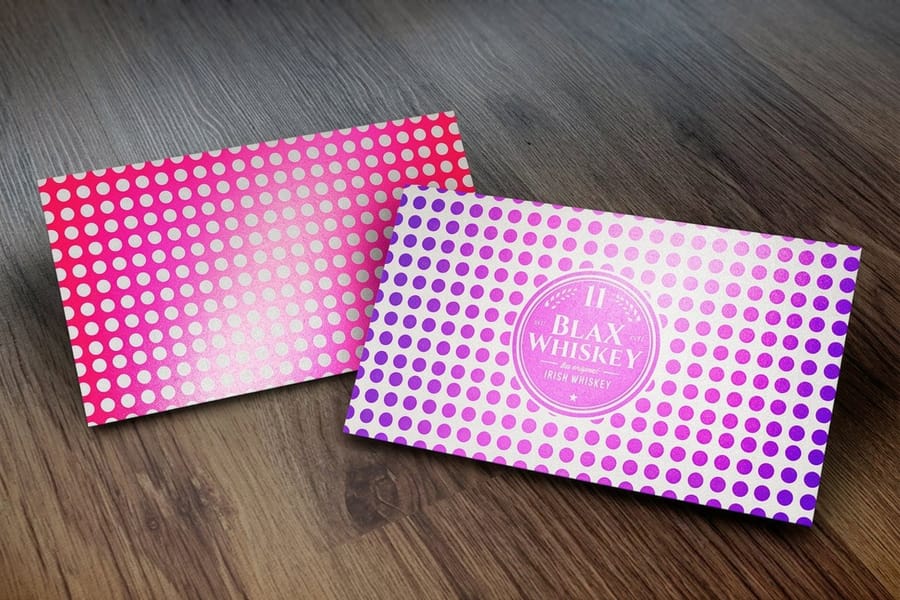
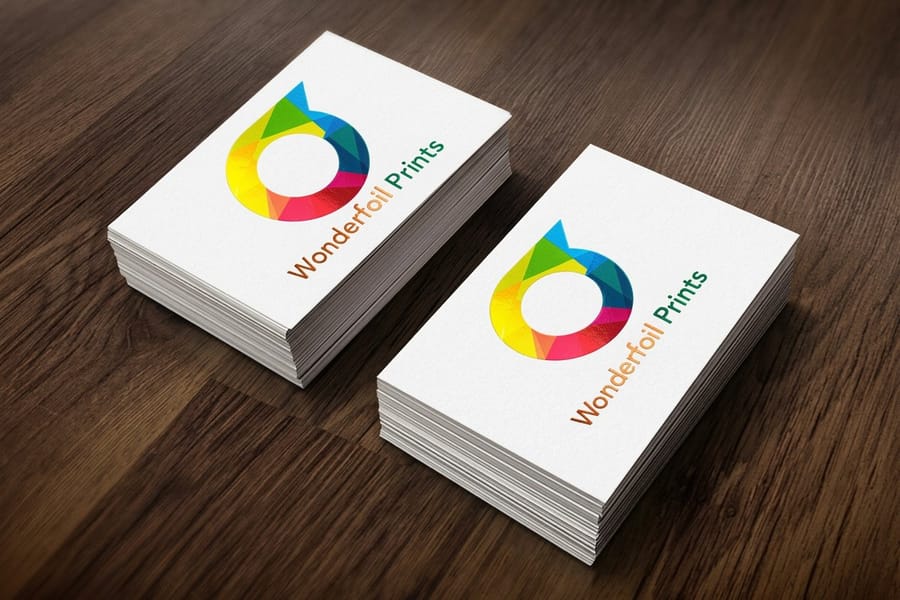
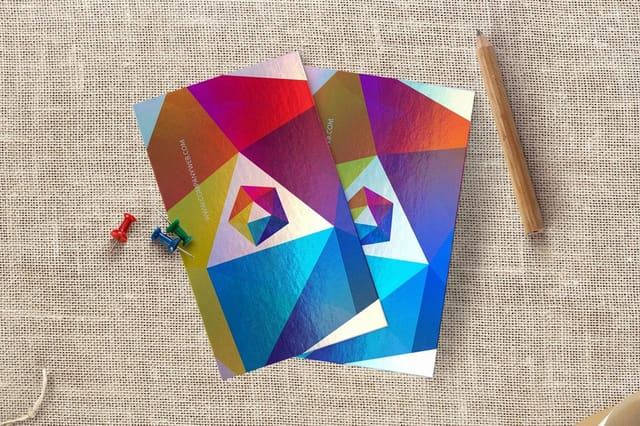
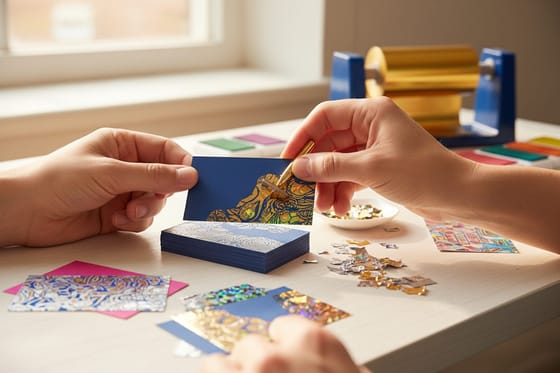
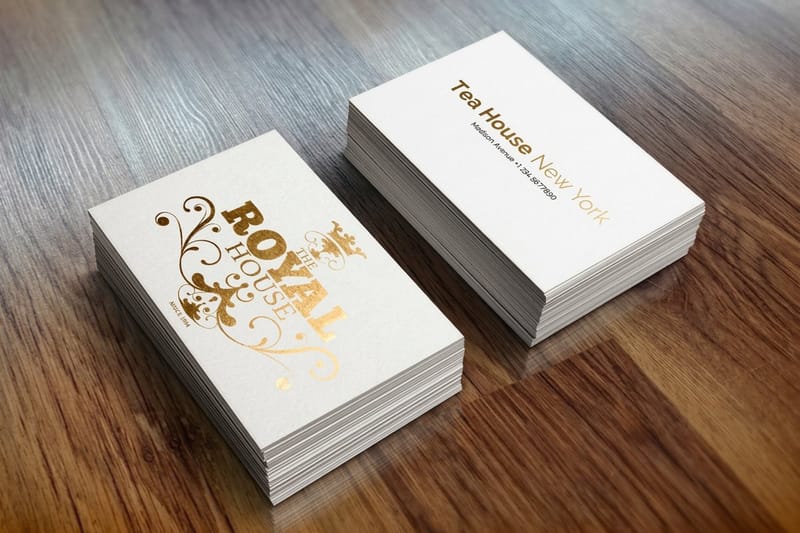
Metallic is the only one of the three that changes as the card moves. The foil accent is a metallised layer stamped onto the sheet under heat and pressure, so it mirrors the room. Tilt the card and the logo flares. That reaction is why people remember the card, and no amount of gold-colored CMYK ink reproduces it, because ink cannot reflect.
Metallic Business Cards print full color on a bright 16pt gloss cover, then take the foil accent on the front. Seven sizes are available from a 1.5 x 3.5 in slim card to a 2.5 x 2.5 in square, with three coating choices (bare, High Gloss UV, or Spot UV on the front) and rounded corners at a 1/8 or 1/4 in radius. They are rated 5.0 out of 5 across 103 reviews, and they run a 7 business day turnaround with a free online proof, which is a proof you should actually look at, because foil placement is the one thing a flat PDF preview hides.
That limit is never advertised. The smallest set is 500 cards at $126.32. Stamping has setup that a run of 100 cannot absorb, so there is no cheap trial. If your design is not finished, this is the wrong material to learn on. If your design is finished and you hand out cards at events rather than by the handful, 500 is not a large number and 25.3 cents a card is fair for what arrives.
Two related products are worth knowing about. Metallic Foil Business Cards at $222.13 per 500 open up seven foil colors including rose gold and black, on 16pt silk laminated or 14pt uncoated cover, front, back or both. And the difference between stamped foil, printed foil and metallic ink is explained properly in foil stamping vs foil printing vs metallic ink, along with what a foil accent is on a card specifically.
The Three Side by Side, With Real Numbers
Cost per card flatters metallic and hides the thing that decides most orders, which is the size of the cheque you have to write before you see anything. Both numbers are in the table.
| Material | Base stock | Smallest run | That run costs | Per card | Standard turnaround |
|---|---|---|---|---|---|
| Kraft | 18pt uncoated, 100% post-consumer recycled | 100 | $24.75 | About 24.7 cents | 5 business days, 2 day rush |
| White | 73 stocks, 14pt to 80pt, coated or uncoated | 100 | $17.57 | About 17.6 cents | 3 business days, Same-Day rush |
| Metallic | 16pt gloss cover plus stamped foil accent | 500 | $126.32 | About 25.3 cents | 7 business days, free online proof |
Read the fourth column and the fifth column together. Kraft and metallic land within about half a cent of each other per card, so on unit economics they are near enough identical. On entry cost they are not remotely alike: $24.75 lets you try a kraft design and throw it away, and $126.32 does not. That single gap is the reason most first orders are white or kraft and most reorders are metallic.
The turnaround column has its own arithmetic. Between a 3 day white card and a 7 day metallic card sits four working days, which is most of a week when an event date is fixed. Rush options narrow it, but a rush costs money that the per-card table above does not show. If your deadline is close, the material choice is being made for you.
Which Material Wins for Your Card
There is no overall winner, and any page that names one is selling you something. There is a right answer per brand, and it falls out of three questions: what does the artwork need, how many cards do you need, and what date is fixed.
- Kraft wins when your brand story is craft, sustainability or anything hand-made, and when the artwork is type and a single-color mark rather than photography. It also wins whenever you want the card recognized by touch. Budget the white ink pass if any element is light.
- White wins when color accuracy matters, when the design carries photography or a precise brand color, when the deadline is short, or when this is the first printing of a design that has not been proofed in the hand yet. It is also the only one of the three with a Same-Day option.
- Metallic wins when the card is handed over in a setting where being remembered is the entire job, and when the design is already settled. It needs 500 cards, seven days and a finished logo, and it repays all three.
One combination worth naming, because it comes up constantly: a firm that wants the eco story and the shine. That is not a contradiction. Ultra Thick Kraft Business Cards put Metallic Gold or Copper edge paint on 100% recycled kraft, so the metal appears on the cut edge instead of the face, and the sheet still recycles as paper. If the sustainability argument is the point, what sustainable printing means and are business cards recyclable are the two pages to read next, because an uncoated sheet and a laminated one behave very differently at the end of their life.
Still torn between the two paper materials on their own terms? Kraft vs standard business cards takes that pair apart in more detail than a three-way comparison has room for.
Setting Up Artwork for Each Material
Each material asks for something different from the file, and the differences are cheap to handle at the design stage and expensive to handle after a proof comes back wrong.
Kraft. Design on a brown background in your artboard, not a white one, or you will approve a palette you never actually ordered. Anything that should appear white has to be built as a printed white object on the 5/0 setup, including knocked-out logos and reversed type. Push contrast harder than feels necessary, because the brown eats the bottom of the range. Avoid large flat areas of pale ink, which show the sheet through and look patchy.
White. Build in CMYK, not RGB, and expect the small shift that comes with it. Keep live text clear of the trim edge and hold a proper bleed, because a card is trimmed after printing and a border that measures even in the file can look uneven on the cut. The size and bleed numbers are in the business card size guide, and every layout in blank templates already has them built in.
Metallic. The foil is a separate press pass, so it needs its own layer telling the press exactly where metal goes, as 100% solid shapes rather than tints or gradients. Hairlines and small serif type in foil tend to fill in under the pressure, so give the accent some weight. Keep the accent to the one element you want remembered, because foil everywhere reads as cheap rather than expensive. The full file setup is in how to set up your design files for foil, and the free online proof on a metallic order is where you confirm the placement before 500 cards are made.
Wally lays all three on the counter
Brown, white and shiny, and what each one costs you

Wally puts the same design on all three sheets. On kraft it goes warm and quiet, so he swaps the pale blue for solid black and adds the white ink pass. On white it comes back exactly as drawn, in 3 business days, for $17.57 a hundred. On metallic the logo flares when he tilts it, and he reminds you the smallest set is 500 cards at $126.32 and seven days. Prove the design on white, then reprint it on the material your brand actually sounds like.
Compare every business card stock →Specs and pricing
The three materials side by side, with live prices
Kraft is one recycled stock done properly. White is 73 stocks to choose from. Metallic adds a stamping pass to a gloss sheet. Configure each one and watch the price move with the quantity, the size and the turnaround.

Print it
Order the material your brand actually sounds like
Explore more
Where to go next
By the numbers
Kraft, metallic and standard cards on one press
Common Questions
Your card material questions, answered
Can I print white text on kraft business cards?
Yes, but it is a separate ink, not an absence of ink. Kraft Business Cards offer a 5/0 option, which is CMYK plus a white ink pass, and that white pass is what lets light artwork read on the brown sheet. Without it, anything you leave unprinted simply shows as kraft brown. Plan for it at the design stage, because a logo that was drawn as white-knockout on a white card has to be rebuilt as a printed white shape for kraft.
Why do photos look flat on kraft cards?
Because the ink is translucent and the sheet underneath is brown rather than white. On a white card the paper reflects light back through the ink and gives you the bright end of the range. On kraft that reflected light is warm and darker, so highlights close up, pale skin tones go sallow, and light blues drift toward gray green. Line art, single-color logos and heavy type survive this beautifully. Full-bleed photography does not. Print the photo card on white and save the kraft for the design that is mostly type.
Is a metallic business card the same as a metallic pearl stock?
No, and the difference is worth knowing before you order. Metallic Business Cards are a bright 16pt gloss cover sheet with a real metallic foil accent stamped onto the front, so the shine is a discrete shape you place. Metallic pearl is a stock with shimmer running through the whole sheet, and it appears in the 73 stocks on Standard Business Cards. One puts a mirror on your logo. The other gives the entire card a soft glimmer.
Which of the three is cheapest per card?
White, at every quantity that matters. At the smallest run each product sells, a standard card is about 17.6 cents, a kraft card is about 24.7 cents and a metallic card is about 25.3 cents. The metallic figure looks close, but you can only reach it by buying 500 at once for $126.32, while the other two let you spend under $25 to try the design first.
Do kraft business cards count as recycled?
The stock we print them on is made from 100% post-consumer recycled paper, and it is uncoated, which is the part people forget. A coating or a laminate is a plastic film that makes a card harder to put back into the paper stream. Kraft goes into recycling as it comes off the press. That is a genuine argument, and it is a different argument from the foil accent on a metallic card, which is a metallised layer bonded to the sheet.
Can I get foil on a kraft card instead of choosing one or the other?
You can, on the heavier line. Ultra Thick Kraft Business Cards run 32pt through 80pt recycled kraft with 22 edge paint colors including Metallic Gold and Copper, so the metal shows on the cut edge rather than the face. Metallic Foil Business Cards take the other route and offer a 14pt uncoated cover stock alongside the 16pt silk laminated, so you can put stamped foil on an uncoated sheet. The combination exists. It just is not the standard kraft product.
How much artwork rework is involved if I switch materials late?
Switching between white and metallic is mostly additive: you build a separate spot layer that tells the press where the foil goes, and the CMYK artwork underneath barely changes. Switching to kraft is the expensive one, because the palette itself has to be re-judged against a brown base and any white element has to become a printed white object. If there is a chance you will end up on kraft, design for kraft first and let the white version be the easy adaptation.
Which material should a new business order first?
White, in the smallest box, unless you already know your brand story is texture or luxury. A $17.57 box of 100 on a 3 business day turnaround lets you find the typos, check the trim and see the design in a real hand before you commit. Once the design is settled, reorder it on kraft or metallic. Ordering 500 metallic cards as a first print run is how people end up with 480 cards carrying an old phone number.
Get Started
Pick the sheet first, then print the design on it.
Kraft for texture and the recycled story, white for accuracy and speed, metallic when the card has to be remembered. Configure any of the three and watch the price move as you change the quantity and the turnaround.
Legal Disclaimer
Gold Standard guarantees apply to all standard orders placed through 4over4.com. Price match requires verifiable proof of a competitor's published price for an equivalent product with matching specifications and turnaround time. Satisfaction guarantee covers manufacturing defects and print quality issues. Contact support with order number and documentation. On-time delivery rate based on tracked orders 1999 to 2026. Individual results may vary based on shipping carrier performance.
