
How to Put Your Logo on a Banner Without It Getting Cut Off


The file to send, the margin the hem and grommets take back, where on the banner the logo belongs, and how large it has to be for the distance people will read it from.
Send the logo as vector art, place it in the top third of the banner, and keep it at least 2 inches inside every edge. The hem folds about an inch of material around to the back and grommets punch about an inch in, so anything nearer the edge is either hidden or has a hole through it. Size it by distance, at roughly 1 inch of height per 10 feet people stand away, and check the material: mesh is 30 percent open and breaks up hairline detail that vinyl holds.
Quick answer
Vector file, top third, 2 inches off every edge
A banner's live area is smaller than its trim size, and that is what catches people out. The hem folds roughly an inch of material to the back, and the grommet line sits about an inch in from the edge, so a logo parked in the corner gets half hemmed and half punched. Keep it 2 inches clear, put it in the top third where the eye lands and where a table or a parked car cannot block it, and supply vector art so it stays sharp at any width. Then size it to the distance: about 1 inch of height for every 10 feet away your audience stands.
Start With a Logo File the Press Can Actually Use

Nine out of ten banner problems are file problems, and they are all decided before anyone opens a layout. A banner is the largest thing most businesses ever print, so a logo that looks perfect on a business card can fall apart at forty times the size.
Vector is the answer if you have it. An AI, EPS, PDF or SVG logo is stored as math, not pixels, so it prints just as crisply at 2 inches as at 6 feet. Convert the fonts to outlines before sending so nothing substitutes on our end. Our guide to print file types covers which format to ask your designer for.
If the logo is raster, do the arithmetic. Banners print at roughly 100 dpi at final size, far below the 300 dpi a business card wants, because nobody stands 12 inches from a banner. A logo that will run 24 inches wide therefore needs around 2,400 pixels of width. Build the file at quarter scale at 300 dpi if the full size file gets unwieldy; the math comes out the same and the file opens faster. The explanation of dpi and ppi is worth five minutes if that distinction is fuzzy.
Two more things get people. A logo dragged off a website almost always carries a white rectangle behind it, which is invisible on a white web page and glaring on a red banner, so strip it properly with the steps in making a logo transparent. And convert to CMYK yourself rather than letting the RIP guess: bright blues and greens are the ones that shift, and converting RGB files for print walks through it. If the brand color has to be exact, give us the Pantone number.
Where the Logo Goes, and the Edges That Will Eat It

Put the logo in the top third of the banner and at least 2 inches inside every edge. The top third because banners are read downward and the lower part is the section most often hidden behind a table, a parked car or the people standing in front of it. The 2 inches because the finished banner is smaller than the printed sheet in ways that are easy to forget.
| Finishing | What it takes off the visible area | Keep artwork back by | Where it applies |
|---|---|---|---|
| Hem | About 1 inch on each side, folded and welded to the back. | 2 inches | Nearly every outdoor vinyl and mesh banner. |
| Grommets | A 3/8 inch hole punched roughly 1 inch in, spaced every 24 to 36 inches. | 2 inches | Anything tied or bungeed to a fence, rail or frame. |
| Pole pocket | 3 to 4 inches sewn shut at the top, or at both ends. | 5 inches | Pole banners and anything hung from a rod. |
| Stand cassette | 3 to 6 inches at the bottom rolls into the base and is never seen. | Bottom 6 inches | Retractable banner stands. |
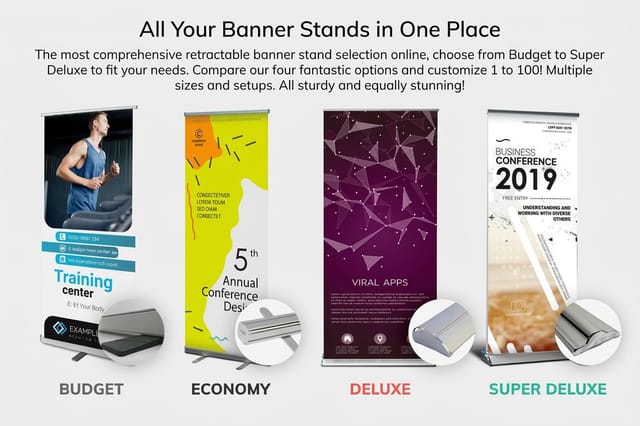
Read the last column against your own job. A banner going on a fence needs corner clearance more than anything else, because that is where the grommets land. A pole banner loses a strip at the top and bottom to sewn pockets, so a logo centered vertically ends up looking low once it is hung. On retractable banner stands the bottom strip disappears into the cassette and the top is where a standing viewer's eye lands, which is the strongest argument for putting the logo at the top on that format specifically.
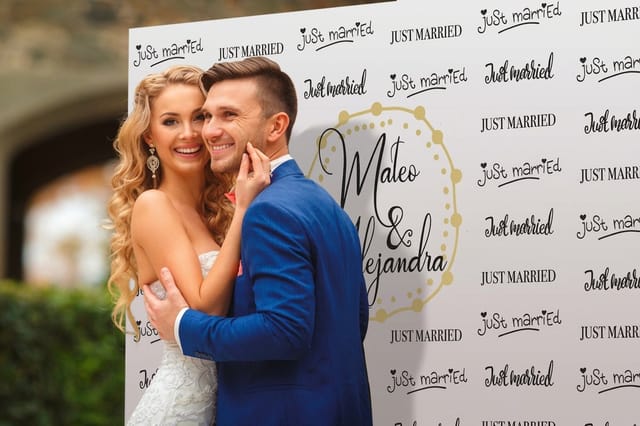
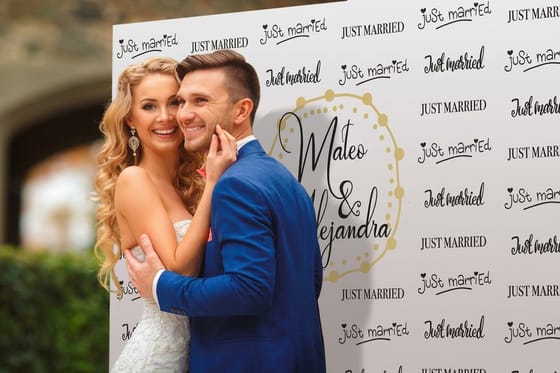
One format ignores all of this. A step and repeat banner is nothing but logo, tiled on a grid that is sized so a chest-up photo catches at least two complete marks. The rules there are about grid pitch and angle rather than margins, and the step and repeat backdrop guide covers the setup.
Size the Logo for the Distance People Read It From

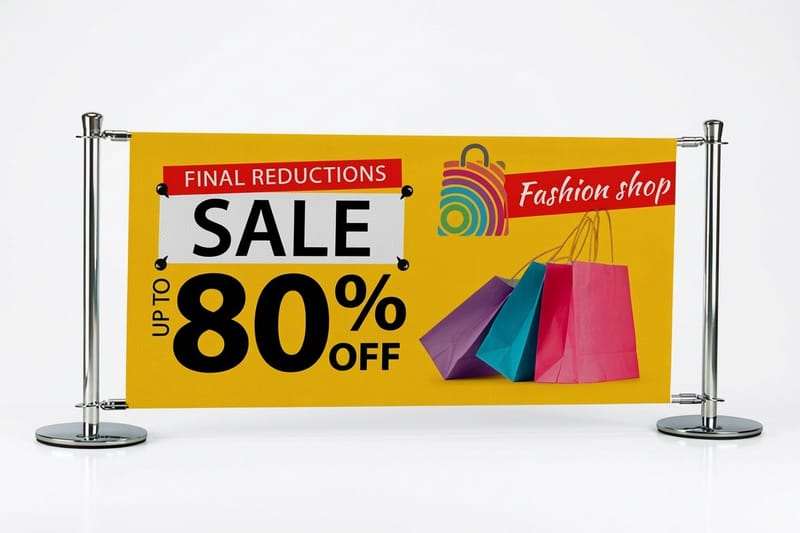
The trade rule is about 1 inch of letter height for every 10 feet of viewing distance. That figure describes legibility for someone stopped and looking, so if your audience is driving past, double the height and cut the word count. Work out the distance first and size the logo to it; guessing produces banners that are perfectly designed at arm's length and unreadable from the street.
| Viewing distance | Minimum cap height | Logo mark height | Typical banner |
|---|---|---|---|
| 10 ft | 1 inch | 3 to 4 inches | Trade show table or retractable stand. |
| 25 ft | 2.5 inches | 6 to 8 inches | Storefront banner read from the sidewalk. |
| 50 ft | 5 inches | 12 to 15 inches | 3 by 6 or 4 by 8 across a parking lot. |
| 100 ft | 10 inches | 20 to 24 inches | 4 by 10 roadside, four words at most. |
Here is the limit nobody mentions when they tell you to make the logo bigger. At 100 feet a 3 foot tall banner can hold a 20 inch logo and about one line of text, and that is the whole design. You are choosing between brand recognition and a message, so decide which job the banner is doing. If people already know the name, shrink the logo and sell the offer. If they do not, the logo wins and the copy becomes a phone number.
Type weight matters as much as height at distance. A thin geometric wordmark loses its counters before a heavier one does, which is why some logos need a bolder secondary lockup for large format use. Banner fonts goes into which faces survive scale, and the banner size guide helps you pick the canvas before you start placing anything. You can start from a correctly sized file in the blank template library.
The Material Your Logo Has to Live On
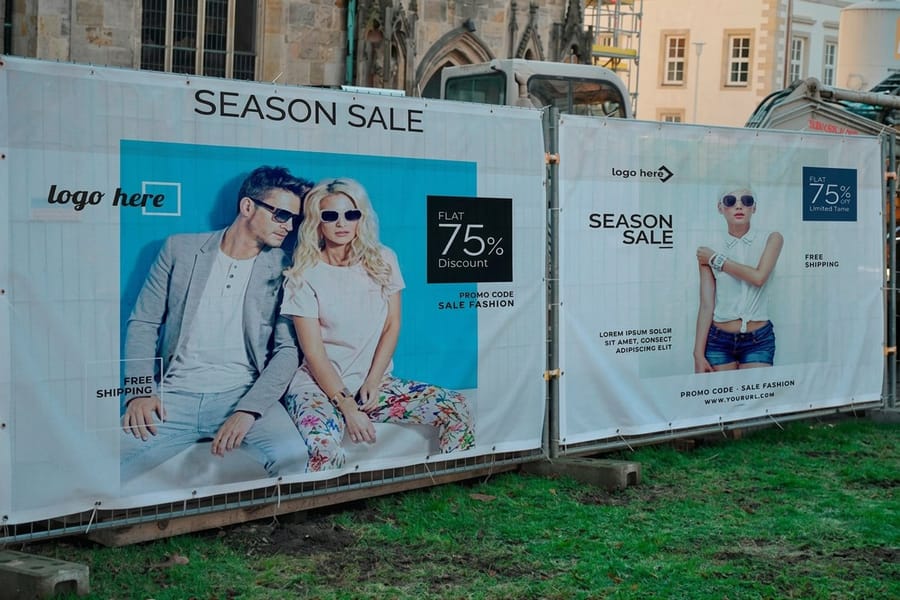
Material changes how a logo reproduces, and the difference shows up in fine detail rather than in color. Pick the surface for the location, then check that the logo still holds on it.
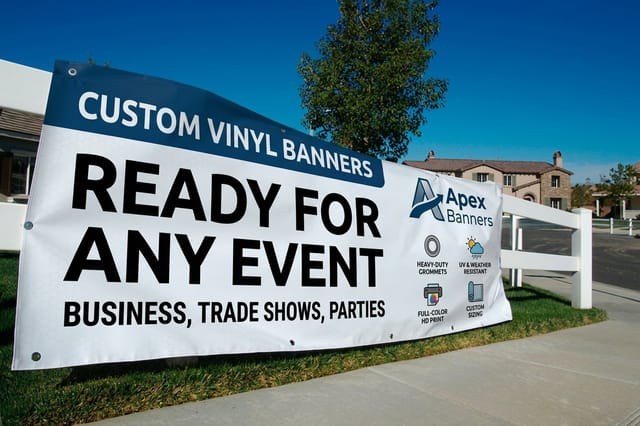
Scrim vinyl is the default and the most forgiving. Vinyl banners start at $79, take a solvent print with hard edges, and hold hairline strokes, small taglines and tight registration without argument. If the logo has delicate parts, this is the safe surface.
Mesh trades detail for wind. Mesh banners start at $75 and are roughly 70 percent material and 30 percent open, which lets gusts through so a large banner does not tear off a fence. That open area also interrupts thin lines, so a logo with hairline rules or 1 inch legal text will look chewed up. Thicken the strokes or drop the small type before printing on mesh.
Fabric is dye sublimated into polyester, so the ink lives in the fiber rather than on top of it. Fabric banners start at $57.20, do not glare under trade show lighting, and fold into a bag without cracking. The edges of a printed logo are a fraction softer than on vinyl, which nobody notices at 10 feet and a designer notices at 10 inches. For an indoor wall or a booth, indoor banners start at $25.
One trap for double-sided work: printing both sides of a standard vinyl banner lets the back image ghost through in daylight, and a reversed logo showing faintly behind the front one looks like a printing error. Blockout banners carry an opaque center layer that stops it. For a fuller comparison, read banner material types, or browse the whole range in banner printing and vinyl banners.
Wally places the logo
Two inches off the edge, top third, vector file
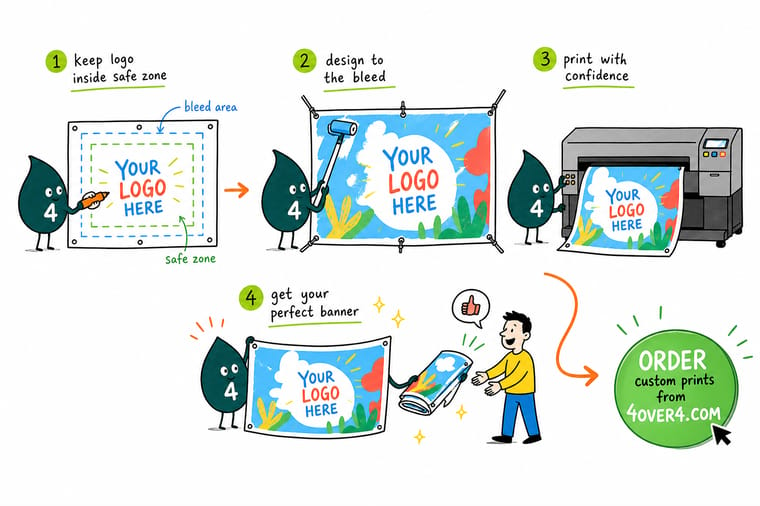
Wally lays the banner out flat and marks a line 2 inches in from every side. The hem takes about an inch of that when the edge folds to the back, and the grommets punch through the rest. Everything he wants people to see lives inside that line, and the logo goes in the top third because the bottom is where the table and the crowd end up. Then he steps back to where customers will actually stand. If the logo stops reading from there, it goes up in size and a line of copy comes out.
Price a vinyl banner →Specs and pricing
Banner sizes, finishing options and starting prices
Configure the size, hem and grommet spacing before you place the logo, with live options and starting prices from the 4OVER4.COM configurator.


Print it
Put your logo on a banner that hangs straight and reads from the street
Explore more
Where to go next


By the numbers
Banners hemmed with two inches clear of every edge
Common Questions
Your logo banner questions, answered
What file format should I send for a logo on a banner?
Vector first: AI, EPS, PDF or SVG, with fonts converted to outlines. Vector art has no fixed size, so the same file prints correctly on a 2 foot retractable and a 10 foot fence banner. If all you have is a raster logo, a PNG or TIFF with a transparent background at about 100 dpi at the finished print size works, which means a logo that will run 24 inches wide needs to be around 2,400 pixels wide. You can also build the whole banner at quarter scale at 300 dpi, which produces a smaller file that still holds up when we scale it back to full size.
Can you print my logo from the JPG on my website?
Usually not at banner size. A website logo is typically 200 to 600 pixels wide because that is all a screen needs, and blown up to 2 feet across it lands at 20 to 25 dpi, which shows as soft, stepped edges from ten feet away. It also carries a white box behind it unless it is a transparent PNG. Ask whoever built your logo for the original vector file, or send us what you have and we will tell you before printing whether it holds at the size you want.
Where should the logo go on a banner?
In the top third, usually top left or centered, at least 2 inches inside every edge. Top third because banners are read downward and the bottom is the part most often blocked by a table, a parked car or people standing in front of it. Two inches because the hem folds about an inch of material to the back and the grommet line sits about an inch in. A retractable stand is a special case: keep the bottom 6 inches clear of anything you need to see, because that strip rolls into the base cassette.
How big should the logo be on a 3 by 6 foot banner?
It depends on where people stand. For a storefront read from a sidewalk 25 feet away, a wordmark around 2.5 to 3 inches of cap height is legible and a logo mark of 6 to 8 inches tall reads clearly. For a roadside banner seen from 100 feet, the same logo needs to be closer to 20 inches tall, and at that scale a 3 by 6 banner has room for the logo plus about four words. That trade-off is the real design decision: distance costs you copy.
Will my logo color match my business cards?
Close, but not identical, and it is worth knowing why before you compare them side by side. Banner ink is laid on coated vinyl or dye sublimated into polyester, while a business card is printed on paper stock, so the same CMYK build reads slightly warmer or cooler across the two. Deep blues, bright oranges and greens shift the most. If the color has to hold, give us the Pantone number rather than a screen grab, and convert artwork to CMYK before sending so nothing is guessed for you at the RIP.
What if I do not have a logo file at all?
Use the Design Online option on the banner product page. It opens the browser designer where you upload an image, drop in text, position it against the safe zone, and see the layout before you commit. It handles a straightforward logo plus a headline well. What it will not do is rebuild a low resolution logo into a sharp one, so if the only copy you have is a small web image, budget for a redraw first and print second.
Get Started
Supply a vector logo, then set the banner size
Pick the size, choose hems and grommets, upload the logo or build the layout in the browser designer, and we print it on 13 oz scrim vinyl that survives a season outdoors.
Legal Disclaimer
Gold Standard guarantees apply to all standard orders placed through 4over4.com. Price match requires verifiable proof of a competitor's published price for an equivalent product with matching specifications and turnaround time. Satisfaction guarantee covers manufacturing defects and print quality issues. Contact support with order number and documentation. On-time delivery rate based on tracked orders 1999 to 2026. Individual results may vary based on shipping carrier performance.
