
Double Sided Pop Up Banners That Read Clean From Both Directions


Four different products share this search term, they range from $108.75 to $1,599, and only one thing separates a real two-sided display from a printed front with a plain back. Telling them apart is easy once you know what to look for, and your floor plan decides which you need.
A double sided pop up banner is a portable display printed on both faces, built either as two banners back to back in one retractable base or as a single skin printed on both sides of a hung banner or a tube frame. It only works on opaque material: ordinary banner vinyl passes light, so the back graphic ghosts through the front. Two-sided builds use a blockout core, 15oz BlackOut on hung banners and 13oz smooth blockout on retractable panels. At 4OVER4.COM a Double Retractable Stand starts at $525 with the base and both 33 by 81 inch banners included, and a 2 Sided Blockout Banner starts at $108.75.
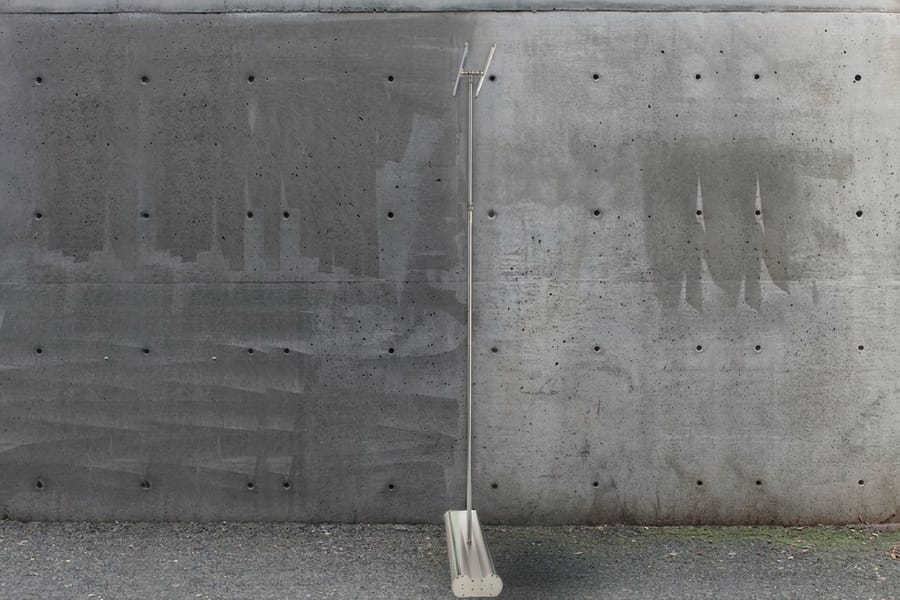
Quick answer
Two clean faces come from an opaque core, not from a printer setting
Print both sides of ordinary banner vinyl and the two images ghost into each other. A real double sided display carries an opaque layer between its printed faces, so light stops at the middle and each side reads on its own. That layer is 15oz BlackOut vinyl on a hung banner and 13oz smooth blockout on a retractable panel. Everything else is a choice about traffic: island booths, aisle ends, lobbies and sidewalk hangs justify a second face, while an inline booth against a back wall does not.
The Four Builds That Answer to Double Sided Pop Up Banner
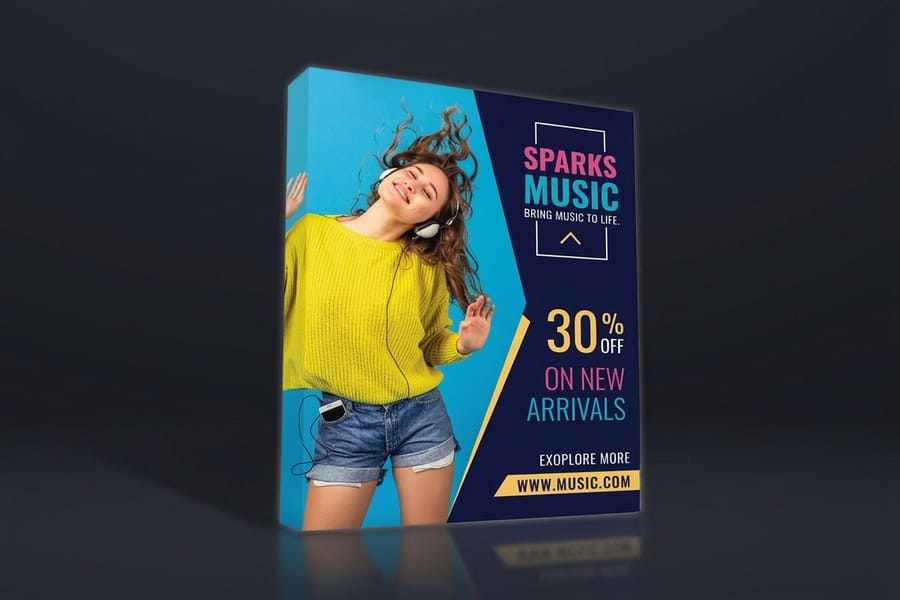
The phrase covers four different products, and they do not cost or behave alike. Pick by how the crowd moves past the display, then match the hardware to it.
| Build | What it actually is | How the second face happens | Starts at |
|---|---|---|---|
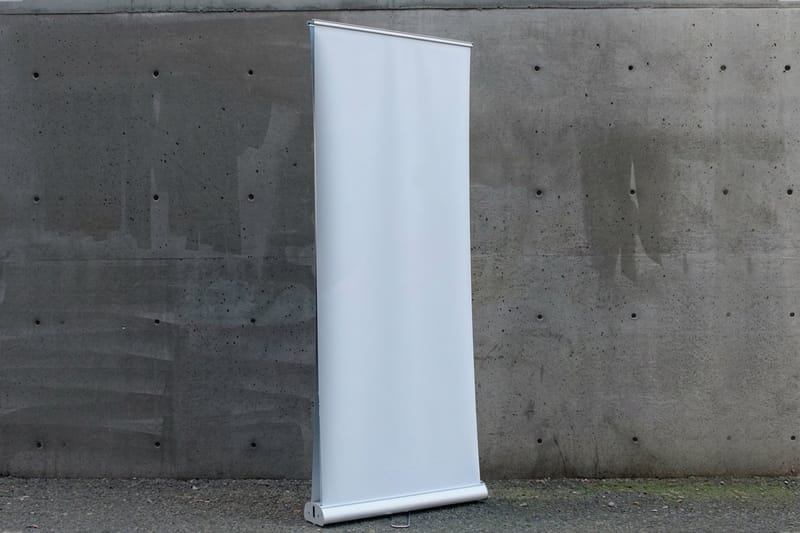
| Double retractable stand | Two banners back to back in one aluminum base, each rolling into the base for travel. | Two separate 33 by 81 inch printed panels, one per face. | $525 |
| 2 sided blockout banner | A hung vinyl banner, hemmed and grommeted, in 13 sizes from 2 by 3 ft up to 4 by 10 ft. | One sheet of 15oz BlackOut vinyl printed full color on both faces. | $108.75 |
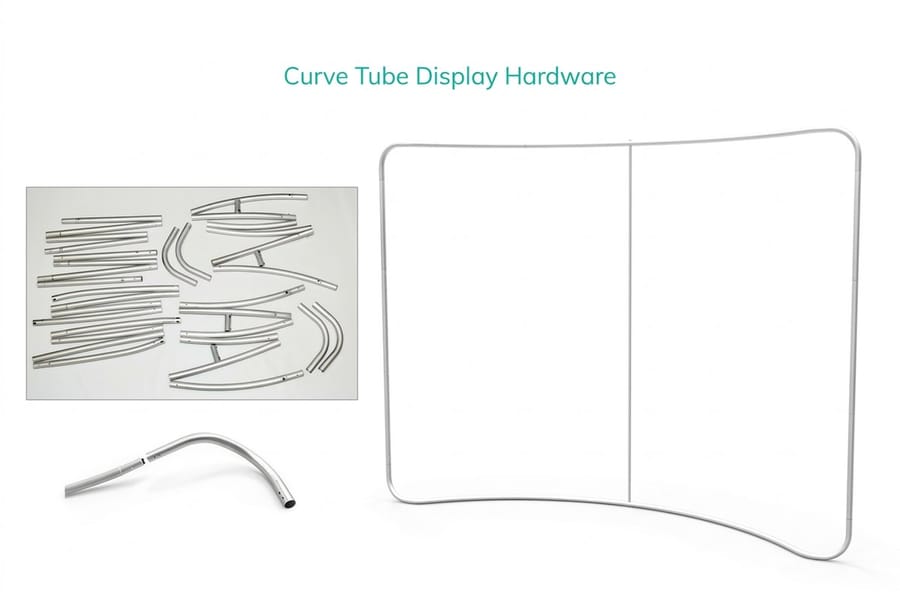
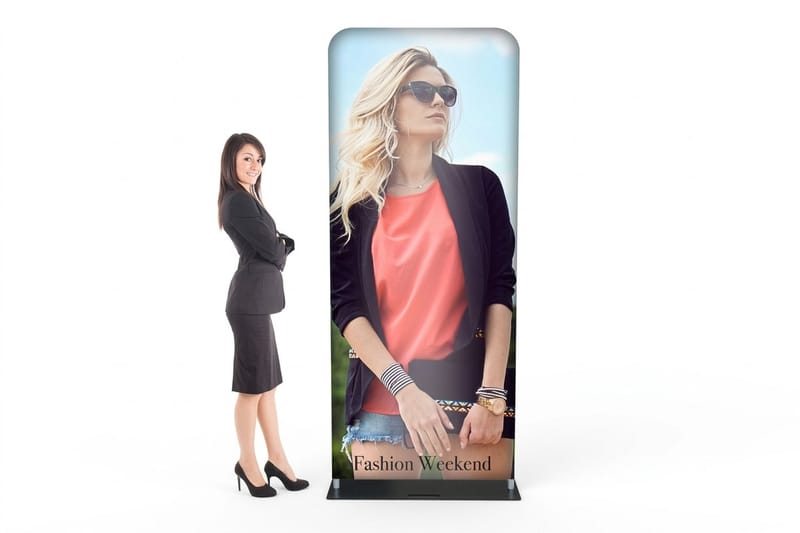
| Curve or straight tube display | 8.8oz tension fabric stretched over a tool-free push-fit aluminum tube frame. | Order the skin double sided so the back of the frame prints too. | $548.09 curve, $635.96 straight |
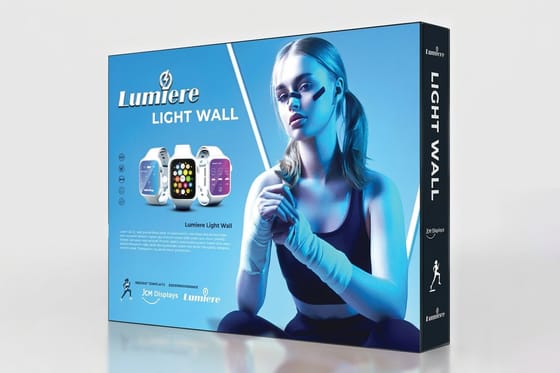
| SEG backlit popup | Silicone edge fabric in a lit frame, 8 ft or 10 ft, custom to 117 by 88 inches. | Single or double sided skins, lit from inside the frame. | $1,599 |
The classic pop up display is missing from that table on purpose. At $752.39 it stretches one printed face of 8.8oz tension fabric over a collapsible frame, in 4 sizes across 8 ft and 10 ft, curved or straight. It is built to be the back wall of a booth, and a back wall is only ever seen from one side. When the aisle walks past your back, the curve tube display and the straight tube display take a double sided skin on the same tension-fabric idea, and the whole family sits together on displays printing.
Show-Through Is the Whole Problem, and Material Is the Whole Fix
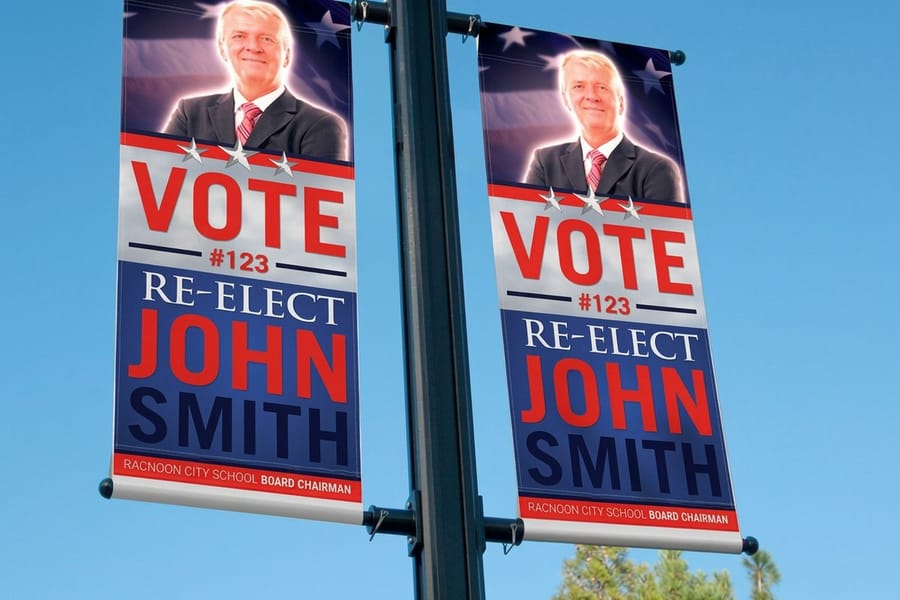
Print both faces of ordinary banner vinyl and you get two muddy images. Light behind the sheet pushes the reverse graphic forward, so every dark shape on side B lands as a shadow on side A. No press setting fixes it. The stock does.
2 sided blockout banners run on 15oz BlackOut vinyl, which carries an opaque black layer sandwiched between the two printable faces. Light stops dead at that core, so each face is read on its own. Double retractable stands use the same principle on a lighter 13oz smooth blockout, because a retractable panel lives indoors and has to roll into a base without cracking.
The core costs you two things worth knowing about. It adds weight, and it removes the mesh option, because a blockout layer is solid by definition and cannot let wind through the way a mesh weave does. It also kills backlighting from behind, since the whole point of the core is that light does not pass. If you want a two-sided wall that glows, that is a different build: SEG backlit popup displays put the light source inside the frame between two 6oz backlit fabric skins rather than behind a single sheet.
Ask any supplier which core they use before you compare prices. A quote that names the stock and its weight is describing a real two-sided banner. A quote that just says "double sided" is often describing a printed front and a plain back. The banners collection lists the material on every option so you can check.
When Two Sides Win, and When You Paid for a Face Nobody Sees
A second printed face is worth roughly the cost of a second display, so it earns its keep only where traffic genuinely arrives from more than one direction. Four placements pass that test.
- Island booths. Four open sides means the back of everything you set up is on display all day. This is the placement double sided tube frames and SEG walls exist for.
- Aisle ends and cross aisles. Traffic flows both ways past the same spot, and half of it approaches from behind your graphic.
- Lobby and registration. People walk in past one face and walk out past the other, often hours apart and in a different frame of mind.
- Sidewalk and stage hangs. A banner strung across a walkway or between two crowds is read from both directions by definition, which is the case a 2 sided blockout banner is built for.
Now the honest limit. A standard inline 10 ft booth pushed against pipe and drape sees exactly one direction, and a second printed face there is money on the floor. The same goes for a retractable tucked into a corner behind a table, or a lobby stand set flat against a wall. In those spots take the budget you would have spent on the reverse graphic and put it into size instead: a wider or taller single-sided retractable banner stand reads further down the room than a narrow two-sided one.
Booth space is the other constraint people forget. A double retractable base is heavier and deeper than a single, which matters when you are carrying it through a loading dock and setting it in a 10 by 10 footprint. If you are pricing a whole booth rather than one stand, the trade show booth kits bundle the wall, the stand and the counter so the pieces are sized to each other, and banner stands printing lists every stand in the range side by side.
Ordering a Two-Sided Display That Reads Right the First Time
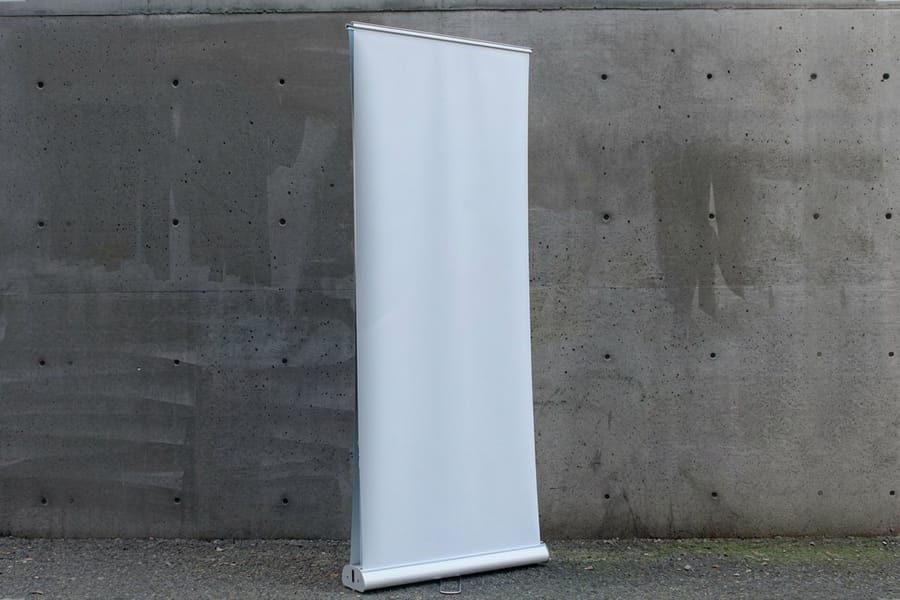
Most reprints on two-sided jobs come from artwork, not from press. Work through these six steps in order and the job goes through clean.
- Map the traffic before you pick hardware. Stand where the display will go and count how many directions a stranger can approach from. One direction means single sided, and you just saved several hundred dollars.
- Choose the build from the table above. Hung span goes to blockout vinyl, floor stand goes to a double retractable, booth wall goes to a tube frame or an SEG wall.
- Build side A and side B as two separate files. Same trim size, same bleed, two independent layouts. Flipping one file to make the back is how type ends up mirrored, and it is the most common two-sided reprint we see.
- Keep live copy out of the dead zones. On a 33 by 81 inch retractable panel the bottom few inches sit down in the base and the top curls over the pole clip. Logo, offer and phone number belong in the middle band, roughly between knee height and just above eye level.
- Take the free online proof. On a single-sided job you can reasonably go Straight To Production. On two faces, sign off on the digital preview first and check the back panel specifically for mirrored text and for a color that shifted when it was duplicated.
- Pick turnaround against the show date, not the art date. Double retractable stands print on a 3 business day standard with 2-day and 1-day rush. 2 sided blockout banners run 4 business days standard with a 2 business day rush. Book the slower option and finish the art early rather than paying rush to cover a late file.
If you are setting up artwork from scratch, pull a correctly sized layout from the blank template library so the bleed and safe area are already right, and our guide to how online printing works walks through proofing and file handoff end to end. For sizing the graphic against viewing distance, trade show poster sizes covers how large type has to be to read from the middle of an aisle.
Wally explains two-sided banners
One hang, two faces, one opaque layer holding them apart
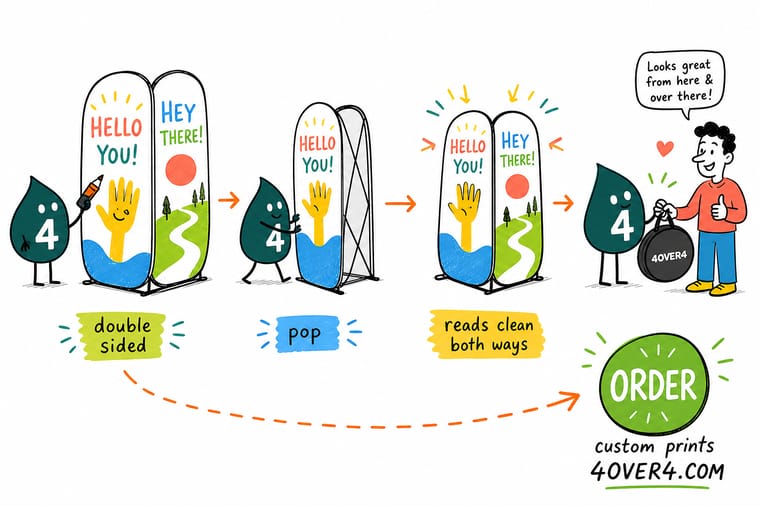
Wally hangs a banner across an aisle with people walking both ways. On plain vinyl the light behind it pushes the back graphic through and both sides go muddy. So he switches to blockout stock, which carries an opaque black layer between the two printed faces, and the light stops dead in the middle. Now the front reads front and the back reads back. His one rule when you send the files: draw side B as its own artwork. Flip side A to make it and the type comes out backwards.
Order a double retractable stand →Specs and pricing
Sizes, materials and starting prices on the two-sided builds
Configure the three main double sided options side by side, with live size choices and starting prices straight from the 4OVER4.COM configurator.


Print it
Order a display that works in both directions
Explore more
Where to go next

By the numbers
Trade show printing you can plan a show date around
Common Questions
Your double sided banner questions, answered
What is a double sided pop up banner?
It is a portable display with a printed graphic on both faces, so people reading it from either direction see a finished message. In practice it is built one of two ways. Either two separate printed panels sit back to back in one base, which is how a double retractable stand works, or a single piece of material carries print on both of its faces, which is how a 2 sided blockout banner and a double sided tension-fabric skin work. The name is loose in the market, so check which build a quote is actually describing before you compare prices.
Will the design on the back show through the front?
Only if the material is wrong. Standard banner vinyl passes light, so daylight or hall lighting behind the sheet pushes the reverse image forward and both faces read muddy. That is why cheap two-sided banners so often ship with a plain back. 2 Sided Blockout Banners use 15oz BlackOut vinyl with an opaque black layer between the two printable faces, and Double Retractable Stands use 13oz smooth blockout, so light stops at the core and each face is read on its own.
Do both sides have to carry the same design?
No. On a double retractable stand you can run the same design twice or set two different designs, one per face, at no change to the build. Same design on both faces is the safer choice when both directions are cold traffic walking past for the first time. Two different designs earn their keep when the sides face genuinely different audiences, like a registration queue on one side and an exhibit floor on the other.
Can a standard pop up display print on both sides?
Not the classic one. The 8.8oz tension-fabric pop up display at 4OVER4 starts at $752.39 and is engineered as a booth back wall, with one printed face and 4 sizes across 8 ft and 10 ft in curved or straight profiles. The two-sided options in the same family are the Curve Tube Displays and the Straight Tube Display, both of which can be ordered single sided against a wall or double sided when the aisle sees the back, and the SEG Backlit Popup Displays, which take single or double sided silicone-edge skins.
How much more does the second printed side cost?
Less than a second display, more than nothing. A single Retractable Banner Stand starts at $139 for a 24 by 79 inch budget kit with the base and banner included. A Double Retractable Stand starts at $525 and includes the aluminum base plus two 33 by 81 inch printed banners, so part of that gap is the larger graphic size and the heavier base, not just the second print. On hung banners the step is smaller: 2 sided blockout banners start at $108.75 for one banner and the per-banner price slides toward $86 as the run grows across 20 quantity tiers.
Can a two-sided banner hang outside?
Yes, with one caveat about wind. 15oz blockout vinyl is UV and water resistant and its perimeter is hemmed, folded back and welded rather than sewn, so grommets pull against two thicknesses instead of one. What it cannot do is breathe. A mesh banner sheds wind through its weave, but a blockout core is solid by definition, so a large two-sided banner on an exposed sidewalk hang needs wind slits, a tight tie-down at every grommet, and a realistic look at the span before you order it oversized.
Get Started
A pop-up display costs $752.39, a curve tube $548.09
Pick your build, upload side A and side B, and we print on blockout stock so neither face shows through the other. Standard turnaround is 3 business days on double retractable stands, with 1-day rush when the show date moves.
Legal Disclaimer
Gold Standard guarantees apply to all standard orders placed through 4over4.com. Price match requires verifiable proof of a competitor's published price for an equivalent product with matching specifications and turnaround time. Satisfaction guarantee covers manufacturing defects and print quality issues. Contact support with order number and documentation. On-time delivery rate based on tracked orders 1999 to 2026. Individual results may vary based on shipping carrier performance.
