
How to Print an Oversized Check for a Donation or Prize Photo


The giant check in a donation photo is a printed board, not a bank document. Here are the three sizes that actually get used, what to mount them on, and how to lay out the fields so the amount still reads once the picture is cropped.
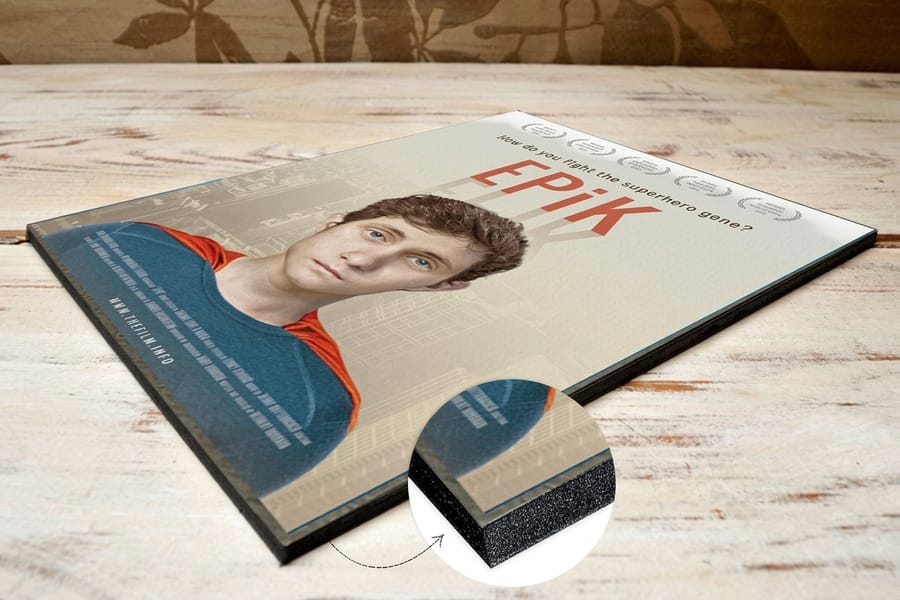
Print an oversized check at 24 by 12 inches for a handshake photo, 36 by 18 for a press shot, or 48 by 24 when two people hold it on a stage. Mount it on 3/16 inch foam board for one event, or on PVC rigid plastic when it has to survive a trunk and a second outing. Leave the payee, amount and date blank only if someone will write them in with a wide chisel tip marker, and keep routing and account numbers off the artwork completely, because the photo goes public.
Quick answer
Three sizes, one shape, and a board chosen by how often it travels
An oversized check is a rigid printed panel in a two to one shape, most often 24 by 12, 36 by 18 or 48 by 24 inches. Foam core is the light, cheap choice for a single event; PVC rigid plastic is the one to buy if the same board comes out every quarter. Print the payer and the field rules, leave the payee and amount blank if they can still change, and set the numerals as the largest element on the board. The routing and account numbers stay off it, always.
Which Oversized Check Size to Order
Pick the size from the photo, not from the amount. A donation of ten thousand dollars does not need a bigger board than a donation of five hundred; the number of people in the frame does.
| Size | Who holds it | Where it works | The catch |
|---|---|---|---|
| 24 x 12 in | One person, one hand at each end | Office handovers, club meetings, phone photos at conversational distance | Gets lost in a wide room shot with more than three people |
| 36 x 18 in | One person comfortably, two for a group shot | Press photos, ribbon cuttings, anything a local paper might run | Will not fit in a small car back seat lying flat |
| 48 x 24 in | Two people, one at each end | Stages, arenas, video coverage from the back of a room | Awkward for one person, and foam core at this size flexes as you walk |
Every one of those is exactly twice as wide as it is tall, which is the useful part. Build the layout once at 24 by 12 inches and the 36 and 48 versions come out of the same file with no reflowing. If your event schedule is not settled, order the 36 by 18. It reads in a photo, one person can still manage it, and it does not need a van.
Sizes outside the 2:1 range are possible on any of our boards, but they stop looking like a check. The proportion is what the eye recognizes before it reads a single word, and the same rule that governs trade show poster sizes applies here: an unfamiliar shape costs you a second of comprehension, and a photo does not have a second.
Mounting: Foam Board, PVC, or a Mounted Poster
The substrate decides whether the check survives one event or ten. There are four sensible options and they separate cleanly by weight and by how many times the board gets carried.
| Material | Feel in the hand | Reuse | Starts at |
|---|---|---|---|
| Foam Core | Very light, rigid until something hits an edge | One event, maybe two if it never leaves the office | $49.99 |
| PVC Rigid Plastic | Noticeably heavier, stiff, solid edge | Years, wipes clean, tolerates a trunk | $25.00 |
| Mounted Posters | Print bonded to a board, smooth photographic surface | Good, if the edges are protected | $39.99 |
| Vinyl Banners | Flexible, needs two people or a frame to hold flat | Rolls up and ships anywhere | $79.00 |
Foam core is the default for a reason. A 36 by 18 foam board weighs so little that whoever holds it during a fifteen minute photo session is not fighting it, and a shaky presenter shows in every frame. What foam core cannot do is take a hit. The core crushes, the crease stays, and there is no repairing it.
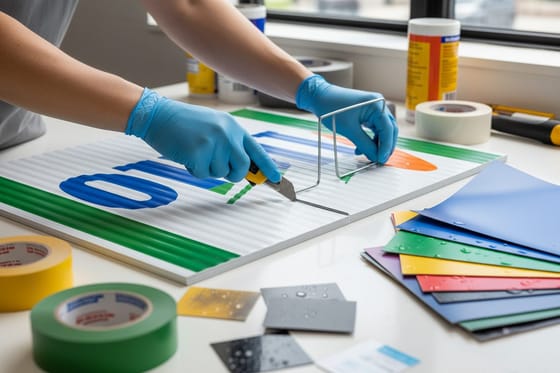
PVC is the answer for any organization that presents a check on a schedule. It costs less to start with, it does not dent, and a marker line wipes off with alcohol so the same board can carry a different amount next quarter. The one honest downside is weight, and a 48 by 24 PVC panel held at arm length gets heavy faster than you expect. The rigid sign material comparison goes deeper on how each substrate behaves once it leaves the shop, and the full range sits in large format printing.
Fill-in Fields and the Reusable Check
Decide before you send the file which fields are printed and which are written on the day. It changes the artwork, not just the workflow.
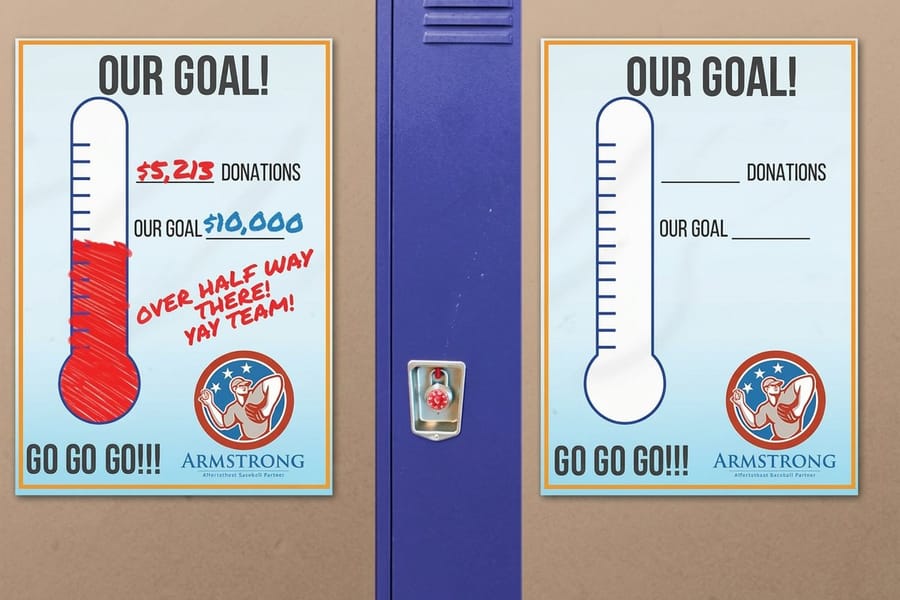
Print permanently: the payer name and logo, the field labels, the rules, and the memo line label. Leave open: the payee, the amount, and the date, if any of the three can still change. A board that says the wrong name because a sponsor pulled out two days before the event is a board you reprint.
Write with a wide chisel tip marker, not a pen. A standard fine point looks confident on your desk and disappears completely at ten feet, which is where the camera is. Practice the amount once on scrap: numerals written freehand come out smaller than people expect, and the amount is the one thing the photo has to deliver.
For a check that gets reused, Dry Erase Foamcore starts at $45.00 and turns the whole board into a writable surface. It has one real limitation. The dry erase coating is glossy, so a direct on-camera flash bounces straight back and blows out the middle of the check. Tilt the board about ten degrees forward, or ask the photographer to bounce the flash, and the problem goes away. If the photos are always taken outdoors in daylight, it is a non-issue.
Setting Up the File So the Amount Reads
Large format artwork does not follow the same resolution rule as a business card. A board that gets viewed from six feet away does not need 300 ppi at full size, and building it that way produces a file so large it becomes hard to hand off.
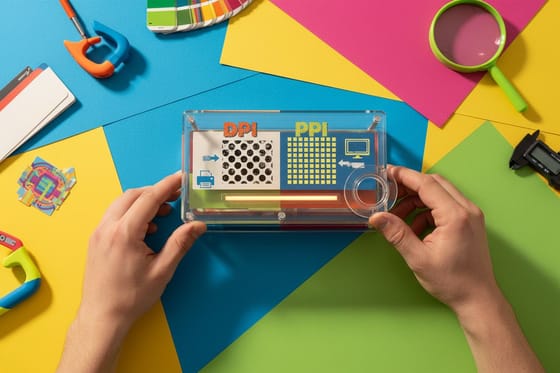
Two workable approaches. Build at full size, 24 by 12 or 36 by 18 inches, at 100 to 150 ppi. Or build at half size at 300 ppi and let the press scale it, which keeps the file manageable and comes out identical. What you must not do is build at 8 by 4 inches and hope: enlarging that far softens every edge, and the numerals are the first thing to go mushy. Our explanation of DPI and PPI covers why the two numbers get confused in the first place.
Layout, in order of what the camera sees. The dollar amount is the largest element and sits above the horizontal center line, because hands and bodies cover the bottom of the board in almost every photo. The payee comes second. The payer logo sits top left where it is legible but never competes with the number. Keep the memo and signature lines inside the bottom two inches and accept that they will be partly hidden.
Use flat dark type on a light field. Gradients behind numerals cost contrast in a compressed social media image, and a thin outlined typeface collapses when the photo is resized to a thumbnail. Set up bleed and safety the same way you would for any large board; a correctly sized starting file for common sign sizes is in the blank template library, and how online printing works walks through the handoff from your file to the finished panel.
The Part About Bank Details Nobody Mentions

A presentation check is a prop. It carries no legal weight, no bank honours it, and the actual money moves by a normal check, an ACH transfer or a wire either before or after the photo. Everyone in the room knows this. The problem is what gets copied onto the artwork out of habit.
Do not print a routing number, an account number, or a genuine check number on a board that is about to be photographed and posted. Those numbers on a public image are enough for somebody to attempt an ACH debit against the account. Designers copy them from a scan of a real check because it looks authentic, and it is the single most damaging mistake on this kind of job. Put the organization name and logo in that space instead, or leave the MICR line off completely.
Two smaller conventions worth following. Use your own logo rather than the bank logo, because the bank has no involvement in the prop and some will ask you to remove it. And write the amount identically in numerals and in words, since a mismatch between the two is the detail people notice and screenshot.
One last practical note: the recipient usually keeps the board. Charities hang them in a lobby, schools put them on a wall, and a foam core check that has been carried once looks tired within a year. If you want the check to stay presentable on someone else wall, order it on PVC rigid plastic or as a mounted poster rather than foam. It costs little more and it lasts as long as the relationship it celebrates. For the full spread of board options, browse poster printing alongside the rigid substrates.
Wally explains the big check
Twice as wide as it is tall, and the number does all the work
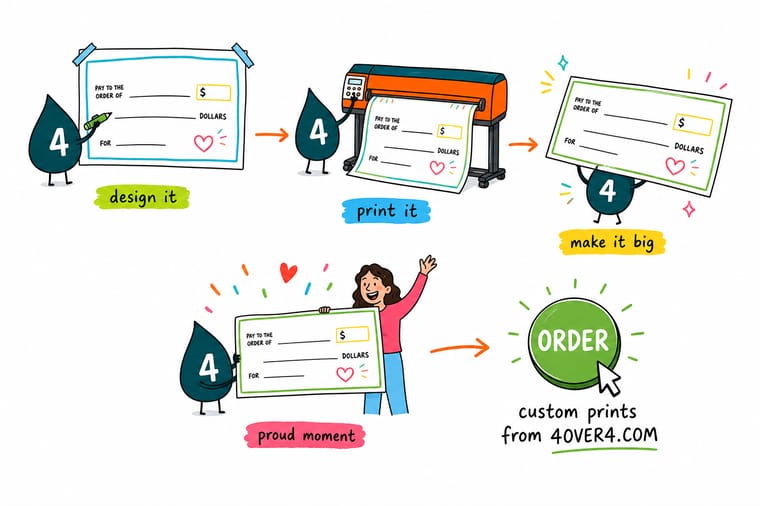
Wally builds the board at 24 by 12 inches, scales the same file up to 36 by 18 when a photographer is coming, and puts the dollar amount above the middle where no hand can cover it. Foam core if the check goes out once, PVC if it comes back every quarter. He leaves the payee and amount blank when they can still change and writes them in with a fat chisel marker on the day. And he never, ever prints the routing number on something that is about to be posted online.
Order a foam core presentation check →Specs and pricing
Board options, sizes, and starting prices
Compare the three substrates a presentation check gets built on, with live size and quantity choices and starting prices straight from the 4OVER4.COM configurator.



Print it
Order the board your check gets printed on

Explore more
Where to go next

By the numbers
The large format side of a shop carrying 1,000+ products
Common Questions
Your oversized check questions, answered
What size is a standard oversized presentation check?
Three sizes cover almost every event. 24 by 12 inches is the everyday choice for a handshake photo and the easiest to transport. 36 by 18 inches is what most press photographers expect, because it still reads clearly when the shot is cropped for print. 48 by 24 inches is a two-person board for a stage or a stadium presentation. All three share the same two to one proportion, so the same artwork scales between them without redrawing anything.
What should an oversized check be printed on, foam board or PVC?
Foam board if the check is used once, PVC if it is used again. A 3/16 inch foam core panel weighs almost nothing and one person can hold a 36 by 18 board at arm length without shaking, which matters during a long photo session. The trade-off is that foam core dents permanently, so a single corner strike on the way to the venue shows in the picture. PVC rigid plastic is heavier and stiffer, shrugs off handling, and wipes clean, which is why organizations that present a check every quarter buy PVC once instead of foam board four times. Foam Core starts at $49.99 and PVC Rigid Plastic starts at $25.00 at 4OVER4.COM.
Can you fill in an oversized check by hand?
Yes, and it is the normal way to handle a check whose amount is not final until the morning of the event. Print the payer lockup and the field rules, leave the payee, amount and date blank, and fill them with a wide chisel tip marker. A fine tip pen vanishes at photo distance. If the same board gets reused for different recipients, order it as Dry Erase Foamcore so the fields wipe off, but be aware the dry erase surface is glossy and will flare if the photographer uses direct flash. Angle the board slightly down and the reflection goes away.
Is an oversized presentation check a real check?
No. A presentation check is a printed prop with no legal standing, and the actual payment moves separately by a regular check, an ACH transfer or a wire. That distinction has a practical consequence: never print a real routing number, account number or check number on the board. The photo is going on a website and a social feed, and those two numbers are all somebody needs to attempt a debit against the account. Print the organization name and logo instead, and leave the bank details off entirely.
How large should the dollar amount be printed?
Sign shops work to roughly one inch of letter height for every ten feet of viewing distance, and a presentation check is photographed from six to fifteen feet. That puts the numerals somewhere between two and three inches tall on a 24 by 12 board, which usually means the amount occupies close to a third of the height of the check. If the number looks oversized on your monitor at 25 percent zoom, it is probably right. Print the written amount line at half that size or less, because nobody reads it in the photo.
How do you transport a 48 by 24 inch check without wrecking it?
Corners are the whole problem. Foam board arrives flat and stays fine until it meets a door frame, so carry it face to face with a second board or a sheet of cardboard taped over the corners, and never lay it flat in a trunk where something can slide onto it. PVC and mounted posters both handle transport better because the edge is solid rather than compressible foam. If the check has to fly or ship to another city, a printed vinyl banner rolls into a tube and can be taped to a rented board when it arrives, which is the only version of this that travels well.
Get Started
Order a foam core check panel, printed in 4 business days
Pick foam core for a single event or PVC for a board that comes back every quarter, send the artwork at full size, and we print a panel that reads from the back of the room.
Legal Disclaimer
Gold Standard guarantees apply to all standard orders placed through 4over4.com. Price match requires verifiable proof of a competitor's published price for an equivalent product with matching specifications and turnaround time. Satisfaction guarantee covers manufacturing defects and print quality issues. Contact support with order number and documentation. On-time delivery rate based on tracked orders 1999 to 2026. Individual results may vary based on shipping carrier performance.
