
How to Display a Poster in an A-Frame Sign That Survives the Sidewalk


The frame takes a rigid panel, not a sheet of poster paper. Here are the real insert sizes for each frame, what to do when the poster already exists on paper, and what a fresh set of panels costs.
An A-frame does not hold a paper poster. It holds a rigid insert, almost always 4mm corrugated plastic, printed to the panel size rather than the frame size. A Signicade frame stands 25 by 45 inches and takes a 24 by 36 inch panel. A metal rod frame is 27.75 by 31.5 inches and takes panels from 24 by 18 inches. If your artwork exists only on paper, mount it to 3/16 inch foam core and keep it indoors, because paper on a sidewalk buckles in the first damp hour.

Quick answer
The panel is the poster, and it is smaller than the frame
Print to the insert dimensions, on a rigid substrate, and the sign works for years. Every A-frame face is a channel or a grommet pair sized for a stiff sheet, so the printed piece has to carry its own structure. Corrugated plastic at 4mm does that and shrugs off rain. Foam core does it indoors only. Loose paper does not do it anywhere. Match the panel size to your frame first, then design inside it.
What an A-Frame Is Actually Built to Hold
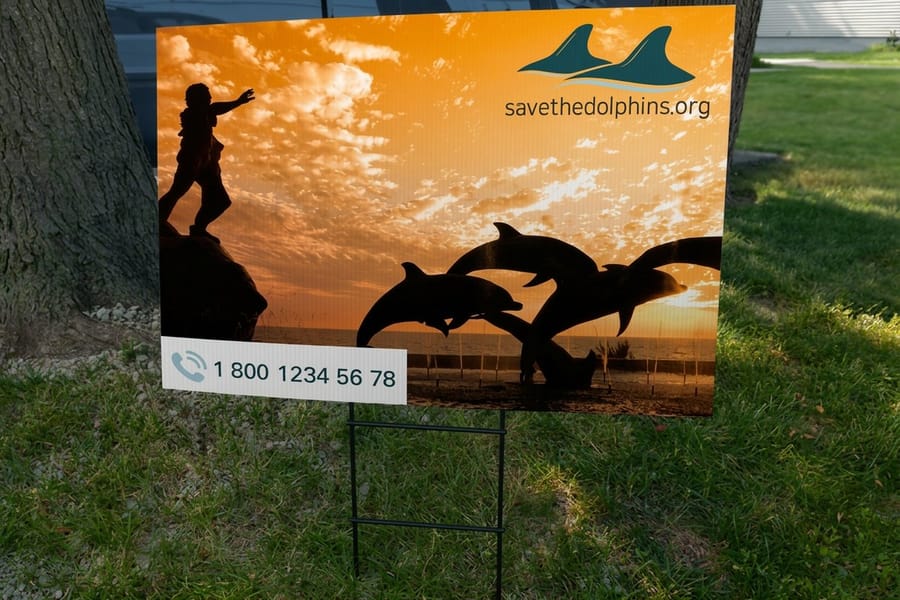
Walk up to any sidewalk sign and put a thumbnail on the face. You will feel a rigid sheet about the thickness of a business card stack, with a faint ribbed texture running one direction. That is 4mm corrugated plastic, and it is the material the whole format is built around.
Corrugated plastic is two thin polypropylene skins with vertical flutes between them, so it holds its own shape across a 36 inch span without a backing board. It also does not absorb water. Those two properties are the reason A-frames use panels rather than paper, and they are also the reason the frame has no glass, no clip, and no backing plate. The insert is structural. Take the panel out and there is nothing left to hold anything flat.
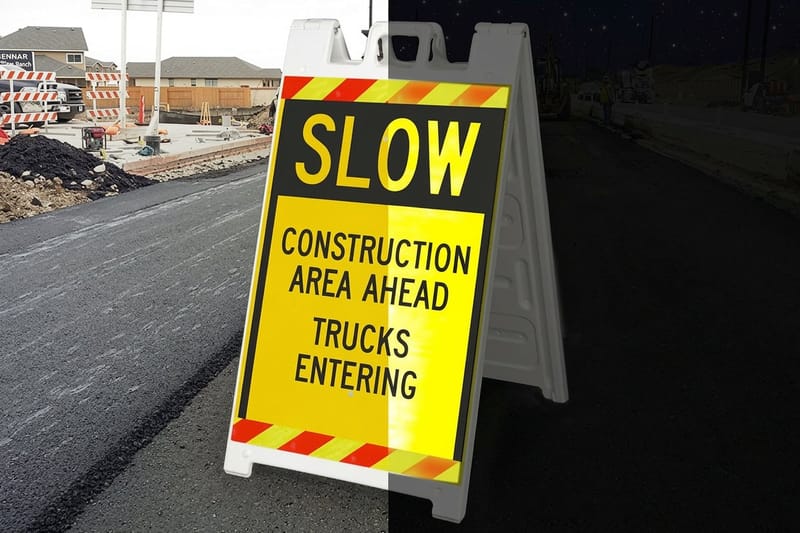
This is where most people go wrong. They design a poster, send it to a poster printer, and then discover the frame has a 3mm channel expecting a rigid sheet. A 100# gloss text sheet in that channel will bow within an afternoon, and outdoors it wicks water up the flutes of the channel and tears. If the finished piece is going outside, the right move is to print the artwork directly onto coroplast signs, which start at $25 for an 11 by 17 inch sign and run up to 30 by 40 inches. Our explainer on coroplast signs covers how the flute direction affects rigidity.
Insert Sizes: Order the Panel, Never the Frame
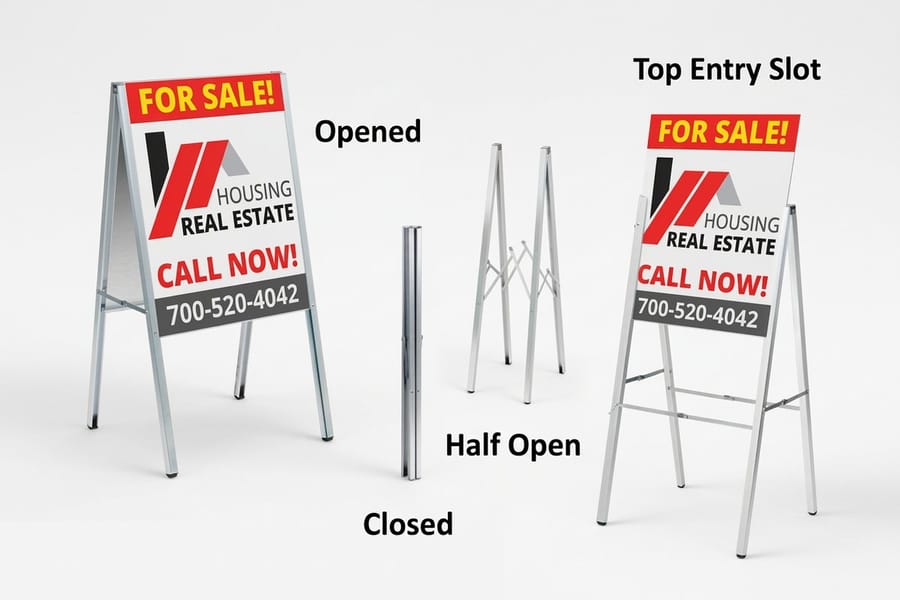
The single most common ordering mistake on a sidewalk sign is printing to the frame dimensions. A Signicade stand is 45 inches tall, but roughly 9 inches of that is base and rail that never shows print. Print a 25 by 45 inch file and you will pay for a panel that does not fit.
| Frame | Frame size | Panel sizes it takes | Best for |
|---|---|---|---|
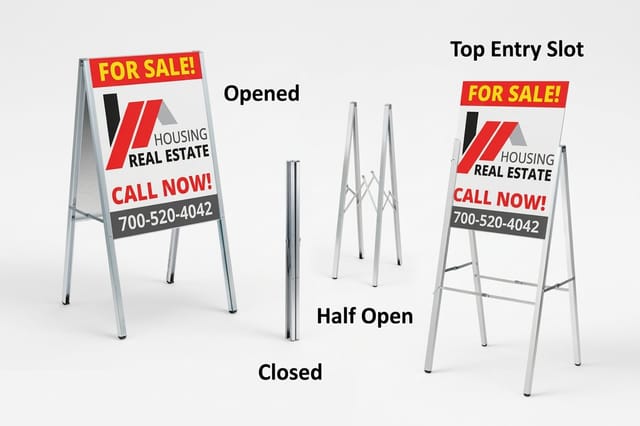
| Signicade | 25" x 45" | 24" x 36" | The default sidewalk sign, white plastic body, ballast base for wind. |
| Signicade Deluxe | 27" x 46.125" | 24" x 36" | Same panel, heavier frame, when the sign lives outside all day every day. |
| Aluminum | 26" x 44.5" | 22" x 28" or 24" x 36" | Satin silver body that reads as fixture rather than promo, folds flat. |
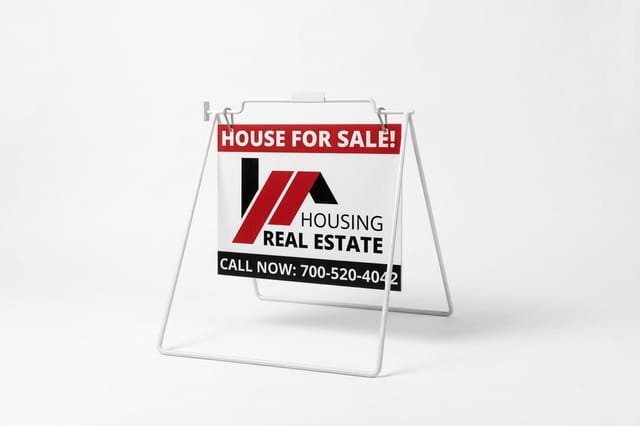
| Metal rod | 27.75" x 31.5" | 24" x 18", 24" x 24", 18" x 24" | Low and wide, for a doorway or a table edge where a 45 inch stand blocks the view. |
Read the third column and ignore the second when you build the file. Note also that the metal rod frame is the only one in the list that goes landscape, which matters if your message is a wide line of text rather than a stacked block. The full A-frame size guide lists every remaining frame in the range, and the Signicade versus aluminum comparison covers which body actually stays put in wind.
Set your artboard to the panel size with a standard bleed and keep live text at least an inch inside the trim, because the top and bottom edges disappear into the channel. Start from a correctly sized layout in the blank template library if you would rather not measure it yourself.
When You Really Do Have a Paper Poster

Sometimes the poster already exists. A tour print, a movie one-sheet, an event design that came from a designer as a finished paper piece. You can put it in an A-frame, with two conditions: mount it, and keep it indoors.
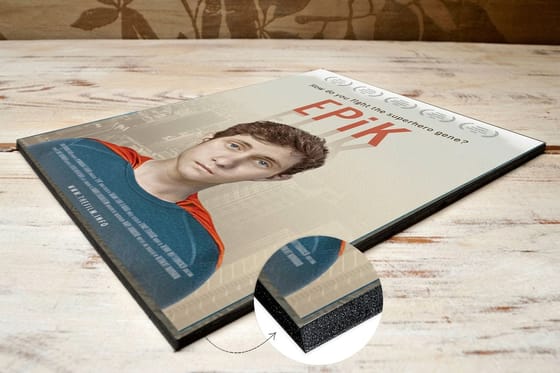
Mounting means bonding the sheet to a rigid board. Mounted posters start at $39.99 for an 8 by 10 and run to a custom 40 by 60, laminated onto 3/16 inch foam core in white or black. That 3/16 inch is close enough to the 4mm channel on most frames to sit securely. Foam core prints start at $49.99 and work the same way when you want the board cut to the artwork rather than a stock size.
The limit is water. Foam core is paper skin over polystyrene, and paper skin plus rain equals a delaminated edge and a warped board, usually within a single wet afternoon. Nothing about a lamination fixes that, because the water gets in through the cut edge, not the face. So a mounted poster in an A-frame is a lobby, showroom, or trade-show tool. The moment it goes on a sidewalk, reprint it on coroplast instead. If the piece is destined for a wall rather than a stand, our guide on hanging a poster without damage covers the frameless options, and poster printing lists the paper and synthetic stocks, including waterproof 8mil and 15pt plastic.
Swapping the Art Without Rebuying the Sign
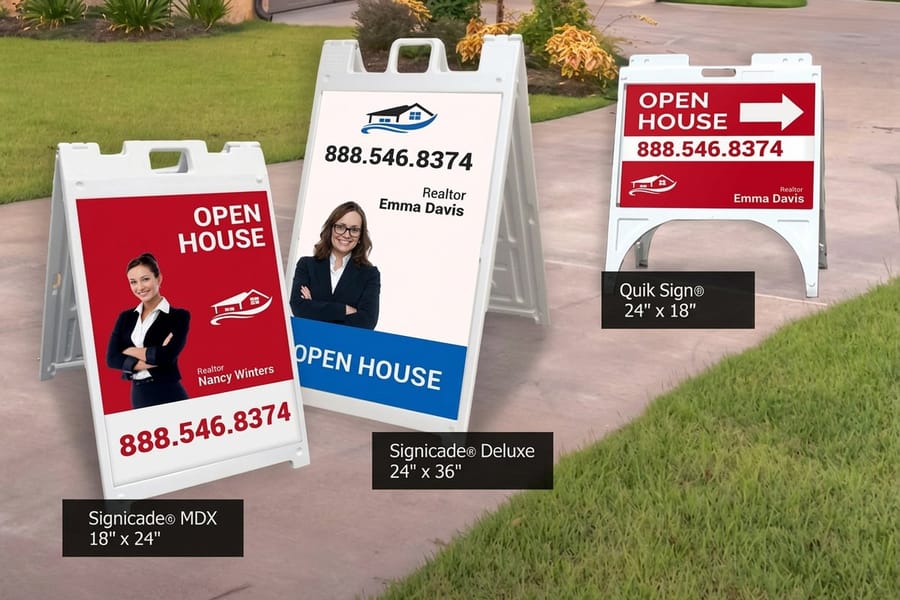
The economics of an A-frame only work if you treat the frame as equipment and the panels as consumables. Buy the stand once, then reprint panels whenever the message changes.
A complete Signicade A-frame kit starts at $182.32 and includes the frame plus two printed 24 by 36 inch panels. Aluminum A-frames start at $146.07 for the frame plus two signs, and metal rod A-frames start at $65.90 with the per-unit price dropping to $53.82 at ten units. After that first order, a replacement pair of coroplast panels is the only cost you carry, and standard turnaround is 4 business days with 3-day, 2-day and Next Day rush available when a sale lands sooner than planned.
Two habits make the swap painless. Keep the panel file as a template with the layout locked and only the offer, price and dates on an editable layer, so a seasonal change is a ten minute edit rather than a redesign. And order panels in pairs even when only one face is visible today, because the second panel costs almost nothing to print alongside the first and saves a full setup later.
Store retired panels flat, not leaning against a wall, since corrugated plastic takes a permanent curve if it sits bowed in the heat. If you rotate three or four seasonal designs, that one storage habit keeps them all usable. Browse the whole range on A-frame signs printing or compare it against the rest of the curb lineup on sidewalk signs.
Wally sets up the sidewalk sign
Slide the panel in, not the paper
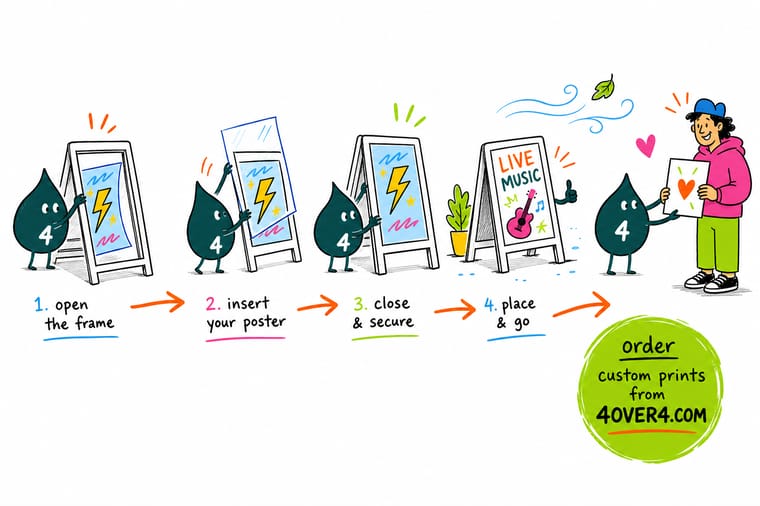
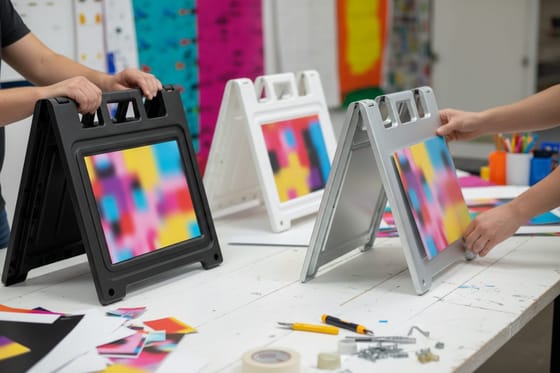
Wally tips the frame back, lifts the old panel out of the top channel, and drops the new one in. No tools, no clips, about twenty seconds a face. The trick is printing to the panel size rather than the frame size, because roughly nine inches of a Signicade is base and rail that never shows art. He prints on 4mm corrugated plastic so rain does nothing to it, keeps the frame for years, and reprints a pair of panels every time the offer changes.
Order a Signicade A-frame kit →Specs and pricing
Frames, panel sizes, and starting prices
Configure a frame with its two printed panels, or price a set of replacement coroplast signs on their own, with live options straight from the 4OVER4.COM configurator.


Print it
Put your message on the curb this week

Explore more
Where to go next

By the numbers
The shop that prints the poster for the frame
Common Questions
Your A-frame poster questions, answered
Can you put a paper poster in an A-frame sign?
Only if you mount it first, and only indoors. An A-frame has no glass and no backing board, so a loose paper sheet has nothing keeping it flat. It ripples within hours, and outdoors it wicks water at the edges and tears at the grip points. Bond the print to a 3/16 inch foam core board and it behaves like a proper insert for indoor use. For a sidewalk, skip the paper stage and print straight onto 4mm corrugated plastic, which is what the frames are designed around.
What size poster fits an A-frame sign?
It depends on the frame, and the panel is always smaller than the stand. A Signicade A-frame measures 25 by 45 inches and takes a 24 by 36 inch panel. The Signicade Deluxe frame measures 27 by 46.125 inches and takes the same 24 by 36 inch signs. An aluminum A-frame is 26 by 44.5 inches and accepts either 22 by 28 or 24 by 36 inch panels. A metal rod frame is 27.75 by 31.5 inches and takes 24 by 18, 24 by 24, or 18 by 24 inch signs.
How do you change the sign in an A-frame?
On a Signicade or aluminum frame the panel slides into a channel on each face, so you tip the frame back, lift the old panel out of the top, and drop the new one in. On a metal rod frame the sign is held by grommets at the top corners, so you unhook it, hook the replacement, and you are done. Neither takes tools. That is the whole point of the format: the stand stays, the message changes.
How much does it cost to refresh the artwork?
A complete Signicade kit starts at $182.32 with the frame and two printed panels included, and the aluminum version starts at $146.07. Once you own the stand, a replacement pair of coroplast panels is the only recurring cost, and coroplast signs start at $25 for an 11 by 17 inch sign with 9 sizes available up to 30 by 40 inches. Keeping one frame and rotating panels is cheaper than buying a new kit for every promotion.
Should the two panels carry the same design?
Usually yes, because most people only see one face. Both directions of foot traffic should get the same offer and the same price. The exception is a location where the two directions genuinely differ, like a corner store where one face reads to people coming from a train station and the other faces a parking lot. In that case a different message on each panel costs nothing extra at print time.
Will an A-frame panel fade outdoors?
Yes, eventually, and full-coverage dark inks show it first. Coroplast panels printed with our outdoor inks hold color through a normal season of sun and rain, but a panel that lives in direct southern exposure all year will drift, especially in reds. Plan on the panel being consumable rather than permanent. If the sign has to stay legible for years rather than months, a rigid substrate under a lamination is the better spend.
Get Started
Order a coroplast insert panel, printed in 3 business days
Pick a frame, upload the panel artwork, and we ship the stand with two full color corrugated plastic signs, one for each direction of foot traffic.
Legal Disclaimer
Gold Standard guarantees apply to all standard orders placed through 4over4.com. Price match requires verifiable proof of a competitor's published price for an equivalent product with matching specifications and turnaround time. Satisfaction guarantee covers manufacturing defects and print quality issues. Contact support with order number and documentation. On-time delivery rate based on tracked orders 1999 to 2026. Individual results may vary based on shipping carrier performance.
