
How to Negotiate a Home Deal Without Overpaying or Losing the House


The seller's situation decides the deal, not your opening number. Find it, decide what to trade, and know when your bargaining power runs out.
Win a home deal by learning why the seller is moving, then making one evidence-backed offer that trades the terms you can afford to lose for the one thing you need. Price is only one of five levers. Closing date, contingencies, repair credits and personal property all carry money, and sellers usually care most about a term rather than the headline figure. Your bargaining power peaks when the inspection report lands and again if the appraisal falls short, and it ends the day your contingencies come off.

Quick answer
The seller's situation sets the price, your evidence sets the tone
Find the reason behind the move, then put a number in front of it with the comparable sales attached. A seller carrying two mortgages will trade price for a fast, certain close. A seller with nowhere to go will trade price for a rent-back. Both of those are cheaper for you than cash. Hold your inspection and financing contingencies until you can genuinely carry the risk, use the report to ask for a credit rather than repairs, and decide your walk-away figure while you still feel nothing about the house.
Find Out Why the Seller Is Moving Before You Name a Number

Every home has two prices. There is the number on the listing, and there is the number the seller will take on the day their circumstances become the loudest thing in the room. The gap between those two is the whole negotiation, and it has nothing to do with how charming your agent is.
So ask. Why are they moving, and by when. Have they already bought something else. Is there a probate, a divorce, a job start date, a bridging loan quietly running. A seller who has closed on a new house is paying for two homes every month and will trade price for certainty. A seller who is curious about what the market might pay has no reason to move on anything, and no tactic will change that.
Then read the listing history, because it talks. Days on market against the local average tells you whether the asking price was ever right. A price cut tells you the seller has already accepted they were high, which means the next move is easier for them than the first one was. Photos swapped mid-listing, a change of brokerage, a listing pulled and relisted to reset the clock: all of it is information, and all of it is free.
Write down what you learn in one paragraph before you talk about money. If you cannot describe the seller's situation in three sentences, you are not negotiating yet, you are bidding.
Put the Evidence in Their Hands, Not in an Email Thread

An offer is a number plus a reason. Send only the number and the seller hears an opinion about their home. Send the number with three closed comparable sales, a repair estimate and a clean summary of your financing, and the same figure reads as arithmetic. That is the cheapest edge available to a buyer, and most buyers skip it.
Paper still does something a PDF does not. It stays on the kitchen table after the agent leaves, it gets shown to the spouse who was not at the meeting, and it cannot be scrolled past. Agents who present offers or listing pitches in person tend to bring a short printed packet for that reason. A four page brochure holds the comps, the photos and the terms in one piece, starting at $57.11 for a run you can leave behind at every appointment. A single sheet works too: flyers start at $39.54 and are the right format for one property and one page of numbers.
If you are the seller, the same logic runs in reverse. A buyer walking through your home with a printed sheet of what you have replaced, when, and by whom, is a buyer who finds less to negotiate with at inspection. Sellers working without an agent get more out of this than anyone, because the packet is doing the job a listing presentation usually does.
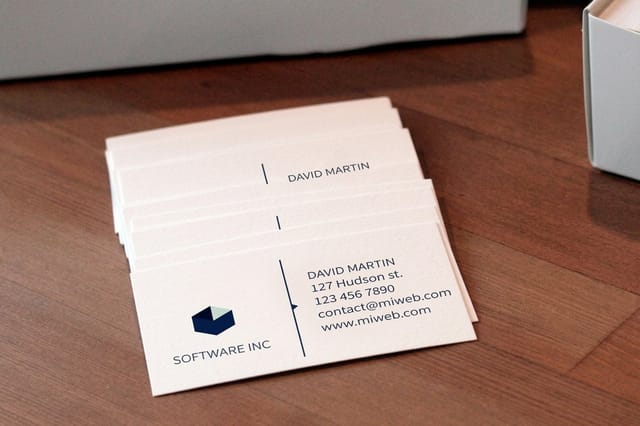
Two other pieces earn their place around a deal. Standard postcards from $16.48 are how investors and agents reach owners who have not listed yet, which is where the least contested deals live, and the mechanics of that are covered in our real estate postcard mailing guide. Standard business cards from $17.57 are the one thing that survives the walk back to the car. Browse the whole set in marketing materials, or start from the checklist in our real estate print marketing kit guide.
The Five Levers, and What Each One Really Costs You

Buyers fixate on price because it is the only lever they can see. Sellers care about the whole package, and often about one thing in it more than the money. Trading the levers you do not need for the one you do is how a deal closes without either side feeling beaten.
| Lever | What the buyer gives up | What the seller feels | Use it when |
|---|---|---|---|
| Price | Cash, permanently. | The headline number their neighbors will hear. | The comps genuinely do not support the ask, and you can show it. |
| Closing date | Flexibility, and sometimes rent for a few weeks. | Whether their next move works at all. | They have bought elsewhere, or they have not found anywhere yet. |
| Contingencies | Protection. This is the expensive one. | Certainty that the deal will not unravel. | Your financing is underwritten and you can carry the risk. Never before. |
| Repair credit | Nothing, if the report supports it. | A cut to their net, arriving late. | The inspection found something structural, mechanical or wet. |
| Personal property | Nothing. | Either relief or irritation, depending on the item. | You want the appliances, the ride-on mower, the drapes. Ask early. |
Read the second column before the third. Waiving an inspection contingency is not a concession, it is buying a house you have not examined, and the cost of being wrong is a five figure repair you agreed to in advance. Shortening the inspection window to a week is a real concession that costs you almost nothing if you have a licensed inspector on standby.
Sequence matters too. Ask for the appliances in the first offer, when it is a detail. Ask in the final round and it reads as one more thing, at the point where everybody is tired and the goodwill has run out.
Counters, Inspection Findings, and the Number You Walk Away At

Counter offers are not a haggle, they are a signal about how you work. Answer within the day, change one or two terms rather than five, and attach a short reason for each change. A counter that moves everything at once tells the other side you were never serious about the first version, and it invites the same treatment back.
The inspection is where most deals genuinely move, and where most buyers overplay. Split the report into three piles: structural, mechanical and water, then safety, then cosmetic. Negotiate the first pile, mention the second, and ignore the third entirely. Ask for a credit at closing rather than repairs. You get to choose the contractor, and you avoid discovering that the roof was patched by whoever the seller could book on a Thursday.
Then there is the moment nobody plans for: the point where you stop. Set the walk-away number before you have imagined furniture in the living room, and set it as a number, not a feeling. Include the repairs you already know about and the reserve you will need in the first year. When the negotiation goes past it, leave. The next house is not as good, and it will not cost you sleep for a decade either.
Sellers, run the same exercise from the other end. Know the lowest net you will accept after commission, credits and carrying cost, and know it before the first offer lands. If you are selling without an agent, the presentation work matters more, not less, and our guides to property marketing in print and for sale signs cover the pieces that get a house seen before any of this starts.
Wally explains the offer packet
The number lands better when the reasoning arrives with it
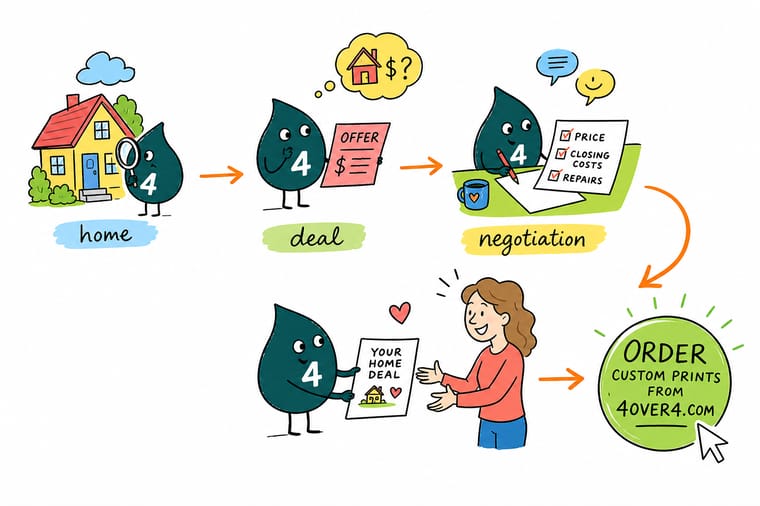
Wally never sends a bare figure. He brings three closed sales down the same street, a repair quote with a contractor's name on it, and a line saying his financing is already underwritten, all printed on one thing he can leave on the table. The seller reads it twice after he goes home. Same offer, same buyer, completely different reception.
Print brochures for your offer packet →Specs and pricing
Sizes, stocks and starting prices for the deal pieces
The three formats that do the work around a property negotiation, with live configuration options and starting prices from the 4OVER4.COM configurator.



Print it
Show up with something they can hold


Explore more
Where to go next





By the numbers
Printing you can plan a deal around
Common Questions
Your home negotiation questions, answered
How much below asking price should I offer on a house?
There is no universal figure, and anyone who gives you one is guessing about a market they cannot see. The answer comes from three things: what similar homes actually closed for in the last few months, how long this one has been listed, and how many other buyers are circling. A house that has sat for two months past the local average is telling you the asking price was wrong, and an offer under it is a correction rather than a lowball. A house in its first weekend with three showings booked is a different conversation, and there your room to move is in terms, not price.
Should I write a personal letter to the seller?
Be careful with this one. Buyer letters describing your family, your faith or your plans for the nursery can reveal characteristics protected under fair housing law, and many brokerages now refuse to pass them on for exactly that reason. If you want to add something human, keep it to the deal: why the timeline suits the seller, that your financing is already underwritten, that you will not ask for cosmetic repairs. That reads as reliability, which is what a seller is actually buying.
What happens if the appraisal comes in below the contract price?
The lender will only lend against the appraised value, so the gap becomes cash the buyer has to find, and that reopens the negotiation. Three outcomes are normal: the seller drops to the appraised figure, the buyer covers the difference in cash, or the two split it. Which one happens depends on whether the seller believes another buyer would sail through the same appraisal. If the comparable sales that drove the appraisal are public, put them in front of the seller rather than describing them.
Can I still negotiate after the home inspection?
Yes, and it is usually the strongest moment you get, because the report is evidence rather than opinion. Ask for a credit at closing instead of repairs wherever you can. A credit is a number you control, while a repair is work a seller will hire out to the cheapest bidder in the week before they move. Keep the list short and structural. A buyer who returns with twenty items including a loose cabinet handle teaches the seller that nothing on the list is serious.
Will I lose the house if I counter instead of accepting?
Rarely, and almost never in a single-offer situation. A seller who has spent weeks getting to an accepted offer is not going to blow it up over one round of back and forth. The real risk is different: a slow counter. In a competitive market, response time is a term of its own, and a same-day counter with a firm expiry signals you are organized in a way a nudge on price never does.
What is a rent-back and when is it worth offering?
A rent-back lets the seller stay in the house for an agreed period after closing, usually paying you something close to your daily carrying cost. It is worth offering when the seller has not found their next home yet, which is one of the most common reasons a good deal stalls. It costs you delay rather than money, so it is often the cheapest concession on the table and it buys real goodwill on price.
Get Started
Bring the numbers on paper
Print the comps, the terms and the repair estimate in one packet you can leave behind, and let the offer keep arguing for you after you have gone.
Legal Disclaimer
Gold Standard guarantees apply to all standard orders placed through 4over4.com. Price match requires verifiable proof of a competitor's published price for an equivalent product with matching specifications and turnaround time. Satisfaction guarantee covers manufacturing defects and print quality issues. Contact support with order number and documentation. On-time delivery rate based on tracked orders 1999 to 2026. Individual results may vary based on shipping carrier performance.
