
How Behavioral Marketing Turns Customer Actions Into Better Offers


Which behaviors are worth a trigger, how long each one stays true, and which channel can still answer it in time. Built to run by hand for a month before you automate anything.
Behavioral marketing decides what to send based on what a person did, not which demographic bucket they sit in. An event such as a quote request, a first order, an approaching renewal or a lapse becomes a trigger, and the trigger picks both the message and the channel. The rule that governs everything is expiry: a signal loses value by the hour, so fast signals go to email and slow signals, the ones still true in week two, are the only ones a mailed piece can answer.

Quick answer
The trigger picks the message, the expiry picks the channel
Behavioral marketing is timing before it is targeting. You watch for events that a person chose to make, you write down how long each event stays true, and only then do you pick a channel that can arrive inside that window. Cart abandonment expires in hours and belongs to email. Renewals, first orders and lapses stay true for weeks, which is what makes them the right work for a printed piece. Everything else is bookkeeping.
Which Behaviors Are Actually Signals

Most teams start by tracking everything and then discover that almost none of it predicts a purchase. An email open means a preview pane loaded. Time on page means someone walked away with a tab open. These are events, not intent.
A signal is worth a trigger when it is unambiguous, when the person chose to do it, and when you know roughly how long it stays true. Test any candidate against those three. A quote request passes all three. A homepage visit fails the second one and usually the third.
| Signal | What it tells you | Stays true for | Channel that fits |
|---|---|---|---|
| Cart abandoned | Priced it, hesitated, still deciding right now. | Hours, sometimes a day. | Email or an ad. Mail arrives after the decision. |
| Quote or sample requested | Live project with a budget attached. | Two to four weeks. | Email first, then a mailed piece as the follow up. |
| First order placed | New relationship worth reinforcing. | The whole first month. | Anything, including a thank you card in the box. |
| Renewal or reorder due | A date you already know in advance. | Predictable, weeks ahead. | Mail, because you can schedule backwards from the date. |
| Lapsed past normal interval | Habit broken, still reachable. | Months. | Mail, where the inbox has already stopped working. |
Read the third column before the fourth. It is the one that decides whether print can play at all, and it is the column that gets skipped in most planning documents. A trigger that expires in six hours belongs to email and nothing else.
Timing Is the Whole Strategy
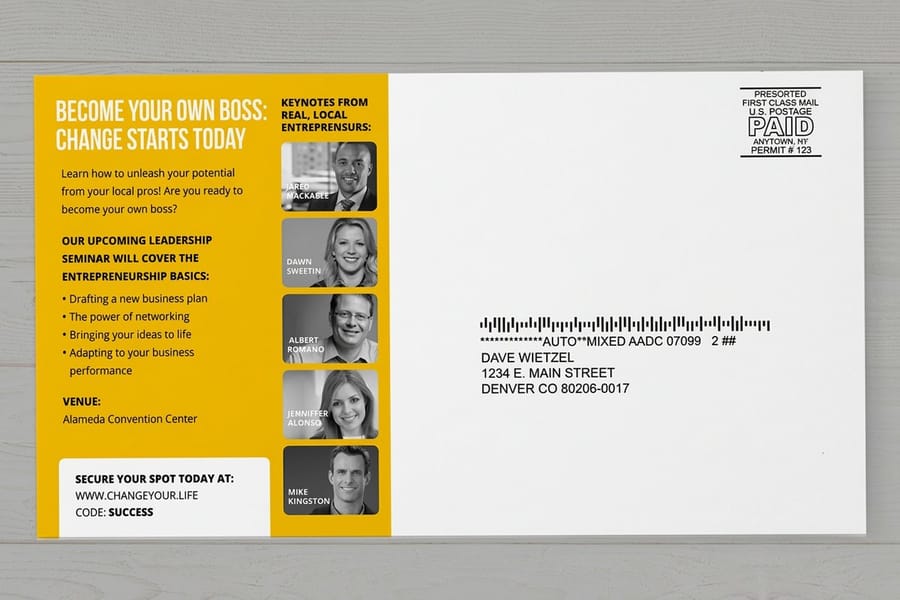
A behavioral signal decays. The longer you wait, the less it tells you, and every channel has a floor on how fast it can respond. Email clears in minutes. A retargeting ad clears within the hour. A printed piece needs a production run and then transit before it reaches a mailbox.
That floor is not a flaw to engineer around. It is the constraint that tells you which triggers to give to print in the first place. Aim a mailed piece at a renewal date, a lapse, or a post purchase moment, and the delay is irrelevant because the signal is still true when the piece lands. Aim it at a same day browse and you have mailed a reminder about a decision that was already made.
Two habits keep this honest. Write the expiry next to every trigger when you design it, in hours or weeks, before you pick a channel. And schedule mail backwards from the date it needs to arrive, not forwards from the day you approve the artwork. Our guide on sending direct mail postcards walks through the handoff, and direct mail cost per piece covers what each drop costs once postage is in the number.
The one exception worth building is the fast follow up on a slow signal. Somebody requests a sample, gets an email the same hour, and a mailed postcard a week later while the project is still open. Two touches, two channels, one signal, and neither of them wasted.
Four Segments Beat Forty Rules

Rule sprawl is how behavioral programs die. A team builds nine triggers, then twelve, then adds exclusions so people do not get three messages in a week, and within a quarter nobody can say which rule sent which piece. Start smaller than feels satisfying.
Four segments carry most of the value in a small list:
- New. First order in the last thirty days. The job here is a second order, not a discount.
- Active. Buying at or above their normal interval. Leave them alone except for genuine news and reorder reminders.
- Slipping. Past their usual gap between orders but not gone. This is the segment where a mailed piece earns the most, because the inbox has already been tuned out.
- Lapsed. No order in three intervals. Worth one strong offer, then a rest.
Notice that every one of those is derived from two fields you already have: last order date and order count. That is the whole reason to start here. Recency and frequency are computable from any order export, and they explain more about the next purchase than anything you could ask in a survey.
Add a fifth segment only when you can name the message it gets and the message it would otherwise have received. If those two are the same, the split is decoration. When you do start varying the printed piece per segment, variable data printing is how one run carries a different offer per record, and the customer experience guide covers how the touches should feel connected rather than automated.
What to Send, and Where a Printed Piece Earns Its Slot

The message should name the behavior. Not literally, and not in a way that feels surveilled, but the offer has to make sense given what the person just did. A lapsed customer does not need a product tour. A new customer does not need a win back discount, and sending one teaches them to wait for the next.
Digital carries the fast triggers. Print carries the slow ones, and it does something the inbox cannot: it stays on a desk. Three placements pay for themselves consistently:
- Post purchase, in the box. A printed greeting card from $56.02, or a die cut sticker from $93.37 as a small extra, turns a shipment into a second impression. It costs cents per order and it arrives when goodwill is highest.
- Renewal or reorder, timed to the date. Direct Mail Postcards from $89.68 include the mailing, so a segment export becomes a drop without a trip to the post office.
- Lapsed win back, one strong offer. Plain standard postcards from $16.48 if you are mailing them yourself, which keeps the test cheap enough to run twice before you commit.
Keep the printed piece to one idea and one action. A postcard is read while somebody walks from the mailbox to the kitchen, which is roughly four seconds, so a headline, a reason, and a single next step is the whole budget. The direct mail design guide has the layout rules, and the postcard printing range shows the sizes and stocks that survive a mailstream.
Measuring It Without Fooling Yourself

Behavioral triggers fire on people who were already engaged, so the reported numbers flatter the program. A win back postcard sent to customers who bought twice last year will show a strong response, and most of that response would have arrived anyway.
The fix is a holdout. Hold back a random ten to twenty percent of each segment, send them nothing, and compare revenue per person over a fixed window. Random matters. Holding back the cheapest addresses or the oldest records is not a control group, it is a second segment.
Judge on revenue per person, not response rate. A trigger with a low response rate on a large segment often beats a high response rate on a tiny one, and response rate alone hides the cost of the drop. Set the measurement window before the drop, longer for mail than for email, because a postcard sits on a counter for a week before anyone acts on it.
Then cut. Retire any trigger that does not beat its holdout after two runs, rather than tuning the creative on a rule that was never going to work. For the wider measurement frame, the marketing analytics guide covers attribution across channels and direct mail against digital compares what each one actually returns.
The Thirty Day Build Checklist

Run the first version by hand. A month of manual sends tells you which triggers deserve automation, and it costs nothing to abandon a rule that never worked.
- Week one, export. Pull a list with email, last order date, and order count. Nothing else is required to start.
- Week one, sort. Split it into new, active, slipping and lapsed using your own average gap between orders as the boundary.
- Week two, write. One message per segment. Name the behavior in the offer, not in the copy.
- Week two, hold back. Mark a random fifteen percent of each segment as the control before anything is sent.
- Week three, send the fast half. Email the new and active segments. Record the date, the segment size, and the offer.
- Week three, print the slow half. Order the mailed piece for slipping and lapsed, scheduled backwards from the arrival date you want.
- Week four, compare. Revenue per person, treated against holdout, per segment. Keep what beat the control and rewrite what did not.
- Then automate. Only the triggers that survived. Everything else stays manual until it earns its place.
The point of doing it slowly is that a behavioral program is mostly judgement about which signals matter, and judgement does not come out of a tool. Once the rules are proven, the campaign build guide covers turning them into a repeatable calendar.
Wally explains behavioral marketing
Watch what they did, then check the clock
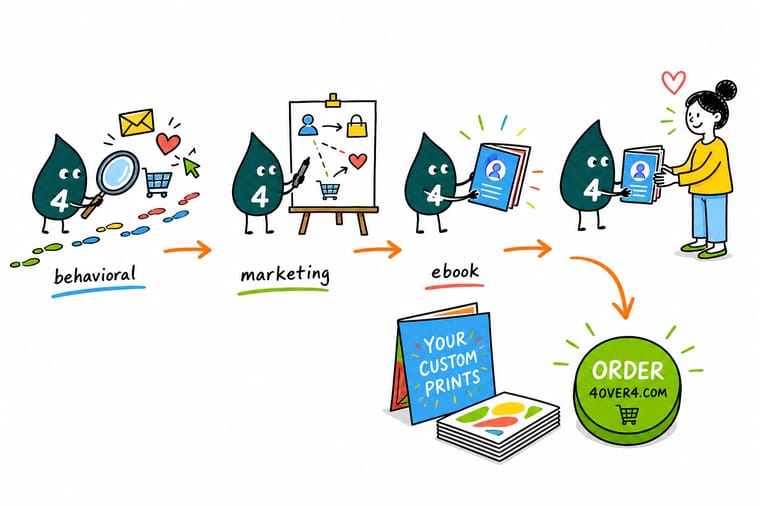
Wally does not ask who you are. He watches what you did, writes the time next to it, and asks one question: is this still true tomorrow? Left the cart at noon, that is an email, right now. Renewal in three weeks, first order last Tuesday, gone quiet since spring, those keep. Those go on a postcard, because a postcard takes a few days to arrive and it is still the right message when it lands.
Order direct mail postcards →Specs and pricing
The printed pieces a trigger can fire
Sizes, stocks and starting prices straight from the 4OVER4.COM configurator, for the three formats that carry most triggered print.



Print it
Turn a segment into something that lands on a desk



Explore more
Where to go next




By the numbers
The print side of your program, handled
Common Questions
Your behavioral marketing questions, answered
What is behavioral marketing?
Behavioral marketing is deciding what to send, and when, based on what a person actually did rather than what category they fall into. The inputs are events: pages viewed, an item added to a cart, a quote requested, a first order placed, a subscription due to renew, a customer who has not bought in ninety days. Each event becomes a trigger, the trigger picks a message, and the message goes out on whichever channel can still arrive while the event means something. The alternative, demographic marketing, sorts people by who they are and sends everyone in a bucket the same thing on the same calendar.
How is behavioral marketing different from personalization?
Personalization changes the contents of a message. Behavioral marketing changes whether the message is sent at all, and when. Dropping a first name into a subject line is personalization on a batch campaign that would have gone out anyway. Holding that campaign back from everyone except the people who looked at the product twice last week is behavioral. The two work together, but the timing decision is worth far more than the merge field, and it is the one most small teams skip.
Which behaviors are actually worth building a trigger on?
Start with the ones that are unambiguous and repeatable: a first purchase, a second purchase, a quote or sample requested, a renewal or reorder date approaching, and a lapse past your normal buying interval. Those five cover most of the revenue in a small business list. Vaguer signals such as a single page view, an email open, or time on site produce a lot of triggers and very little intent, which fills your calendar with sends that nobody asked for.
Can direct mail be part of a behavioral program?
Yes, on the signals that stay true for a couple of weeks. Mail needs print production time plus transit before it lands, so it cannot answer a cart abandoned this morning. It answers a renewal that is thirty days out, a customer who lapsed last quarter, or a first order that just shipped. Direct Mail Postcards start at $89.68 at 4OVER4.COM with mailing handled for you, which is the practical way to fire a physical piece off a list segment without touching a post office.
How much data do I need before this is worth doing?
Less than most people assume, because the first version does not need a data warehouse. If you can export a list with an email address, a last order date, and an order count, you can build the four core segments in a spreadsheet and run the program by hand for a month. That manual month teaches you which triggers produce replies, and it stops you from automating a bad rule at scale. Automate only the triggers that already worked when you sent them yourself.
How do I know whether the triggers caused the sales?
Hold back a random ten to twenty percent of each segment and send them nothing. If the holdout buys at nearly the same rate, the trigger is taking credit for something that was going to happen anyway, which is the most common failure in behavioral programs. Compare the treated group with the holdout on revenue per person over a fixed window, not on open rate or response rate, because a trigger that fires on your best customers will always look excellent by those measures.
Get Started
A triggered postcard costs 18 cents at 500 pieces
Export the segment, pick a size, upload the artwork, and we print and mail it for you. Slipping and lapsed customers are the two segments where a postcard still outperforms another email.
Legal Disclaimer
Gold Standard guarantees apply to all standard orders placed through 4over4.com. Price match requires verifiable proof of a competitor's published price for an equivalent product with matching specifications and turnaround time. Satisfaction guarantee covers manufacturing defects and print quality issues. Contact support with order number and documentation. On-time delivery rate based on tracked orders 1999 to 2026. Individual results may vary based on shipping carrier performance.
