
13oz vs 18oz vs Mesh Banner Vinyl and Which Weight Holds Up Outside


Three banner materials, one decision. The ounce number measures less than people think, weight does not beat wind, and one grade belongs on your wall, pole or fence.
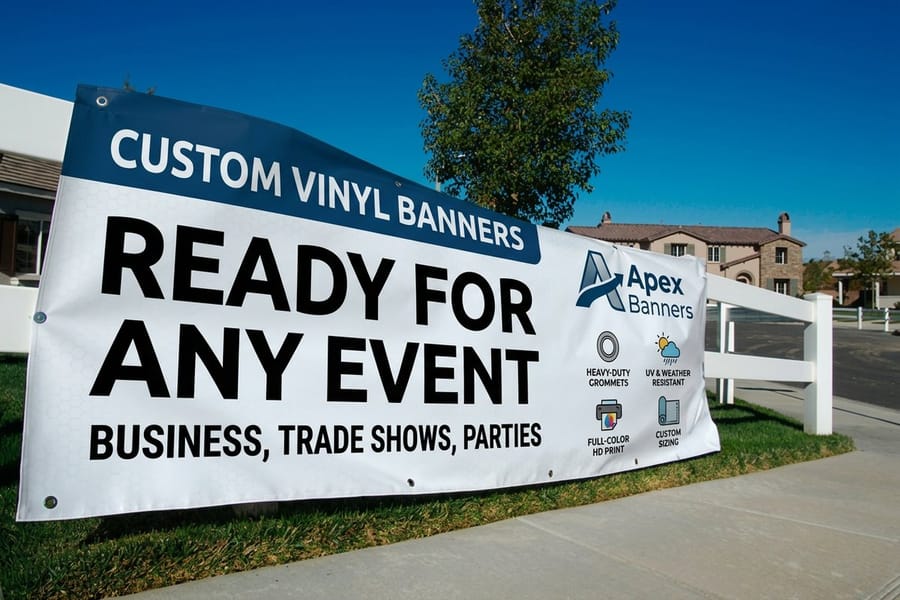
Order 13oz vinyl for a banner that hangs flat on a wall or indoors, 18oz blackout when it is double sided and mounted on a pole bracket, and 8oz mesh whenever the site is a fence or an open building face. The ounce figure is weight per square yard, and going heavier buys tear strength and opacity, not wind resistance. Only the holes in perforated mesh actually reduce the load a gust puts on the fixings.
Quick answer
Weight buys tear strength, holes buy wind resistance
Thirteen ounce vinyl is the default for anything hanging against a wall. Step to 15oz or 18oz blockout when both faces have to print without ghosting through each other, which is why pole banners and double sided hangs use it. Move to 8oz perforated mesh when the banner sits on a fence, a scaffold or an open building face, because that is the only one of the three where a gust passes through the material instead of loading it. Same size, same wind, same force: the heavier sheet just takes longer to fail.
What the Ounce Number on Banner Vinyl Actually Measures
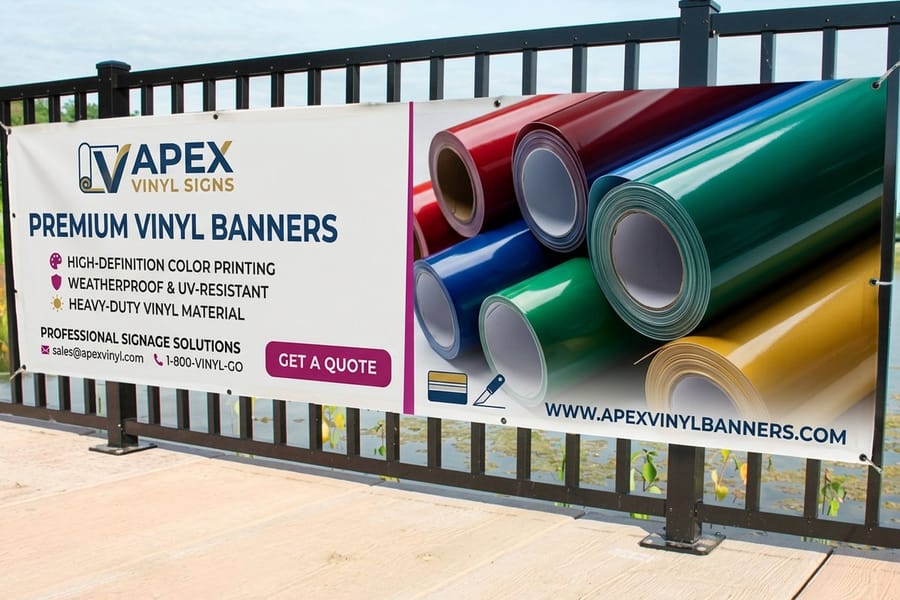
Banner vinyl is graded by how much a square yard of it weighs. Thirteen ounces per square yard is the everyday outdoor grade, eighteen is the heavy grade, and the number climbs because two things inside the sheet get bigger at once.
Every solid banner is a sandwich. In the middle sits a woven polyester grid called scrim, and on either side of it sits PVC. The scrim does the structural work, holding the sheet together when a corner takes load. The PVC does the visible work, accepting ink and shrugging off rain and UV. Going from 13oz to 18oz means a denser scrim weave and thicker PVC skins, which is why the heavy grade resists a tear that has already started and holds a grommet that has begun to work loose. Our scrim vinyl guide takes that construction apart layer by layer.
Mesh breaks the pattern. It is lighter, at 8oz per square yard, not because the material is flimsy but because a large part of the face is missing on purpose. The sheet is perforated with tiny holes across its whole area, so there is simply less material to weigh. Comparing 8oz mesh against 13oz solid as if they sit on one scale is the mistake behind most bad banner orders.
One number is worth knowing before you shop. Vinyl banners start at $79 for a 2 by 4 foot banner and run to a 240 by 180 inch custom span, and the 13oz and 15oz BlackOut materials are a choice inside the same configurator rather than two separate products.
Wind Is the Question That Decides Everything Outdoors
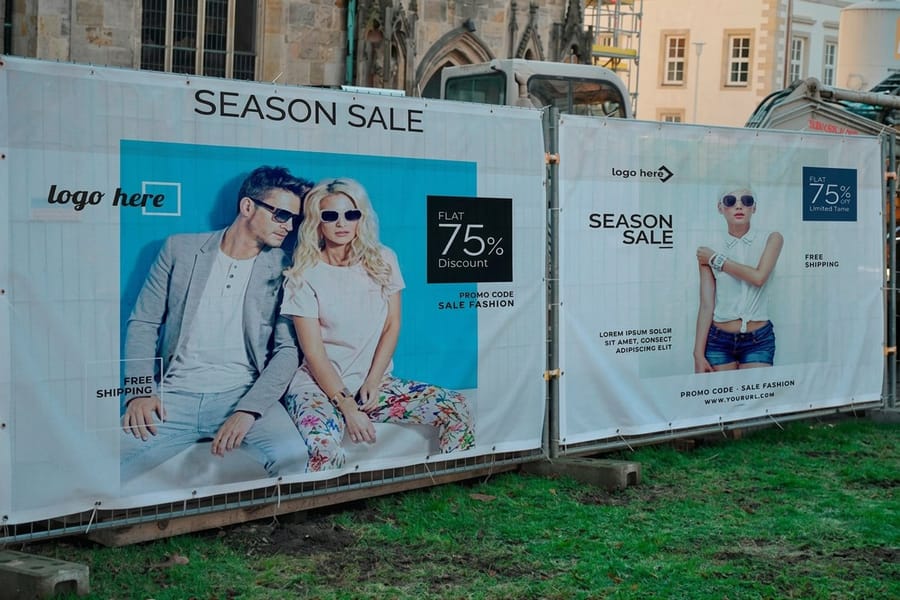
Here is the part most banner pages skip. Wind load is a function of the area of the face and the speed of the air hitting it. Mass barely enters into it. A 4 by 8 foot banner in 18oz pushes on its fixings with the same force as the same banner in 13oz, because the wind does not know or care what the sheet weighs.
So heavier vinyl does not solve a windy site. It changes what happens after the load arrives. The 13oz banner is more likely to split from a grommet or lose a hem, while the 18oz one takes that punishment longer. If the site is genuinely exposed, the honest fixes are a smaller banner, more attachment points, or a face that lets the air through.
| Material | Weight | Wind behavior | Opaque? | Where it belongs |
|---|---|---|---|---|
| Mesh | 8oz perforated | Air passes through the holes, so load stays low. | No | Fences, scaffolding, building faces, stadium rails. |
| Standard vinyl | 13oz scrim | Solid face, full sail load, bows in a gust. | Mostly, single sided | Walls, storefronts, indoor events, sponsor runs. |
| BlackOut vinyl | 15oz blockout | Same sail load as 13oz, more tear strength. | Yes, light-blocking core | Double sided hangs over sidewalks and aisles. |
| Blackout pole vinyl | 18oz blackout | Same sail load, best tear strength, wind slits available. | Yes, light-blocking core | Street light poles and bracket-mounted runs. |
Read the third and fifth columns together and the choice usually makes itself. A chain link fence has nowhere for air to go, so mesh banners from $75 are the only sane answer there. A flat brick wall shelters the back of the banner, so 13oz is fine. Whatever you pick, hang it tight and hang it often: grommets every 2 feet beats grommets at the corners on any face bigger than about 3 by 6 feet, and our grommet placement guide covers the spacing in detail.
Opacity, Double Sided Printing and Why 15oz and 18oz Exist

The second reason to step up from 13oz has nothing to do with strength. It is light. Standard outdoor vinyl passes enough light that anything printed on the back reads as a ghost through the front, and a dark block behind pale type will wreck it.
Blockout material solves that with an opaque core buried between the two printed skins. Light stops at the core, so each face prints and reads independently. That is the whole reason our pole banners run on 18oz blackout: a banner held off a street light pole by a bracket gets read from both directions of traffic, and it hangs in open air where nothing shelters it. They start at $97.76 for an 18 by 24 inch banner, come in 13 portrait sizes up to 30 by 72 inches, and offer up to 11 wind-slit settings for exposed streets.
When the double sided piece is a rectangle over a sidewalk or down an exhibition aisle instead of a pole banner, the middle grade does the job. 2 Sided Blockout Banners run on 15oz BlackOut vinyl from $108.75, in sizes from 2 by 3 feet up to 4 by 10 feet. And if you only ever needed one face, do not pay for the core: order the 13oz material and put the money into a bigger banner or hems on all four sides instead.
One warning worth repeating. Blockout is not the same as blackout paint on the back of a cheap banner, and it is not the same as printing white behind your artwork. Neither trick stops show-through. The core has to be in the material, which is why it is a material choice at the configurator and not a finishing option. If you want the full spec ladder side by side, the vinyl banners printing category lists each grade with its live pricing.
What Mesh Costs You in Image Quality
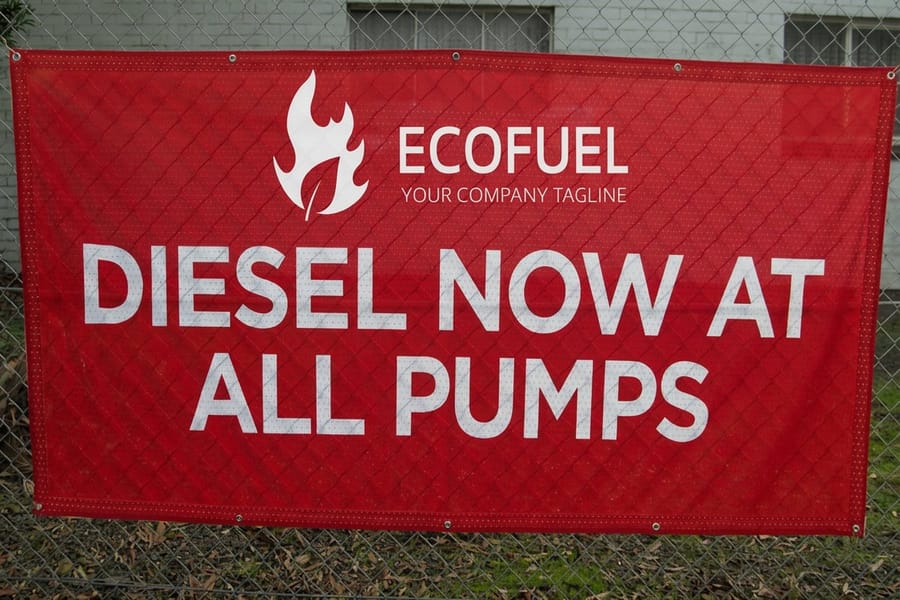
Mesh earns its place on windy sites, and it charges for it in detail. Part of every printed letter is a hole, so ink coverage across the face is genuinely lower than on solid vinyl, and the eye fills in the rest from a distance.
Three habits keep that from biting. Set type larger than you would on solid vinyl and keep the strokes heavy, because thin serifs and hairline rules break up first. Avoid small reversed type, where a pale letter sits inside a dark block and the holes eat the counters. Favour flat color and simple logo shapes over photographic backgrounds, since a photograph is exactly the kind of fine tonal work perforation flattens.
Background matters too, and this one surprises people. A mesh banner hung against bright sky lets daylight through from behind, which lifts the shadows and makes the image look washed out, while the same banner against a dark building face reads noticeably denser. If your mesh banner will be silhouetted against sky, push the contrast in the artwork before it goes to print rather than after it is hanging.
Check the design at the distance people will really stand. A banner read from across four lanes of traffic needs a different type size to one read from a fence line six feet away, and our banner size guide works through that maths. The mesh material explainer covers the perforation itself if you want the substrate detail.
Pick by the Site, Then by the Budget

Work through it in this order and you will not order the wrong banner twice.
- Is it going on a fence, a scaffold or an open building face? Mesh, every time. Solid vinyl on a fence is a sail with nothing behind it.
- Does it need to read from both sides? Blockout. 18oz blackout for a pole bracket, 15oz for a rectangle hung in the open.
- Is it flat against a wall, or indoors? 13oz. The wall shelters the back and you save the money for size or finishing.
- Is it going up and down repeatedly? Consider a stand instead of a hang. Retractable banner stands from $139 keep the graphic rolled and protected between uses.
- Is it indoors and photographed a lot? Fabric banners from $57.20 kill the glare that solid vinyl throws under event lighting.
On price, the grades sit closer together than most buyers expect. Mesh starts at $75 and vinyl at $79, which means the wind decision costs you almost nothing, and the real jumps come from size and from double sided printing rather than from the material grade. Compare the full range on the banners printing collection, and if the banner is already ordered, the hanging guide covers the ties, bungees and tension that decide how long it survives.
Wally explains banner weight
The wind does not care what your banner weighs

Wally hangs two banners the same size in the same gust. The solid 13oz one bellies out like a sail and pulls on every grommet. The 8oz mesh one barely moves, because the air goes through the holes instead of pushing on the face. Swapping the solid banner for a heavier 18oz sheet would not change the push at all. It would only take longer to tear. So Wally picks mesh for the fence, 13oz for the wall, and 18oz blackout when both sides have to print without showing through.
Shop mesh banners →Specs and pricing
The three banner grades, side by side
Sizes, materials, finishing and starting prices straight from the 4OVER4.COM configurator, so you can compare the vinyl weights against the mesh before you commit.


Print it
Order the banner your site can actually hold

Explore more
Where to go next


By the numbers
Behind the banner order, years, products, customers
Common Questions
Your banner material questions, answered
Is 18oz banner vinyl stronger than 13oz?
Yes, and the difference is in the scrim. Banner vinyl is a woven polyester grid sandwiched between PVC layers, and the heavier grade uses a denser grid plus thicker PVC. That means more resistance to tearing once a grommet starts to pull, and more resistance to a hem letting go. It does not mean the banner catches less wind, and it does not by itself mean the print lasts longer in sun.
Does a heavier banner handle wind better?
Not in the way most people assume. Wind load depends on the area of the face and the speed of the air, so a 4 by 8 foot banner in 18oz and the same banner in 13oz push on their fixings with the same force. The heavy material simply survives that force longer before the vinyl splits at a corner. If wind is the real problem, the fixes that work are perforated mesh, a smaller banner, or more attachment points, not a heavier sheet.
Do wind slits actually help?
They relieve some pressure, and they cost you print. A slit is a cut through the printed face, so it releases part of the load but also puts a stress point in the middle of the artwork and interrupts the image. Pole banners at 4OVER4.COM offer up to 11 wind-slit settings because a bracket-mounted banner hangs alone in open air with nothing to shelter it. On a wall-mounted banner, tightening the hang and adding grommets usually does more good than cutting the face.
Can you print both sides of a 13oz banner?
You can, but you will see the back through the front. Standard 13oz outdoor vinyl passes light, so a solid block on side two shows as a shadow behind side one, and any reversed type turns muddy. Double sided work belongs on blockout material: our 2 Sided Blockout Banners run on 15oz BlackOut vinyl from $108.75, and pole banners run double sided on 18oz blackout from $97.76 for an 18 by 24 inch banner.
What size mesh banner should I order for a chain link fence?
Measure the panel between posts and take a little off, rather than matching the fence exactly. Mesh banners here print from 8 inches up to 120 inches wide and 360 inches tall in half-inch steps, so you can size to the real opening instead of a preset. Order grommets every 2 feet rather than corners only, and tie every one. The whole point of mesh is spreading a low load across many fixings.
Which banner material lasts longest outdoors?
Outdoor life is set less by the ounce number than by three other things: how much direct sun the face takes, whether the hem and grommets were done properly, and whether the banner is tensioned or left to flap. A flapping 18oz banner will fail before a taut 13oz one. Order hems on all four sides, hang it tight, and take it down between seasons if the campaign is not permanent.
Get Started
Mesh banners ship in 3 business days, pole banners cost $97.76
Pick your weight, add hems on all four sides and grommets every 2 feet, and we print a banner sized to your wall, pole or fence.
Legal Disclaimer
Gold Standard guarantees apply to all standard orders placed through 4over4.com. Price match requires verifiable proof of a competitor's published price for an equivalent product with matching specifications and turnaround time. Satisfaction guarantee covers manufacturing defects and print quality issues. Contact support with order number and documentation. On-time delivery rate based on tracked orders 1999 to 2026. Individual results may vary based on shipping carrier performance.
