
Political Postcards

See Political Postcards in action
Watch the Political Postcards overview from 4OVER4.COM. A short walkthrough of options, premium stocks, live pricing and fast turnaround.
- From $16.48 per set of 50, with the per-postcard price dropping as the mailing climbs all the way to 100,000.
- 14 sizes, from a compact 2.5" x 2.5" card up to a full 6" x 11" mailer, plus custom sizing up to 6" x 11".
- 22 stocks: gloss, silk, uncoated, soft touch, linen, metallic pearl, synthetic plastic, rigid vinyl, and 30% and 100% recycled options.
- Full color on the front with a blank or black back, or on both sides, finished plain or with a High Gloss UV Coating, with variable data supported.
- 3 business day standard turnaround, with 2-day, Next-Day and Same-Day rush, rated 4.6 out of 5 across 20 reviews.
Direct Mail That Reaches a Voter Before Election Day
In the two seconds between the mailbox and the recycling bin, a political postcard has to make its whole case. It introduces a candidate, pushes a ballot measure, reminds a voter where to vote, asks for a donation, or drives turnout on election day. Mail a whole precinct or hand-deliver on a canvass, and a full-color card puts your message in front of a voter where they actually read it. Political postcards start at $16.48 for a set of 50, rated 4.6 out of 5 across 20 reviews.
These cards do a lot of work for the money. They print for pennies each at scale, they carry a full slate or a single sharp message, and you can personalize every card to the voter who receives it. Want to see how political postcards sit next to the rest of the range? Browse every option on postcards printing, or stay here and build yours from the choices below.
The price rewards a bigger mailing. A set of 50 starts at $16.48, and the per-postcard cost keeps sliding as the count climbs, so a district-wide blast costs far less per card than a small test batch. Tap any tier below to see the live set total and exactly how much each step up saves before you commit.
What Are Political Postcards?
Political postcards are full-color direct-mail cards that campaigns, candidates, PACs, and committees send to reach voters. At 4OVER4 they print in 14 sizes, from a 2.5" x 2.5" card up to a 6" x 11" mailer, on any of 22 stocks. Campaigns use them to introduce a candidate, push a ballot measure, remind voters of a polling place, ask for a donation, or drive turnout. Because the size is yours to pick, a quick reminder can run small and cheap while a full slate card runs large. If you want the everyday mailing formats, the Standard Postcards cover those, and political postcards sit right beside them for campaign work.
Political postcard printing for campaigns
Campaign mail carries copy that no other postcard has to carry, and it is the reason artwork gets sent back late in a cycle. Sort it before you lay out the front.
The paid for by disclaimer. Give it its own clear band rather than tucking it into the design. The usual home is along the bottom of the mail side or under the message block on the address side, set on a plain background so it reads without effort, boxed if your committee's practice is to box it. Reserve the space at layout stage: a disclaimer squeezed in after the art is finished is the one that ends up over a photo, too small, or inside the trim area where it can be cut. Keep it inside the safe margin, away from the trim edge, and clear of the address block and the indicia and barcode zone on the address side, because anything printed into that zone can slow the mailing down at the mail house. Confirm the exact wording your jurisdiction requires with your compliance counsel, because that wording changes by state and by committee type, and it is your artwork rather than a print setting.
The union bug. A union bug is artwork, not a press option, so it belongs in your file. Place the bug supplied by your union print buyer into the layout and it prints exactly as it appears in your file, at whatever size and position you set. We print what you upload and nothing gets added or dropped in prepress, so check the bug is present on the proof before you approve, because a card that goes out without it is a reprint rather than a fix.
Between those two, the remaining space decides the size. A 2.5" x 2.5" card is a reminder piece and little else. Most persuasion mail lives in the middle of the 14 sizes, and a full 6" x 11" mailer is what you pick when a disclaimer, a photo, a contrast section and a polling place line all have to coexist without crowding.
What Size Should a Political Postcard Be?
The right size comes down to how much you need to say and how much postage you want to spend. A compact 3" x 4" card keeps a big get-out-the-vote blast affordable, while a 6" x 11" mailer gives you room for a candidate bio, a full slate, or a side-by-side on a ballot measure. There are 14 set sizes in all, and if none is exactly right you can set a custom size up to 6" x 11" in the configurator. All the sizes, both finishes and the full stock list are grouped below exactly the way the live configurator shows them, so you know what you can change before you change it. For a premium foil-accented look, the Metallic Foil Postcards take the same formats up a tier.
Here are a few easy ways to make a political postcard pull its weight.
Pick a stock that reads official
A heavier stock gives an endorsement or fundraising card real presence in the hand. Everyday 14pt and 16pt gloss keeps a large mailing cheap, while 18pt, 24pt, and 26pt stocks feel substantial. Linen adds a textured, official weight, metallic pearl catches the light, and there are 30% and 100% recycled stocks for a campaign that runs on a green message. A High Gloss UV Coating makes a candidate photo snap. For a smaller keepsake format, the Mini Cards run the same quality in a pocket square.
Personalize every card to the voter
Turn on variable data and each postcard can carry a different voter name, address, precinct, or polling place while the design stays fixed. A card that names the right polling location reads as local and real, not mass-produced. It is the difference between a flyer and a message meant for one person.
Design it without a designer
You do not need a design background to make a political postcard look sharp. Start from a professionally built layout in our postcard design templates, then change the colors, copy, and photo in the online editor in minutes. One clear message and a strong photo fill the card.
Already have your artwork? Skip the editor and download a press-ready blank instead. Each blank political postcard template is built at the real trim size with the 1/8" bleed and safe margin already drawn in, so your design never crowds the cut. Grab the size that matches your order below, drop your art in, and upload.
Wally gets your message in the mailbox
Why a $16.48 stack of postcards can move a whole precinct.
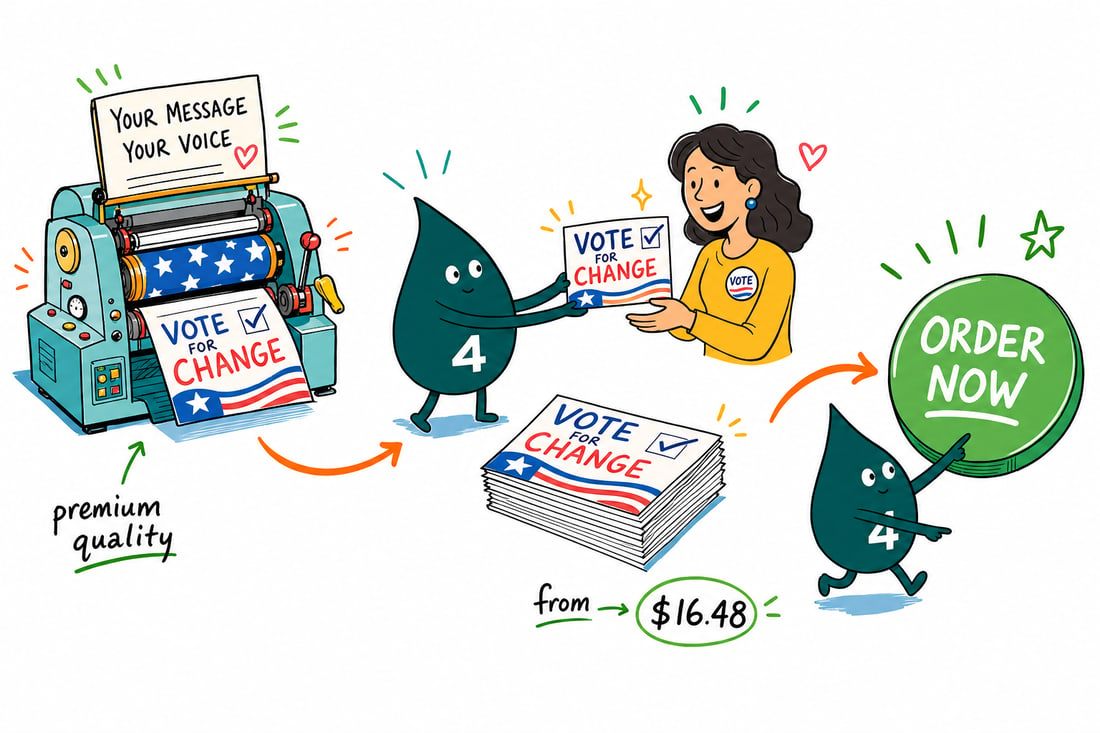
Fifty political postcards start at $16.48, and the per-postcard price keeps dropping as your mailing grows. Print a different voter name on each card, pick a size from a pocket 2.5 inch square to a 6 by 11 inch mailer, and set your speed. Wally gets them printed and out the door, same-day when the deadline is tight.
Press-Ready Blank Templates

How Much Do Political Postcards Cost?
Political postcards start at $16.48 per set of 50, and the per-postcard price keeps dropping as the quantity climbs toward 100,000. A set of 800 runs $73.60, about 9 cents each, and 7,000 land at $176.61, roughly 2.5 cents each. Push to a district-wide 100,000 and the cost drops under 2 cents per card. So how many do you actually need? Drag the slider below to set your count and watch both the set total and the true per-postcard cost update live, and find the point where one more step up barely moves the budget.
Can You Print a Different Name on Each Postcard?
Yes. Turn on variable data and you can drop a unique voter name, address, precinct, or one-off donation code onto every single card in the run, so each one ships personalized instead of identical. That turns a generic mailer into a card addressed to a real voter, with their own polling place or a QR link that goes straight to a donation page. Upload a spreadsheet with one row per recipient and the design stays fixed while the personalized fields change card to card. Free online proofs let you confirm the layout before the full run prints, so a whole mailing goes out right the first time.
Personalize every card to the voter
Variable data is what separates campaign mail from a flyer with an address on it. You supply the voter file as a spreadsheet, one row per record, with a column for every field you want printed, and the run merges those fields into the card so each piece comes off the press already personalized.
Merging the voter file. Export from your voter database into a clean sheet with consistent column headers and no merged cells, and standardize before you send: names in the case you want them printed in, no stray leading spaces, one column per line of the address. The most common failure is not the print, it is a file where a handful of rows are missing a field, so decide up front what prints when a field is empty and give those rows a fallback value rather than leaving a blank line on the card.
Household versus individual addressing. Individual addressing puts one name on one card and mails a card to every registered voter at an address, which is what you want for a persuasion message aimed at a specific voter or for tracking response by name. Household addressing collapses an address to a single piece, either to the family name or to a generic household line, which cuts the piece count and the postage sharply on a multi-voter address. Turnout mail is usually individual, because the ask is aimed at one person's record. Broad awareness mail is usually household. Deduplicate the file to the level you chose before printing, not after.
Precinct specific lines. The same variable data pass that prints a name can print a different polling place on each card. Add a column for the polling location, the address and the hours, keyed to each voter's precinct, and every card in the run tells its recipient where their own polling place is rather than pointing at a lookup site. The same technique carries a ward number, a ballot measure number, a district specific candidate line, or an early voting site that differs across the mailing.
Because all of this comes from your file, check the proof against the file itself, not just against the design: look at the first record, a record with a long name, and a record with an unusual address, since those three catch nearly every merge fault before 100,000 cards print.
How Do Political Postcards Compare to the Rest of the Range?
Political postcards are the value pick when you need to reach a lot of voters for a little money, but they are not your only move. If you are weighing a standard postcard, a foil-accented card, or a pocket mini, it helps to see the trade-off in plain numbers. The chart below lines up political postcards against their closest siblings so you can compare the starting price on each before you choose.
Getting mail in hands before election day
Campaign mail has one deadline that does not move, so build the schedule backwards from election day rather than forwards from today. There are four blocks of time and only one of them is printing.
- In home window: the days between the mail drop and the card landing in the mailbox. This is the block campaigns underestimate. Confirm the window with the mail house for the class of mail you are using, and treat it as the real deadline your artwork is aiming at.
- Mail drop and preparation: the mail house needs the printed cards in hand before it can sort, address and induct them. Ask for their required lead time and add it above the in home window.
- Production and transit: 3 business days standard, plus carrier time to reach you or your mail house. The 2-day, Next-Day and Same-Day rush tiers shorten production, not the road.
- Artwork lock: the date after which nothing changes. Production does not start until you approve the proof, so a card approved late on a Friday can lose a full weekend, and a late disclaimer correction can cost more days than the printing itself.
Add those four together and count back from the day the card should be read, not the day polls close. For a turnout piece that has to arrive in the final week, that usually means locking artwork well before the last weekend of the campaign, with the voter file cleaned and deduplicated by the same date. If the schedule is tight, the piece to keep flexible is the design, not the file: a card can be simplified in an hour, but a voter file that arrives broken restarts the whole clock.
How Fast Can You Get Political Postcards Printed?
Political postcards print on a 3 business day standard turnaround, and when a deadline moves up you can shift to 2-day, Next-Day, or even Same-Day production. Same-day orders need approval by the daily cutoff to ship that afternoon from our NYC plant, so a last-minute turnout push or a rapid-response mailer still lands on time. Across all orders, 99.8% arrive on time and 82% ship early, so you are not gambling on the date before an election. See exactly what each faster speed adds when you build your order.
See the Rest of Our Postcards
Political postcards are one stop in a much larger lineup, and you can scan the full print product range any time. If a standard mailer, a foil-accented card, or a heavier stock would serve you better, the rest of the family is one tap away. Each option shows its own starting price and links straight to its product page, so finding the right fit takes seconds.
Print Your Political Postcards Today
At 4OVER4.COM, quality comes first, and it's backed by a satisfaction guarantee and 25+ years of printing since 1999. Whatever size, stock, or finish you pick, these political postcards are built to land in a mailbox and move a voter. Need them before a deadline or an election? Our Same-Day production keeps you covered. Print your political postcards today.