
6 Print Products That Give Your Brand the Neuromarketing Edge
Neuromarketing turns into a purchase order at exactly six places, and none of them need a lab. Each pick below buys one sensory cue, comes with the price it starts at, and comes with the situation where that cue is a waste of money.
The six cues you can actually buy are touch, gloss contrast, metallic glint, physical relief, a cut shape and mail with no envelope. They map to soft touch cards from $40.28, spot UV from $76.88, raised foil from $86.78, embossed cards from $251.36, die-cut stickers from $93.37 and postcards from $16.48. Each one works at one distance only, so match the cue to where your piece is met and skip the rest.

The picks
Six picks, from $16.48 postcards to $251.36 embossed cards
Start with the cue that matches where your piece is met, not with the finish that sounds most expensive. Each product below is priced straight from the configurator and the price falls as the quantity climbs. Lay one out from scratch in the free online designer or start from a design template and drop your logo in.
Cue by cue
What each pick buys, and where it stops working
Read the row before you read the section. A finish is worth its money when the moment of contact suits it, and the fastest way to waste a print budget is to buy a cue the recipient never gets close enough to notice. Tap any pick to jump to the full write-up.
| Pick | The cue it buys | Starts at | Where it fails |
|---|---|---|---|
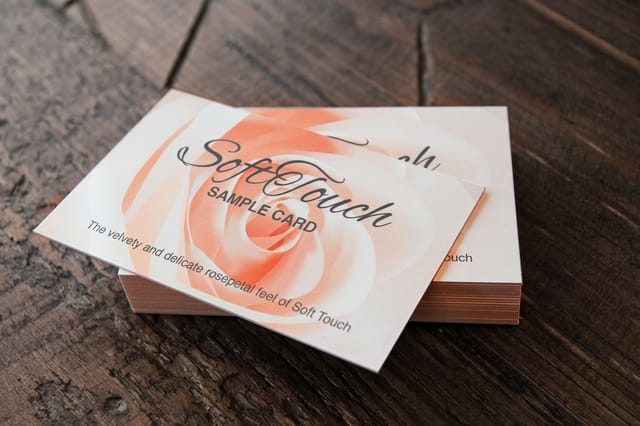
| 1. Soft touch business cards | Touch. A suede laminate that makes a hand stay on the card a beat longer. | $40.28 | Dark solids hold fingerprints, ballpoint skates across it, and saturated reds and oranges go slightly flat under the coating. |
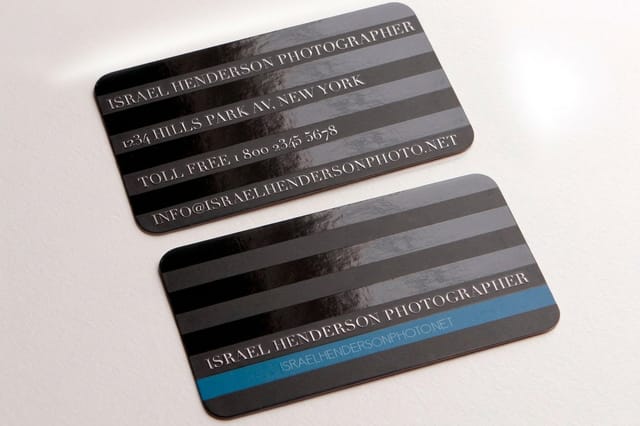
| 2. Spot UV business cards | Luminance contrast. A gloss island sitting on a matte field pulls the eye to one element. | $76.88 | Flat overhead light hides it completely. Glossing half the layout removes the contrast that made it work. |
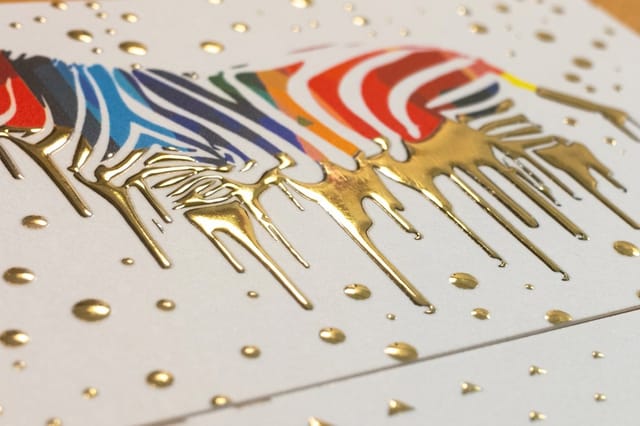
| 3. Raised foil business cards | Specular glint. Metal moves as the card tilts, and movement is what the eye is built to catch. | $86.78 | Nothing prints on top of foil, hairline reversed type under about 6pt fills in, and a large foil panel shows every thumbprint. |
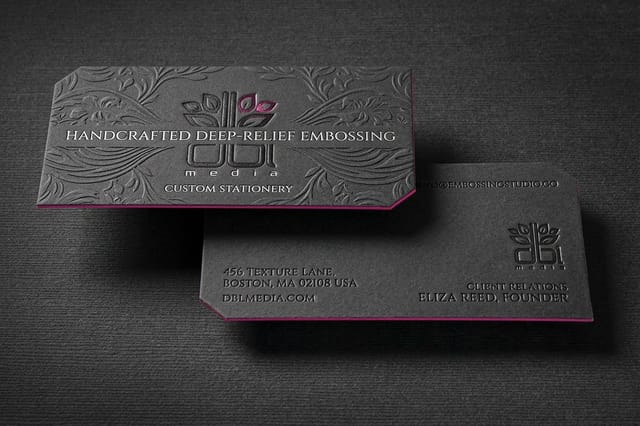
| 4. Embossed business cards | Relief. Real height a thumb finds in a pocket without looking at the card. | $251.36 | The back debosses wherever the front rises, fine serifs collapse when pushed, and the die is why the price jumps. |
| 5. Die-cut stickers | Shape. An outline that is not a rectangle breaks the pattern of everything else on the surface. | $93.37 | Thin necks and long spikes tear on the peel, and art that runs to the cut line loses a sliver to normal cut tolerance. |
| 6. Standard postcards | No envelope. The offer is read during the sort, before anyone decides whether to open anything. | $16.48 | It is met at arm’s length for about a second, so any cue that needs a hand or a raking light is wasted on it. |
1. Soft touch business cards: the cue that keeps the card in a hand

Of the six picks, this is the one people react to before they read anything. A soft touch business card carries a suede laminate that feels closer to peach skin than to paper, and the usual response is that the person turns it over, runs a thumb across it, then asks what it is. That extra handling is the entire point. A card being held is a card being read.
The honest limits are worth knowing before you order. The laminate is a film, so a dark solid picks up fingerprints and shows a scuff along a pocket edge after a week. Ballpoint skates on it, which matters if your sales team writes a cell number on the back, so ask for an uncoated writable strip when they do. And the coating slightly mutes saturation: a bright red or orange lands a shade calmer than the same ink under gloss. Our breakdown of what soft touch paper actually is covers the film, and the finish comparison in matte, glossy or soft touch puts it against the alternatives.
Start here if you only have room in the budget for one cue. It is the cheapest of the six at $40.28, it needs no die, no second pass and no special art setup, and it is the one people notice with the lights off. The rest of the soft touch printing collection extends the same finish to folders and postcards when you want the whole set to feel the same.
2. Spot UV business cards: steer the eye with a gloss island
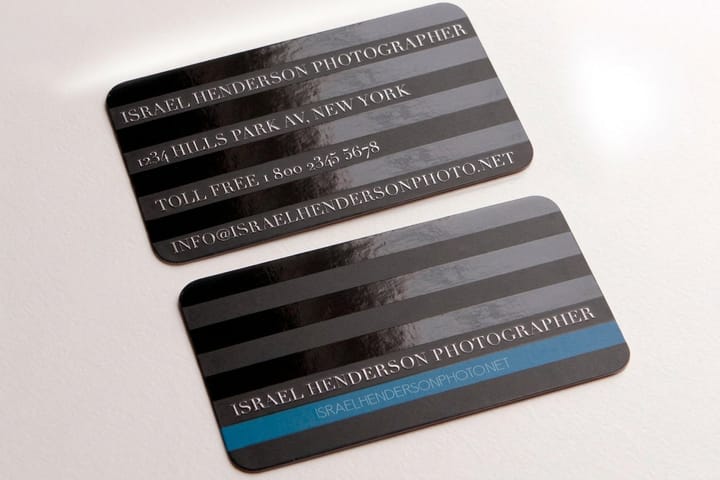
Attention follows a change in brightness, and spot UV manufactures that change without adding a single drop of ink. A clear varnish is laid over one element on an otherwise matte card, and the edge where gloss meets matte is what the eye locks onto. Put it on the logo, the one word that matters, or a single graphic shape. Nothing else.
The failure case is spot UV applied to everything. Gloss the headline, the logo, the border and the pattern behind them and there is no longer a contrast, just a shiny card, which is the plainest version of a cue canceling itself out. The other limit is light: this finish needs light coming across the sheet at an angle, so under flat overhead office light it nearly disappears. Judge the proof by the window, not under a ceiling panel. Hairline outlines below about 1pt are also risky, because normal registration movement between the varnish and the print can leave the gloss a hair off the shape it was meant to trace.
For layouts that use it well rather than everywhere, the work collected in 18 creatives who use spot UV designs is a better brief than any list of rules, and the full spot UV printing collection shows which other products take the same treatment.
3. Raised foil business cards: movement the eye cannot ignore

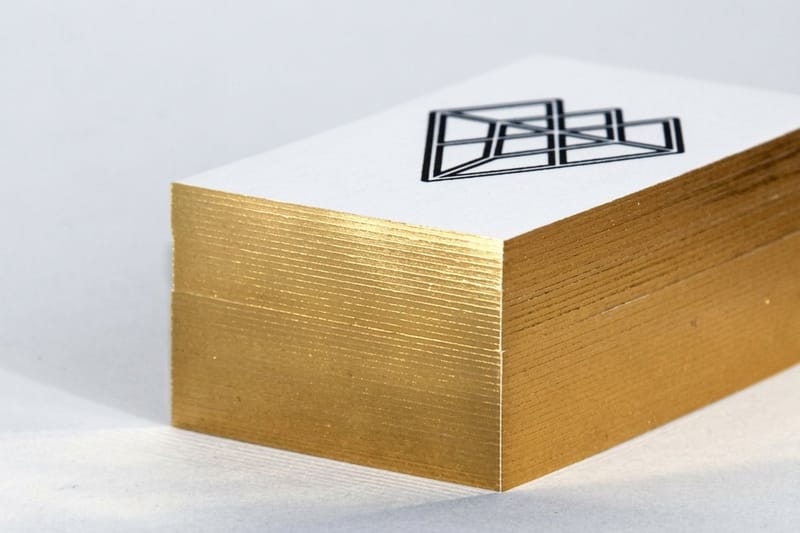
Foil does something no ink does. It reflects a bright point of light that slides across the card as the card tilts, and a moving highlight reads to the eye as motion, which is the oldest attention trigger there is. Raised foil adds height to that, so the shine sits slightly above the stock and the highlight is sharper. The second effect is social: metal has meant expensive for a very long time, and a foil logo borrows that meaning whether or not you asked it to.
Design around three constraints. Nothing prints on top of foil, so the foil element has to be a self-contained shape, not something you plan to overprint with type. Reversed hairlines under roughly 6pt fill in as the foil spreads, so keep foil type solid and reasonably weighted. And a large flat foil panel behaves like a mirror, which means it collects thumbprints the same way a phone screen does; a smaller foil mark on a matte field looks better after a day in a pocket than a full foil back does after an hour.
Color pairing decides whether the foil reads as expensive or as loud. Gold on a deep neutral is safe, silver on black is sharper, and copper needs a warm field or it turns muddy. The pairings in 10 color combinations that work in print transfer directly to foil work, and the foil printing collection carries the finish across the rest of the catalog.
4. Embossed business cards: the only cue that works in the dark

Embossing pushes the stock itself up into a raised shape with a metal die, so the mark has real height rather than a printed impression of it. That is why an embossed business card is the one pick on this list that still registers when the card is in a pocket and nobody is looking at it. A thumb finds the logo. Nothing else here can do that.
Two things follow from how it is made, and both change the artwork. The first is that the sheet has to go somewhere: wherever the front rises, the back sinks in the same shape, so a two-sided card needs the reverse laid out around that dent instead of pretending it is not there. The second is that fine detail does not survive the press. Thin serifs, small counters in letters like a lowercase e, and tight interior gaps flatten out, so an embossed mark wants weight and space.
Then there is the price. Embossed cards start at $251.36 against $40.28 for soft touch, and the gap is the die, which is a one-time tooling cost carried by whatever quantity you order. That math says embossing belongs on a small run of cards that get handed to people who sign contracts, not on the box you empty at a trade show. Get the stock right first, because a thin sheet cracks along the raised edge, and our guide to card stock and coating for embossed cards names the weights that hold the shape. The embossing printing collection has the rest.
5. Die-cut stickers: an outline that breaks the pattern
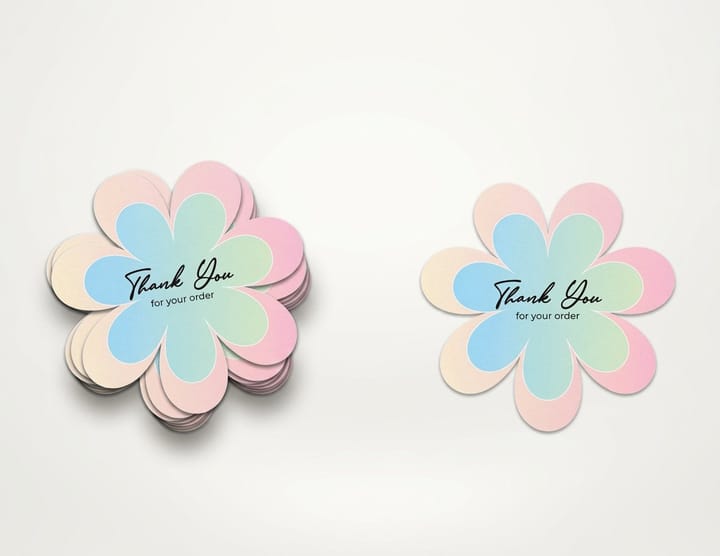
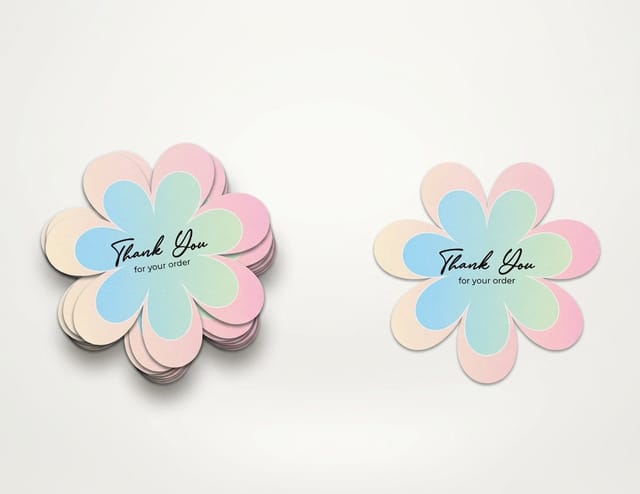
A rectangle is what every other printed thing on a laptop lid, a water bottle or a shop window already is, so a rectangle disappears into the crowd. Die-cut stickers are cut to the outline of the art itself, and that irregular silhouette is what makes one get looked at instead of scanned past. The other advantage is time: a card is read once, while a sticker stays on a surface for months and gets seen again every day by the person who put it there and by everyone sitting across from them.
The cut line is where die-cut art goes wrong. A long thin spike or a narrow neck between two shapes tears the moment somebody peels the sticker off the backing, so thicken anything narrower than a few millimeters or fold it into the main body of the shape. Keep type and any detail you care about a comfortable margin inside the cut, because normal cut tolerance moves the blade a fraction and art that runs right to the edge loses a sliver. Simple, chunky outlines survive real use. Delicate ones look excellent on screen and come back with a broken leg.
Why any of this works on people rather than on paper is the subject of the psychology behind custom sticker marketing, which is the closest companion piece to this kit. If you are laying one out from scratch, our free design templates start you with the cut line already in the right place.
6. Standard postcards: the message nobody has to decide to open
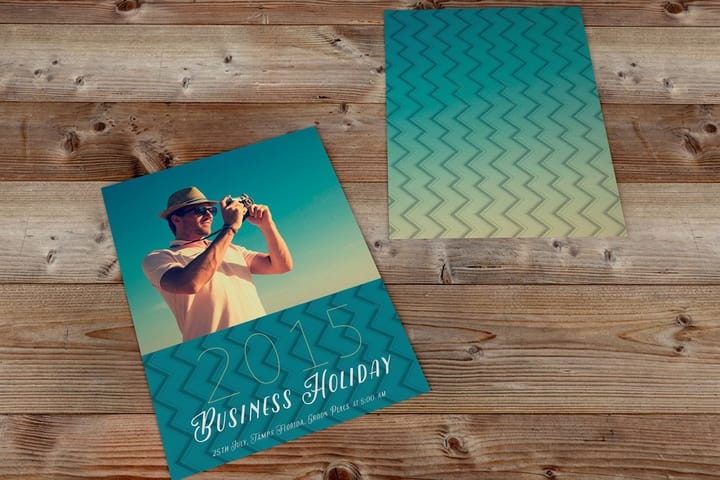
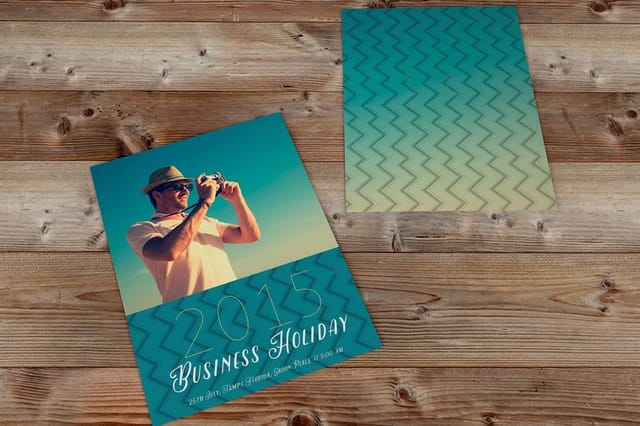
Every envelope asks the recipient a question before it delivers anything, and the answer is often no. A postcard removes the question. The offer is face up during the walk from the mailbox to the kitchen bin, which is the whole reason postcards remain the cheapest way to put a real object in someone’s hand, starting at $16.48.
What it costs you is subtlety. That walk is about a second long at arm’s length, so the largest element on the card is the only thing you can count on being read. One offer, one image, one instruction, and tonal contrast strong enough to survive a glance. This is also the piece where the other five cues stop paying: a soft touch coating on a mailer spends money on a texture that nobody registers before the sorting decision is made, and spot UV needs a light angle a mailbox does not provide.
Postcards are also the only pick here that gives you a clean test. Print two versions, change one thing, send them to halves of the same list with different tracking URLs, and you have your own result instead of somebody else’s study. The sending mechanics are in 5 quick steps to send direct mail postcards, the angles worth testing are in 12 postcard marketing ideas, and the direct mail collection handles the list and the postage.
Specs and pricing
The cheapest cue and the cheapest test, side by side
Soft touch cards are where most brands start, and postcards are what you split-test the result on. Soft touch cards start at $40.28 for 50 on 32pt uncoated stock in 5 business days, postcards at $16.48 for 50 on 14pt gloss cover in three.

| Quantity | Price Per Unit | Total |
|---|---|---|
| 50 | 80.6¢ | $40.28 |
| 100 | 76.7¢ | $76.65 |
| 200 | 59.9¢ | $119.74 |
| 300 | 53.9¢ | $161.67 |
| 400 | 44.9¢ | $179.65 |
| 500 | 38.3¢ | $191.60 |
| 600 | 33.9¢ | $203.60 |
| 700 | 30.8¢ | $215.58 |
| Quantity | Price Per Unit | Total |
|---|---|---|
| 50 | 33.0¢ | $16.48 |
| 100 | 24.2¢ | $24.16 |
| 200 | 15.9¢ | $31.86 |
| 300 | 12.8¢ | $38.45 |
| 400 | 11.3¢ | $45.04 |
| 500 | 10.3¢ | $51.62 |
| 600 | 9.89¢ | $59.31 |
| 700 | 9.57¢ | $67.00 |
Wally explains the six cues
One sense each, one distance each
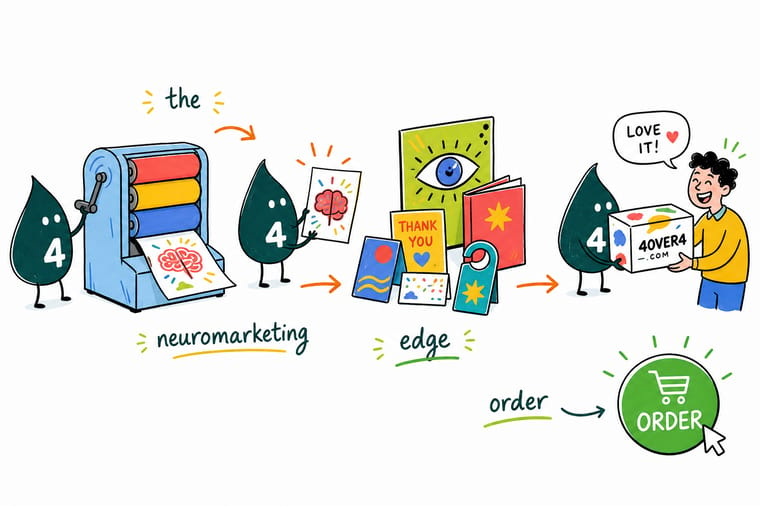
Wally sorts the six picks by the moment they are met. From ten feet only size and contrast register, which is postcard territory. At arm's length a foil glint and a gloss island separate from the matte around them. In the hand, soft touch and embossing take over, because texture cannot be seen from across a room. Pick the cue that fits your moment of contact, then split-test it before you print the big run.
Read the neuromarketing guide →See it in use
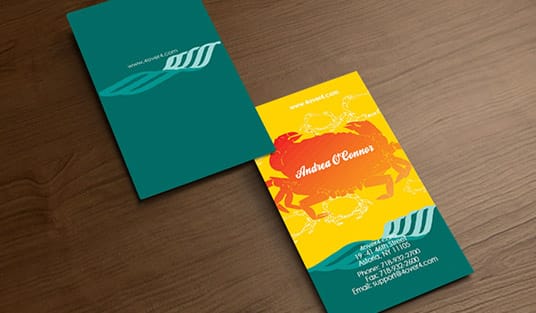
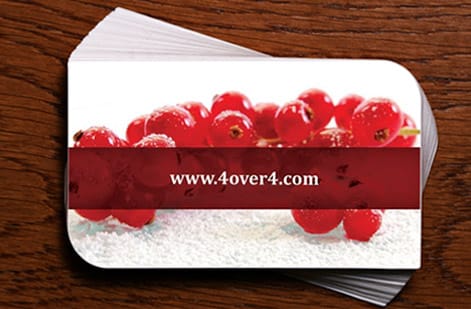
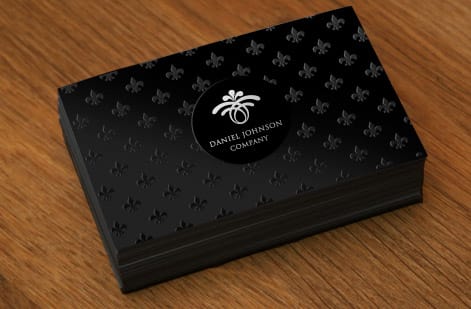
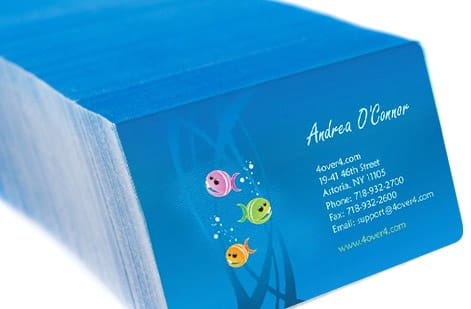
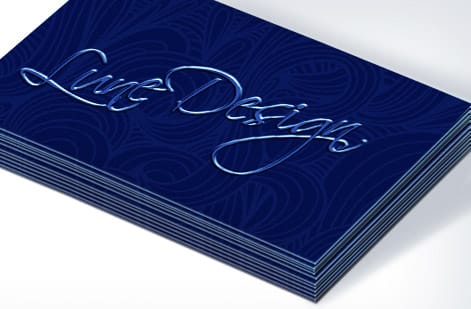
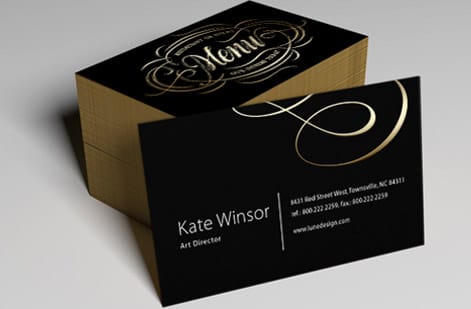
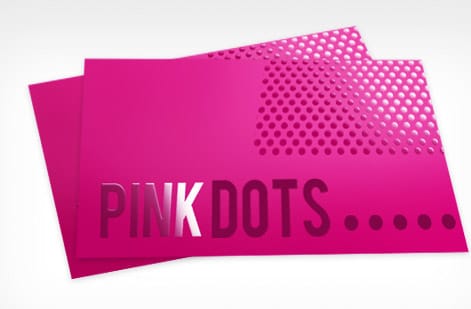
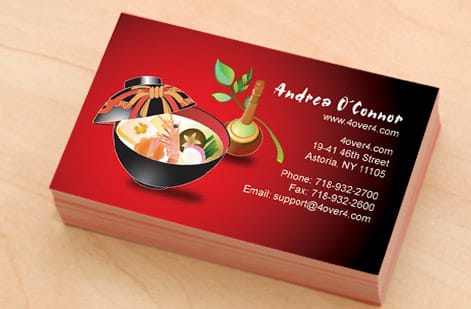
Card finishes you can feel before you read
Explore more
Where to go next


By the numbers
What a first impression can be printed on
Common Questions
Common questions about sensory print finishes
Which finish should I test first if I can only afford one?
Soft touch. It starts at $40.28, needs no die and no special artwork, and it is the cue people react to fastest, usually before they have read the card. Spot UV at $76.88 and raised foil at $86.78 are the next step up and both reward a design built around one element rather than a whole layout. Embossing at $251.36 is worth it only on a short run of cards that go to people who sign things.
Can I put spot UV and foil on the same business card?
You can, and the usual result is that neither one lands. Both cues work by being the single brightest event on an otherwise quiet surface, so putting them side by side splits the attention they were bought to concentrate. If you want both, give foil the logo and leave the rest of the card matte, or run the two finishes on different pieces in the same set so each has a card to itself.
Can you write on a soft touch card with a pen?
Not reliably. The laminate is a film, so ballpoint skates and gel ink sits on top and smears before it dries. If a sales team writes a direct number or an appointment time on the back, ask for an uncoated writable panel on that side, or use a matte card for the people who write and soft touch for the ones who do not.
Why do embossed cards cost so much more than every other finish?
A metal die has to be made for your specific shape, and that tooling is a one-time cost spread across whatever you order. It is why embossed business cards start at $251.36 while soft touch starts at $40.28 for the same 3.5 in by 2 in card. The per-card gap narrows as the quantity climbs, but on a small run the die is most of what you are paying for, so emboss the mark that will not change rather than a seasonal tagline.
Does a specialty finish actually pay off on a direct mail run?
Rarely, and the reason is the moment of contact. Mail is judged at arm’s length in about a second, which favours size, contrast and the offer itself, not texture or a varnish that needs light raking across it. Spend the finish budget on the pieces people pick up and keep, and spend the mail budget on a bigger card, a better list and a second drop.
How do I know whether the finish did anything?
Change one variable and let the mailbox answer. Print two postcard versions that are identical except for the thing you are testing, split one list in half, give each version its own tracking URL or QR destination, and mail both on the same day. Two drops of a few hundred each will tell you more about your own customers than any published study, and it costs less than most people expect at $16.48 to start.
What is the difference between raised foil and raised spot UV?
Raised foil bonds a metallic film to the stock and reflects a bright moving highlight, so it reads as metal from across a desk. Raised spot UV builds a clear gloss layer that you feel more than you see and that only reveals itself when light comes across the sheet at an angle. Foil is the louder signal, spot UV is the quieter one, and foil cannot be overprinted while spot UV sits on top of your existing artwork.
Get Started
Pick one cue and test it
Print the finish that suits your moment of contact at 4OVER4.COM, then split-test it on a postcard drop. Sizes, stocks and finishes update the price live as you build the order.
Legal Disclaimer
Gold Standard guarantees apply to all standard orders placed through 4over4.com. Price match requires verifiable proof of a competitor's published price for an equivalent product with matching specifications and turnaround time. Satisfaction guarantee covers manufacturing defects and print quality issues. Contact support with order number and documentation. On-time delivery rate based on tracked orders 1999 to 2026. Individual results may vary based on shipping carrier performance.
