
How to Write a Business Plan That Survives a Lender's Questions


The playbook version: what each section has to prove, how the financial model is built, the checklist to run before you send it, and how to put it in front of a lender.
A business plan is a written argument that money going into the business comes back out with a margin on it, structured in nine sections so a reader can check the argument rather than take your word for it. Fifteen to twenty five pages covers almost every case, and the part that decides the meeting is the financial model: three statements, an assumptions page that sources every figure, and a break even number you can say out loud. Write the executive summary last, because it is the page everyone reads first.

Quick answer
Write it backwards, hand it over forwards
Build the plan in the order the evidence appears, then present it in the order a reader wants it. Research the market, model the operations, build the financials, set the pricing, and only then write the executive summary. A lender opens at that summary, jumps to the financials, and reads the rest only if those two hold up. The diagram below shows both orders side by side and the two sections that swap position between them.
What a Business Plan Has to Prove, and to Whom
Three people read a business plan, and they are not looking for the same thing. A lender reads for repayment: can this business service the debt through a slow quarter. An equity investor reads for the size of the win: if this works, how big does it get, and how do I get my money back out. You read it for the assumption that will hurt, which is usually hiding in the gap between what you expect to sell and what you expect to spend to sell it.
Write for the lender first. Their test is the strictest and the most concrete, and a plan that survives it will hold up in the other two rooms. That means the argument runs on cash rather than adjectives, and every claim has a source you can name.
Now the honest limit. The plan will be wrong. Your first ninety days of real customers will contradict the forecast, and pretending otherwise costs you credibility with anyone who has run a business. What keeps the document useful is the assumptions page, because a wrong number with a stated reason behind it can be corrected. A wrong number with no reasoning behind it can only be replaced with another guess.
If you are still deciding whether the business is worth planning at all, work the idea through starting a small business from home first, and read money psychology in business before you set your prices. Both feed straight into the numbers you are about to write down.
The Nine Sections and the Claim Each One Carries

Standard structure exists because readers navigate by it. Keep the names, keep the order, and treat each heading as a promise you have to keep by the end of that section.
| Section | What it must prove | Where it usually fails |
|---|---|---|
| Executive summary | That the whole case fits on one page and is worth reading further. | Written first, so it promises things the rest of the plan never delivers. |
| Company description | What the business does, its legal form, and who owns it. | Drifts into mission statement language nobody can check. |
| Problem and solution | That a specific customer already pays to solve this, badly. | Describes a problem with no evidence anyone spends money on it. |
| Market analysis | The size of the market you can actually reach, built from the bottom up. | A national figure with a percentage claimed off the top. |
| Competition | That you know who the buyer picks today and why they might switch. | The line "we have no competitors", which reads as no research. |
| Products and pricing | Unit economics: price, cost to deliver, and the margin left over. | Price set by matching a competitor rather than by cost plus positioning. |
| Marketing and sales | How a stranger becomes a customer, and what that costs each time. | A channel list with no cost per customer attached. |
| Operations and team | That the people and suppliers to deliver the promise exist now. | Roles listed with nobody named and no hiring cost in the model. |
| Financials | Three statements, an assumptions page, and a break even you can defend. | Revenue that curves upward for no stated reason. |
The appendix is where supporting proof lives: signed letters of intent, a lease, permits, product photography, resumes. Lenders skim it, but they notice when it is empty. This is also the part most founders hand over as a stack of loose sheets, which is why a short run presentation folder earns its place. It keeps the plan, the financials and the appendix as one object instead of three piles.
The Financial Model Is the Plan, the Rest Is Context
Four documents carry the whole financial section. A profit and loss statement shows whether the business makes money. A cash flow statement shows whether it survives long enough to make it, which is a different question and the one that kills more businesses. A balance sheet shows what it owns and owes. An assumptions page tells the reader where every number came from.
That last page is the one people skip and the one experienced readers turn to first. Write it in plain sentences: units sold per month and why that figure, average order value and what it is based on, cost of goods per unit from a supplier quote, rent from the actual lease, payroll by role and start date. If you cannot state the source, the number is not ready.
Break even is arithmetic, so get it exact. Fixed costs divided by contribution margin per unit. If you sell at $40, it costs $16 to deliver, and fixed costs run $6,400 a month, contribution is $24 and break even is 267 units a month. Say that number out loud before the meeting. Then say what happens if the price drops to $36: contribution falls to $20 and break even climbs to 320 units, a jump of about a fifth for a ten percent discount. Discounting moves the break even line much faster than founders expect, and being able to explain that in one sentence does more for your credibility than another page of narrative.
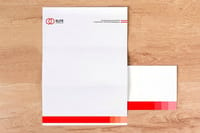
Build year one month by month, then years two and three annually. Show the low point of the cash balance and name the month it happens, because that is the number a lender is sizing the facility against. When the model is printed for review, put it on printed letterheads rather than plain office stock so the pages stay identifiable once they are separated from the binding.
How to Hand the Plan Over So It Gets Read
Send the PDF two or three days ahead so it can be forwarded to whoever else has a say. Bring paper to the room. Paper keeps everyone on the same page number while you talk, it lets a banker write in the margin, and it stops the meeting becoming five people scrolling separately.
The format depends entirely on how many copies you need, and this is where money gets wasted.
| Copies needed | Best format | Starting price | Why |
|---|---|---|---|
| 3 to 5 | Short run presentation folders with laser printed pages | $108.75 | You can reprint a revised financial page the night before without reprinting anything else. |
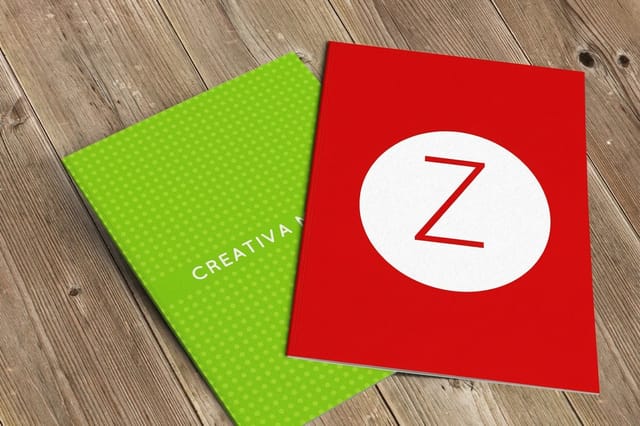
| 25 and up | Bound booklets | $240.55 | A stitched booklet reads as a finished document and survives being passed around a board. |
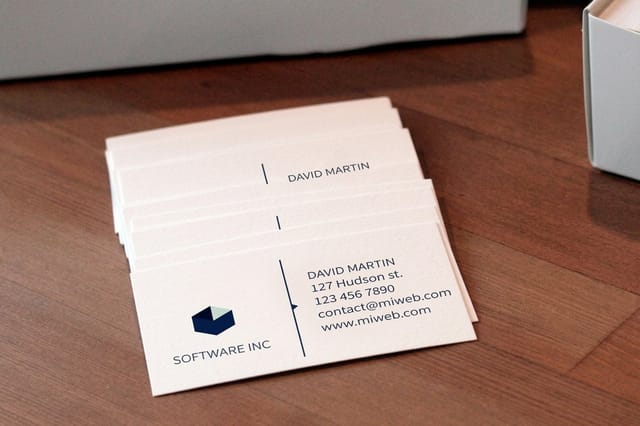
| Every meeting | Standard business cards | $17.57 | The cheapest thing on this list and the only one that leaves the room in someone's wallet. |
Read the price column against the copy count before you order. Binding three copies of a document you are still editing is the classic first time mistake: the financials change, and the binding is the part you cannot revise. Bind it once the numbers have stopped moving. For a franchise pack, a board circulation or an investor roadshow, the bound version is worth it, and the bookbinding collection lists the stitching and binding options side by side.
Two details matter more than the cover design. Number every page, because a lender who wants to argue with your assumptions needs to point at them. Print the financials single sided, since anything double sided gets photocopied badly and comes back missing the reverse. If you want the whole set to look like it came from one business, the brand launch essentials kit pairs the folder with matching stationery.
The Playbook Checklist and the First Ninety Days
Work down this list before you send anything. Each item is something a reader has rejected a plan over.
- The summary fits on one page and states the ask, the use of funds, and the repayment or exit in plain numbers.
- Market size is built from the bottom up from customers you can name a route to, not a share of a national total.
- Every forecast number appears on the assumptions page with its source, including the ones you are least sure about.
- Break even is calculated, written down, and rehearsed out loud, along with what it becomes at a ten percent discount.
- Year one is monthly and the lowest cash balance is labeled with the month it lands in.
- Competition names real companies and explains why a customer would switch, not why you are better.
- The team section names people or names the gap and puts the hiring cost in the model.
- The appendix carries proof: quotes, letters of intent, the lease, licenses, resumes.
- Pages are numbered and the file is a PDF, not a document that reflows on someone else's machine.
- Somebody outside the business has read it and can repeat the argument back to you correctly.
Once the doors open, the plan changes job. It stops being a pitch and becomes a scoreboard. Each month, put actual revenue and actual costs beside the forecast and write one line explaining the variance. Three months of that tells you more about the business than the original document ever did, and it turns the second funding conversation from a pitch into a track record.
Keep the original assumptions page intact instead of overwriting it. Being able to show a lender what you predicted, what happened, and what you changed in response is the single most persuasive thing a young business can put in front of them. When you are ready to spend on the launch itself, the grand opening business toolkit covers the print you will need on day one, and small business printing tips keeps that first budget honest.
Wally explains the business plan
Nine sections, one argument, and a number he can say out loud
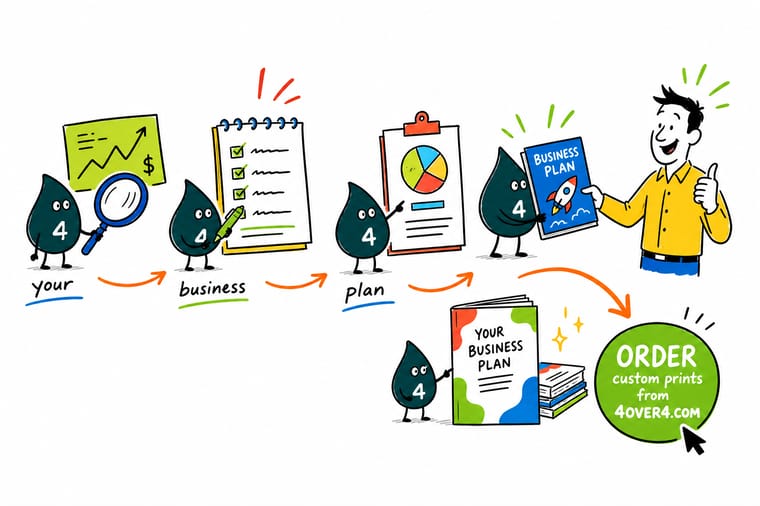
Wally writes the market research first and the summary last, because the summary has to be honest about numbers that do not exist yet. He puts every forecast figure on one assumptions page with its source next to it. He works out break even before the meeting, then works it out again at a ten percent discount so nothing catches him mid sentence. He emails the PDF ahead, and he still brings printed copies, numbered, so everyone in the room argues with the same page.
Print and bind your business plan →Specs and pricing
Formats for the plan, the appendix and the leave behind
Sizes, binding choices and starting prices straight from the 4OVER4.COM configurator, so you can price the print before the meeting is booked.


Print it
Put the plan in front of people on paper

Explore more
Where to go next



By the numbers
The print partner behind a lot of first business plans
Common Questions
Your business plan questions, answered
How long should a business plan be?
Fifteen to twenty five pages of body copy, plus appendices, covers almost every case. The exception is a plan attached to a bank application, where the lender often supplies a form or an outline you have to follow. Length is not the quality signal people think it is. A short plan with a defensible break even number beats a forty page plan whose revenue line has no stated assumptions behind it. Cut anything that would still be true if you swapped your business for a different one.
Do I actually need a business plan to get a loan?
For a bank loan or an SBA backed loan, yes, in practice. Lenders want the written plan, personal and business financial statements, and projections, because they are underwriting your ability to repay rather than your enthusiasm. For a friends and family round, or for bootstrapping, nobody will ask for the document. You still want it, because writing the financial model is how you find the assumption that would have quietly sunk you in month seven.
What is the difference between a business plan and a lean canvas?
A canvas is a one page grid of hypotheses you can fill in during an afternoon and rewrite every week while you test the idea. A business plan is the version you can hand to someone who controls money. The canvas is better for the first six weeks because it is cheap to be wrong on it. It is worse the moment somebody needs to see a repayment schedule, because a grid of sticky notes carries no cash flow.
How far out should the financial projections go?
Three years is the usual ask, with year one broken out month by month and years two and three shown annually. Monthly detail in year one matters more than the far end of the forecast, because that is where seasonality, ramp up and the cash low point actually show. Anything past year three is a growth rate assumption wearing a spreadsheet, and experienced readers treat it that way.
Should I print the plan or send a PDF?
Do both, and do them in the right order. Email the PDF two or three days before the meeting so it can be circulated and skimmed. Bring printed copies to the room so everyone is on the same page number while you talk, and so nobody is pinching to zoom on a phone. Three to five copies is enough for a bank meeting. Print more only when the same document goes to a board, a franchise group, or a roadshow.
How often should I rewrite it?
Touch the financial model monthly and the narrative twice a year. The model is where reality lands first, because your actual sales and costs immediately disagree with the forecast. Keep the original assumptions page rather than overwriting it. A plan that shows what you predicted, what happened, and what you changed is far more convincing at the second funding conversation than a clean document with no history.
Get Started
Short run folders cost 10 for $108.75, three business days
Bind the finished version as a booklet, or keep it loose in a short run folder while the financials are still moving. Both ship from our Queens plant.
Legal Disclaimer
Gold Standard guarantees apply to all standard orders placed through 4over4.com. Price match requires verifiable proof of a competitor's published price for an equivalent product with matching specifications and turnaround time. Satisfaction guarantee covers manufacturing defects and print quality issues. Contact support with order number and documentation. On-time delivery rate based on tracked orders 1999 to 2026. Individual results may vary based on shipping carrier performance.
