
When to Start Printing Wholesale Calendars for the Q4 Selling Season


A wholesale calendar program runs on one fixed delivery date and works backwards from it. The schedule runs month by month, the quantity follows its own math, and the binding decides how many days the job needs on the floor.
Start selling wholesale calendars in July and have the artwork locked by the middle of October. The calendars have to reach clients in the first week of December, and shipping, binding, printing and proof approval all stack backwards from that date. Sample in spring, pitch through the summer while next year budgets are set, proof the date grid twice in late October, and print in a single longer run rather than two short ones.

Quick answer
One fixed date, and eight weeks of work behind it
Everything in a calendar program is scheduled backwards from a first week of December delivery. Ship in late November, print and bind through late October and November, approve the proof in late October, and lock the artwork by the middle of that month. That leaves the selling to July, August and September, when clients are setting next year budgets. Sample in spring so you pitch with a calendar in your hand rather than a PDF on a screen.
Why Calendar Timing Decides Whether the Run Sells
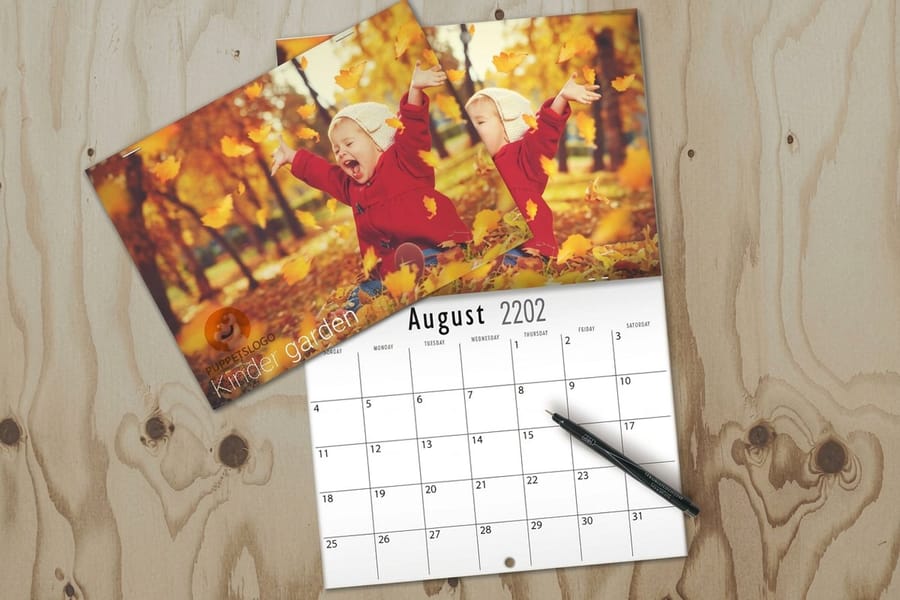
A calendar is the only thing we print that has an expiry date on the cover. Every other job can sit in a stockroom and still be worth something in March. A box of next year calendars is worth full price in November, half in January, and nothing by February.
That single fact changes how a wholesale program is run. You are not managing a print deadline, you are managing a selling deadline that sits weeks in front of it. The client has to say yes, supply a logo, approve a proof and take delivery while the year still has twelve months in it. Work backwards from the first week of December and the whole thing lands in the middle of October, which is why calendar programs that start in autumn feel rushed and calendar programs that start in July do not.
The second reason timing matters is competitive rather than logistical. There is one wall, one desk and one fridge in each office, and whoever gets there first in December owns that space for a year. A calendar that arrives on 27 December competes with something already hanging. The specification work behind that delivery is covered in our guide to bulk calendar printing for clients, and the formats themselves sit on the calendar printing category page.
The Wholesale Calendar Selling Season, Month by Month

A wholesale calendar program runs the year in this order. The dates are the ones that hold when nothing goes wrong, so treat them as the latest sensible moment rather than the earliest.
| Window | What happens | What goes wrong if you are late |
|---|---|---|
| March to May | Order samples, settle which formats you will offer, and price them at your trade cost. | You end up pitching from a PDF. Clients pick a calendar by holding it, and a sample on the desk closes better than a mockup on a screen. |
| July to September | Pitch clients and take orders while next year budgets are being set. | You arrive in October, when the same marketing contact is buried in holiday campaigns and pushes the decision to next year. |
| Early to mid October | Collect logos and imprint copy, build the pages, lock the artwork. | Chasing a logo file in late October eats the slack you kept for the proof round. |
| Mid to late October | Proof approved, including a separate check of the date grid. | Approval is the real gate. A job waiting on one signature loses days nobody can recover afterwards. |
| Late October to late November | Print, then the finishing passes: punch, bind, polybag, label the cartons. | Each pass is a separate handling step. A schedule that budgets for printing but not for binding is short by days, not hours. |
| Mid to late November | Ship, split between branches or client addresses. | Carrier networks are at their yearly peak. Slack is cheaper than an upgraded service. |
| First week of December | In hands. | Offices thin out from mid December. A calendar handed over on 5 December goes home. One that lands on the 27th sits in a mail tray. |
Two supporting moves make the summer pitch land. Send a sample with a dated cover so the client can see their own logo in the imprint area, and follow it with a short mailer to the accounts your reps will not visit. Standard postcards start at $16.48 and are the cheapest way to put a September reminder on a buyer's desk. If you are buying at trade prices, the terms are on our reseller page, and seasonal pricing on print runs shows up on daily deals.
When to Start Design and When to Approve the Proof
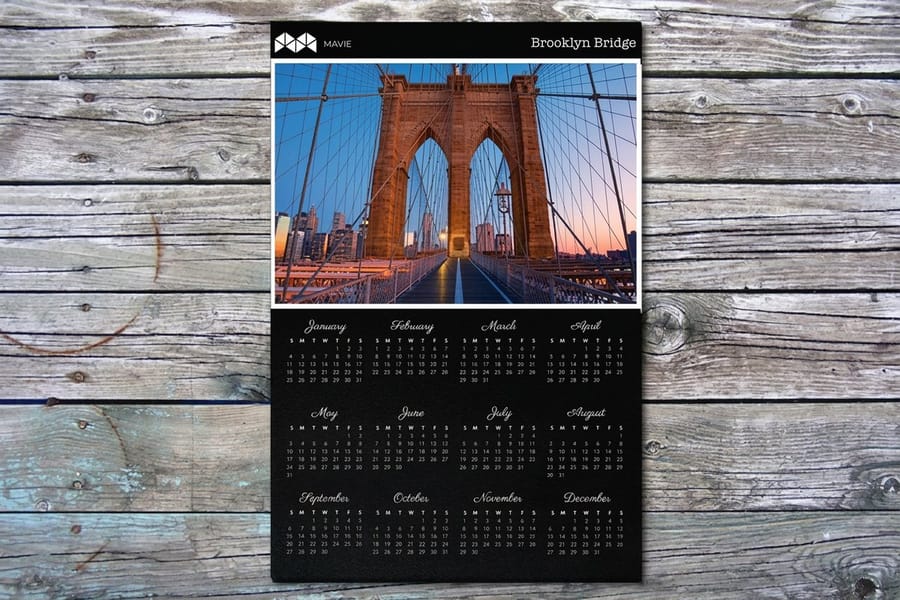
Start the design in September and approve the proof by late October. The design itself is rarely the bottleneck. What takes the time is the part nobody schedules: collecting a usable logo from each client, agreeing the imprint copy, and checking thirteen pages of facts.
Thirteen pages is the number to remember. A cover plus twelve months is thirteen leaves, and every one of those month pages is a page of dates that can be printed wrong at scale. Check the leap year. Check that Thanksgiving is the fourth Thursday and not the last one. Check the observed date when a holiday lands on a weekend, check the week start if the grid begins on Monday, and check regional holidays if any of the run crosses a border. Two people should proof the grid separately against a published source before anything goes to plate, because a wrong date cannot be stickered over on a run of several thousand.
Build the file the way you would for any print job: artwork at full size, fonts converted to outlines, and the imprint area kept clear of the trim. Our wall calendar design guide covers the page structure, how to design a calendar cover covers the one page that sells the whole piece, and the correctly sized layouts are in the blank template library. Every order gets a proof before it prints, and the details of that step are on our free proofs page.
Production and Shipping Time You Have to Plan Around

Printing is the fast part. The days go on the finishing floor and in transit, and both get slower in November because everyone else is printing holiday work at the same time.
After the press run, a bound calendar goes through separate passes: trimming, punching, coil or wire binding, hanging hook insertion on wall formats, polybagging, then carton packing and labeling. A flat poster calendar skips almost all of that, which is why it can be ordered later in the season than a wire bound one. If a run splits between branches or client segments, add the kitting step to the plan as well, and put a printed carton label with a destination and a piece count on every box. It is the cheapest insurance in the job.
Transit is the other variable, and December is the worst month of the year to discover a service level. Check what ground, air and freight actually take from our Queens plant to your delivery zones in transit times by service and zone, and read print delivery and turnaround explained for how production days and shipping days stack. If the calendar has to be in hand on a fixed date, buy the slack in November rather than the upgraded service in December. Standard posters start at $108.75 and are the fallback when a client comes to you in the last week of November, because a single sheet needs no binding pass at all.
How Many Calendars to Order, and How Many Spares

Order the confirmed quantity, the copies people take home, and about ten percent on top. That last ten percent covers transit damage, the replacement a client asks for in January, and the rep who takes a dozen to a meeting. Spares are cheap while the job is on press and expensive once it is off, because a reprint pays the setup again on almost no volume.
The bigger decision is presell against spec. Presold quantity carries no risk: the client has agreed, the artwork is theirs, and the calendar is delivered. Spec stock is a bet on a buyer you have not signed, on a product that is worthless in eight weeks. Wholesalers who carry spec stock well usually print a generic dated calendar with a clear imprint panel and add the client name afterwards with a label or a short cover run, which keeps the gamble in the cheap part of the job rather than in the whole run.
Run length is also where the margin is. Price bands are built around the length of the press run, so one order of two thousand beats two orders of one thousand placed six weeks apart, even at the same total. The mechanics are in how bulk printing price breaks work, and the volume terms are on our bulk discounts page. If a client's budget will not stretch to a calendar, a dated magnet starts at $19.68 and holds the same fridge space for the year, which is a useful second tier to have in the pitch.
Choosing Binding and Format for a Wholesale Run

Pick the format for how the calendar is used and how it travels, not to shave the price. Standard Calendars and Wire-O Coil Calendars both start at $812.59 at 4OVER4.COM, so the binding is not what moves the entry cost. Page count, stock and quantity are.
| Format | Finishing passes after print | How it ships | Where it earns its place |
|---|---|---|---|
| Saddle stitched wall | Fold, stitch, trim. | Lies flat, mails in an envelope or flat mailer. | Runs where a large share is mailed and postage is the deciding cost. |
| Wire-O or coil wall | Punch, bind, insert hanger, polybag. | Rigid and bulky, usually a parcel. | Calendars that hang open on a wall all year and get written on. |
| Desk tent | Score, fold, bind the short edge. | Small and light, mails cheaply. | Office desks, and clients whose brand needs to be seen during phone calls. |
| Poster calendar | Trim only. | Rolled in a tube or shipped flat. | Late orders, warehouses and workshops, and anywhere the whole year has to be visible at once. |
Two specification traps catch wholesalers every year. The first is the multiple of four. A stitched calendar with a cover and twelve months is thirteen leaves, and stitched work is imposed in four page increments, so you either add a notes page and a company page or you pay for blank leaves. The second is the writing surface. Gloss coated stock makes photography look its best and makes a ballpoint smear, so if the grid is meant to be written in, ask for uncoated or dull coated date pages and save the gloss for the cover.
For the format detail, the spiral bound calendar guide covers coil binding, standard calendar sizes covers wall, desk, poster and pocket dimensions, and custom calendar printing options lists every binding and finish we run. If a client wants a binding style applied to something other than a calendar, our binding service page has the full list.
Wally explains calendar timing
One pin in December, then count backwards
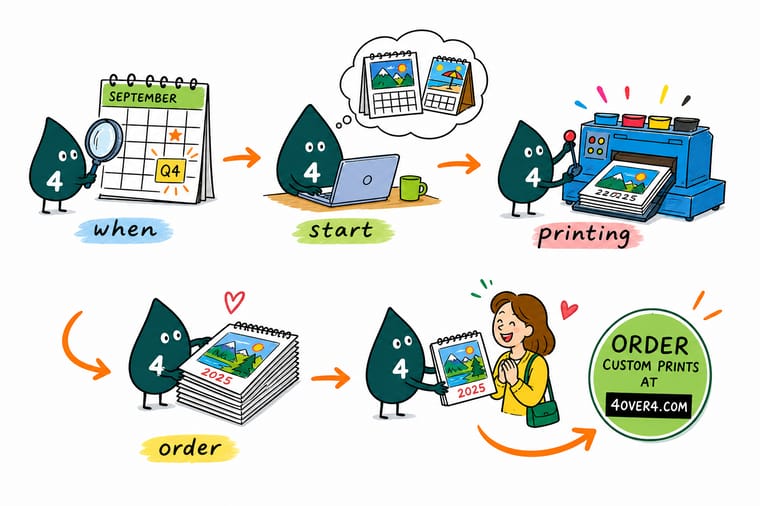
Wally puts a pin in the first week of December, when the calendars have to be in a client's hands. Then he walks back: shipping in late November, binding and kitting through November, printing from late October, the proof approved before that, and the artwork locked in the middle of October. Everything left over is selling time, and it lands in July, August and September. He samples in spring so he can hand a client a real calendar instead of showing them a screen.
Price a wholesale calendar run →Specs and pricing
Calendar formats, sizes and starting prices
Standard calendars run 25 for $812.59 in seven business days, and the Wire-O coil version prints the same quantity in five.



Print it
Lock in your calendar print run at 4OVER4



Explore more
Where to go next



By the numbers
The press that runs your seasonal calendar
Common Questions
Your calendar timing questions, answered
What is the latest I can order wholesale calendars and still deliver in December?
Plan to have artwork approved by the middle of October. That leaves room for a proof round, the press run, the binding and kitting passes, and transit during the busiest carrier weeks of the year. Later orders still get printed, but every day after that date comes out of the slack you would otherwise use to fix a date grid error or a shipping delay. If you are past the middle of November, switch the conversation to a flat poster calendar or a magnet, both of which skip the binding passes.
Should I print calendars on spec or only against confirmed orders?
Print the confirmed quantity, and treat spec stock as a separate decision with its own buyer in mind. A calendar is the only print product that is worthless on a fixed date, so unsold cartons do not roll into next year. Wholesalers who carry spec stock successfully usually print a generic dated calendar with a blank imprint panel, then add the client name in a second short run or with a label, which keeps the risk in the cheap part of the job.
Do calendars still sell in January?
Some, at a discount, and the window closes fast. A calendar delivered in the first week of December buys twelve months of wall space. One delivered on 20 January buys eleven months and arrives after the recipient already hung something else. Price January stock to clear it rather than holding it, and put the effort into next year, when the same client can be approached in July with a sample.
Wire-O or saddle stitch for a calendar that has to be mailed?
Saddle stitch mails better and wire binding hangs better. A coil bound wall calendar is rigid and bulky, so it usually travels as a parcel, and on a moderate quantity the postage can approach the print cost per piece. A stitched calendar lies flatter in a mailer. If most of the run is hand delivered by reps and only a slice is mailed, print one binding and accept the postage on the small portion rather than splitting the run into two setups.
How many spare calendars should a wholesale run include?
Add the confirmed quantity, the copies people take home, and roughly ten percent on top for transit damage, replacements and the rep who wants a dozen for a client visit. Spares are cheap while the job is on press and expensive afterwards, because a reprint pays the setup again on almost no volume. That is also why one larger run beats two smaller ones, as the price bands in bulk printing are built around run length.
Can a client logo be added to a generic calendar after it is printed?
Yes, if the design leaves a clear panel for it. The usual approaches are a printed label applied to the cover, or a short second run of covers only. Both cost more per piece than printing the imprint in the first pass, so they are a way to spread risk across several buyers, not a way to save money. Decide which route you are taking before the cover is designed, because a cover with no quiet area has no room for either.
Get Started
Wire-O coil calendars run 25 for $812.59, five business days
Choose the format, set the page count and the quantity, and we print, bind and ship the run so it reaches your clients while the year still has twelve months in it.
Legal Disclaimer
Gold Standard guarantees apply to all standard orders placed through 4over4.com. Price match requires verifiable proof of a competitor's published price for an equivalent product with matching specifications and turnaround time. Satisfaction guarantee covers manufacturing defects and print quality issues. Contact support with order number and documentation. On-time delivery rate based on tracked orders 1999 to 2026. Individual results may vary based on shipping carrier performance.
