
What a Modern Estate Manager Does and How to Run a Private Property Like a Business


The role, the written authority it needs, the household manual that carries it, and the maintenance calendar that keeps a property out of crisis mode.
A modern estate manager runs a private property the way a general manager runs a small company: the budget, the staff, the vendor contracts, the maintenance calendar and the records, reporting to the principal. The role only functions with three things in writing, a spending limit, a decision path and a confidentiality agreement. Everything else is documentation, and the household manual is the deliverable that proves the job is being done.

Quick answer
One person owns the money, the people, the systems and the record
Estate management is general management applied to a private household. The budget, the hiring, the vendor contracts, the security, the maintenance calendar and the documentation all sit with one person who reports to the principal. The distinguishing skill is not service, it is recordkeeping under interruption. Every system on a property publishes its own service interval, and the calendar below is simply the sum of those intervals put on one sheet.
What a Modern Estate Manager Actually Runs
Strip the title back and the job is general management with a very short reporting line. One person owns the money, the people, the buildings and the record, and answers to the principal rather than to a board.
The money side is an operating budget for staff, utilities, supplies and routine service, plus a separate capital plan for the roof, the driveway, the HVAC replacement that everyone knows is coming in three years. The people side is hiring, scheduling, reviews and the awkward conversations. The buildings side is systems, grounds, security, vehicles, and whatever else has a serial number. The record side is the part nobody puts in the job listing and the part that decides whether the role works.
Two things must be written down before the first week ends. A spending limit, so you can approve the emergency plumber at 6am without a phone call. And a decision path that says what you decide, what you recommend, and what only the principal decides. An estate manager without both gets blamed for acting and for waiting, sometimes about the same event. Add a confidentiality agreement and a background check standard that applies to every person who gets an alarm code, including vendors.
Scope is where the title confuses people. A house manager runs the inside of one residence. A property manager works on income real estate under leases. The estate manager sits above the household roles, holds the contracts, and usually covers grounds, outbuildings and any second property. If a listing says estate manager but describes laundry schedules, it is a house manager job with a better title on it.
The Household Manual Is the Real Deliverable

Ask an experienced estate manager what they leave behind and they will describe a document, not a spreadsheet of tasks. The manual is the thing that makes the property survivable when you are on a plane, in surgery, or gone.
Six blocks carry it. A property data sheet: water, gas and electrical shutoffs, panel locations, meter numbers, well and septic detail, alarm zones. An equipment register: make, model, serial, install date, warranty end and filter size for every system, because the filter size is the single most looked up number in any house. A vendor directory with account numbers and after hours lines. Opening and closing procedures for the house, the pool and the irrigation. The principal's standards, written out. An emergency tree that names who calls whom, in order.
Write it for a competent stranger. If a sentence assumes you are standing in the room, rewrite it. Photographs of panels and plates do more than paragraphs.
Then decide what gets printed. Keep the master digital, because it is searchable and one vendor change should not cost a reprint. Print the emergency and systems pages, because a power cut takes the digital copy with it and that is exactly when someone needs the main water shutoff. A bound edition also ends arguments about what the standard is. Standard booklets start at $240.55 and hold a 20 to 60 page manual comfortably; put the revision date on the cover, reprint once or twice a year, and destroy the old copies so nobody runs the house from a stale binder. If you would rather build the layout yourself, the blank template library has correctly sized files, and how online printing works covers proofing and turnaround.
Build the Vendor Bench Before the Pipe Bursts

The difference between a calm estate and a chaotic one is whether the phone number was already in the manual. Vetting under pressure produces the vendor who was available, not the vendor who was good.
Qualify every trade the same way, before you need them, and write the answers down.
| Trade | Verify before the first visit | Typical service rhythm | What goes wrong without it |
|---|---|---|---|
| HVAC | License, certificate of insurance naming the owner, filter sizes on file | Filters quarterly, full service twice a year | Frozen coils in July and a compressor bill instead of a filter bill |
| Standby generator | Factory authorization for the brand, fuel supplier contact | Monthly test run, annual service | The unit that never ran finds out it cannot start during the outage |
| Plumbing | After hours number, response time in writing, shutoff walkthrough | Annual inspection, water heater flush | Nobody knows which valve isolates the wing that is flooding |
| Irrigation and grounds | Insurance, backflow certification where required | Spring start, mid season audit, fall blow out | A split manifold under the lawn and a spring repair bill |
| Alarm and access | Background checks on techs, code change procedure | Quarterly test, codes reviewed on every staff change | A former contractor still holds a working code |
Then make the property readable. Label the breaker panels, the shutoffs, the irrigation zones, the keys and the storage so a new housekeeper or a fire crew can act without you. Tape and a marker peel off in a damp mechanical room; printed custom labels start at $25 and stay legible for years. Keep a running notepad in the kitchen for shift handover notes, at $93.37 for a printed pad run, because verbal handovers vanish.
Load every interval into a shared calendar with the vendor attached and a reminder two weeks ahead. Review the whole sheet quarterly and move the dates that reality keeps overriding. The diagram above shows why a single list works: a monthly generator test and a once a year flue sweep are different rhythms but the same discipline.
Budgets, Staff and the Paper Trail That Protects You

Money questions arrive months late and in a casual tone. What did the tree work cost last October. Did we already replace that pump. The estate manager who can answer in a minute keeps the job comfortably; the one who has to reconstruct it does not.
Run two ledgers. Operating covers payroll, utilities, supplies, routine service and small repairs, reconciled monthly against receipts. Capital covers the roof, the resurfacing, the system replacement, tracked with an install date and an expected life so the conversation happens a year early instead of the week the thing dies. Household payroll goes through a proper household employment payroll service, not petty cash, because domestic staff are employees in the eyes of the tax authorities and the exposure sits with the family.
Staff need the same clarity in writing: schedules, standards, time off, guest protocol, phone and photo rules. Fold it into the manual as a staff section, or print it separately and have each person sign the acknowledgment page.
Correspondence is the last piece and the most visible. Estates and family offices still send letters: contractor notices, condolence and thank you notes, club and school paperwork, anything that should not arrive as an email. Printed letterheads start at $99.95 and matching printed envelopes at $142.99, and our letter printing and mailing guide explains the folding and insertion side. Order yourself standard business cards from $17.57 so vendors have a title, a direct line and a reason to call you before they call the house. The business basics collection holds the everyday items, and if the principal owns rental or listed property, the real estate collection covers the signage and mailers that go with it.
Wally runs the house
A manual on the shelf beats a manager who never sleeps
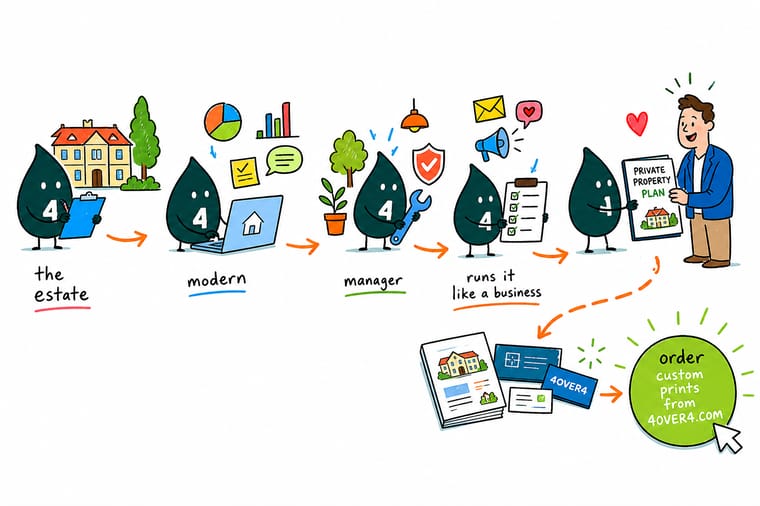
Wally writes down the shutoffs, the serial numbers, the filter sizes and the vendor after hours lines, binds them into one manual, and dates the cover. He puts each system on the calendar at the interval its maker asks for, then attaches the vendor to the reminder. When the pump fails at midnight he is not remembering anything. He is turning to a page.
Print your household manual as a booklet →Specs and pricing
Manual, stationery and labels, with live options
The three print items an estate office reorders most, with sizes, stocks and starting prices straight from the 4OVER4.COM configurator.



Print it
Equip the estate office



Explore more
Where to go next






By the numbers
The print partner behind the estate office
Common Questions
Estate management questions, answered
What does a modern estate manager actually do?
The estate manager runs a private property the way a general manager runs a small company. That means an operating budget and a capital plan, hiring and scheduling the household staff, holding the vendor contracts, keeping the preventive maintenance calendar, managing access and security, handling insurance and warranty paperwork, and running special projects such as a renovation, a move or a large event. On multi property principals the role also coordinates the other houses, the vehicles and often the boat or the aircraft crew. The daily work is scheduling and follow up. The value is that nothing on the property is discovered by failure.
What is the difference between an estate manager, a house manager and a property manager?
Scope and who pays. A house manager runs the inside of one residence: staff, service, standards, supplies. An estate manager sits above that and owns the grounds, the systems, the budget, the contracts and often more than one property, with the house manager reporting in. A property manager works for an owner on income real estate and answers to leases, tenants and rent rolls, which is a different job with different licensing in most states. Titles get used loosely in job listings, so read the duties and the reporting line rather than the word on the door.
What belongs in a household manual?
Six blocks cover nearly everything. A property data sheet with the water, gas and electrical shutoffs, panel locations, meter numbers, well and septic details and alarm zones. An equipment register listing make, model, serial, install date, warranty end and filter size for every system. A vendor directory with the account number and the after hours number. Opening and closing procedures for the house, the pool and the irrigation. The principal's standards, written plainly, from linen changes to how the coffee is made. And an emergency tree that says who calls whom, in order. Write it so a competent stranger could run the house from it on day one.
Should the household manual be printed or kept digital?
Both, doing different jobs. The full manual belongs in a shared digital file because it is searchable, it is current, and you can update one vendor number without reprinting anything. The emergency and systems pages belong on paper in the mechanical room and the kitchen, because a power cut or a dead router takes the digital copy with it. A printed edition also settles arguments about what the standard is. Print it as a dated revision once or twice a year, put the revision date on the cover, and destroy the old copies so nobody works from a stale binder.
How do you build a preventive maintenance calendar from scratch?
Walk the property with a notebook and list every system that has a manufacturer, then find the interval that manufacturer publishes. Standby generators want a monthly exercise cycle and an annual service. Forced air systems want filters on a quarterly rhythm at minimum, more often with dogs or construction dust. Gutters get cleared after leaf fall and again in spring. Flues get swept before the first fire. Irrigation gets started in spring and blown out before the first freeze. Load each item into a shared calendar with a vendor attached and a reminder two weeks ahead, then review the whole sheet each quarter and move the dates that reality keeps overriding.
What should an estate manager do in the first 30 days on a new property?
Find and label the shutoffs, then photograph every panel, plate and serial tag. Collect certificates of insurance and license numbers from every vendor currently on the property, and remove access from anyone you cannot verify. Change the alarm codes and start a key and fob log. Sit with the principal and write down the spending limit, the decision path and the standards that matter most to them, because those are the two conversations everyone skips. Only then start the manual. The first draft can be rough as long as it is real, and it improves every week you use it.
Get Started
House stationery starts at 50 letterheads for $99.95
Bind the household manual, label every shutoff, and print the stationery the estate office sends out, all from one place with a proof before anything runs.
Legal Disclaimer
Gold Standard guarantees apply to all standard orders placed through 4over4.com. Price match requires verifiable proof of a competitor's published price for an equivalent product with matching specifications and turnaround time. Satisfaction guarantee covers manufacturing defects and print quality issues. Contact support with order number and documentation. On-time delivery rate based on tracked orders 1999 to 2026. Individual results may vary based on shipping carrier performance.
