
How to Run a Simple SWOT Analysis in One Hour


Four boxes, one rule that decides which box a line goes in, and the crossing step that turns the grid into decisions instead of wall art.
A SWOT analysis sorts what you already know into four boxes: strengths and weaknesses, which are internal and yours to change, and opportunities and threats, which are external and happen with or without you. The sorting takes an hour. The value comes from the step after it, where you cross the boxes in pairs so each one leaves the room as a sentence with an owner and a date.

Quick answer
Two rows about control, two columns about consequence
Sort by what you control, not by what sounds good. The top row holds the things you can change yourself this quarter. The bottom row holds the things happening outside you. Then cross the boxes: strength with opportunity is where you attack, weakness with opportunity is what you build, strength with threat is what you defend, weakness with threat is what you drop. Five lines per box, one owner per pairing, one date each.
What Actually Belongs in Each of the Four Boxes

The grid has one structural rule, and almost every weak SWOT breaks it. The top row is internal: things you can change by yourself, this quarter, without anyone outside the business agreeing. The bottom row is external: things that happen whether you turn up or not. Helpful and harmful split the columns.
People break the rule because it feels natural to sort by good news instead of by control. "Customers love us" goes in strengths, fine. "The market is growing" also feels like good news, so it lands in strengths too, and now the box mixes things you can act on with things you can only react to. The moment that happens the grid stops producing decisions, because you cannot assign an owner to a market.
| Box | The test it has to pass | A line that fails | The same line, fixed |
|---|---|---|---|
| Strengths | You can use it this quarter without asking permission, and a customer would notice it. | We have a great team. | Two of our four installers are certified on the brand the local hospitals specify. |
| Weaknesses | It is a gap you could close yourself, and somebody could be named against it. | Marketing is weak. | Nobody owns follow up, so quotes over 500 dollars go unanswered after the first email. |
| Opportunities | It is a change already happening outside the business, not something you hope for. | We could grow online. | Two of the four competitors in our county closed their showrooms in the last year. |
| Threats | It is somebody else's move or a rule change, and you can put a date on it. | The economy. | Our largest supplier announced a price rise that takes effect in January. |
Read the last column and the pattern is obvious: every usable line is specific enough that somebody in the room could argue with it. If a line cannot be argued with, it is not a fact, it is a mood. And if a line honestly fits in two boxes, it has been written too vaguely to act on, so split it into the internal half and the external half or throw it out.
Running the Whole Thing in One Hour

The hour only works if it is timeboxed out loud, with someone watching the clock. One shape survives contact with a real group.
- Minutes 0 to 5, write the question. One sentence at the top of the board, with a decision and a deadline in it. "Should we take on a second van before the spring season" is a question. "Our business" is not. Everything that follows gets judged against that sentence, which is what makes the cutting round possible later.
- Minutes 5 to 20, silent writing. Everyone fills their own sheet before anyone speaks. This is the round groups drop first and it is the one that matters most, because as soon as discussion starts the loudest person sets the frame and the quiet person with the counter knowledge writes nothing. A pad each keeps it individual: custom notepads start at $93.37 for a run, and having the four headings already printed on every sheet saves the first two minutes of every session you ever run.
- Minutes 20 to 40, post and cluster. Read lines out, put them in a box, group the duplicates. Duplicates are signal. If five people independently wrote the same weakness, it stops being an opinion. A wall sized grid you can wipe and redraw earns its place here; dry erase posters start at $29 and let the same grid come back out at the next quarterly session instead of being photographed and lost.
- Minutes 40 to 55, cut to five. Each box keeps a maximum of five lines. This is where the thinking happens. A group that will not cut has not decided anything, it has only listed, and a forty line grid has exactly the same priorities as a blank one.
- Minutes 55 to 60, name the pairings. Pick the two crossings you will act on before the next session, and write a name and a date next to each. Without this step the sheet becomes wall art.
One warning on the room. Keep it between four and eight people, and make sure at least two of them speak to customers every day. Grids built entirely by owners are consistently strong on ambition and thin on what goes wrong at the counter, which is precisely the material the weaknesses box needs.
Crossing the Boxes: How a Grid Becomes Four Decisions
A finished grid is a sorted list, and a sorted list is not a plan. The step that converts it is called TOWS, and it is simply reading the boxes in pairs instead of one at a time. Four pairings, four kinds of move.
Strength crossed with opportunity is where you attack. You have something ready and something is changing outside in your favour. This pairing is the shortest path to revenue and it should get the budget. If your certified installers line meets your two closed competitors line, the move writes itself.
Weakness crossed with opportunity is what you build. The opening is real but you are not equipped for it. This is the pairing that turns into a hire, a system, or a piece of training, and it is the one most often mistaken for an attack, which is how businesses chase openings they cannot serve and burn the goodwill.
Strength crossed with threat is what you defend. Something is coming and you have a shield for it. A supplier price rise met with a strong second supplier relationship is a defense, not a crisis. Name the shield explicitly, because in a bad quarter people forget they have one.
Weakness crossed with threat is what you drop or fix now. Exposed and unprepared. This is the pairing to be honest about, and the honest answer is often to stop doing something rather than to try harder at it.
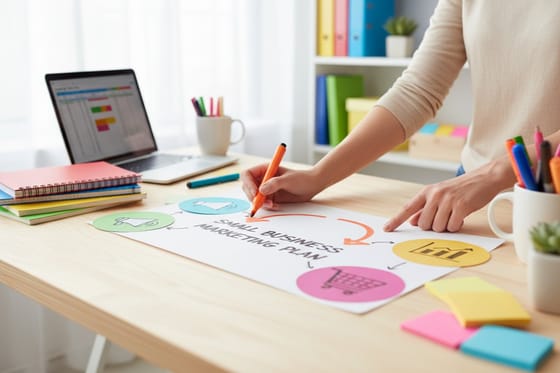
Each pairing has to leave the room as a single sentence with an owner and a date. Once you have those sentences, they need to reach people who were not in the room, and that is the point at which strategy turns into materials: a decision summary that survives the walk to a board meeting, and customer facing copy that says the new thing. Our small business marketing plan guide takes the shortlist and puts a calendar under it, and brand messaging covers turning a named strength into a sentence a customer can repeat.
Where SWOT Falls Down, and What to Put Next to It
SWOT is popular because it takes ten minutes to explain, and it is criticised for the same reason. Three limits are worth knowing before you rely on it.
It has no weighting. Every line looks the same size on the wall. A threat that could end the business sits next to a mildly annoying one in the same typeface. Fix it cheaply: put a rough dollar figure and a date next to every external line before you cut. The cutting round then argues about size instead of about phrasing.
It has no clock. Nothing in the format distinguishes a competitor move landing next month from a demographic shift arriving over ten years. Both are threats, and only one changes what you do this quarter.
It rewards whoever writes the most. The silent round helps, and clustering duplicates helps more, but a grid still reflects who was in the room. If the same three names produce the grid every quarter, bring in someone from a different function or a customer, and expect the weaknesses box to get longer.
What pairs well with it: a pre-mortem for the threats box, where the group assumes the plan already failed and explains why, and any simple scoring pass that forces the shortlist into an order. When the output has to travel, print it. A quarterly one page grid and the four sentences in a short run presentation folder from $108.75 keeps a board pack together, and the customer facing half of the decision usually lands as brochures from $57.11 or a run of flyers from $39.54. Quantity is the lever on all three, so read how bulk price breaks work before you settle on a run size, and browse marketing materials for the full range that comes out of a planning session. For turning the opportunity column into actual pipeline, thirteen lead generation strategies is the practical next read.
Wally explains SWOT
Four boxes, then the two lines you draw across them
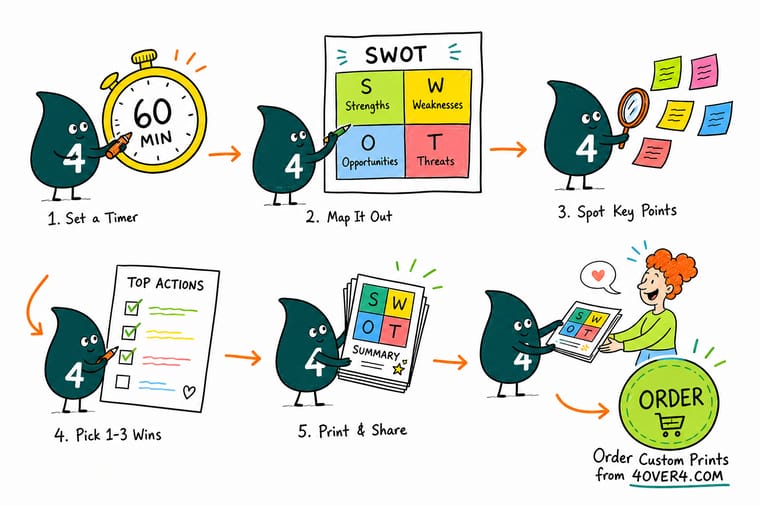
Wally puts one question at the top of the board, then fills four boxes. Top row is anything he can change himself. Bottom row is everything happening outside the shop. He cuts each box to five lines, because a wall of forty says nothing. Then he draws the crossings: a strength meeting an opportunity is where he pushes, a weakness meeting a threat is what he stops doing. Every line he keeps gets a name and a date next to it, or it is just decoration.
Print a reusable dry erase grid →Specs and pricing
The session kit, sizes and starting prices
The three things a planning session actually consumes: a wall grid you can wipe and reuse, a pad per person for the silent round, and something printed to carry the decision out of the room. Live configuration choices and starting prices from the 4OVER4.COM configurator.



Print it
Equip the session, then carry the decision out


Explore more
Where to go next
By the numbers
Printing that keeps up with the plan at 4OVER4
Common Questions
Your SWOT analysis questions, answered
What does SWOT stand for?
Strengths, Weaknesses, Opportunities, Threats. The first two are internal: things inside the business that you can change without anyone else agreeing. The last two are external: market shifts, competitor moves, rule changes, supply conditions. The letters are arranged as a two by two grid so that internal sits on one row and external on the other, which is the only structural rule the tool actually has.
How long should a SWOT analysis take?
An hour with the right people beats a week of circulating a document. Five minutes to write the question at the top, fifteen for everyone to fill their own sheet in silence, twenty to post and cluster the lines on a wall, fifteen to cut each box down to five, and five to name the pairings you will act on. Anything longer usually means the question was too broad and the group is now describing the company instead of deciding something.
Who should be in the room?
Between four and eight people, and at least two of them should touch customers daily. A grid built only by owners and managers tends to be strong on ambition and thin on what actually goes wrong at the counter. Keep it under eight, because past that the silent writing round stops fitting into the time and someone stays quiet the whole session.
What is the difference between SWOT and TOWS?
SWOT sorts the facts. TOWS pairs them. TOWS takes the same four boxes and crosses them: strengths against opportunities gives you the move to push on, weaknesses against opportunities gives you the capability to build first, strengths against threats gives you the defense, weaknesses against threats gives you the thing to stop doing. If your SWOT ended at the grid, you did half the exercise.
How often should we redo it?
Quarterly for the external boxes, yearly for the internal ones. Opportunities and threats go stale fastest because they describe other people, and a threat with a date on it either arrived or did not. Strengths and weaknesses move slowly, so rewriting them every quarter mostly produces the same lines in a different order. Date the sheet, keep the old one, and compare.
Is a SWOT analysis a strategy?
No, and treating it as one is the common failure. A SWOT is a sorted list of what you already know, made visible. Strategy is choosing what to do and what to give up. The grid is useful because it forces everyone to look at the same facts before they argue, and because the internal and external split stops people blaming the market for something they control. What comes out of it is a shortlist, which then needs owners, dates and a budget.
Get Started
Got the four sentences? Print what carries them.
A wipeable wall grid for the session, pads for the silent round, folders and brochures for everything that has to leave the room and reach someone who was not in it.
Legal Disclaimer
Gold Standard guarantees apply to all standard orders placed through 4over4.com. Price match requires verifiable proof of a competitor's published price for an equivalent product with matching specifications and turnaround time. Satisfaction guarantee covers manufacturing defects and print quality issues. Contact support with order number and documentation. On-time delivery rate based on tracked orders 1999 to 2026. Individual results may vary based on shipping carrier performance.
