
Standard vs Oversized Postcards and Which Size Actually Mails Cheaper


One size band decides your postage, and everything above it costs the same to mail. The line sits at a fixed dimension, crossing it buys you space, and a caliper limit catches 16pt cards on the way.
A standard postcard stays within 4.25 by 6 inches and 0.016 inches thick, which is the only band USPS charges the postcard rate for. An oversized postcard is anything past that line, and it mails at the First-Class letter price. The letter rate does not climb again as the card grows, so a 5 by 7 and a 6 by 11 cost the same to mail. Cross the line only when the card needs the space or the visibility, and if you cross it, use the room you are already paying for.
Quick answer
Everything above 4.25 by 6 inches mails at the same price
Standard means postcard rate. Oversized means letter rate. USPS prices a card at the postcard rate only while it stays between 3.5 by 5 and 4.25 by 6 inches, and between 0.007 and 0.016 inches thick. Past any of those numbers the card is priced as a First-Class letter, and it stays at that one price all the way to 6.125 by 11.5 inches. So the decision is binary, not gradual: hold the small band and save on every piece, or step over it and take the whole space that the letter rate already covers.
The Size Line That Sets Your Postage
Everything on this page hangs off one measurement. USPS charges the postcard rate for a rectangular card between 3.5 by 5 inches and 4.25 by 6 inches, with a caliper between 0.007 and 0.016 inches. Inside those numbers you pay the cheapest rate in the mailstream. Outside them, by any amount, you pay the First-Class letter price.
The part people miss is what happens after the line. The letter rate does not scale with the card. A 5 by 7 and a 6 by 11 carry the same postage, because both sit inside the letter maximum of 6.125 by 11.5 inches. So the money question is never how big should this card be. It is whether the card should cross the line at all, and if it does, whether you are taking full advantage of the space you are now paying for anyway.
| Size | Mails as | Design room | Where it fits |
|---|---|---|---|
| 4" x 6" | Postcard rate | One image, one headline, one call to action. | Appointment reminders, repeat drops to a house list, high volume. |
| 4.25" x 6" | Postcard rate, at the exact ceiling | A quarter inch more height than a 4 by 6. | Getting the most card out of the cheap rate. |
| 5" x 7" | Letter rate | Headline plus a short offer block that still reads at arm's length. | Invitations, announcements, product launches. |
| 5.5" x 8.5" | Letter rate | Half a letter sheet, room for a coupon and a map. | Menus, service lists, grand openings. |
| 6" x 9" | Letter rate | Two clear zones, offer on one side, proof on the other. | Home services, dental, real estate. |
| 6" x 11" | Letter rate, near the limit | Full panel layouts with several offers. | Seasonal promotions that would otherwise need a brochure. |
Confirm the current rates with USPS before you commit a budget, since the numbers move. The size bands themselves have been stable for years, and they are what your artwork has to respect. Our guide to laying out a postcard for mailing covers the address side rules that come with either choice.
What Actually Changes When You Go Oversized
Three postcard lines cover almost every job, and they differ less in quality than in what they are set up to do. All three share the same 22 paper types, the same three ink options and the same rounded corner and variable data choices, so the decision is about size, quantity and whether we mail it for you.
| Product | Sizes offered | Starts at | Choose it when |
|---|---|---|---|
| Standard Postcards | 2.5" x 2.5" through 6" x 11" | $16.48 | You want the full size ladder, including the only sizes that hold the postcard rate. |
| Oversized Postcards | 4" x 6" through 6" x 9" | $51.62 | You have settled on a larger card and want the scoring option for a fold. |
| Direct Mail Postcards | 4" x 6" through 6" x 9" | $89.68 | You want the cards printed, addressed and dropped in the mailstream by us. |
Read those starting prices carefully, because they are not comparing the same thing. Standard Postcards start at $16.48 on the 2.5 by 2.5 inch mini at the smallest quantity tier. Oversized Postcards start at $51.62 because the base configuration is already a 5.5 by 8.5 sheet. Set both to the same size and the same quantity in the configurator and the gap narrows to what the extra paper actually costs. The standard line also carries fourteen quantity tiers against ten on the oversized line, which matters if you order in small repeat batches rather than one annual run.
The one genuine feature difference: the oversized line offers a second scoring option, so a 6 by 9 can be scored and folded into a self mailer. The standard line offers a single scoring choice. If the piece needs to fold, start on the oversized configurator rather than trying to force it later.
Picking Between 4 by 6 and Everything Above It
Start with the arithmetic, because it decides more jobs than taste does. On a five thousand piece drop, the difference between postcard postage and letter postage multiplies five thousand times before a single card is read. On a four hundred piece drop to a warm list, that same difference is small enough to ignore, and the larger card is almost always the better buy.
Then look at where the card lands. Mail gets sorted standing at a counter, and the sort is physical: bills and statements get squared into a pile, and anything smaller than a letter tends to disappear inside it. A 4 by 6 survives that only if the recipient already knows you. A 6 by 9 cannot be hidden. It sits on top, face up, and it gets read before it gets thrown out. That is what the letter rate is actually buying, and it is worth paying for on a cold list and wasted on a reminder card.
The third question is how much you have to say. If the offer is one sentence and a phone number, a bigger card does not help, it just gives you more white space to fill badly. If the piece needs a before and after image, a service list and a map, a 4 by 6 will look cramped no matter how carefully you set it. Print a sample at full size, hold it at arm's length, and see whether the headline still reads. Our blank template library has the correct trim, bleed and safe area for every size we print, so the sample matches what comes off the press.
One caveat worth knowing before you size a carrier route campaign: EDDM Retail requires a flat-size piece, taller than 6.125 inches or longer than 11.5 inches. Our largest card, the 6 by 11, misses both by a small margin and is therefore not EDDM eligible. If you are weighing a full campaign against doing it yourself, the direct mail agency versus DIY comparison lays out what each route costs in time.
Stock, Coating and the Thickness Ceiling
Size is the loud decision. Caliper is the quiet one, and it catches people at the post office counter rather than on the proof. The postcard rate allows 0.016 inches of thickness. 16pt cardstock measures about 0.016 inches, which means it qualifies with nothing to spare.
Add a laminate to that 16pt sheet and it stops qualifying. Gloss laminated postcards bond a plastic film to both faces, which is what makes them tear resistant and water resistant, and it is also what puts the finished card over the limit. The fix is simple once you know it: for a laminated card at the postcard rate, print on 14pt. For a 16pt card at the postcard rate, choose a UV coating instead, which adds shine without adding measurable caliper.
Coating has a second consequence nobody mentions until the cards arrive. A gloss or UV coated address side will not hold ballpoint or gel ink, so anything you plan to hand address or hand sign has to be printed uncoated on that face, or coated on the front only. If the campaign includes a handwritten note, say so when you order rather than discovering it with five thousand cards on the desk.
Beyond that, the stock choice is about what the card is for. Uncoated reads as personal and takes pen. Coated holds saturated color and photographic images. The heavier linens and metallic pearlescent stocks in the range make sense on invitations and announcements, where the card is kept rather than skimmed. If you want to compare finishes side by side before committing, the postcard printing category lists every stock and finish we run, and the comparison guides cover the finish decisions that come up most often.
Wally measures the cutoff
Two cards, one ruler, two very different postage bills
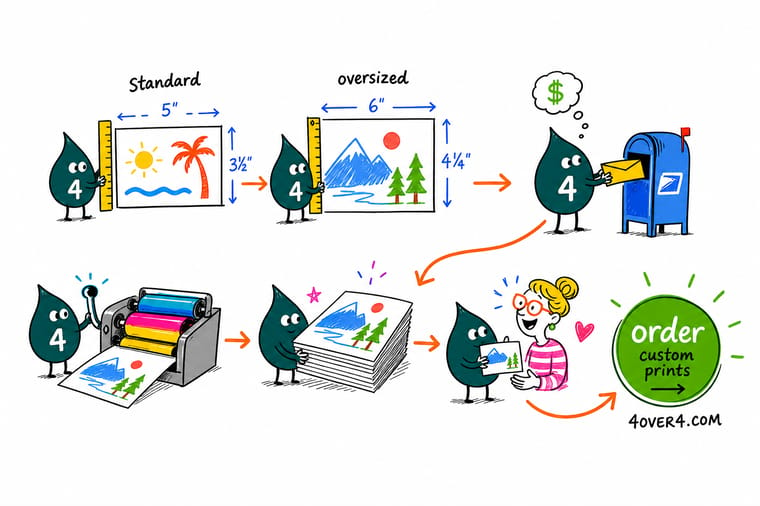
Wally holds a 4 by 6 in one hand and a 6 by 9 in the other. The small one fits inside the 4.25 by 6 inch box, so it mails at the postcard rate. The big one does not, so it mails as a letter. What he wants you to notice is the third card in his pocket: a 6 by 11. It costs exactly the same postage as the 6 by 9, because once you are over the line the price stops moving. If you are paying letter rate anyway, take the space.
Compare postcard sizes and prices →Specs and pricing
Sizes, stocks and starting prices side by side
The live configurator for each postcard line, so you can price the same size at the same quantity instead of comparing two different base configurations.


Print it
Order the size the campaign actually needs
Explore more
Where to go next
By the numbers
Standard, oversized and gloss laminated postcards
Common Questions
Your postcard size questions, answered
What counts as a standard postcard?
For postage purposes, a standard postcard is rectangular, at least 3.5 by 5 inches and 0.007 inches thick, and no more than 4.25 by 6 inches and 0.016 inches thick. Stay inside all four numbers and USPS charges the postcard rate. Break any one of them and the piece is priced as a First-Class letter. In print shop language the term is looser: most people mean a 4 by 6, which is the size that sits comfortably inside the band with room for a trim variance.
Do oversized postcards cost more to mail?
Yes, but only once. Every card above 4.25 by 6 inches mails at the First-Class letter price, and that price does not climb again as the card grows. A 5 by 7 and a 6 by 11 cost the same to mail. That is why stepping from 4 by 6 to 5 by 7 is the expensive decision and stepping from 5 by 7 to 6 by 9 is nearly free on postage, though the printing and the paper still go up.
Can I print a 16pt postcard and still pay the postcard rate?
16pt cardstock measures about 0.016 inches, which is the exact ceiling, so it qualifies but with no margin. Anything added on top of the sheet changes that. Gloss lamination bonds a film to both faces and pushes the finished card past the limit. If you want a laminated card at the postcard rate, drop to 14pt. If you want 16pt, order it with a UV coating rather than a laminate, since coating adds no measurable caliper.
Is a 6 by 9 postcard worth the extra postage?
It is worth it when the card has to survive the sort at the kitchen counter. A 6 by 9 cannot be tucked inside a folded bill or slipped under a magazine, so it stays visible. Home services, dental practices and real estate agents use that size for exactly that reason. For appointment reminders, order confirmations and repeat drops to a house list, the extra postage on every piece buys attention nobody needed to be paid for, and a 4 by 6 does the job.
What is the largest postcard I can order at 4OVER4.COM?
The Standard Postcards configurator runs from 2.5 by 2.5 inches up to 6 by 11 inches. A 6 by 11 is still inside the First-Class letter maximum of 6.125 by 11.5 inches, so it mails as a letter rather than as a flat, which surprises people who assume a card that large must be priced like an envelope. Oversized Postcards run 4 by 6 through 6 by 9 and add a second scoring option if you want the card folded.
Does an oversized card change how I lay out the address side?
The rules are the same but the space is different. USPS still wants the delivery address, the barcode clear zone and the postage block in the right hand portion of the address side, with a quiet margin around them. On a 4 by 6 that eats most of the panel and leaves you a narrow message column. On a 6 by 9 the same block occupies a corner and leaves a genuinely usable half panel for copy, which is one of the few design arguments for going larger.
Can I use an oversized postcard for EDDM?
Not automatically. EDDM Retail requires a flat-size mailpiece, which means taller than 6.125 inches, longer than 11.5 inches, or thicker than 0.25 inches. A 6 by 11 card misses the height requirement by an eighth of an inch and misses the length by half an inch, so it does not qualify. The common EDDM sizes clear the bar on height, which is why 6.5 by 9 shows up so often on carrier route mailers.
Get Started
Standard cards run 50 for $16.48, oversized 50 for $51.62
Set the size, the stock and the quantity in the configurator and you get a live price before you upload a file. Cross check the caliper if the card has to hold the postcard rate.
Legal Disclaimer
Gold Standard guarantees apply to all standard orders placed through 4over4.com. Price match requires verifiable proof of a competitor's published price for an equivalent product with matching specifications and turnaround time. Satisfaction guarantee covers manufacturing defects and print quality issues. Contact support with order number and documentation. On-time delivery rate based on tracked orders 1999 to 2026. Individual results may vary based on shipping carrier performance.
