
How to Design a Farmers Market Banner That Sells From Across the Aisle


Where to hang it on a 10 foot canopy, mesh or vinyl, how tall the letters have to be for a market aisle, and the hem and grommet details that keep it flat all morning.
Design a farmers market banner around one glance from the middle of the aisle: a 3 by 6 foot banner on the canopy back wall above crate height, three lines of text, and capital letters about one inch tall for every ten feet of viewing distance. Print it on mesh if it ties to a canopy frame so wind passes through, on solid vinyl if it hangs against a wall. Keep live text 2 inches inside the trim because the hem folds back, and ask for grommets every 2 feet rather than corners only.
Quick answer
One glance from the aisle is all you get
Put the banner where the crates cannot hide it and size the type to the aisle. On a standard 10 by 10 pop-up, that means a 3 by 6 foot banner on the back wall or a 2 by 8 across the top bar, carrying the farm name, what you sell, and one proof line. Capital height runs about one inch per ten feet of read distance, so a 20 foot aisle needs 2 inch caps at minimum. Mesh for anything tied to the frame, vinyl for a flat wall, text held 2 inches inside the trim, grommets every 2 feet.
Start With Where It Hangs, Then Pick the Size
Most market banners are designed as a rectangle on a screen and only afterwards do people work out where to tie it. Do it the other way around. Walk the stall in your head at 9am, when the table is loaded and two customers are standing in front of it, and ask what a shopper can still see from the middle of the aisle.
The answer is almost always the canopy back wall. A 3 by 6 foot banner there sits above crate height, fills the space behind you, and reads down the row. Across the front top bar of a 10 foot canopy, go 2 by 8 or 2 by 10 feet so the banner spans the frame instead of floating with slack on either side. The table front is the weakest position, because by mid-morning it is behind produce boxes and a cooler, so give it a 2 by 6 foot piece carrying prices or a payment note rather than your farm name.
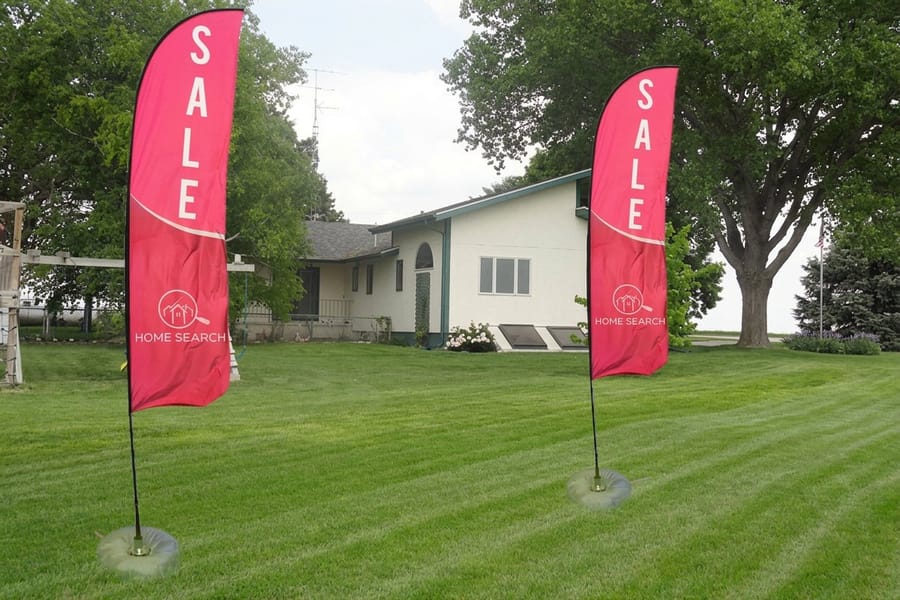
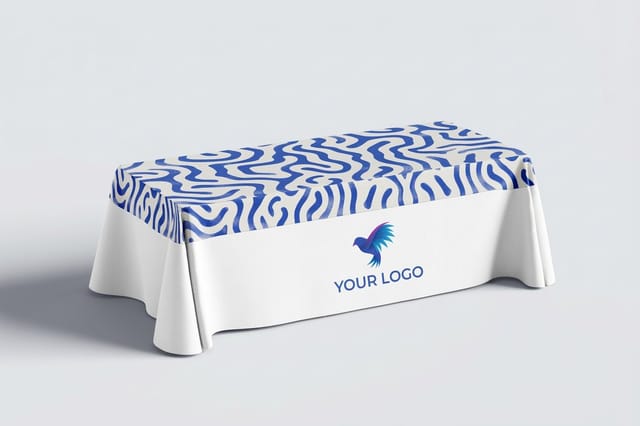
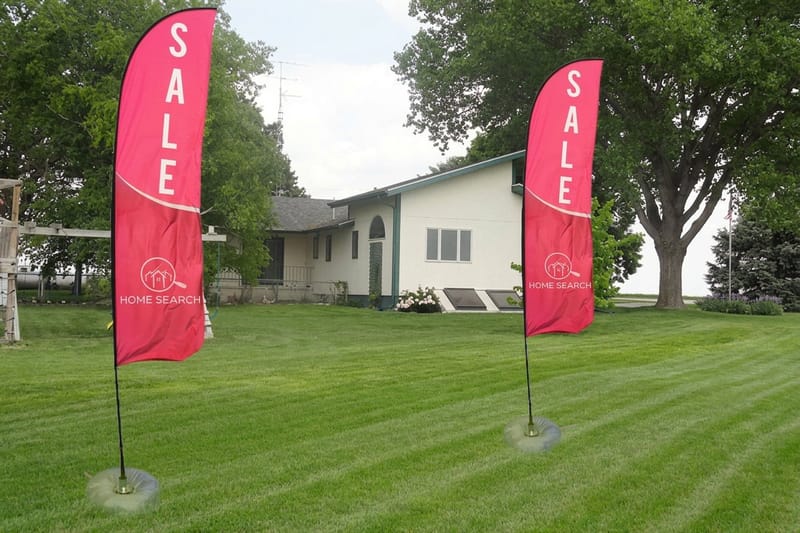
Two more surfaces earn their space at a busy market. A feather flag is vertical, so it stays visible over the heads of a crowd and marks your row from the parking lot. A fitted table throw replaces the table-front banner and hides everything stored underneath, which no banner can do. If you are still deciding between a flexible banner and a rigid panel for the same job, our banners versus signs guide lays out where each one wins.
Vinyl or Mesh, and Why the Wind Decides
Material is not a taste question at an outdoor market. It is a wind question, and a pop-up canopy is the lightest structure on the field.
| Material | How it behaves outdoors | What it costs you | Use it for |
|---|---|---|---|
| Scrim vinyl | Solid and opaque. Catches wind across the full face, so it pulls hard on whatever it is tied to. | Nothing in image quality. It is the sharpest of the three. | Back walls, indoor markets, brick walls, anything sheltered. |
| Mesh vinyl | Perforated, so air passes through instead of pushing the banner. | Tiny visible holes up close and slightly softer color. | Canopy frames, fences, any open-air stall in a breeze. |
| Fabric | Hangs soft, no glare, wrinkles from folding until it relaxes. | Less rain tolerance than vinyl and a higher price. | Indoor winter markets and photo-friendly brand backdrops. |
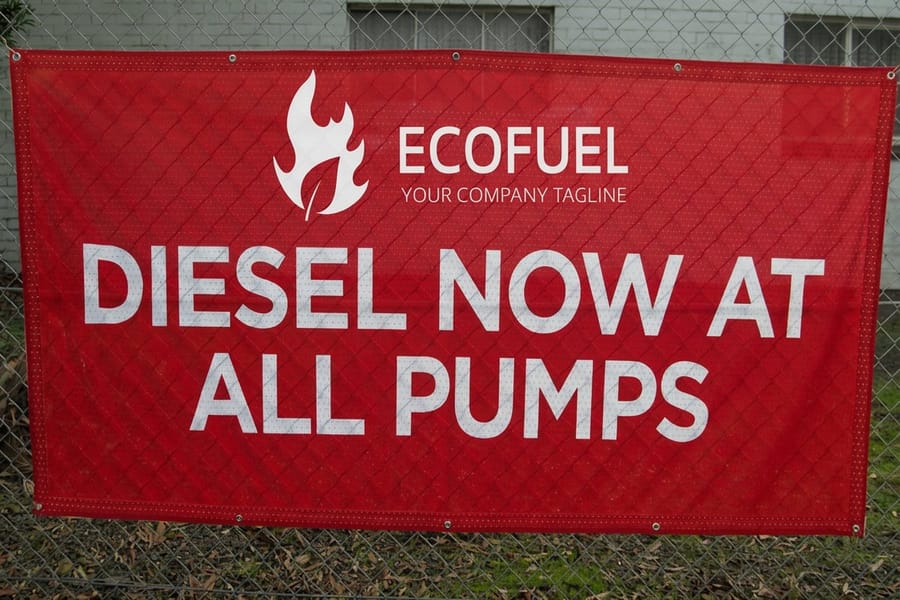
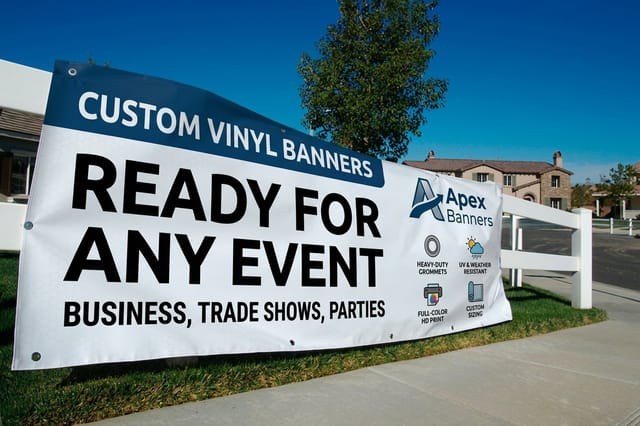
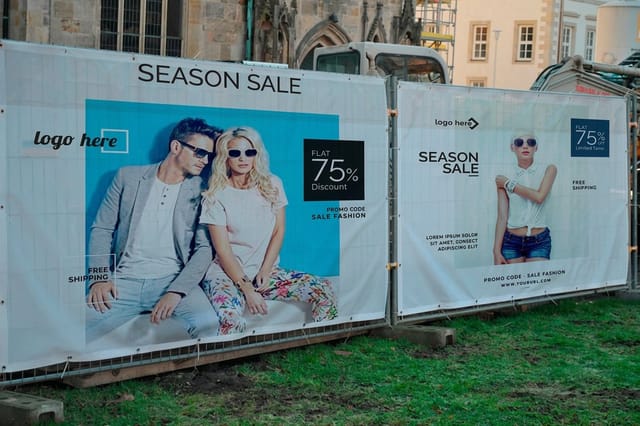
The practical rule: if the banner is tied to something you carried in yourself, print it on mesh banners. If it hangs against a wall or a solid backdrop, vinyl banners give you the cleaner image. Weight matters less than people expect at market sizes, though 13oz scrim is the standard for anything that gets rolled and unrolled every weekend. The full breakdown lives in our banner material guide.
Layout: Three Lines, Sized for the Aisle
A market banner is read at walking pace by someone already carrying a bag. You get one glance, and the glance answers one question: is this the stall I want.
So write three lines and stop. Line one is the farm or business name, set as large as the banner allows. Line two is what you sell, in plain words, because "Hollow Creek Farm" tells a stranger nothing while "Peaches and Stone Fruit" turns a walker into a customer. Line three is the single proof or offer that matters here: certified organic, no spray, pick your own Sundays, or the market days you attend. A fourth line costs the first three their size.
Size the type off the distance, not off the artboard. Roughly one inch of capital height reads at ten feet, so a 20 foot aisle wants 2 inch caps as the absolute floor. On a 3 by 6 foot banner that puts the name around 6 to 10 inches tall, the product line at 3 to 4 inches, and anything under 2 inches is decoration nobody reads. Set the name in something heavy with open counters. Condensed light type looks elegant on screen and disappears at thirty feet, and script fonts lose entirely at that distance. Our banner font guide has the specifics on which faces hold up.
Leave the middle third of a table-front banner emptier than feels right. That is where the cash box, the scale, and a customer's elbow will be.
Color, Photos, and What Full Sun Does to Both
Contrast beats color choice every time. Dark type on a light field or light type on a saturated field both read at distance. Two mid-tone colors against each other, like a medium green on a medium brown, look agricultural and vanish by the time a shopper is two stalls away. Squint at your proof on screen: if the words stop being words, the banner is already failing.
Photographs are where most farm banners go wrong. A crate of tomatoes shot at golden hour looks fantastic on a laptop and turns into a red-brown smear under an open sky with type sitting on top of it. If you want produce imagery, use one clean object against a plain background, keep it on one side, and put text on flat color rather than over the picture. Flat color also survives fading better, since there is no fine tonal detail to lose. There is more on high-visibility pairings in our advertising sign color guide.
One honest limit: deep reds and purples are the first inks to shift under months of direct sun, so a banner built entirely on a plum background will look tired sooner than the same design on a strong blue or green. Store it rolled printed side out rather than folded, because a fold crease holds a shadow permanently and the crease always lands across a letter.
Setting Up the File and Hanging It Straight
Banners do not need the resolution a business card needs, because nobody reads one from eight inches away. Build at full size at 100 to 150 dpi, or build at a tenth scale at 300 dpi and let us scale it up. What you cannot do is stretch a 72 dpi web logo across six feet and hope, since the edges of the letters will visibly stair-step at arm's length while a customer stands at your table.
- Bleed: extend background color at least 0.25 inch past every edge so the trim never exposes white.
- Safe area: hold live text 2 inches inside the trim. A hem folds roughly an inch of material back and grommets punch through that fold.
- Color: supply CMYK. A screen blue set in RGB prints duller, and on a six foot banner that shift is impossible to ignore.
- Type: outline your fonts, or send the file with fonts embedded, so nothing resets to a default face on our end.
- Grommets: ask for them every 2 feet along the top and bottom edges, not just the corners.
Start from a correctly proportioned layout in the blank template library rather than guessing the artboard, and check the dimensions against our banner size guide before you place a single element.
Hanging is the last quarter of the job. Use a zip tie or a bungee ball at every grommet along the top, then tie the bottom edge too. A banner secured only at two top corners sags into a smile and flips face-away in the first gust, and a folded-back banner sells nothing. If your market puts you on grass with no frame at all, yard signs on wire stakes take the message down the walkway to the entrance where the crowd arrives.
Wally sets up the stall
Banner high, three lines, big letters, ties on every grommet
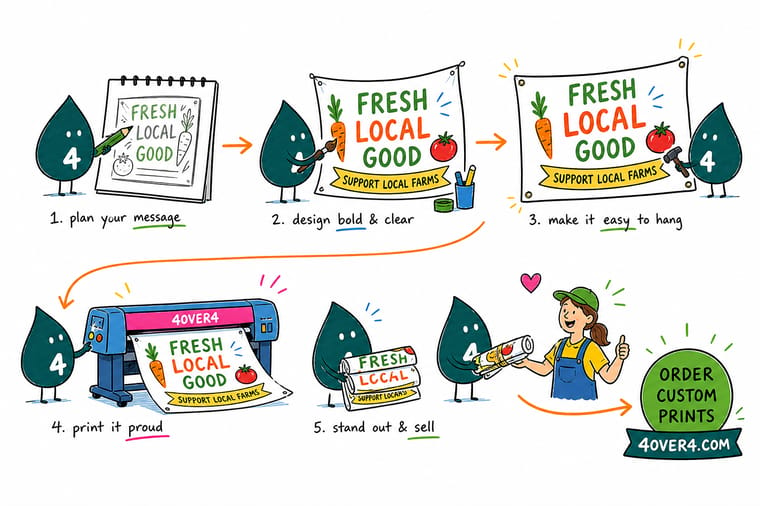
Wally loads the table first, then stands back in the aisle to see what is left showing. The table front is gone behind the crates, so his banner goes on the canopy back wall. Farm name huge, what he sells underneath it, one proof line, nothing else. He measures the letters against the aisle, not against the banner. Mesh, because his canopy weighs less than the wind. And a tie at every grommet, top and bottom, so it stays flat instead of flipping backwards at ten in the morning.
Price a mesh banner for your stall →Specs and pricing
Banner sizes, materials, and starting prices
Configure the size, hem and grommet options for each banner type and see the live starting price from the 4OVER4.COM configurator.

Print it
What to order for a market stall
Explore more
Where to go next

By the numbers
Vinyl and mesh banners for open air stalls
Common Questions
Your market banner questions, answered
What size banner do I need for a farmers market stall?
For the standard 10 by 10 foot pop-up canopy, a 3 by 6 foot banner on the back wall is the usual pick. It clears the crates, fills the visual gap behind your head, and still fits in a tote. If you are hanging across the front top bar instead, go 2 by 8 or 2 by 10 feet so it spans the frame rather than floating in the middle of it. The table front takes a 2 by 6 foot piece, which matches a six foot folding table with a little wrap at the ends.
Should a farmers market banner be vinyl or mesh?
Mesh if the banner is tied to a canopy frame or a fence outdoors, vinyl if it hangs flat against a wall or a solid backdrop. Mesh vinyl is perforated so wind passes through it, which stops the banner from behaving like a sail and pulling on the frame. The trade-off is real: mesh shows tiny holes up close and looks slightly softer in color, so a design that leans on fine text or a photographic background prints better on solid vinyl.
How big should the text be on a market banner?
Work backwards from where the shopper stands. The trade rule of thumb is about one inch of capital letter height for every ten feet of viewing distance, so a 20 foot aisle needs 2 inch caps as the floor and your farm name should be well above that. On a 3 by 6 foot banner that usually means the name sits between 6 and 10 inches tall, the product line around 3 to 4 inches, and nothing smaller than 2 inches survives.
Will a banner fade over a season of Saturdays?
Outdoor banner inks hold up for a season of weekend use, but two things shorten that. Deep reds and purples shift first under direct sun, and a banner left rolled wet in a hot car develops creases that print as shadows. Roll it printed side out around a length of pipe, never fold it, and pick a strong contrast that still reads if the color drifts a little.
How do I attach a banner to a pop-up canopy?
Grommets every 2 feet along the top and bottom, then zip ties or bungee balls at every grommet rather than rope through two corners. Tension across the whole edge is what keeps the banner flat and stops the middle from bowing in a gust. Tie the bottom edge as well, even loosely, or the banner will flip up and show its back to the aisle all morning.
What does a farmers market banner cost?
A printed vinyl banner starts at $79 at 4OVER4.COM and mesh banners start at $75, which covers most stall sizes. If you sell at an indoor winter market or a food hall where there is nothing to hang from, retractable banner stands start at $139 and stand on their own. A fitted table throw runs $225 and replaces the table-front banner entirely, with the bonus that it hides the crates and coolers underneath.
Get Started
Order a 3 by 6 vinyl banner, printed in 3 business days
Pick your size, choose mesh for the canopy or vinyl for a wall, add hems and grommets every two feet, and we print it flat and ready to tie.
Legal Disclaimer
Gold Standard guarantees apply to all standard orders placed through 4over4.com. Price match requires verifiable proof of a competitor's published price for an equivalent product with matching specifications and turnaround time. Satisfaction guarantee covers manufacturing defects and print quality issues. Contact support with order number and documentation. On-time delivery rate based on tracked orders 1999 to 2026. Individual results may vary based on shipping carrier performance.
