
How to Choose a Trade Show Display Company That Ships On Time


Most display vendors show the same photos and quote the same formats. What separates them is elsewhere, and five questions settle it before you pay a deposit.
Judge a trade show display company on four things: whether it prints the graphic itself, when its production clock starts, what a replacement panel costs on its own, and whether hardware and graphics ship together. Price comes after those, because the cheap stand with a sealed graphic costs more by the second show. Confirm the venue height rule and the advance warehouse deadline before you order anything taller than a retractable stand.
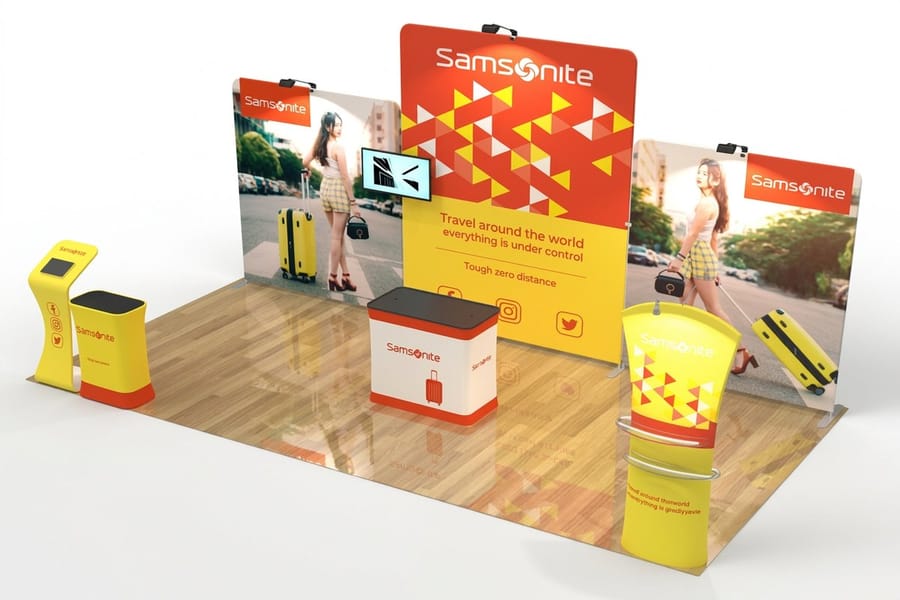
Quick answer
The vendor question that decides everything else
Find out who runs the press before you compare prices. A display company that prints in house owns your file, your proof and your ship date. A storefront that forwards the job to a wholesale printer owns none of them, and every extra handoff is a place the artwork gets re-exported and a day nobody is accountable for. After that, three numbers decide the rest: when the production clock starts, what a replacement graphic costs by itself, and what the show hall allows in your booth.
First Question: Does the Company Print the Graphic Itself?

A large share of trade show display websites do not own a printer. They take the order, forward the artwork to a wholesale printer, and pass the tracking number back to you. The product can still be fine. What changes is who answers when something goes wrong.
Count the handoffs. On a resold job your file is exported once by you and again by the reseller, the proof is generated by a company you never speak to, and the ship date lives in a system your salesperson can only ask about. On a direct job there is one file, one proof, and one person who can walk to the press. That difference shows up on the days when nothing goes wrong, and it decides the outcome on the day something does.
You can settle it in one email. Ask what equipment the graphic is printed on and where. A printer answers in a sentence. A reseller changes the subject to product features. The same test works for signage vendors generally, which is the point of our guide to choosing a sign printing company.
The other half of the question is whether hardware and graphics ship from the same place. When a panel arrives an eighth of an inch too wide for its rail, a single supplier reprints it. Two suppliers argue. Buying a complete trade show booth kit, or matching stands and graphics from one displays and stands catalog, removes that argument before it starts.
What Each Display Type Costs, and Where Each One Fails
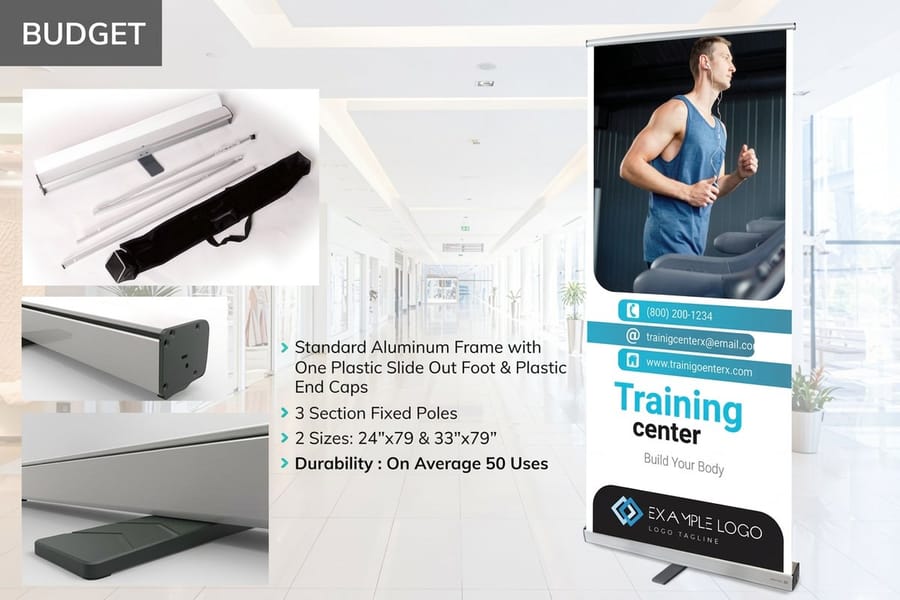
Vendors sell the same five or six formats under different names, so compare the format first and the brand second. Starting prices below are live 4OVER4.COM prices, and the last column is the part sales pages leave out.
| Display | Starts at | Setup | Where it belongs | What it gives up |
|---|---|---|---|---|
| X-frame stand | $91 | Under a minute, one person | Corridors, registration tables, cheap extra sign | Grommets pull at the corners and the fabric ripples, so it reads budget next to a fabric wall |
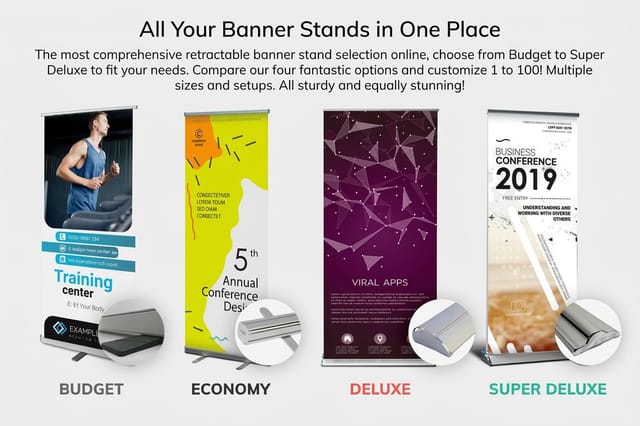
| Retractable stand | $139 | Under a minute, one person | The default booth sign, flanking a table or a doorway | The cassette swallows the bottom of the graphic and the spring is the part that eventually dies |
| Table throw | $225 | Drape it, no tools | Any booth with a table, hides the crates underneath | Needs the right table length, and the fold over the front edge cuts into the top of the design |
| Feather flag | $108.75 | Pole sections plus a base | Outdoor events, parking lots, sidewalk traffic | Height rules inside most halls, and it needs a weighted base on any hard floor |
| Pop up display | $752.39 | Twenty minutes, two people | The back wall of a 10 by 10 in-line booth | A real case to ship and store, and creases if the fabric is packed badly |
Two comparisons come up constantly. The X-frame versus the retractable is the clearest: the retractable costs more because the graphic is under tension in a rigid cassette instead of hanging off four corner grommets, which is exactly what our retractable versus X-frame comparison walks through. The other is the table covering, where a table runner at $97.76 covers only a strip down the front and leaves the boxes under the table on show, while a full throw at $225 closes the front and the sides. Our table covers versus table runners breakdown has the measurements.
Height is the rule people learn the expensive way. A standard in-line booth caps the back wall at eight feet with side rails much lower, which is why a tall flag that works outside a store gets pulled inside a hall. The exhibitor kit states the limit for your show. Read it before you order anything taller than a retractable.
Read the Turnaround the Way a Printer Reads It
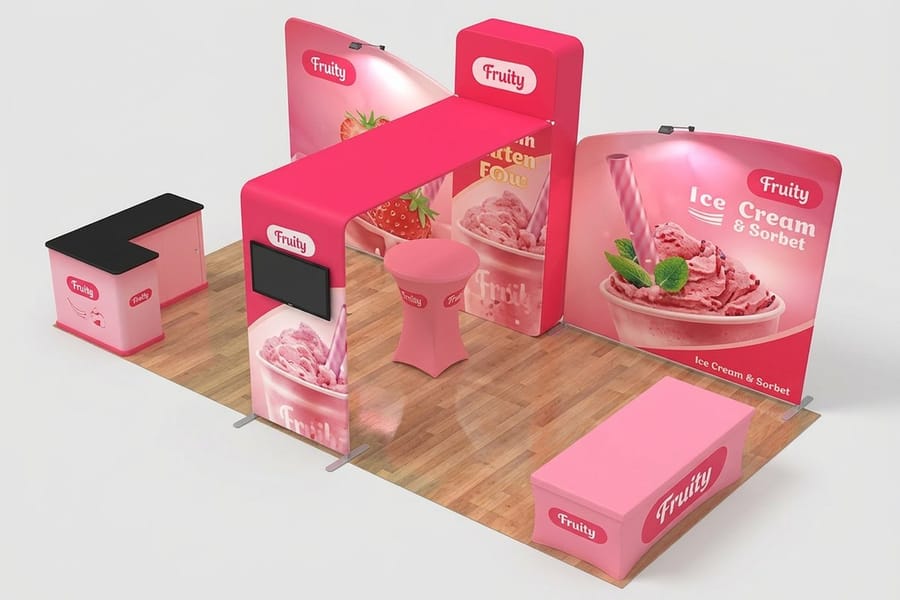
Almost every missed show deadline comes from reading a production time as a delivery date. They are different numbers and the gap between them is where the panic lives.
Build the calendar backwards from the hall, in four blocks. The show has a deadline for the advance warehouse, which is usually about two weeks before the doors open and is stated in the exhibitor kit. Before that sits transit from the plant, which depends on distance and on whether a crated booth is going freight rather than parcel. Before that sits the printer production window, which is the only number the vendor quotes. And before all of it sits your own approval time, because artwork changes hands twice and someone always wants the tagline reworded.
Two questions separate a vendor that will hold the date from one that will not. When does the production clock start, at checkout or at proof approval? And what is the last date they can accept the order and still hit the show? A vendor that has actually shipped to convention centers answers both without checking. If you are already inside the danger window, our last minute booth materials guide covers what can still be saved and what cannot.
Hardware weight matters here too. A retractable stand ships in a slim box and moves like any parcel. A booth kit ships crated, and crated freight is scheduled rather than dropped off, so it needs more room in the calendar than its production time suggests. Everything about how the file becomes a shipment is in our guide to how online printing works, and the full equipment range sits under large format printing.
Five Questions That Sort the Vendors in One Email

Send the same five questions to every vendor on your shortlist and compare the replies rather than the websites. The answers take a good supplier ten minutes and expose a weak one immediately.
| Ask this | A good answer sounds like | Walk away when |
|---|---|---|
| Do you print the graphic in house? | Names the process and the location | They answer about the product instead of the press |
| When does the production clock start? | At proof approval, and here is the cutoff time | Only a vague range, never a start point |
| What does the replacement graphic cost? | A price for the panel alone, in writing | The graphic cannot be bought separately |
| What happens if the color is off? | A stated reprint policy with a deadline to report | Case by case, decided after you complain |
| Do you supply a template for this exact stand? | A sized file with the safe area marked | Send a PDF at the finished size and we will fit it |
The template question is the sharpest of the five. Every display format has hidden geometry: the cassette on a retractable, the fold on a table throw, the panel seams on a pop up wall. A supplier who prints these every week has a file for each one, marked. A supplier who tells you to send whatever you have is going to scale your artwork and hope. Our blank template library is where our own sizes live, and the trade show planning checklist puts the artwork deadline where it belongs in the timeline.
One more thing worth pinning down in writing: what the vendor does when the piece arrives wrong. Ours is stated openly on the 4OVER4.COM guarantees page, and any supplier should be willing to point at something equally specific instead of a friendly sentence in the chat window.
Wally sizes up a display vendor
Ask who runs the press, then ask what the reprint costs
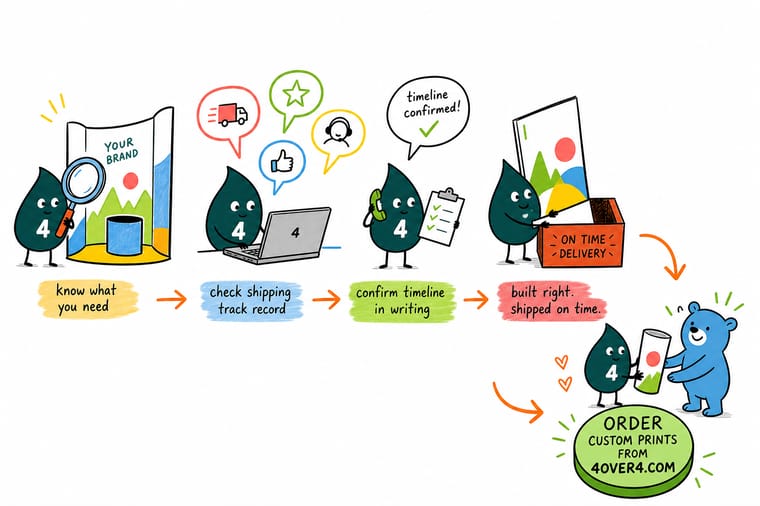
Wally reads a display quote from the back. He wants to know who prints the graphic, when the clock starts, and what the replacement panel costs on its own, because that is the number he pays again at the next show. Then he checks the exhibitor kit for the height rule, because a flag that clears a parking lot is often too tall for an in-line booth. Only after all that does he look at the price of the stand.
Shop retractable banner stands →Specs and pricing
Display sizes, options and starting prices
The three formats that cover most booths, with live configuration choices and starting prices straight from the 4OVER4.COM configurator.



Print it
Order the display and the graphic from one place


Explore more
Where to go next




By the numbers
Trade show printing you can plan around
Common Questions
Your trade show vendor questions, answered
Should I buy from a trade show display company or from a printer?
Buy from whoever actually prints the graphic, because that is the part that fails. Display specialists are useful when you need a custom island build, rigging, or on-site labor at the hall. For the pieces most exhibitors actually need, a retractable stand, a fabric wall, a table throw and a stack of handouts, a commercial printer that runs its own large format equipment removes a middleman from the schedule and from the proof.
How far ahead should I order trade show displays?
Work backwards from the venue, not from the vendor. Find the exhibitor kit deadline for the advance warehouse, subtract shipping transit, subtract the printer production window, then subtract three or four days for your own artwork approval, because that is the step that always slips. Ordering the week of the show is possible for a single retractable stand and close to impossible for a full booth kit that has to be crated.
What does a trade show display actually cost?
At 4OVER4.COM an X-frame banner stand starts at $91, a retractable banner stand at $139, a table throw at $225, a pop up display at $752.39, and a full trade show booth kit at $2,599. The spread is mostly hardware. A retractable and a pop up print the same way, but one is a spring roller in an aluminum cassette and the other is a collapsible frame with magnetic fabric panels and a shipping case.
Can I reuse the hardware and reprint only the graphic?
On mainstream retractable stands and pop up frames, yes, and that is the main reason to care which system you buy into. Ask two things before ordering: does the vendor sell the replacement graphic on its own, and what does that panel cost. Some low priced stands are sealed units where the graphic cannot be swapped, which turns a reprint into a whole new stand.
What should I check in the artwork before approving a display proof?
Check the bottom and the edges. A retractable graphic loses roughly the bottom inch and a half into the cassette, so a logo parked at the base disappears. On a table throw, the fold over the table edge eats the top band of the design, and anything below the table line is hidden by chairs and boxes. Keep type inside the safe area, build the file at full size, and start from a correctly sized layout in the blank template library rather than scaling a poster file up.
Does one vendor need to supply the whole booth?
No, but the pieces that touch each other should come from the same place. Hardware and its graphic belong together. Handouts, business cards and signage can come from anywhere, as long as the colors were built from the same file and printed on comparable stock, since a logo printed on uncoated stock will read warmer next to the same logo on a fabric wall.
Get Started
Order a pop up display from $752.39
Pick the stand, upload the graphic once, and get hardware and print from the same place so nobody can pass the blame at the loading dock.
Legal Disclaimer
Gold Standard guarantees apply to all standard orders placed through 4over4.com. Price match requires verifiable proof of a competitor's published price for an equivalent product with matching specifications and turnaround time. Satisfaction guarantee covers manufacturing defects and print quality issues. Contact support with order number and documentation. On-time delivery rate based on tracked orders 1999 to 2026. Individual results may vary based on shipping carrier performance.
