
How to Choose Company Banners That Read Across the Room and Survive the Weather


Where the banner hangs decides the material, and how far away people stand decides the size. Both numbers are below, alongside the finishing that keeps a banner attached and the kit that comes back out next season.
Order a company banner by where it hangs: 13oz. vinyl on a wall or storefront from $79, perforated mesh in wind from $75, a blockout retractable stand for a booth aisle from $139, and a step and repeat backdrop for a photo line from $217.50. Size it with the signage rule of one inch of capital-letter height per ten feet of reading distance, so a headline read across a 50 foot lot needs five inch caps. Keep dates and booth numbers off the expensive pieces and the same kit works at the next event.
Quick answer
Placement picks the material, distance picks the size
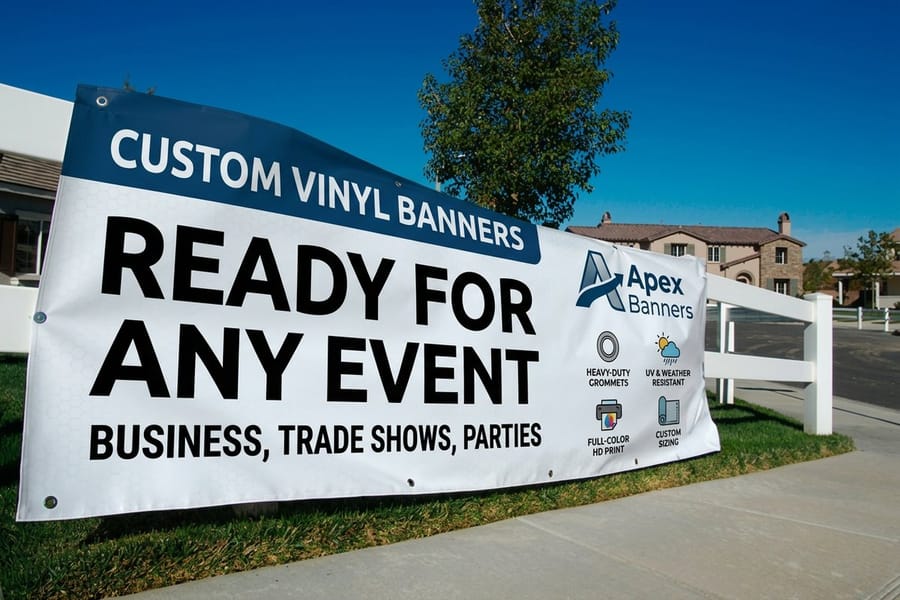
Start with the spot, not the artwork. A wall or storefront takes 13oz. vinyl, an exposed fence takes perforated mesh so the wind passes through, a booth aisle takes a blockout retractable stand, a photo line takes a wrinkle free fabric backdrop, and a folding table takes a printed polyester throw. Then size it by distance at one inch of cap height per ten feet, check the hem and grommet safe area before you export, and keep the year and the booth number off anything you plan to use twice.
Pick the Banner by Where It Hangs
Most banner orders go wrong at the first decision, when someone picks a product because they saw a photo of it rather than because it fits the spot it has to live in. Walk the venue in your head instead. Is there a wall, a fence, a table, a doorway, or nothing at all to attach to?
Five placements cover almost every company event, and each one has a product that is built for it.
| Where it goes | What to order | Material | Starts at |
|---|---|---|---|
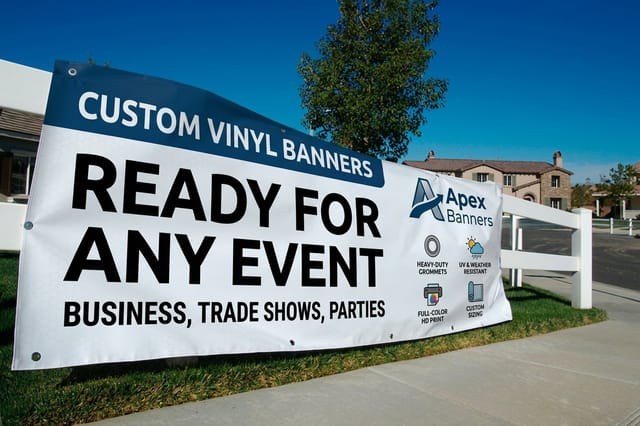
| Wall, fence or storefront outdoors | Vinyl banners | 13oz. outdoor vinyl, or 15oz. BlackOut for double sided | $79 |
| Exposed fence or scaffold in wind | Mesh banners | 8oz. perforated vinyl | $75 |
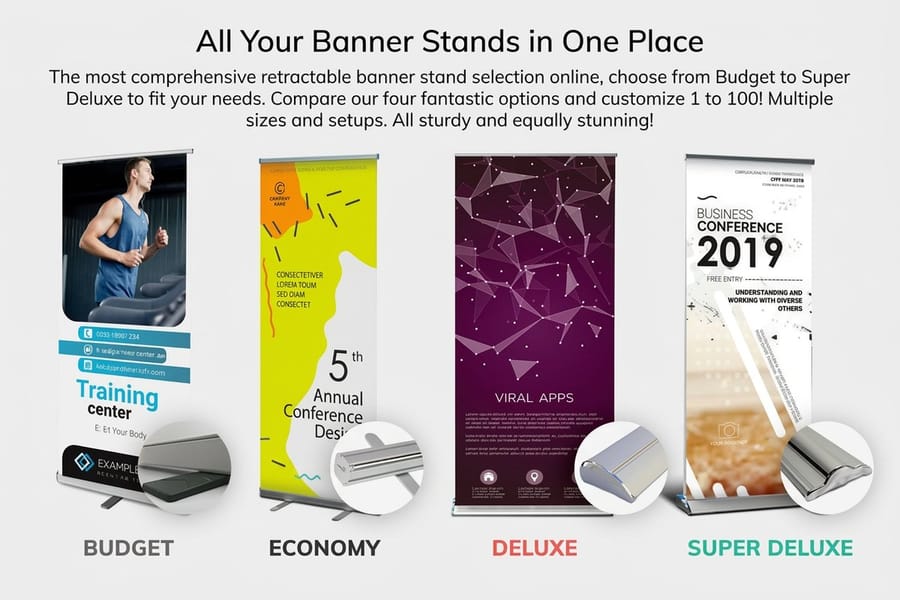
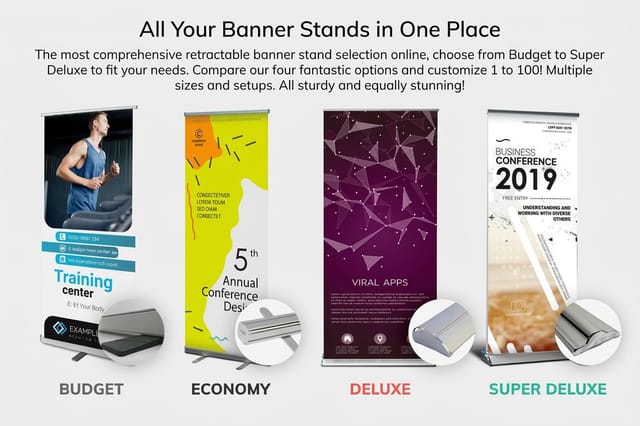
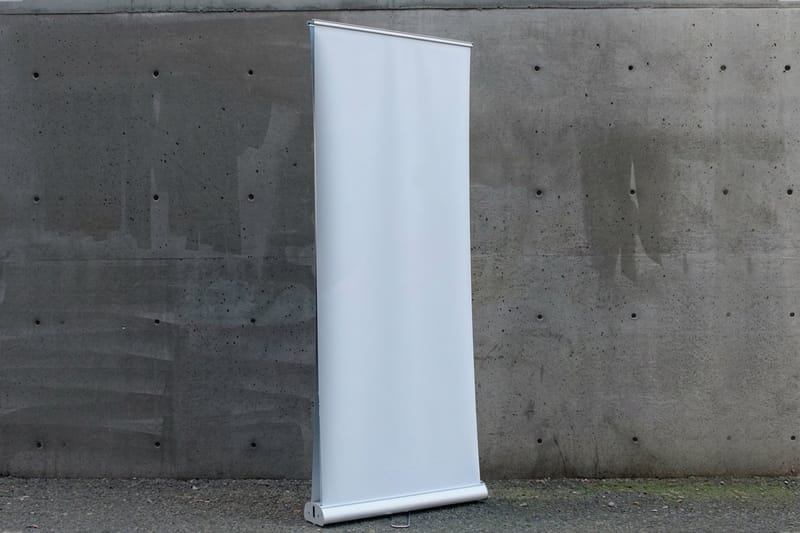
| Booth aisle, lobby, registration desk | Retractable banner stands | 13oz. blockout vinyl, aluminum base included | $139 |
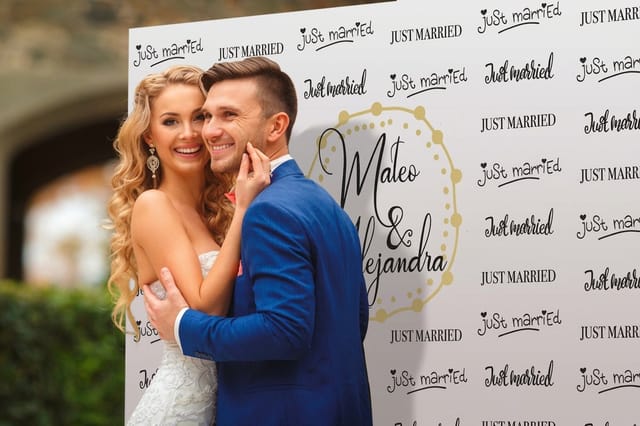
| Photo line or press wall | Step and repeat banners | 13oz. blockout vinyl or 9oz. wrinkle free fabric | $217.50 |
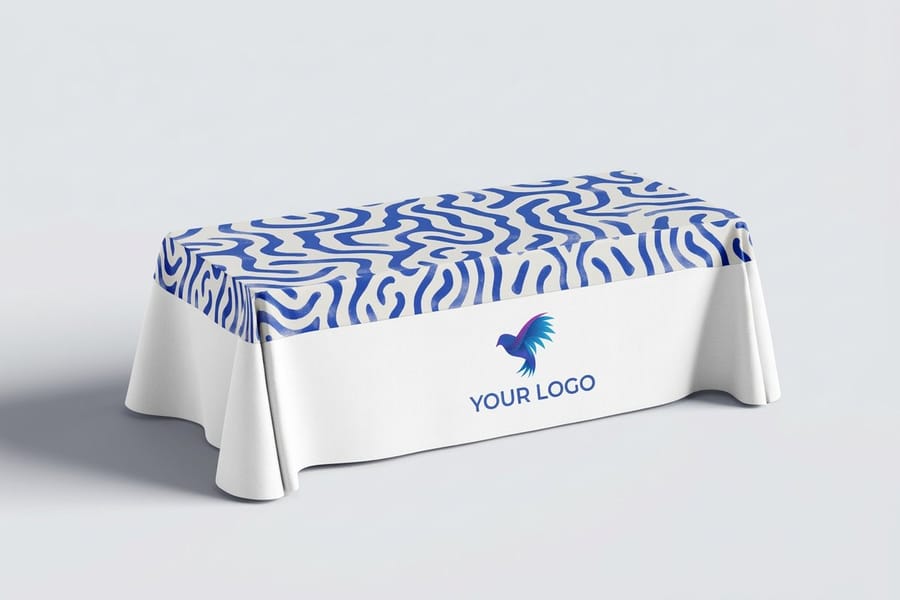
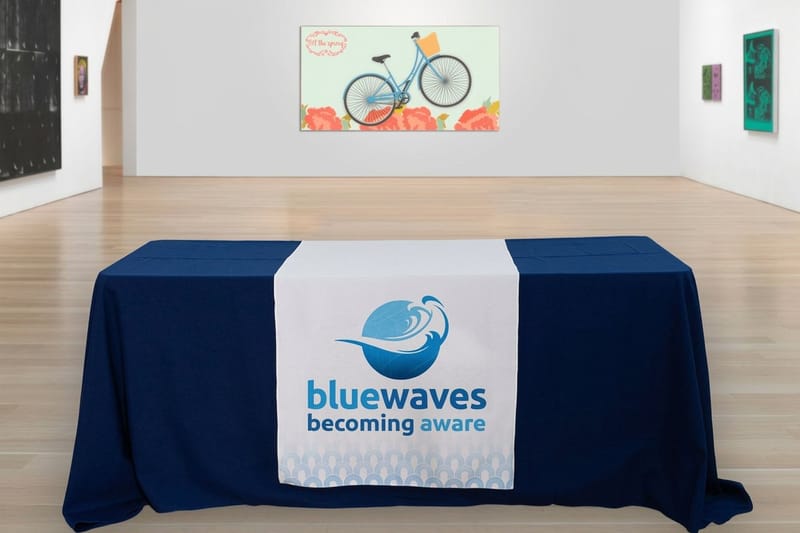
| The table you are standing behind | Table throws | 9oz. premium polyester | $225 |
Nothing to attach to is the case people forget until load-in. Ground you cannot drill and walls you cannot touch are what feather flags exist for, at $108.75 with a stake base for grass or an X base for a hard floor. Indoors, where the banner hangs from a rod in a corridor and never sees weather, indoor banners start at $25 for a 12 by 24 inch and go up to 48 by 96 inches on blockout vinyl. The full range sits in the banners collection.
Sizing a Banner So People Can Read It
The size is not a design choice. It falls out of one number: how far away the person reading it is standing.
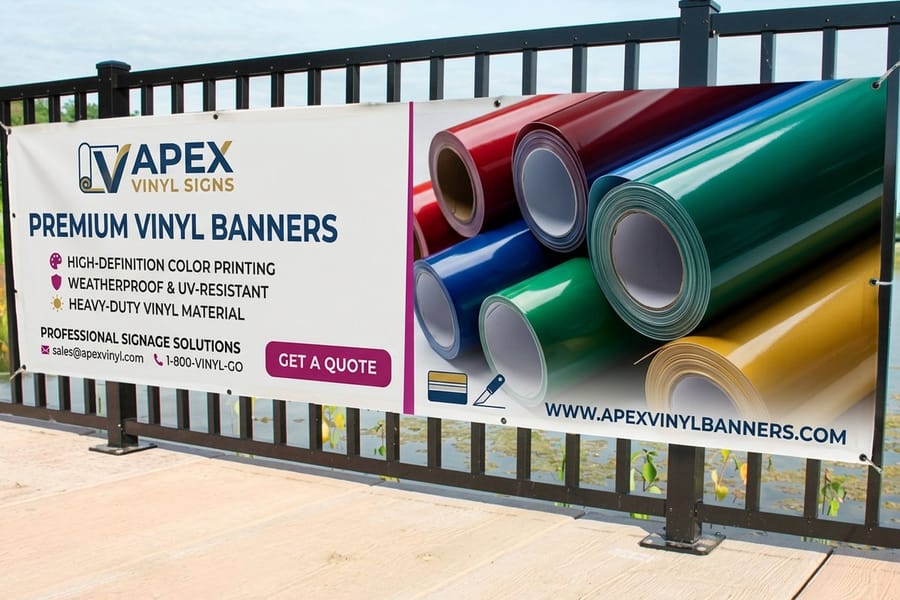
The working rule in signage is one inch of capital-letter height for every ten feet of reading distance. Someone glancing up from an aisle six to ten feet away reads one inch caps comfortably. Across a hall at 40 feet you need four inches. From the far side of a parking lot at 100 feet you need ten. Once you have the cap height, the banner height follows, because a headline realistically gets somewhere between a third and a half of the panel after the hem, a logo and a line of supporting text.
That is why a 2 foot by 4 foot vinyl banner, the default size, tops out around 100 feet of useful reading distance and why stretching the same 2 foot height to 2 by 10 buys you more words rather than more distance. If the distance is the problem, go taller. Custom sizing on vinyl banners runs up to 240 by 180 inches, roughly 20 feet by 15, so height is available long before legibility is.
Two habits keep the file honest. Write the headline first and count the words, because six words at five inch caps beats sixteen words at two. Then check the safe area, since hems fold in an inch of the printed edge and grommets punch through it. Start from a correctly sized layout in the blank template library and the bleed and safe zones are already drawn for you. For the poster and backdrop version of the same maths, the trade show poster sizing guide works through booth distances.
Indoor and Outdoor Materials, and What Each One Fails At
Four materials cover company events, and each one has a specific failure mode that tells you when not to use it.
- 13oz. scrim vinyl. The everyday outdoor banner. Tough, weatherable, cheap per square foot. It fails in sustained wind on an exposed run, where it acts as a sail and tears at the fixing points, and it fails when light comes through from behind because the print ghosts.
- 15oz. BlackOut vinyl. Heavier with a light-blocking core, so a double sided print does not show through from one face to the other. It costs more and weighs more, which matters when you are hanging a long run off one rail.
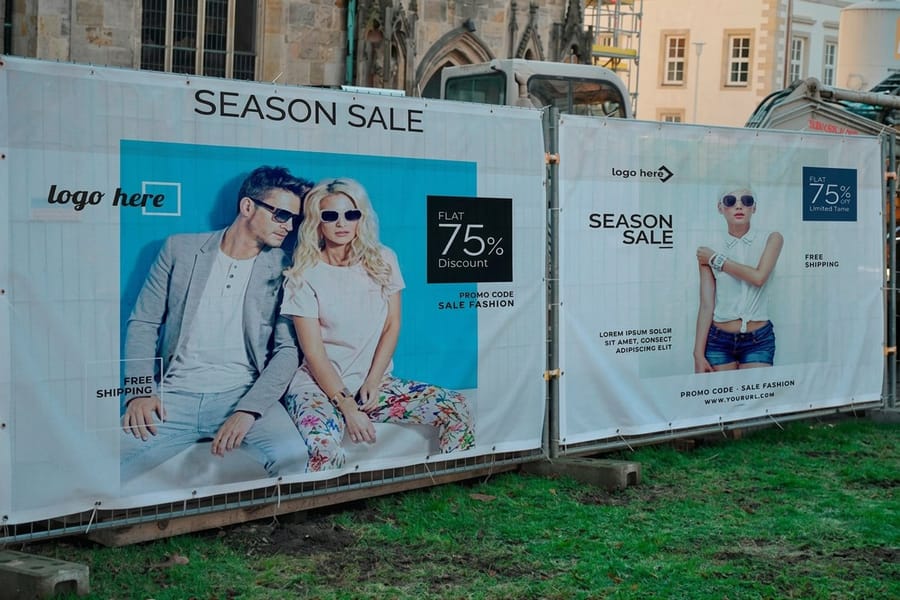
- 8oz. perforated mesh. Tiny holes across the whole sheet let wind through instead of catching it. The trade-off is honest: the perforation lightens the color slightly and you can see through it up close, so mesh belongs on fences and scaffolds, not behind a photo line.
- 9oz. polyester fabric. Matte, glare-free and easy to fold into a case, which is why step and repeat backdrops and table throws use it. It creases if you pack it badly and it is not a weather material, so keep it indoors.
Glare is the one people only discover on the day. A photo wall lit by flash on glossy vinyl bounces light straight back into the lens and washes out the logos, which is the whole argument for ordering a step and repeat on the 9oz. wrinkle free fabric instead. On outdoor durability more broadly, the same reasoning that governs sign substrates applies here, and the outdoor sign materials guide covers what a season of sun and rain actually does.
Finishing is part of the material decision, not an afterthought. Hems fold and reinforce the edge on the top and bottom or all four sides, and they are what stops a grommet pulling out. Grommets give you holes to tie or hook through. Pole pockets, sewn in 2 inch or 4 inch, take a rod. Pick hems plus grommets for a tie-up hang and pole pockets for a rod, and never fix a banner through unhemmed vinyl.
Build an Event Kit You Can Use Twice
The cheapest banner is the one you already own. Most companies reprint every season for a reason that has nothing to do with wear: they printed a date on it.
Split the kit in two. The durable half carries only the things that do not change, meaning the logo, the tagline, the web address and the product category. A retractable stand at $139 with an aluminum base, a table throw at $225, and a step and repeat backdrop at $217.50 come to roughly $580 and go back in the crate at the end of every show. The disposable half carries the year, the show name, the booth number and any offer, and it lives on a $79 vinyl banner or a stack of signs you are happy to recycle.
Storage decides whether the durable half survives. Roll vinyl face out around a tube rather than folding it, because a crease across a print stays visible under any light. Fabric goes back in its bag loosely, not compressed. Retractable stands travel best of the three since the graphic winds into its own housing and the whole thing fits a shoulder case.
Order the kit together rather than piece by piece across three months. One order means one color run and one proof round, so the teal in your logo matches across vinyl, fabric and polyester instead of drifting between substrates. Everything a booth needs sits in trade show printing, the hardware in banner stands, and the throws in table covers. If you have never sent large format to a printer before, how online printing works walks the file handoff end to end.
Wally explains company banners
Where it hangs, how far it reads, what it is made of
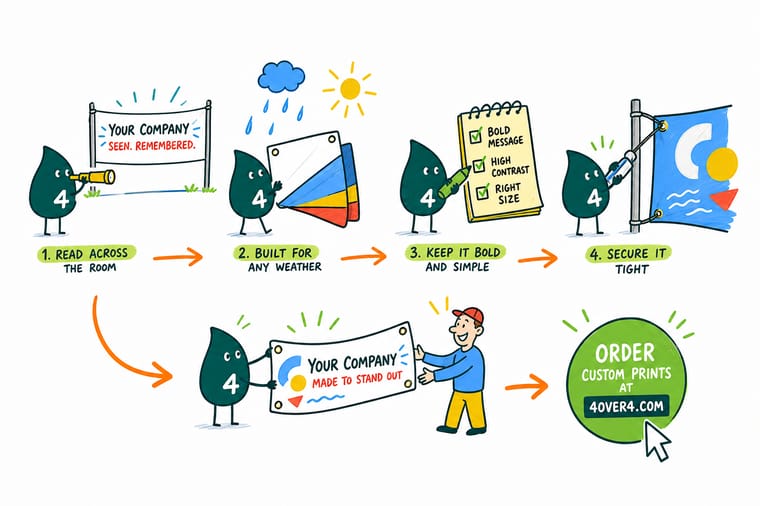
Wally walks the venue before he opens the design file. Wall or storefront gets 13oz. vinyl. A fence with wind coming across it gets perforated mesh, because holes beat a sail. A booth aisle gets a retractable stand on blockout vinyl so the light behind it stays behind it. Then he steps back and counts: one inch of letter height for every ten feet he has to read from. Last thing he does is take the year off the artwork, so the same banner shows up at the next event.
Order vinyl banners →Specs and pricing
Sizes, materials, and starting prices
Compare the three pieces most company events actually need, with live configuration choices and starting prices straight from the 4OVER4.COM configurator.

Print it
Order the banners your next event needs
Explore more
Where to go next

By the numbers
A thousand products, banners among them
Common Questions
Your company banner questions, answered
What size banner should a company order for a trade show booth?
For the back wall of a 10 by 10 booth, an 8 foot by 8 foot step and repeat fills the space without overhanging the pipe and drape. For the aisle edge, a retractable stand at 33 inches by 79 inches reads from the walkway and packs into a case you can carry. For the table itself, an 84 inch by 126.5 inch throw covers a standard 6 foot table on all four sides. Those three cover most booths, and none of them needs the venue to supply hanging hardware.
How do I know whether to order indoor or outdoor banner material?
Ask two questions: does wind hit it, and does light come through behind it. Wind means perforated mesh, because 8oz mesh has holes that let air pass instead of catching it. Backlighting or a bright hall means a blockout vinyl with an opaque core so nothing ghosts through, which is what indoor banners and retractable stands use. If neither applies, 13oz scrim vinyl is the everyday choice, and it is what a standard vinyl banner ships on.
Do wind slits help an outdoor banner survive a storm?
Not really, and they are the most common piece of bad advice in signage. Cutting half-moon slits into a solid vinyl banner weakens the sheet without meaningfully reducing the load, so the banner still fills like a sail and the slits become the point where it tears. If the location is exposed, order perforated mesh instead. The perforation is the whole material rather than a few cuts, so the wind goes through evenly.
How far ahead of an event should banners be ordered?
Standard production on vinyl banners and retractable stands is three business days, table throws are four, and shipping sits on top of that. Working back from load-in, ordering ten business days out leaves room for a proof round and a courier delay without touching a rush fee. Same-day and next-day rush exist on the vinyl products, but rush pricing on a large banner costs more than planning does.
Can the same banner be used at more than one event?
Yes, if the artwork does not fight you. Keep the year, the show name, the booth number and any promotional price off the expensive pieces and put them on a cheap reprint or a separate small banner. Roll a vinyl banner face out around a tube rather than folding it, because a crease across a printed panel does not relax back out. Retractable stands travel best since the graphic winds into its own base.
What artwork resolution does a large banner need?
Large format is viewed from a distance, so it does not need the 300 dpi you would give a business card. Build the file at a quarter or half scale and supply roughly 100 to 150 dpi at that reduced size, which lands around 25 to 40 dpi at full size and looks clean from six feet away. Vector logos and vector type stay sharp at any size, so keep those as vectors rather than flattening them into the image. Our blank templates carry the right bleed and safe area for each banner size.
Get Started
A table throw costs $225.00, feather flags $108.75
Pick the size, choose 13oz. vinyl, blockout or perforated mesh, add hems and grommets where the fixings go, and we print a banner that hangs straight and reads from across the lot.
Legal Disclaimer
Gold Standard guarantees apply to all standard orders placed through 4over4.com. Price match requires verifiable proof of a competitor's published price for an equivalent product with matching specifications and turnaround time. Satisfaction guarantee covers manufacturing defects and print quality issues. Contact support with order number and documentation. On-time delivery rate based on tracked orders 1999 to 2026. Individual results may vary based on shipping carrier performance.
