
Catalog Envelope Printing, Sizes, Closures and Open End Fit


The envelope that opens on the short end, holds a report flat, and quietly moves your mailing from letter postage to flat postage. Sizes, closures and the fit rule, from a printer who runs them.
A catalog envelope is an open end envelope: the flap and the opening run across the short edge, and the back is seamed down the center. It is the envelope for material that has to arrive unfolded, in sizes from 6 x 9 up to 12 x 15.5, with 9 x 12 taking an unfolded 8.5 by 11 stack. The rule is a half inch larger than the contents on both dimensions. The catch is postage: over 6 1/8 inches tall, a mailpiece becomes a flat, so a 6 x 9 mails at letter rates and a 9 x 12 does not.
Quick answer
Open end, center seam, and a postage line at 6 1/8 inches
Catalog envelopes open across the short edge and carry a seam down the middle of the back. That construction takes a thicker stack than a booklet envelope and suits hand stuffing, which is why reports, certificates and catalogs travel in them. Size at a half inch over the contents: 6 x 9 for a half-folded sheet, 9 x 12 for an unfolded 8.5 by 11 stack, 10 x 13 for anything stapled or bound. Then decide the closure, because gummed, peel and seal, self-seal and clasp differ far more in labor and shelf life than in price.
What a Catalog Envelope Is, and How to Spot One
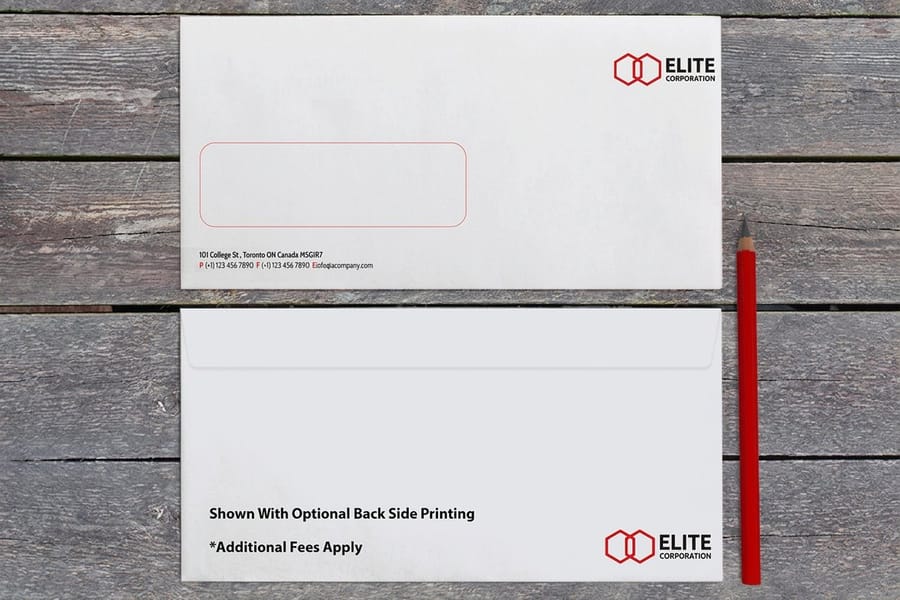
Hold the envelope with the flap away from you and look at where it opens. If the opening runs across the short edge, it is a catalog envelope, also sold as an open end envelope. If it runs along the long edge, it is a booklet envelope. That single difference drives everything else about how the envelope is made, filled and priced.
Now turn it over. The back of a catalog envelope carries a seam straight down the middle, where the two side panels fold in and overlap. A booklet envelope puts its seams at the outer edges instead and leaves the back panel unbroken. The center seam is not a defect. It is what lets the envelope hold a thicker stack without splitting at a corner, and it is also the reason heavy solid ink across the back of a catalog envelope never looks quite even along the join.
Catalog envelopes are built for material that must arrive flat: catalogs, price lists, annual reports, certificates, unfolded proposals, large prints. Anything you would be annoyed to receive with a crease down the middle belongs in one. For an overview of every family we print, the envelope types guide lays them out side by side, and the full range sits under envelope printing.
Catalog Envelope Sizes and What Each One Holds
Catalog envelopes are sold both by inches and by an old number code that still appears on wholesale price lists. You rarely need the numbers, but they show up on quotes, so here they are next to the sizes people actually order.
| Size | Trade number | What it holds | Watch for |
|---|---|---|---|
| 6 x 9 in | #55 | A half-folded 8.5 x 11 sheet, a small booklet, a folded brochure. | The only common catalog size that still mails at letter rates. |
| 6.5 x 9.5 in | #63 | The same contents with a little more slack for a thicker insert. | Over the 6 1/8 inch letter height, so it mails as a flat. |
| 9 x 12 in | #90 | An unfolded 8.5 x 11 stack, roughly twenty to twenty five sheets of bond. | The default. Half an inch of clearance on each side is what makes it easy to fill. |
| 9.5 x 12.5 in | #93 | An unfolded stack in a folder or a thin binder cover. | Order it when the insert itself is 9 x 12, not 8.5 x 11. |
| 10 x 13 in | #97 | Stapled or bound reports, presentation folders, small catalogs. | Give bound material the extra inch or the spine buckles the face. |
| 12 x 15.5 in | #110 | Tabloid sheets, large prints, oversized certificates. | Add a stiffener. At this size the envelope alone will not stop a bend. |
The sizing rule is a half inch larger than the contents in both directions. Less than that and stuffing becomes a fight, and the corners of the insert catch on the seam. Much more than that and the contents slide, which is how a flat piece arrives creased anyway. If you are matching an envelope to a piece we already print, the envelope size guide maps the whole numbering system, and blank templates give you the correct trim and flap outline to design against.
One more variable: thickness. A plain catalog envelope holds about a quarter inch of paper before the seam takes real strain. Past that, order an expansion envelope with a 1 inch or 2 inch gusset in the sides and bottom, which folds out to make room instead of stretching.
The Four Closures, and Which One to Order
Closure is the decision most people skip, and it is the one that costs the most in labor. Four are common on catalog envelopes.
- Gummed. A dry adhesive strip you moisten. Cheapest per envelope, stores for years without going off, and the standard choice when a mail house or a moistening machine is doing the sealing. Sealing several hundred by hand is slow and unpleasant.
- Peel and seal. A release liner over pressure-sensitive adhesive. Pull the strip, press the flap. It costs more per piece and it is the right answer whenever a person is stuffing by hand, because it removes the slowest step in the job.
- Self-seal. Two latex strips that bond to each other and to nothing else. Fast, and no liner to throw away. The catch is shelf life: latex loses tack after roughly a year, faster in a warm store room, so it suits envelopes you will use soon rather than stock you are buying ahead.
- Metal clasp. A prong through a hole, usually over a gummed flap. The only closure built for repeated opening, which makes it an interoffice and filing choice. USPS can apply a nonmachinable surcharge to clasp envelopes at letter sizes, so it is a poor fit for a mailing.
Whichever you pick, keep artwork off the adhesive. Ink and aqueous coating both sit between the glue and the paper and stop the seal, so we hold art at least a quarter inch clear of the gum line on printed envelopes. If you would rather run the addressing yourself and keep the envelope plain, blank envelopes start at $13.17 and take an inkjet or laser address pass without trouble.
Catalog vs Booklet Envelopes, and Why Mail Houses Care
The two are constantly swapped in purchase orders, and the mistake surfaces late, usually on the day someone tries to stuff ten thousand of them.
| Feature | Catalog, open end | Booklet, open side |
|---|---|---|
| Opening | Across the short edge. | Along the long edge. |
| Back seam | Down the center. | At the two sides, back panel clean. |
| Filling | Hand stuffing, contents fed in narrow end first. | Machine inserting, contents slide in flat. |
| Strength | Handles a thicker stack before the seam strains. | Prefers thinner, uniform contents. |
| Printing | Solid coverage on the back shows the seam. | Uninterrupted back panel for full coverage art. |
| Best for | Reports, catalogs, certificates, mixed-thickness contents. | Large runs of identical inserts through an inserter. |
The honest summary: catalog envelopes are easier for a human, booklet envelopes are easier for a machine. If the run is small enough that your own team is filling them, the open end wins on handling and on how much it will take. If a lettershop is running the job, ask their operations contact before you commit, because retooling an inserter for the wrong envelope costs more than the envelopes did.
Contents matter as much as the envelope. A saddle-stitched piece behaves differently from loose sheets, and booklets versus catalogs covers where the page count pushes you from one binding to the other. Our standard booklets start at $240.55 and drop straight into a 9 x 12.
When a Catalog Envelope Is Worth the Postage
Here is the trade-off nobody mentions until the postage invoice arrives. USPS classifies a mailpiece taller than 6 1/8 inches as a flat rather than a letter, and flat postage starts well above letter postage on the very first ounce. A 6 x 9 catalog envelope squeaks under that line and mails as a letter, provided it is under a quarter inch thick, evenly thick and flexible. A 9 x 12 is over the line by nearly three inches and mails as a flat whatever it weighs.
So the real question is whether the contents must stay flat. A sales letter, a two-page proposal or a folded brochure loses nothing to a fold, and folding it into a 6 x 9 is the cheapest single change available on a large mailing. A certificate, a signed contract, a photographic print or a catalog with a printed spine is ruined by one, and the flat rate is simply the price of it arriving in usable condition.
Three cases where the larger envelope earns its cost outright: anything a recipient is expected to keep or file, anything that is going to be photographed or displayed, and anything sent to a small list where the per-piece postage matters less than the impression. For everything else, run the numbers on folding first. If the mailing is large enough for those decisions to add up, bulk mailing explains where the further discounts sit, and ordering bulk envelopes covers the quantity breaks on the envelopes themselves.
Match the stationery while you are at it. A 9 x 12 arriving with a printed letterhead inside reads as one considered piece rather than three separate purchases, and both print on the same run.
Wally explains catalog envelopes
Short end opens, center seam on the back
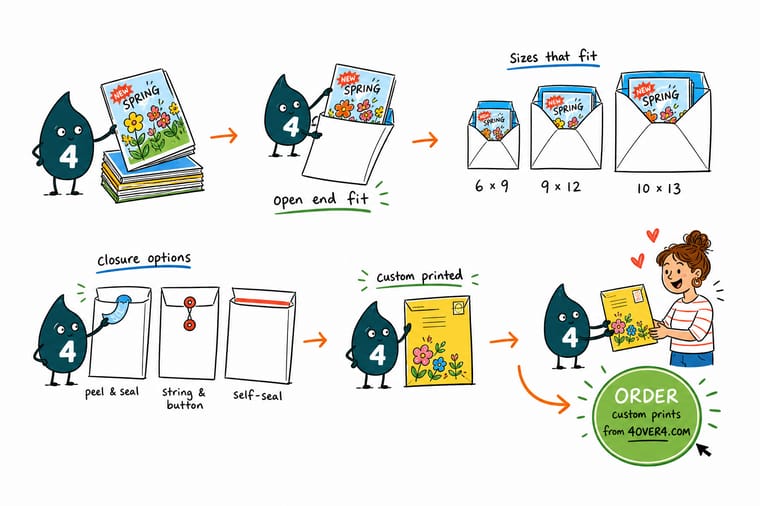
Wally feeds the report in through the short end, because that is what open end means. Turn the envelope over and the seam runs down the middle, which is what lets it take a thick stack without splitting a corner. He sizes it half an inch bigger than the contents, keeps his artwork a quarter inch clear of the gum so the flap still seals, and remembers that anything over 6 1/8 inches tall mails as a flat rather than a letter.
Order printed envelopes →Specs and pricing
Envelope sizes, stocks and starting prices
Blank envelopes start at 50 for $13.17 in 1 business day, printed envelopes at 250 for $142.99 in 7.
Print it
Order envelopes that fit what you are sending
Explore more
Where to go next

By the numbers
Open end and booklet closures
Common Questions
Your catalog envelope questions, answered
What is a catalog envelope?
A catalog envelope is an open end envelope: the flap and the opening run across the short edge, so you load the contents through the narrow end. The back is seamed down the center. Printers and paper merchants also call it an open end or a booklet-size mailer, though that last name causes trouble, because a booklet envelope is a different thing entirely. The common sizes are 6 x 9, 9 x 12 and 10 x 13, and they are built for material that should arrive flat, such as catalogs, reports, brochures and certificates.
What is the difference between a catalog envelope and a booklet envelope?
The opening. A catalog envelope opens on the short end and is seamed down the middle of the back. A booklet envelope opens along the long side and is seamed at the two sides, which leaves the back panel clean. That changes how each one is filled: a booklet envelope can be stuffed on an inserting machine because the contents slide in flat across the wide opening, while a catalog envelope is usually hand stuffed. If you are mailing a few hundred pieces in house, the catalog envelope is easier to hold and fill. If a mail house is running ten thousand, ask them which one their equipment prefers before you order.
What size catalog envelope fits an 8.5 x 11 sheet?
A 9 x 12. It leaves a half inch of clearance on each dimension, which is what you need to slide a stack in without dog-earing the corners. A 9 x 12 catalog envelope holds roughly twenty to twenty five sheets of 20 lb bond comfortably before the seam starts to strain. For a thicker stack, or for anything with a staple or a spiral, move to 10 x 13 or specify an expansion envelope with a 1 inch or 2 inch gusset.
Do catalog envelopes cost more to mail?
Usually yes, and the reason is height rather than weight. USPS treats a mailpiece taller than 6 1/8 inches as a flat, and flat postage starts well above letter postage. A 6 x 9 catalog envelope stays under that line and mails at letter rates as long as it is under 1/4 inch thick, uniformly thick and flexible. A 9 x 12 crosses it and mails as a flat no matter how light it is. When a mailing is large and the contents will survive a fold, folding into a 6 x 9 is the cheapest change you can make.
Which closure should I order?
Gummed is the default and the cheapest, and it stores for years. Peel and seal costs more per envelope and pays for itself the moment a person is stuffing several hundred by hand. Self-seal, where two latex strips press together, is fast but has the shortest useful life, because the latex loses tack after roughly a year in storage and much sooner in a warm room. Metal clasp is the only one built to be opened and closed repeatedly, which makes it an interoffice choice rather than a mailing one, and USPS may charge a nonmachinable surcharge on clasp envelopes in letter sizes.
Can you print full color on a catalog envelope?
Yes, on the front face and on the back panel, with two limits worth designing around. Keep artwork and coating at least 1/4 inch clear of the gum line, because ink and aqueous coating both stop the adhesive sealing. And expect the center seam on the back to show slightly under heavy solid coverage, since the paper is two layers thick along the join and takes ink differently. A clean approach is a full-color front, a return address and a short message on the back, and nothing at all across the seam.
Get Started
50 blank envelopes cost $13.17 and ship in 1 business day
Pick the size, the stock and the closure, upload your artwork, and we print envelopes that seal properly and fit what you are putting inside them.
Legal Disclaimer
Gold Standard guarantees apply to all standard orders placed through 4over4.com. Price match requires verifiable proof of a competitor's published price for an equivalent product with matching specifications and turnaround time. Satisfaction guarantee covers manufacturing defects and print quality issues. Contact support with order number and documentation. On-time delivery rate based on tracked orders 1999 to 2026. Individual results may vary based on shipping carrier performance.
