
How Breakaway Banners Work and How to Size a Football Run Through


The tear panel, the frame, the taped seam and the two measurements that decide whether a team bursts through or bounces off.
A breakaway banner is the thin, disposable panel a football team bursts through at kickoff, printed on a light polyethylene film or paper that splits once a seam is started. The 13 oz scrim vinyl banner most people order by default will not tear, because the woven polyester grid inside it exists to stop exactly that. Build the run-through from disposable film, hang it from top ties with a taped center seam, and spend the vinyl budget on the sideline banner that has to last the season.
Quick answer
Tear film for the run-through, scrim vinyl for everything else
The run-through panel and the season banner are two different products that happen to share artwork. The panel is thin film or paper, hung from top ties only, with a taped seam down the center that parts from the top when the first player hits it. The season banner is 13 oz scrim vinyl, hemmed and grommeted, and its scrim is precisely why it cannot be used for the run-through. Give the frame around 22 feet of clear opening, keep the bottom edge a foot off the grass, and set the type big enough to read from the top of the bleachers.
Why a 13 oz Vinyl Banner Will Not Tear
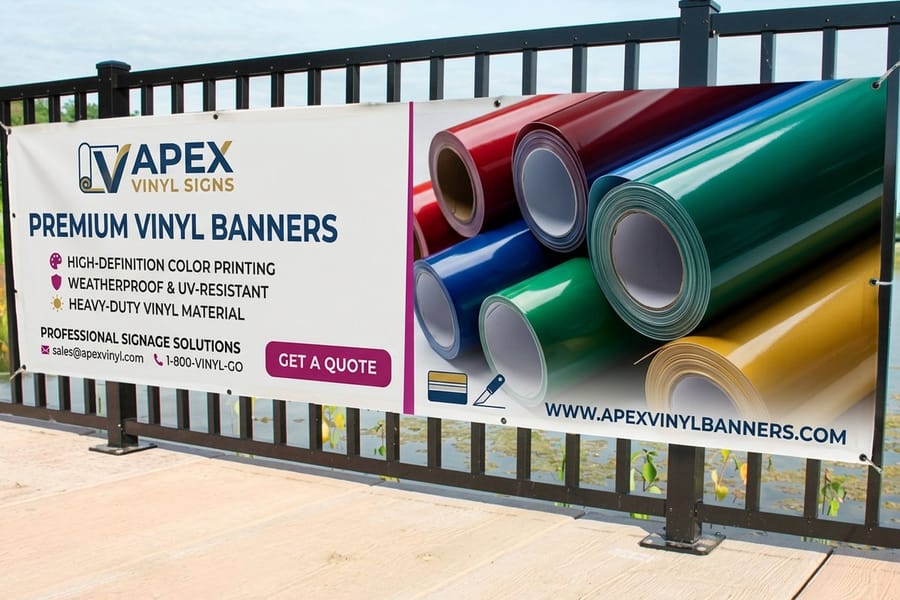
Every run-through problem starts with the same assumption: a banner is a banner. It is not. Hold a piece of 13 oz banner vinyl up to a window and you will see a faint grid running through it. That is scrim, a woven polyester mesh sandwiched between two layers of PVC, and it is the single feature that makes a vinyl banner worth buying for outdoor use.
Scrim spreads load. A gust that would rip a plain sheet gets distributed across the whole weave, which is why a properly hemmed vinyl banner survives a season on a chain-link fence. It also means the material has real tensile strength in both directions. It does not part when something hits it. It stretches, stores the energy, and gives it back.
What that looks like in practice is ugly. A player at speed either bounces, takes the frame down with him, or ends up tangled while the material springs back. Cheerleaders holding poles get pulled off their feet. None of it is theoretical, and it is the reason schools that tried it once do not try it twice.
The material that actually tears has no scrim in it at all. Run-through panels are thin polyethylene film, usually somewhere in the 2 to 4 mil range, or a light paper roll. Both are translucent enough that you can see a shadow through them, both split along a line once one is started, and both are cheap enough to throw away after one kickoff. The trade is durability: leave a film panel on the frame overnight in weather and it will be shredded by morning. That is fine. It was never meant to be there in the morning. If you want the full material comparison, our banner material guide lays out the weights and coatings side by side.
Sizing the Panel and the Frame So the Team Gets Through

Two numbers decide whether a run-through works, and neither one is the banner size on the invoice.
The first is clear opening, meaning the distance between the inside faces of the poles. A frame described as 24 feet wide usually gives about 22 feet of clear span once you account for the uprights and the ties. That is enough for four or five players abreast, which is what you want, because the photograph everyone is actually after is a wall of players coming through together. Squeeze the opening under about 16 feet and the team funnels into single file. The banner still tears. The moment does not happen.
The second is ground clearance. Hang the bottom edge roughly a foot off the grass. A panel that reaches the ground gets stepped on, wraps a leg, and takes the runner down with it, and that is the failure that turns up on video more than any other. Losing a foot of height costs you nothing, because the bottom band of a run-through is crumpled and out of frame within half a second anyway.
Height itself is simpler. Eight feet is the working standard, and it clears everyone comfortably. On a windy Friday, drop to six. Cut the panel about a foot narrower than the clear opening so it hangs loose rather than pulling tight against both poles, because a taut panel resists at the edges and tears crooked.
| Material | Tears on impact | Handles wind | Where it belongs on game day |
|---|---|---|---|
| Polyethylene film, 2 to 4 mil | Yes, cleanly from a started seam. | Poorly. It is a sail and it shreds. | The run-through panel itself, replaced every home game. |
| 13 oz scrim vinyl | No. The scrim is built to stop it. | Very well when hemmed and grommeted. | Sideline and fence banners, sponsor boards, the frame skirt. |
| Mesh vinyl | No. | Best of the four. Air passes through. | Long fence runs and exposed corners of the stadium. |
| Polyester fabric | No. | Fine indoors, flaps outdoors. | Gym walls and pep rallies, where matte fabric kills glare. |
Setting up the artwork file at that scale is its own job. Wide-format layouts are usually built at a fraction of final size with proportional bleed, and the banner sizes and templates guide walks through it. Correctly proportioned starting files are in the vinyl banner template library.
Building the Tear Line, Step by Step

A run-through does not tear at random. It tears where you decided it would, and the decision is made with tape before anyone lines up.
- Print two panels, not one. Split the artwork down the middle and add about 12 inches of overlap to each half. The overlap is what hides the seam from the stands.
- Lay both halves flat and register the artwork. Do this on the gym floor, not on the field ten minutes before kickoff. Slide the top half over the bottom half until the design lines up across the join.
- Tape the top 18 inches of the seam only. Painter's tape on the back face. That short strip is enough to hold the seam closed while the panel hangs, and weak enough that the first shoulder through it releases the whole line.
- Tie the top edge to the frame with light string. Four to six ties spread across the top bar. Leave a clear gap in the ties on either side of the seam so nothing is anchored across the tear path.
- Leave the sides and the bottom completely free. No ties, no weights, no grommets. Anything holding the edges turns the panel into a trampoline.
- Do one walk-through at half speed. One player, no run-up. If the seam does not part with a shoulder at walking pace, there is too much tape on it. Pull some off and try again.
If you only have a single sheet, cut a vertical slit from the top edge down to about head height rather than perforating the whole center line, then tape the slit closed the same way. Perforation across a full 8 foot drop sounds tidier and behaves worse, because thin film tears at its weakest point rather than at its scored one, and that point is usually somewhere off to the side.
None of this applies to the banner you hang for the season. That one gets hemmed edges and grommets every two to three feet, and grommet placement plus a proper hanging method is what keeps it from flogging itself to pieces on the fence.
Team Colors, Logo Placement, and the Friday Night Wind
Color is where school banners most often disappoint, and the cause is boring. Team colors are almost always specified as PMS numbers. Wide-format printers build them from CMYK inks. Most of the spectrum converts closely enough that nobody notices, but deep reflex blues, bright oranges and any fluorescent sit outside what four-color process can reach, so they land near the target rather than on it. Send the PMS number with the file, approve one proof, then reuse that exact file every game so the shade never drifts mid-season.
Placement is a trade-off worth deciding on purpose. Put the mascot dead center and the tear splits it in half, which looks dramatic in the second before impact and terrible in every photo after. Push the mark to one side of the seam and it stays whole while the team comes through the gap. Either is defensible. Choosing by accident is not.
Size the type by distance. The working rule in signage is about one inch of cap height for every ten feet of viewing distance, so a crowd sitting 120 feet back needs letters around 12 inches tall. On a 24 foot banner that means the school name and maybe four words, set across the upper third where nothing gets crumpled. Everything below the halfway line is out of frame the instant the panel parts. Banner design fundamentals covers contrast and legibility in more depth, and football banner wording has the phrasing side.
Then there is wind, which does not care about any of this. A solid 8 by 24 foot panel catches every gust on the field. Drop the height to six feet on a rough night and accept the smaller look. For anything that has to stay up through all four quarters, use mesh banners, which are perforated so air passes through instead of loading the frame. Mesh will not tear on impact, so it is the fence and the backdrop, never the run-through. The vinyl versus mesh comparison covers where the crossover point sits.
What a School Actually Orders for a Season
The run-through panel is the cheap, disposable half of the setup. The printing that matters financially is everything around it, and most of that gets ordered once and used from August to November.
The sideline and sponsor banners. Vinyl banners start at $79, hemmed, grommeted, and rated for a full outdoor season. This is also where sponsor money is repaid, so it is worth printing properly the first time rather than reprinting in October.
The exposed fence runs. Mesh banners start at $75. Anywhere a long banner sits in open wind, mesh is the version that is still flat in week eight.
Indoor and on camera. Fabric banners start at $57.20. Polyester has a matte surface that does not throw glare back at gym lights or a phone flash, which is why interview backdrops and pep-rally walls use it instead of vinyl.
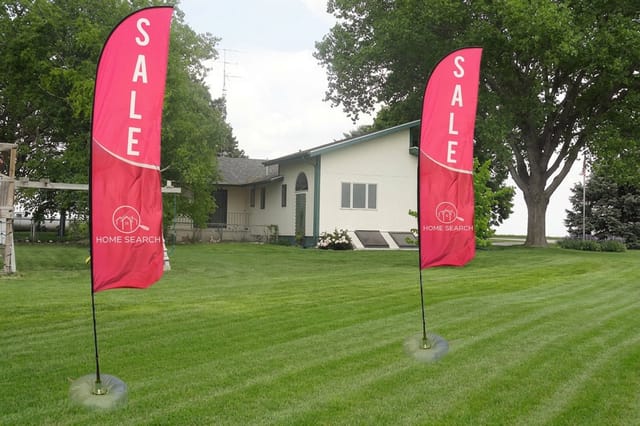
The tunnel and the entrance. Feather flags start at $108.75 and line the walk-out. Yard signs start at $25 and handle senior night, parking direction and booster-club spots. Indoors, a retractable banner stand at $139 gives the athletic director a backdrop that packs into a tube.
Order the reusable pieces together at the start of the season and print the disposable run-through panel separately, because the two have nothing in common except the artwork. The whole range sits in the banner printing collection, and if this is part of a broader push, the sports marketing campaign guide covers how the print pieces fit the calendar.
Wally explains the run-through
Tape the seam, tie the top, leave the sides alone
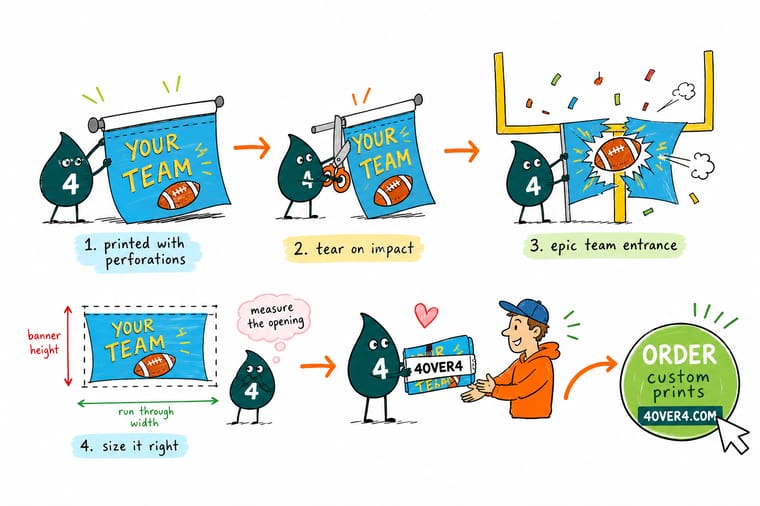
Wally prints the panel in two halves with a foot of overlap, lines the artwork up on the floor, and tapes only the top 18 inches of the seam. He ties the top edge to the frame with light string, leaves the sides and bottom completely free, and keeps the bottom edge a foot off the grass. Then he walks one player through at half speed to check it parts. The vinyl banner behind him stays on the fence all season, because scrim vinyl is built not to tear and nobody should be running at it.
Order team vinyl banners →Specs and pricing
Banner materials, sizes, and starting prices
Compare the three materials a team actually needs side by side, with live size and finishing choices and starting prices straight from the 4OVER4.COM configurator.


Print it
Print the banners that stay up all season

Explore more
Where to go next


By the numbers
Breakaway banners in a 1,000+ product lineup
Common Questions
Your run-through banner questions, answered
What is a breakaway banner?
A breakaway banner, also called a run-through banner, is the large panel a football team bursts through when it takes the field. It is printed on a thin, disposable material that splits under a running body, usually a light polyethylene film or a paper sheet, and it is hung from a frame or held by two people on poles. It is deliberately a one-game item. The banner that stays up all season on the fence is a different product built from reinforced vinyl.
Can a team run through a regular vinyl banner?
No, and trying it is how frames get bent and shoulders get hurt. Standard 13 oz banner vinyl has a woven polyester scrim laminated inside it, which is the whole reason a vinyl banner survives wind and rain on a fence. That scrim does not tear on impact. A player hitting it either stops dead, gets thrown back, or drags the frame down. Order vinyl for the sideline banner and keep a disposable film or paper panel for the run-through.
What size should a football run-through banner be?
Most high school setups run a frame around 20 to 24 feet wide and about 8 feet tall, with the panel cut slightly narrower than the clear opening so it hangs loose instead of binding on the poles. Keep the bottom edge roughly 12 inches off the ground. A panel that touches the grass wraps around legs on the way through, which is the most common way a run-through turns into a pile-up.
How do you make the banner tear where you want it to?
Print it as two panels with about a 12 inch overlap down the middle and join them with painter's tape across the top 18 inches only. The tape holds the seam closed while the banner hangs, and the first runner parts it from the top down. If you have a single sheet, cut a vertical slit from the top edge down to roughly head height instead of perforating the whole line, and tape the slit closed the same way.
How much does a season of team banners cost?
The disposable run-through panel is the cheap part and it is replaced every home game. The reusable printing is where the money sits. Vinyl banners start at $79 at 4OVER4.COM, mesh banners at $75 for fence lines that catch wind, fabric banners at $57.20 for indoor gym and pep-rally use, feather flags at $108.75 for the tunnel entrance, and yard signs at $25 for senior night and parking direction.
What do you do about wind on game day?
A solid 8 by 24 foot panel is a sail, and a gusty Friday will either rip it off the ties early or lean the frame. Two fixes work. Cut the panel height down to 6 feet so there is less surface to catch, and switch anything that stays up all game to mesh, which lets air pass through the perforations instead of loading the frame. Mesh will not tear, so it is for the fence and the backdrop, never for the run-through itself.
Get Started
Vinyl banners hold a full outdoor season, hemmed and grommeted
Pick your size, choose scrim vinyl for the fence or mesh for the wind, and we print hemmed, grommeted banners in your team colors.
Legal Disclaimer
Gold Standard guarantees apply to all standard orders placed through 4over4.com. Price match requires verifiable proof of a competitor's published price for an equivalent product with matching specifications and turnaround time. Satisfaction guarantee covers manufacturing defects and print quality issues. Contact support with order number and documentation. On-time delivery rate based on tracked orders 1999 to 2026. Individual results may vary based on shipping carrier performance.
