
AI Prompt Engineering Made Practical, From First Prompt to Finished Ebook


The four blocks a prompt needs, the patterns that survive a model update, the limits no rewording will fix, and what to do with the library once it works.
Prompt engineering is writing model instructions specific enough to produce usable output on the first or second try, and in practice it is four blocks: the role and context the model cannot know, one clear task, explicit constraints, and the exact output format you plan to use. Examples beat adjectives, positive instructions beat prohibitions, and no phrasing supplies knowledge the model never had. Once the prompts work for other people, they become an ebook, a workshop handbook, or a one page cheat sheet.

Quick answer
Four blocks, and the failure each one prevents
A prompt is not a wish, it is a specification. Role and context set the vocabulary. One task keeps the answer from splitting in two. Constraints control length and register. The output format decides whether you can use the result or have to retype it, and it is the block people leave out most often. Everything else, including examples, patterns and iteration, is refinement on top of those four.
The Four Parts of a Prompt That Change the Output
A prompt that works carries four blocks. Drop one and the output fails in a predictable way, which is useful, because it means you can diagnose a bad answer by asking which block was missing.
| Block | What it controls | Weak version | Version that works |
|---|---|---|---|
| Role and context | Which vocabulary and assumptions the answer draws on. | "You are a helpful assistant." | "You are a bookkeeper reviewing a semi-monthly payroll run for a 12 person shop in New York." |
| Task | The single operation being requested. | "Help me with my ebook." | "Draft the opening 300 words of a chapter explaining few-shot prompting to a reader who has never used an API." |
| Constraints | Length, register, and what to leave out. | "Keep it short and engaging." | "Under 200 words. Continuous prose, no lists. No cooking or recipe analogies." |
| Output format | Whether you can use the result without retyping it. | "Give me the results." | "Return a markdown table with the columns Prompt, Model, Verdict, one row per test." |
The fourth row is where most time gets lost. The model answers the question well, in flowing paragraphs, and then you spend ten minutes converting it into the table you needed. Name the format up front and that step disappears.
There is a fifth lever that sits outside the four blocks: examples. Two or three short samples of the output you want will move the result further than any list of adjectives, because the model matches patterns far more reliably than it interprets descriptions of taste. If you are writing in a house voice, paste two paragraphs of that voice. The same discipline shows up in ordinary business writing, and our guide to building a marketing plan covers where that voice gets defined in the first place.
Prompt Patterns Worth Keeping Where You Can See Them

Five patterns cover most business work. They are not tricks, and none of them depend on a particular model.
- Few-shot. Show two or three input and output pairs before the real request. Best for classification, tone matching and any format you struggle to describe in words.
- Decompose and approve. Ask for an outline, correct the outline, then ask for the draft. Correcting a 12 line outline costs a minute. Correcting a finished 2,000 word chapter costs an afternoon.
- Reasoning before the answer. On multi-step work, ask for the working first and the conclusion last. On a straight lookup it adds noise and latency for nothing, so leave it off.
- Critique against named criteria. Give the draft back with a list of the specific things to check for, then ask for a rewrite. Vague self review produces vague edits.
- Positive constraints. "Do not use bullet points" often returns bullet points. "Write three paragraphs of continuous prose" returns three paragraphs. Describe the target, not the thing you are banning.
The habit that separates people who get good at this from people who stay frustrated is keeping a log. One line for the prompt version, one for what changed, one for whether the output improved. A text file works. A pad next to the keyboard works better for most people, because the whole point is to write while the model is still generating, and custom notepads start at $93.37 for a branded run. Our notepad sizing guide covers sheet counts if you are printing them for a team.
The other artifact worth making is a one page reference of your best prompt openings. Standard bookmarks start at $16.48 and hold roughly 40 words a side, which is enough for the four block skeleton and two examples.
Turning a Prompt Library Into an Ebook People Keep

A prompt library becomes an ebook the moment someone other than you has to run it. That is the real test, not word count. If a colleague can follow the file without asking you a question, you have a product. If they cannot, you have notes.
Structure it the way people use it, not the way you learned it. Open with the four block skeleton, then one chapter per job to be done, each with the prompt, a worked example, and the failure it tends to produce when someone edits it carelessly. An index of prompts by task at the back gets used more than an introduction at the front.
Keep the PDF as the free version and print the edition that has to sit open beside a screen. Workshops, classrooms and client onboarding are where the physical copy earns its cost, because a booklet stays open at the page while both hands are on the keyboard. Standard Booklets start at $240.55, and page counts run in multiples of four for saddle stitching, which is worth designing around from the first spread rather than discovering at the end. Both points are explained in our guide to booklet page counts and creep and in booklet binding methods explained. Set the file up from a correctly sized layout in the blank template library.
Two supporting pieces do the rest of the work. Standard Flyers start at $39.54 and are the cheapest way to hand out the download link at an event or a meetup. Pocket Folders start at $844.54 and are the piece for a paid workshop, where the handbook, the exercise sheets and a business card leave the room as one object. The coach and speaker print kit bundles that set, and the full range sits under booklets and catalogs printing.
Where Prompt Engineering Stops Working
Every honest guide on this topic has to name the ceiling, because a lot of wasted effort comes from people rewording a prompt when the problem was never the wording.
It cannot supply knowledge the model does not have. If the answer depends on your pricing, your inventory or last week's meeting, paste that material into the prompt or connect a retrieval step. Rewording a question about a document the model has never seen produces a more confident wrong answer, not a right one.
Fluency is not accuracy. Ask for sources and you may get plausible ones that do not exist. Anything carrying a number, a name, a date or a citation needs checking outside the model. Build the check into the workflow rather than trying to instruct the model out of the behavior.
Long prompts get brittle. A heavily tuned 600 word prompt is tuned against one model version. When the provider updates, the balance between your instructions shifts and the output moves with it. Keep a handful of test inputs with known good outputs and re-run them after any model change. This is the single habit that separates a prompt library that survives a year from one that quietly rots.
Burying the question loses it. Pasting 40 pages and asking the real question in the last line makes the instruction compete with everything above it. State the task before the material and repeat it after, which costs a sentence and prevents the most common failure with long inputs.
Some tasks are not reliable at any prompt length. Exact arithmetic over long tables, guaranteed schema conformance, and anything requiring a certain answer belong in code with the model doing the parts around it. Knowing which half of a job to hand over is more valuable than any phrasing.
The Prompt Engineering Checklist
Run this before you decide a model is not up to a job. Most of the time one of these is missing.
- Did you give a role and the context the model could not know?
- Is there exactly one task, with one verb and one deliverable?
- Are the constraints explicit, including length and what to leave out?
- Did you name the output format you will actually paste into?
- Are there two or three examples of the output you want?
- Are the instructions positive rather than a list of prohibitions?
- Is the task stated before the pasted material as well as after it?
- Did you change one variable, not five, since the last run?
- Do you have three fixed test inputs you re-run after every edit?
- Is every number, name and date in the output verified outside the model?
- Would a colleague get the same result from this prompt without asking you anything?
The last item is the one that turns a personal habit into something worth publishing. Once a prompt passes it, it belongs in the handbook. If you are building a business around teaching this, the sequencing in our first time entrepreneur launchpad and the channel choices in the digital marketing guide for small business cover what happens after the ebook exists.
Wally explains prompt engineering
Four blocks, then print the ones that work
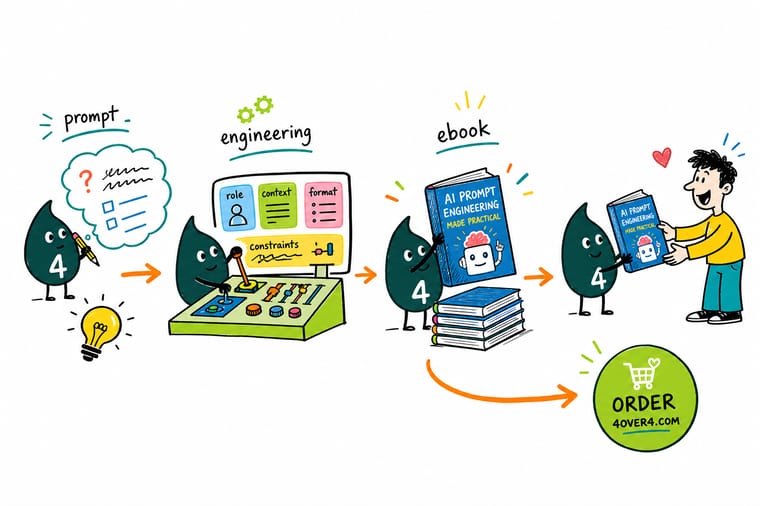
Wally writes the role first, then one task, then the constraints, then the shape he wants the answer in. When the answer comes back wrong he does not rewrite everything. He asks which of the four blocks he forgot, usually the format one. The prompts that keep working get logged on the pad, and the ones a whole team needs end up in a saddle stitched booklet that stays open next to the screen.
Print your prompt handbook →Specs and pricing
Handbook formats, sizes, and starting prices
Compare the three formats a prompt library usually ends up in, with live configuration choices and starting prices straight from the 4OVER4.COM configurator.



Print it
Print the prompts people actually use


Explore more
Where to go next




By the numbers
Who prints and binds your ebook, counted
Common Questions
Your prompt engineering questions, answered
What is prompt engineering in plain terms?
It is writing instructions for a language model that are specific enough to get usable output without three rounds of correction. The craft is not clever phrasing. It is supplying the four things the model cannot guess: the role and context it should work from, the single task you want done, the constraints on length and register, and the exact format you intend to paste the answer into. Most of what people call a bad model response is a prompt that left one of those four blocks empty.
Does prompt engineering still matter as models get better?
The floor rises, the ceiling does not move much. Newer models handle vague requests more gracefully, so a sloppy prompt returns something reasonable instead of something useless. What they still cannot do is guess your audience, your house style, your internal numbers, or the format your spreadsheet expects. Those have to be stated. The skill shifts from coaxing to specifying, and specifying is the part that keeps paying off.
How long should a prompt be?
Long enough to carry the four blocks and the examples, short enough that you can re-test it in a few minutes when a model updates. A working prompt for a repeatable task usually runs between 80 and 300 words. Past that, prompts get brittle: they contain rules that contradict each other, and when the output degrades you cannot tell which line caused it. If a prompt keeps growing, the honest fix is usually to split the job into two calls rather than write a longer instruction.
Why does the same prompt give a different answer each time?
Text generation samples from a distribution rather than picking one fixed answer, so identical input produces varied output by design. You reduce the variation by constraining the shape of the answer rather than the wording: ask for a table with named columns, a numbered list of exactly five items, or a JSON object with named keys. Where the tool exposes a temperature setting, lowering it narrows the spread further. Expect wording to move even then.
How do I stop a model from inventing facts?
Give it the source rather than trusting recall, and ask it to say when the source does not cover the question. Paste the document, the price list, or the transcript into the prompt and instruct it to answer only from that material. Then verify anything that carries a number, a name, a date or a citation. A confident sentence and a correct sentence look identical, which is why a checking step belongs in the workflow rather than in the prompt.
What is the fastest way to fix a prompt that is nearly working?
Change one thing, run it against the same three test inputs, and keep a record of what changed. Most people rewrite the whole prompt when the output disappoints, which destroys the evidence of what was already working. Add the missing block first, usually the output format. If the problem is voice rather than structure, add two examples of the voice you want instead of more adjectives describing it.
Is a printed prompt handbook worth making?
It is worth it when other people have to use your prompts, and not before. Prompts you use alone belong in a text file. Prompts a team, a class, or a client has to follow benefit from a physical reference that sits open next to the screen, which is why workshop leaders print them. Standard Booklets start at $240.55 at 4OVER4.COM, and a saddle stitched run in multiples of four pages is the usual format.
Get Started
25 booklets cost $240.55 and run 7 business days
Pick a page count in multiples of four, choose your stock, and we print a saddle stitched booklet that stays open at the page while both hands are on the keyboard.
Legal Disclaimer
Gold Standard guarantees apply to all standard orders placed through 4over4.com. Price match requires verifiable proof of a competitor's published price for an equivalent product with matching specifications and turnaround time. Satisfaction guarantee covers manufacturing defects and print quality issues. Contact support with order number and documentation. On-time delivery rate based on tracked orders 1999 to 2026. Individual results may vary based on shipping carrier performance.
