
The Agency Growth Blueprint for a Predictable Client Pipeline


A working plan for the next twelve months: the four numbers to run the agency by, how to pick a position you can defend, three pipeline sources that repeat, and the capacity ceiling that decides how fast any of it can move.
An agency grows by improving four multiplied inputs, qualified conversations, close rate, average contract value and months retained, and by lifting the delivery capacity that caps all four. Pick a position narrow enough that buyers repeat it, run three pipeline sources you can repeat every month, price by project or retainer instead of by the hour, and hire one step ahead of demand. Fix the weakest number first, because a new channel cannot rescue a close rate under a third.

Quick answer
Four inputs, one ceiling, and the order you fix them in
Agency revenue is a multiplication, so the weakest input drags the whole result. Count qualified conversations, close rate, average contract value and months retained, then improve whichever is furthest behind. Above all four sits delivery capacity: work sold beyond what the team can ship arrives late and comes back as churn, so capacity moves first and the funnel widens second. Positioning sets your price before you quote, pricing model decides whether growth needs proportional hiring, and retention pays for the next expansion more cheaply than any channel.
The Four Numbers That Decide Whether an Agency Can Grow

Revenue is qualified conversations times close rate times average contract value times months retained. Four inputs, multiplied, which is why improving the weakest one by a third does more than adding a new channel that produces nothing for two quarters.
- Qualified conversations per month. Not leads. A conversation with somebody who has the budget and the authority to say yes.
- Close rate from proposal to signature. If it sits under a third, the problem is usually qualification or the proposal itself, not the pitch.
- Average contract value. Scope and price together. Two small projects at the same total value cost far more to run than one larger one.
- Months retained. The multiplier nobody tracks, and the one that decides whether a good year compounds or resets.
Track one more alongside them: client concentration. When a single account pays more than a quarter of the bills, you are not running a growth plan, you are running a retention plan for one relationship, and every decision you make quietly bends toward keeping that client happy.
Book senior people at about three quarters of their available hours rather than all of them. The remaining quarter is where selling, hiring, training and fixing live, and an agency that bills it away has no capacity left to grow with. If your rates are the thing holding the numbers down, the pricing habits in this look at design pricing are worth an hour.
Positioning Decides Your Price Before You Ever Quote
A generalist agency competes on price because a buyer has no other way to compare it. A specialist competes on the specific outcome it has produced before, and that comparison lands in your favour before the number appears.
Good positioning names two things: who the client is and what problem you fix for them. Ecommerce brands losing repeat buyers. Regional healthcare groups that need compliant patient communications. Manufacturers with a dealer network to support. Each of those tells a prospect in one sentence whether to keep reading, and it tells your own team which work to say no to.
The cost is real and worth naming. Narrowing throws away leads you used to quote, and it will feel like losing revenue for one or two quarters because it is losing revenue for one or two quarters. What you buy with it is a higher close rate, a higher price, referrals that arrive pre-sold, and case studies that stack instead of scattering. The failure mode is going too narrow: a niche of forty companies runs out inside a year, and you rebuild positioning under pressure with no cash cushion.
Positioning has to show up everywhere the buyer touches you, which means the identity work cannot lag behind the strategy. Our guide to building a brand identity covers the parts that outlast a website refresh, and writing a proper design brief keeps the same discipline on client work.
Three Pipeline Sources, Built to Repeat

Most agencies collect channels. What they need is three sources they can run every month without a hero effort, because a pipeline that depends on somebody feeling inspired is not a pipeline.
Referrals with a mechanism. Every agency says referrals drive their business and almost none of them ask on a schedule. Pick the moment: the end of a successful phase, not the end of the engagement, when goodwill is highest and the client is still in the work. Ask for one introduction to a specific kind of company. The referral marketing benchmarks are useful for setting expectations on what a program returns.
Outbound to a list you maintain. A hundred named companies beats a bought database of ten thousand. Research each one enough to open with something true about their situation, then run a sequence that mixes email, a call and something physical. Direct mail is the piece most agencies skip, and it is the reason it still works: a standard postcard starts at $16.48, so fifty of them landing on named desks costs less than one afternoon of anybody's time.
Published proof of work. Case studies with numbers in them, teardowns, and the occasional talk. This is slow and compounds. A printed collection of your best three case studies, run as standard booklets from $240.55, gives a prospect something to hand up the chain, which is exactly what a champion inside a company needs and cannot get from a link.
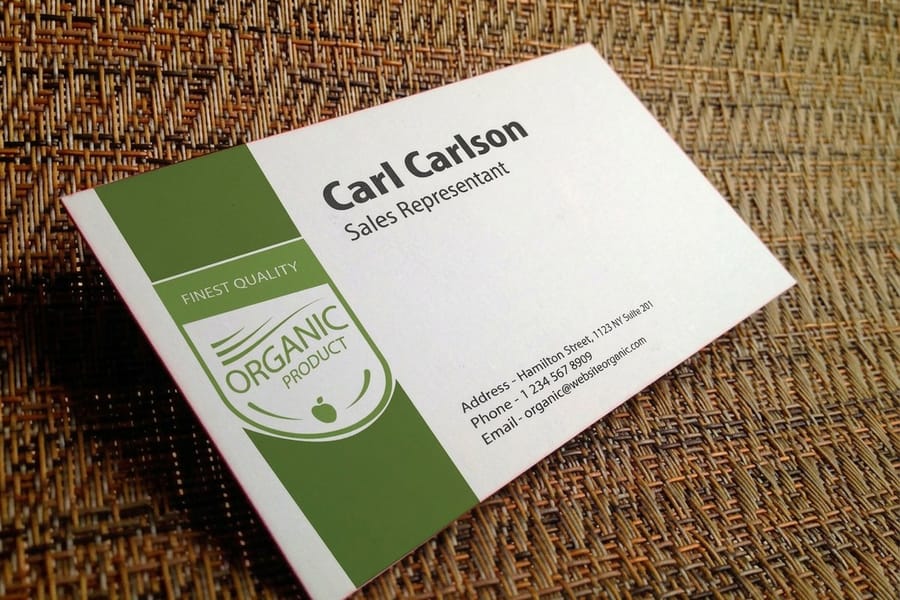
Print earns its place in business development at the two moments that decide deals: the follow-up after a pitch and the approach to somebody who ignores email. Standard brochures start at $57.11 and hold a capability story that stays on a desk. Standard business cards at $17.57 are still the cheapest way to make sure a name survives the walk to the car. For the full range, the marketing materials collection lists what agencies order most, and this guide on getting design clients covers the outreach sequence in more detail.
| Pipeline source | Time to first client | Cost profile | What breaks it |
|---|---|---|---|
| Referrals | Weeks, when you ask | Almost none beyond the ask | Asking at random, or asking for anyone rather than someone |
| Outbound list | One to three months | Research hours plus mailing costs | Buying a list, then blaming the channel |
| Published proof | Six months or more | Senior time, which is the expensive kind | Publishing opinions instead of results |
| Paid advertising | Days to a lead, longer to a client | Continuous spend, stops when you stop | Sending traffic to a page with no positioning on it |
Move Off the Hourly Rate Before You Try to Scale

Hourly billing punishes you for getting faster, which is a strange way to run a business whose whole advantage is experience. It also caps revenue at the number of hours you can hire, and hiring is the slowest lever you have.
Fixed fee per project is the first move. You take on the estimation risk, so it only works when the scope is written down properly and change orders are a normal, unembarrassing part of the relationship. Retainers are the second, and they buy predictable cash and easier hiring. The trade-off nobody mentions: a retainer invites scope creep, because a client who pays monthly starts to feel that everything is included, and the fix is a written scope with a named number of deliverables rather than a vague number of hours.
Productised services sit at the far end. One outcome, one price, one process, sold repeatedly. Margins are excellent and the ceiling is low, so most agencies use one as an entry offer that opens a door to larger work rather than as the whole business.
Whatever model you pick, put the price in front of the prospect on paper. A printed proposal or a leave-behind carries more weight in a committee room than a PDF nobody opens, and the presentation kit guide covers what belongs in it. If you are unsure whether your rates are the problem, compare them against what design work actually commands before you cut them further.
Capacity Sets the Ceiling, Retention Pays for the Next One

The most expensive mistake in agency growth is selling past the team. New work arrives, deadlines slip, the founder gets pulled back into delivery, sales stops, and three months later the pipeline is empty again. That cycle is the reason many agencies bounce off the same revenue number for years.
Raise the ceiling before you raise the top of the funnel. That means hiring or contracting one step ahead of demand, writing down the process for the work you sell every month, and accepting that a new employee carries a partial load for two to three months. Contractors keep margin flexible during spikes and leave nothing behind when they go, so use them for specialisms and overflow rather than for the core.
Then defend what you already have. Retention is the cheapest growth in this guide because it skips the pitch, the discount and the onboarding. A quarterly review where you show the numbers, name what did not work, and propose the next piece of scope does more for revenue than a month of cold outreach. Churn is usually visible a month before it happens: meetings get shorter, junior people start attending in place of the decision maker, and invoices are paid later than usual.
The habits that keep clients also compound into pipeline, because a client who renews twice is the referral source you never have to buy. Both halves of that are covered in our small business digital marketing guide, and the print side of client communication runs through the marketing materials range.
Wally explains agency growth
Four boxes multiply, and one line above them decides the total
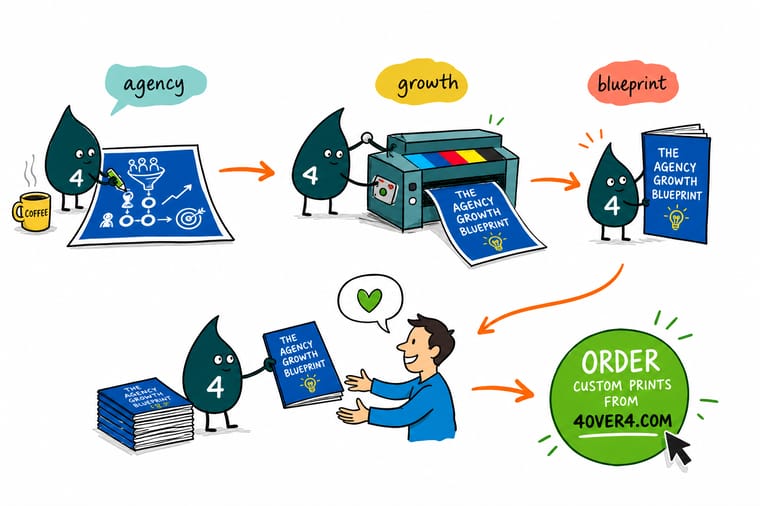
Wally lines up the four boxes: conversations, close rate, contract value, months retained. Multiply them and you get the revenue you can bill. Then he draws the dashed line above: delivery capacity. Sell above that line and the work ships late, so the smart move is to raise the line before widening the funnel. His favorite cheap lever sits in the middle of the funnel, a mailed postcard and a brochure left on a desk after the pitch.
Shop agency marketing materials →Specs and pricing
The business development pieces, sizes and starting prices
The three formats agencies order for pitches, mailings and follow-up, with live configuration options and starting prices from the 4OVER4.COM configurator.



Print it
Give the pipeline something to land on



Explore more
Where to go next






By the numbers
The print partner behind a lot of agency pitches
Common Questions
Agency growth questions, answered straight
What should an agency fix first when growth stalls?
Look at the four numbers in order and fix the weakest, not the loudest. Most stalled agencies have plenty of conversations and a close rate under a third, which points at qualification and proposals rather than lead volume. If the close rate is healthy but revenue is flat, the problem is average contract value or retention, and no amount of new leads will move it. The one exception is a delivery backlog: if projects are already shipping late, every fix on the sales side makes the situation worse.
How narrow should an agency niche be?
Narrow enough that a prospect can repeat your positioning back to somebody else, wide enough that the buyer list runs to hundreds of companies rather than dozens. Naming an industry and a problem works well, for example ecommerce brands with a retention problem. The failure mode at the narrow end is real: if there are only forty companies that fit, you will exhaust the list in a year and have nowhere to grow into. Test a niche for two quarters before you rebuild the website around it.
Should we hire employees or use contractors to grow?
Contractors protect margin while demand is lumpy, and they weaken process, because nobody who leaves after a project writes anything down. Employees cost two to three months of mostly unbillable ramp before they carry a full load, so a hire made in the same week you win a big account arrives too late to help with it. The practical pattern is contractors for spikes and specialisms, employees for the work you sell every month.
Does printed material still win agency clients?
It wins the parts of the process that happen in a room or a mailbox. A leave-behind after a pitch keeps your numbers on the table when the committee meets without you, and a mailed piece reaches a director who never opens cold email. Standard brochures start at $57.11 at 4OVER4.COM and standard postcards at $16.48, which makes a targeted mailing to fifty named accounts one of the cheapest lines in a business development budget. It does not replace the pipeline. It closes the last gap in it.
How many clients should one account manager carry?
It depends far more on meeting load than on revenue. An account with a weekly call, two stakeholders and monthly reporting eats roughly four times the hours of a quarterly retainer at the same value. Count scheduled contact hours per client per month, add fifty percent for the unscheduled kind, and load people from that number. Agencies that assign accounts by revenue instead end up with one manager quietly drowning.
What is a realistic growth rate for a small agency?
Doubling is normal in year one and rare after year three, because early growth comes off a tiny base and later growth has to survive hiring, churn and the founder leaving delivery. Plan around a rate your delivery capacity can absorb without a quality drop, then check it against cash: every new hire and every longer payment term consumes working capital before the revenue lands. Growth that outruns cash is the most common way a profitable agency fails.
Get Started
25 booklets cost $240.55, or $9.62 a copy
Print the capability brochure, the mailer and the case study booklet your pipeline needs, on stock that holds up in a committee room.
Legal Disclaimer
Gold Standard guarantees apply to all standard orders placed through 4over4.com. Price match requires verifiable proof of a competitor's published price for an equivalent product with matching specifications and turnaround time. Satisfaction guarantee covers manufacturing defects and print quality issues. Contact support with order number and documentation. On-time delivery rate based on tracked orders 1999 to 2026. Individual results may vary based on shipping carrier performance.
